

Abstract
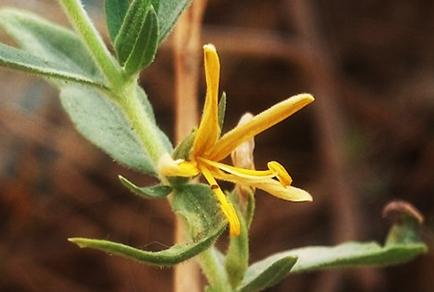
Carlowrigthia fuertensis was known only from type material collected by J.N. Rose in 1910 in the vicinity of El Fuerte, Sinaloa, Mexico; however, these populations have not been located again. In this paper, we report a new population identified thanks to a photographic record in 2023 in the citizen science platform iNaturalist. The new population was located 300 km southeast of the original collection and is currently the only known living population, but its habitat is severely fragmented. Carlowrigthia fuertensis is easily distinguished from other species of the genus by its shrubby habit and morphology of the corolla, fruits and seeds. We present the first in situ and color photographs of the species, a distribution map with historical and current collections, as well as a proposed conservation status.
References
- Bentham, G. (1842) Notes on Mimoseae, with a synopsis of species. London journal of Botany 1: 318–528.
- Bentham, G. (1844) Notes on Mimoseae, with a synopsis of species. London journal of Botany 3: 195–225.
- Brandegee, T.S. (1891) Flora of the Cape Region of Baja California. Proceedings of the California Academy of Sciences Series 2, 3: 108–217.
- Cavanilles, A.J. (1799) Icones et descriptiones plantarum 5. Typographia Regia, Madrid, 174 pp.
- Gonzalez-Gallegos, J.G. & Bedolla-García, B.Y. (2023) Rediscovery of Salvia dugesiana (Lamiaceae) in Guanajuato, Mexico, after 129 years. Phytotaxa 629: 1–12.
- Gray, A. (1878) Contributions to the botany of North America. Proceedings of the American Academy of Arts and Sciences 13: 361–374.
- Daniel, T.F. (2003) New and Reconsidered Mexican Acanthaceae X. Flora del Bajio Region. Novon 13: 37–48.
- Daniel, T.F. (2004) Acanthaceae of Sonora: taxonomy and phytogeography. Proceedings of the California Academy of Sciences 55: 690–805.
- Daniel, T.F. (1983) Carlowrightia (Acanthaceae). Flora Neotropica 34: 1–115.
- Daniel, T.F. (1988a) Taxonomic, nomenclatural, and reproductive notes on Carlowrightia (Acanthaceae). Brittonia 40: 245–255.
- Daniel, T.F. (1988b) Aphanosperma, a new genus of Acanthaceae from Mexico with unusual diaspores. American Journal of Botany 75: 545–550.
- Daniel, T.F., McDade, L.A., Manktelow, M. & Kiel, C.A. (2008) The" Tetramerium lineage"(Acanthaceae: Acanthoideae: Justicieae): delimitation and intra-lineage relationships based on cp and nrITS sequence data. Systematic Botany 33: 416–436.
- Don, D. (1831) On the characters and affinities of certain genera, chiefly belonging to the flora peruviana. Edinburgh New Philosophical Journal 10: 229–238.
- Francisco-Gutiérrez, A. & Alvarado-Cárdenas, L.O. (2023) A new tropical species of Aphyllon (Orobanchaceae: Orobancheae) from Chiapas, Mexico. Botanical Sciences 101: 1174–1183.
- Gentry, H.S. (1948) Additions to the flora of Sinaloa and Nuevo Leon. Brittonia 6: 309–331. https://doi.org/10.2307/2804834
- Gray, A. (1878) Contributions to the botany of North America. Proceedings of the American Academy of Arts and Sciences 13: 361–374.
- iNaturalist (2025) iNaturalist. California Academy of Sciences. Available from: https://www.inaturalist.org/ (accessed 17 June 2025).
- IUCN (2024) Guidelines for Using the IUCN Red List Categories and Criteria, version 16. IUCN Red List Unit, Cambridge U.K. Available from: https://www.iucnredlist.org/ (accessed 11 June 2025).
- Jacquin, N.J. (1760) Enumeratio systematica plantarum. Inter Documentation Company AG, Zug, Switzerland, 41 pp.
- Mesaglio, T., Sauquet, H. & Cornwell, W.K. (2025) Citizen science records are fueling exciting discoveries of new plant species. American Journal of Botany 112: e70048.
- Nees, C.G. (1842) Observationes in Acanthaceas. Linnaea 16: 289–308.
- Nees, C.G. (1844) Tetramerium. In: Bentham, G. (Ed.) The Botany of the voyage of H.M.S. Sulphur. Smith the Elder, London, pp. 147–148, pl. 48.
- Oersted, A.S. (1854) Mexicos og Centralamerikas Acanthaceer. Videnskabelige Meddelelser fra Dansk Naturhistorisk Forening i Kjøbenhavn 8: 113–181.
- Pío-León, J.F., Carrillo-García, J.A., Salomón-Montijo, B. & Márquez-Salazar, G. (2023) Una especie nueva, Castela juyyaania (Simaroubaceae), y tres registros nuevos para la flora semiárida de Sinaloa, México. Acta Botanica Mexicana 130: e2255. https://doi.org/10.21829/abm130.2023.2255
- Pío-León, J.F., Gutiérrez-Sánchez, R.M. & Alvarado-Cárdenas, L.O. (2024) Gonolobus imladrisanthus (Apocynaceae, Asclepiadoideae), una especie nueva de frutos comestibles de Durango, México. Acta Botanica Mexicana 131: e2404. https://doi.org/10.21829/abm131.2024.2404
- Roxburg, W. (1798) Plants of the Coast of Coromandel. W. Bulmer and Co., London, 102 pp.
- Rzedowski, J. (1959) Notas sobre la flora y la vegetaci6n del estado de San Luis Potosí. VIII. Cinco fanerógamas interesantes del sur y centro del estado. Ciencia (Mexico) 19: 77–86.
- Sargent, C.S. (1895) The silva of North America: a description of the trees which grow naturally in North America exclusive of Mexico. Volume 7: Lauraceae-Jungladaceae. Houghton Mifflin and Company, Brookline, Massachusetts, 173 pp.
- Ståhl, B. & Källersjö, M. (2004) Reinstatement of Bonellia (Theophrastaceae). Novon 14: 115–118.
- Standley, P.C. (1911) Contributions from the United States National Herbarium. Volume 13. Government printing office, Washington, 489 pp.
- Watson, S. (1879) Contributions to America botany. Proceedings of the American Academy of Arts and Sciences 24: 36–87.
- Willdenow, C.L. (1806) Species plantarum. Editio quarta. G.C. Nauk, Berlin, 1157 pp.