

Abstract
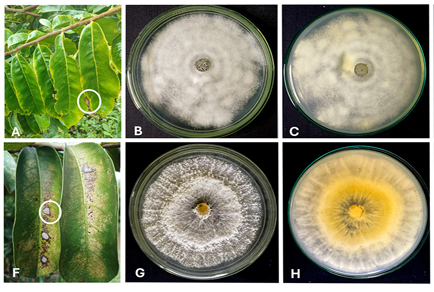
Fungal pathogens are increasingly recognized as major threats to global agriculture, with emerging species posing new challenges to crop health and productivity. This study reports, for the first time in Peru and in Annona muricata (soursop), the identification of Neopestalotiopsis clavispora and N. protearum as causal agents of leaf spot and fruit rot. Pathogenicity assays confirmed that both species infect foliar and fruit tissues in both commercially important cultivars (“common” and “Giant Criolla”), demonstrating their disease-causing potential under controlled conditions. Morphological characterization and multi-locus phylogenetic analyses (ITS, β-tubulin, and TEF1-α) confirmed the identity and taxonomic placement of both species within the Neopestalotiopsis clade. The findings represent a significant expansion of the known host range and geographic distribution of these fungi, which are already documented on a wide range of tropical and subtropical crops. Given their broad host plasticity and ecological adaptability, Neopestalotiopsis spp. may pose an increasing risk to diverse agricultural systems, especially under shifting environmental conditions. This study highlights the importance of developing species-specific diagnostic tools, implementing proactive surveillance, evaluating host resistance, and advancing research into epidemiology and control strategies to mitigate the risk of future outbreaks.
References
- Akinsanmi, O.A., Nisa, S., Jeff-Ego, O.S., Shivas, R.G. & Drenth, A. (2017) Dry Flower Disease of Macadamia in Australia Caused by Neopestalotiopsis macadamiae sp. nov. and Pestalotiopsis macadamiae sp. nov. Plant disease 101 (1): 45–53. https://doi.org/10.1094/PDIS-05-16-0630-RE
- Altschul, S.F., Gish, W., Miller, W., Myers, E.W. & Lipman, D.J. (1990) Basic local alignment search tool. Journal of molecular biology 215 (3): 403–410. https://doi.org/10.1016/S0022-2836(05)80360-2
- Beltran, P.H., Márquez, L.G., García, L.E., Aguilar, P.V.H. & Solano, B.A.R. (2023) Occurrence of Colletotrichum siamense Causing Leaf Spots on Soursop (Annona muricata) in Mexico. Plant disease 107 (9). https://doi.org/10.1094/PDIS-03-23-0592-PDN
- Carbone, I. & Kohn, L.M. (1999) A method for designing primer sets for speciation studies in filamentous ascomycetes. Mycologia 91: 553–556. https://doi.org/10.2307/3761358
- Conforto, C., Lima, N.B., Silva, F.J.A., Câmara, M.P.S., Maharachchikumbura, S. & Michereff, S.J. (2019) Characterization of fungal species associated with cladode brown spot on Nopalea cochenillifera in Brazil. European Journal of Plant Pathology 155: 1179–1194. https://doi.org/10.1007/s10658-019-01847-3
- Costa, J.F.O., Kamei, S.H., Silva, J.R.A., Miranda, A.R.G. da S., Netto, M.B., Da Silva, S.J.C., Correia, K.C., Lima, G.S.de A & Assunção, I.P. (2019) Species diversity of Colletotrichum infecting Annona spp. in Brazil. European Journal of Plant Pathology 153: 1119–1130. https://doi.org/10.1007/s10658-018-01630-w
- Crous, P.W., Summerell, B.A., Swart, L., Denman, S., Taylor, J.E., Bezuidenhout, C.M., Palm, M.E., Marincowitz, S. & Groenewald, J.Z. (2011) Fungal pathogens of Proteaceae. Persoonia 27: 20–45. https://doi.org/10.3767/003158511X606239
- Chaiwan, N., Jeewon, R., Pem, D., Jayawardena, R.S., Nazurally, N., Mapoon, A., Promputtha, I. & Hyde, K.D. (2022) Fungal Species from Rhododendron sp.: Discosia rhododendricola sp.nov, Neopestalotiopsis rhododendricola sp.nov and Diaporthe nobilis as a New Host Record. Journal of Fungi 8 (9): 907. https://doi.org/10.3390/jof8090907
- Chong, D., Alsultan, W., Ariff, S., Kong, L.L, Ho, C.L. & Wong, M.Y. (2023) First Report of Neopestalotiopsis clavispora causing leaf spot on coconut seedling in Malaysia. Plant Disease 107: 3293. https://doi.org/10.1094/PDIS-04-23-0636-PDN
- Darriba, D., Taboada, G.L., Doallo, R. & Posada, D. (2012) jModelTest 2: more models, new heuristics and parallel computing. Nature Methods 9 (8): 772. https://doi.org/10.1038/nmeth.2109
- Doyle, J. & Doyle, J. (1990) Isolation of plant DNA from fresh tissue. Focus 12: 13–15. https://doi.org/10.2307/2419362
- Fisher, M.C., Henk, D.A., Briggs, C.J., Brownstein, J.S., Madoff, L.C., McCraw, S.L. & Gurr, S.J. (2012) Emerging fungal threats animal, plant and ecosystem health. Nature 484: 186–194. https://doi.org/10.1038/nature10947
- Fuentes-Aragón, D., Juárez-Vázquez, S., Vargas-Hernandez, M. & Silva-Rojas, H. (2018) Colletotrichum fructicola, a Member of Colletotrichum gloeosporioides sensu lato, is the Causal Agent of Anthracnose and Soft Rot in Avocado Fruits cv. “Hass”. Mycobiology 46. https://doi.org/10.1080/12298093.2018.1454010
- Glass, N.L. & Donaldson, G.C. (1995) Development of primer sets designed for use with the PCR to amplify conserved genes from filamentous ascomycetes. Applied and Environmental Microbiology 61: 1323–1330. https://doi.org/10.1128/aem.61.4.1323-1330.1995
- Gomdola, D., Bhunjun, C.S., Hyde, K.D., Jeewon, R., Pem, D. & Jayawardena, R.S. (2022) Ten important forest fungal pathogens: a review on their emergence and biology. Mycosphere 13 (1): 612–671. https://doi.org/10.5943/mycosphere/13/1/6
- Gu, X., Zhao, J., Wang, H., Lin, F., Guo, Q., Shrivastava, N. & Jeewon, R. (2018) ATMT transformation efficiencies with native promoters in Botryosphaeria kuwatsukai causing ring rot disease in pear. World J Microbiol Biotechnol 34: 179. https://doi.org/10.1007/s11274-018-2559-8
- Gualberto, G.F., Catarino, A.M., Sousa, T.F., Cruz, J.C., Hanada, R.E., Caniato, F.F. & Silva, G.F. (2021) Pseudopestalotiopsis gilvanii sp. nov. and Neopestalotiopsis formicarum leaves spot pathogens from guarana plant: a new threat to global tropical hosts. Phytotaxa 489 (2): 121–139. https://doi.org/10.11646/phytotaxa.489.2.2
- Huanaluek, N., Jayawardena, R.S., Maharachchikumbura, S.S.N. & Harishchandra, D.L. (2021) Additions to pestalotioid fungi in Thailand: Neopestalotiopsis hydeana sp. nov. and Pestalotiopsis hydei sp. nov. Phytotaxa 479 (1): 23–43. https://doi.org/10.11646/phytotaxa.479.1.2
- Huelsenbeck, J.P. & Ronquist, F. (2001) MRBAYES: Bayesian inference of phylogenetic trees. Bioinformatics 17 (8): 754–755. https://doi.org/10.1093/bioinformatics/17.8.754
- Jayawardena, R.S., Zhang, W., Liu, M., Maharachchikumbura, S.S.N., Zhou, Y., Huang, J.B., Nilthong, S., Wang, Z.Y., Li, X.H., Yan, J.Y. & Hyde, K.D. (2015) Identification and characterization of Pestalotiopsis-like fungi related to grapevine diseases in China. Fungal Biology 119: 348–361. https://doi.org/10.1016/j.funbio.2014.11.001
- Jayawardena, R.S., Liu, M., Maharachchikumbura, S.S.N., Zhang, W., Xing, Q., Hyde, K.D., Nilthong, S., Li, X & Yan, J. (2016) Neopestalotiopsis vitis sp. nov. causing grapevine leaf spot in China. Phytotaxa 258: 63–74. https://doi.org/10.11646/phytotaxa.258.1.4
- Jayawardena, R.S., Hyde, K.D., Chen, Y.J., Papp, V., Palla, B., Papp, D., Bhunjun, C.S.H., Hurdeal, V.G., Senwanna, C.H., Manawasinghe, I.S., Harishchandra, D.L., Gautam, A.K., Avasthi, S., Chuankid, B., Goonasekara, I.D., Hongsanan, S., Zeng, X.Y., Liyanage, K.K., Liu, N.G., Karunarathna, A., Hapuarachchi, K.K., Luangharn, T., Raspé, O., Brahmanage, R. & Wang, Y. (2020) One stop shop IV: taxonomic update with molecular phylogeny for important phytopathogenic genera: 76–100. Fungal Diversity 103: 87–218. https://doi.org/10.1007/s13225-020-00460-8
- Jeewon, R., Liew, E.C.Y. & Hyde, K.D. (2002) Phylogenetic relationships of Pestalotiopsis and allied genera inferred from ribosomal DNA sequences and morphological characters. Molecular Phylogenetics and Evolution 25: 378–392. https://doi.org/10.1016/s1055-7903(02)00422-0
- Jeewon, R., Liew, E.C.Y., Simpson, J.A., Hodgkiss, I.J. & Hyde, K.D. (2003) Phylogenetic significance of morphological characters in the taxonomy of Pestalotiopsis species. Molecular Phylogenetics and Evolution 27: 372–383. https://doi.org/10.1016/s1055-7903(03)00010-1
- Jeewon, R., Liew, E.C.Y & Hyde, K.D. (2004) Phylogenetic evaluation of species nomenclature of Pestalotiopsis in relation to host association. Fungal Diversity 17: 39–55. [https://www.fungaldiversity.org/fdp/sfdp/17-4.pdf]
- Kearse, M., Moir, R., Wilson, A., Stones-Havas, S., Cheung, M., Sturrock, S., Buxton, S., Cooper, A., Markowitz, S., Duran, C., Thierer, T., Ashton, B., Meintjes, P. & Drummond, A. (2012) Geneious Basic: an integrated and extendable desktop software platform for the organization and analysis of sequence data. Bioinformatics 28: 1647–1649. https://doi.org/10.1093/bioinformatics/bts199
- Katoh, K., Misawa, K., Kuma, K. & Miyata, T. (2002) MAFFT: a novel method for rapid multiple sequence alignment based on fast Fourier transform. Nucleic Acids Research 30 (14): 3059–3066. https://doi.org/10.1093/nar/gkf436
- Kumar, S., Stecher, G., Li, M., Knyaz, C. & Tamura, K. (2018) MEGA X: Molecular Evolutionary Genetics Analysis across Computing Platforms. Molecular biology and evolution 35 (6): 1547–1549. https://doi.org/10.1093/molbev/msy096
- Liang, L.J., Jeewon, R., Pem, D., Kumar, S.S.D., Li, H., Lin, F.C. & Wang, H.K. (2021) A novel species of Penicillium with inhibitory effects against Pyricularia oryzae and fungal pathogens inducing citrus diseases. Frontiers in Cellular and Infection Microbiology 10: 923. https://doi.org/10.3389/fcimb.2020.604504
- Maharachchikumbura, S.S.N., Guo, L.D., Cai, L., Chukeatirote, E., Wu, W.P., Sun, X., Crous, P.W., Bhat, D.J., McKenzie, E.H.C., Bahkali, A.H. & Hyde, K.D. (2012) A multi-locus backbone tree for Pestalotiopsis, with a polyphasic characterization of 14 new species. Fungal Diversity 56: 95–129. https://doi.org/10.1007/s13225-012-0198-1
- Maharachchikumbura, S.S.N., Crous, P.W., Groenewald, J.Z., Xu, J. & Hyde, K.D. (2014) Pestalotiopsis revisited. Studies in Mycology 79: 121–186. https://doi.org/10.1016/j.simyco.2014.09.005
- MINAGRI (2022) Anuario estadístico de la producción 2022. Available from: https://siea.midagri.gob.pe/portal/publicacion/boletines-anuales/4-agricola (accessed 2 June 2025)
- National Center for Biotechnology Information (NCBI) (1988) [Internet]. Bethesda (MD): National Library of Medicine (US), National Center for Biotechnology Information. Available from: https://www.ncbi.nlm.nih.gov/ (accessed 20 May 2024)
- Obregón, V.G., Meneguzzi, N.G., Ibañez, J.M., Lattar, T.E. & Kirschbaum, D.S. (2018) First Report of Neopestalotiopsis clavispora Causing Root and Crown Rot on Strawberry Plants in Argentina. Plant disease 102 (9). https://doi.org/10.1094/PDIS-02-18-0330-PDN
- O’Donnell, K. & Cigelnik, E. (1997) Two Divergent Intragenomic rDNA ITS2 Types within a Monophyletic Lineage of the Fungus Fusarium are Nonorthologous. Molecular Phylogenetics and Evolution 7: 103. https://doi.org/10.1006/mpev.1996.0376
- O’Donnell, K., Kistler, H.C., Cigelnik, E. & Ploetz, R.C. (1998) Multiple evolutionary origins of the fungus causing Panama disease of banana: concordant evidence from nuclear and mitochondrial gene genealogies. Proceedings of the National Academy of Sciences of the United States of America 95 (5): 2044–2049. https://doi.org/10.1073/pnas.95.5.2044
- Qi, Y.X., Zhang, H., Peng, J., Zeng, F.Y., Xie, Y.X., Yu, Q.F. & Zhang, X. (2023) First Report of Neopestalotiopsis clavispora Causing Leaf Spot Disease on Banana (Musa acuminata) in China. Plant disease 107 (1). https://doi.org/10.1094/PDIS-03-22-0455-PDN
- Ramos, V.H.V., Pinto, A.C.Q. & Rodrigues, A.A. (2001) Introdução e importância socioeconômica. In: Oliveira, M.A.S. (Ed.) Graviola. Produção: aspectos técnicos. Embrapa Cerrados, Brasília, pp. 9
- Ran, S.F., Maharachchikumbura, S.S.N., Ren, Y.L., Liu, H., Chen, K.R., Wang, Y.X. & Wang, Y. (2017) Two new records in Pestalotiopsidaceae associated with Orchidaceae disease in Guangxi Province, China. Mycosphere 8 (1): 121–130. https://doi.org/10.5943/mycosphere/8/1/11
- Rodríguez, G.E., Hilário, S., Lopes, A. & Alves, A. (2020) Diversity and pathogenicity of Lasiodiplodia and Neopestalotiopsis species associated with stem blight and dieback of blueberry plants in Peru. Eur J Plant Pathol 157: 89–102. https://doi.org/10.1007/s10658-020-01983-1
- Santos, C.C., Domingues, J.L., Santos, R.F.dos Sposito, M.B., Santos, A. & Novaes, Q.S. (2019) First report of Neopestalotiopsis clavispora causing leaf spot on macadamia in Brazil. Plant Disease 103 (7): 1790. https://doi.org/10.1094/PDIS-01-19-0108-PDN
- Senanayake, I.C., Lian, T.T., Mai, X.M., Jeewon, R., Maharachchikumbura, S.S.N., Hyde, K.D., Zeng, Y.J., Tian, S.L. & Xie, N. (2020) New geographical records of Neopestalotiopsis and Pestalotiopsis species in Guangdong Province, China. Asian Journal of Mycology 3 (1): 512–533. https://doi.org/10.5943/ajom/3/1/19
- Shi, J., Li, B., Wang, S., Zhang, W., Shang, M., Wang, Y. & Liu, B. (2024) Occurrence of Neopestalotiopsis clavispora Causing Apple Leaf Spot in China. Agronomy 14: 1658. https://doi.org/10.3390/agronomy14081658
- SIICEX (2024) Exportemos Peru, guanabana. Available from: https://exportemos.pe/descubre-oportunidades-de-exportacion/producto/guanabana-0811909500/pdf (accessed 2 April 2025)
- Stamatakis, A. (2014) RAxML version 8: a tool for phylogenetic analysis and post-analysis of large phylogenies. Bioinformatics 30 (9): 1312–1313. https://doi.org/10.1093/bioinformatics/btu033
- Tang, J., Lai, L.-X., Du, Y.-L. & Yang, Q. (2021) First Report of Neopestalotiopsis protearum Causing Seed Rot on Camellia oleifera in China. Plant disease 105 (12). https://doi.org/10.1094/PDIS-12-20-2717-PDN
- White, T.J., Bruns, T., Lee, S. & Taylor, J.W. (1990) Amplification and direct sequencing of fungal ribosomal RNA genes for phylogenetics. In: Innis, M.A., Gelfand, D.H., Sninsky, J.J. & White, T.J. (Eds.) PCR protocols: a guide to methods and applications. Academic, New York, pp. 315–322. https://doi.org/10.1016/B978-0-12-372180-8.50042-1
- Yang, C.L., Xu, X.L., Zeng, Q., Liu, L.J., Liu, F., Deng, Y., Wang, F.H., Sun, Q.R., Jeewon, R., Hyde, K.D., Jayawardena, R.S., Mckenzie, E.H.C., Wanasinghe, D.N., Liu, Y.G., Xiao, Q.G., Han, S., Yang, H., Li, S.J., Liu, L. & Xie, J.L. (2024) Bambusicolous mycopathogens in China with an update on taxonomic diversity, novel species, pathogenicity, and new insights. Mycosphere 15 (1): 4788–4918. https://doi.org/10.5943/mycosphere/15/1/21