

Abstract
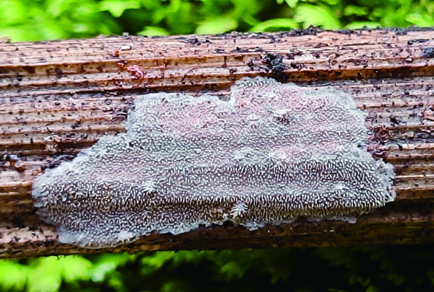
Wood-inhabiting fungi play a key role in ecosystem processes, especially in wood decomposition and the recycling of organic matter. A new wood-inhabiting fungus, Epithele odontioidea, collected from Eastern China, is illustrated and described based on morphological characteristics and phylogenetic analyses. The new species is characterized by resupinate, farinaceous basidiomata, white to grayish, odontioid hymenial surface due to hyphal pegs, monomitic hyphal system, generative hyphae with clamp connections, and ellipsoid to oblong-ellipsoid basidiospores measuring 13.2–18.2 × 6.8–8.7 µm. Phylogenetic analyses of the new species were conducted using internal transcribed spacer (ITS) and nuclear ribosomal large subunit (nLSU) sequences. The phylogenetic analysis indicated that the new species belongs to the genus Epithele and is grouped with the species E. efibulata. A description, illustrations, phylogenetic analysis results, and a comparison with the closely related species of the new species are provided.
References
- Boidin, J. & Gilles, G. (2000) Basidiomycètes Aphyllophorales de l’Île de la Réunion. XIX. Le genre Epithele (Pat.) Pat. 1900. Bulletin Mensuel de la Société Linnéenne de Lyon 69: 193–198. [https://www.persee.fr/doc/linly_0366-1326_2000_num_69_8_11346]
- Boidin, J. & Lanquetin, P. (1983) Basidiomyc`etes Aphyllophorales ́epitheloı ̈des ́etales. Mycotaxon 16: 461–499.
- Chen, C.C., Chen, C.Y. & Wu, S.H. (2021) Species diversity, taxonomy and multi-gene phylogeny of phlebioid clade (Phanerochaetaceae, Irpicaceae, Meruliaceae) of Polyporales. Fungal Diversity 111: 337–442. https://doi.org/10.1007/s13225-021-00490-w
- Cui, B.K., Li, H.J., Ji, X., Zhou, J.L., Song, J., Si, J., Yang, Z.L. & Dai, Y.C. (2019) Species diversity, taxonomy and phylogeny of Polyporaceae (Basidiomycota) in China. Fungal Diversity 97 (1): 137–392. https://doi.org/10.1007/s13225-019-004
- Cui, Y.J., Wu, Y.D., Jiang, Y.H., Zhu, A.H., Wu, F., Liu, H.G., Dai, Y.C. & Yuan, Y. (2024) Diversity of macrofungi in southeast Xizang 1. The wood-decay fungi, Mycology 16 (2): 635–669. https://doi.org/10.1080/21501203.2024.2379476
- Dai, Y.C. (2010) Hymenochaetaceae (Basidiomycota) in China. Fungal Diversity 45: 131–343. https://doi.org/10.1007/s13225-010-0066-9
- Dai, Y.C., Xue, H.J., Vlasák, J., Rajchenberg, M., Wang, B. & Zhou, L.W. (2014) Phylogeny and global diversity of Polyporus group Melanopus (Polyporales, Basidiomycota). Fungal Diversity 64 (1): 133–144. https://doi.org/10.1007/s13225-013-0248-3
- Dai, Y.C., Yang, Z.L., Cui, B.K., Wu, G., Yuan, H.S., Zhou, L.W., He, S.H., Ge, Z.W., Wu, F., Wei, Y.L., Yuan, Y. & Si, J. (2021) Diversity and systematics of the important macrofungi in Chinese forests. Mycosystema 40 (4): 770–805. https://doi.org/10.13346/j.mycosystema.210036
- Deng, Y.L., Jabeen, S., Zhao, C.L. (2024) Species diversity and taxonomy of Vararia (Russulales, Basidiomycota) with descriptions of six species from Southwestern China. MycoKeys 103: 97–128. https://doi.org/10.3897/mycokeys.103.118980
- Dong, J.H., Li, Q., Yuan, Q., Luo, Y.X., Zhang, X.C., Dai, Y.F., Zhou, Q., Liu, X.F., Deng, Y.L., Zhou, H.M., Muhammad, A. & Zhao, C.L. (2024) Species diversity, taxonomy, molecular systematics and divergence time of wood-inhabiting fungi in Yunnan-Guizhou Plateau, Asia. Mycosphere 15 (1): 1110–1293. https://doi.org/10.5943/mycosphere/15/1/10
- Hall, T.A. (1999) Bioedit: A user-friendly biological sequence alignment editor and analysis program for Windows 95/98/NT. Nucleic Acids Symposium Series 41: 95–98. https://doi.org/10.1021/bk-1999-0734.ch008
- Hu, Y., Karunarathna, S.C., Li, H., Galappaththi, M.C., Zhao, C.L., Kakumyan, P. & Mortimer, P.E. (2022) The impact of drying temperature on basidiospore size. Diversity 14 (4): 239.
- Huang, C.J., Wu, X.Q., Liu, X.Y., Fang, Y.T., Liu, L. & Wu, C.S. (2022) Functional fungal communities dominate wood decomposition and are modified by wood traits in a subtropical forest. Science of The Total Environment 806: 1–11.
- James, T.Y., Stajich, J.E., Hittinger, C.T. & Rokas, A. (2020) Toward a fully resolved fungal tree of life. Annual Review of Microbiology 74: 291–313. https://doi.org/10.1146/annurev-micro-022020-051835
- Justo, A., Miettinen, O., Floudas, D., Ortiz-Santana, B., Sjokvist, E., Lindner, D., Nakasone, K., Niemela, T., Larsson, K.H., Ryvarden, L. & Hibbett, D.S. (2017) A revised family-level classification of the Polyporales (Basidiomycota). Fungal Biology 121 (9): 798–824. https://doi.org/10.1016/j.funbio.2017.05.010
- Kalyaanamoorthy, S., Minh, B.Q., Wong, T.K.F., Haeseler, A. & Jermiin, L.S. (2017) ModelFinder: fast model selection for accurate phylogenetic estimates. Nature Methods 14 (6): 587–589. https://doi.org/10.1038/NMETH.4285
- Katoh, K., Rozewicki, J. & Yamada, K.D. (2017) MAFFT online service: multiple sequence alignment, interactive sequence choice and visualization. Briefings in Bioinformatics 20 (4): 1160–1166. https://doi.org/10.1093/bib/bbx108
- Larsson, E. & Larsson, K.H. (2003) Phylogenetic relationships of russuloid basidiomycetes with emphasis on Aphyllophoralean taxa. Mycologia 95 (6): 1037–1065. https://doi.org/10.1080/15572536.2004.11833020
- Liu, S., Chen, Y.Y., Sun, Y.F., He, X.L., Song, C.G., Si, J., Liu, D.M., Gates, G. & Cui, B.K. (2023) Systematic classification and phylogenetic relationships of the brown-rot fungi within the Polyporales. Fungal Diversity 118 (1): 1–94. https://doi.org/10.1007/s13225-02200511-2
- Liu, S.L., He, S.H., Wang, X.W., May, T.W., He, G., Chen, S.L. & Zhou, L.W. (2022) Trechisporales emended with a segregation of Sistotremastrales ord. nov. (Basidiomycota). Mycosphere 13 (1): 862–954. https://doi.org/10.5943/mycosphere/13/1/11
- Liu Z.B., Liu H.G., Vlasák J., Gates G.M., Dai Y.C. & Yuan Y. (2025) Global diversity and phylogeny of Incrustoporiaceae (Polyporales, Basidiomycota) with an emphasis on Skeletocutis. Mycology 16 (3): 1083–1140. https://doi.org/10.1080/21501203.2024.2448145
- Liu, Z.B., Yuan, Y., Dai, Y.C., Liu, H.G., Vlasák, J., Zeng, G.Y., He, S.H. & Wu, F. (2025) Global diversity and systematics of Hymenochaetaceae with non-poroid hymenophore. Fungal Diversity 131: 1–97. https://doi.org/10.1007/s13225-025-00552-3
- Lücking, R., Aime, M.C., Robbertse, B., Miller, A.N., Aoki, T., Ariyawansa, H.A., Cardinali, G., Crous, P.W., Druzhinina, I.S., Geiser, D.M., Hawksworth, D.L., Hyde, K.D., Irinyi, L., Jeewon, R., Johnston, P.R., Kirk, P.M., Malosso, E., May, T.W., Meyer, W., Nilsson, H.R., Öpik, M., Robert, V., Stadler, M., Thines, M., Vu, D., Yurkov, A.M., Zhang, N. & Schoch, C.L. (2021) Fungal taxonomy and sequence-based nomenclature. Nature Microbiology 6 (5): 1–9. https://doi.org/10.1038/s41564-021-00888-x
- Maddison, W.P. & Maddison, D.R. (2018) Mesquite: a modular system for evolutionary analysis. Version 3.5.1. [http://www.mesquiteproject.org]
- Mao, W.L., Wu, Y.D., Liu, H.G., Yuan, Y. & Dai, Y.C. (2023) A contribution to Porogramme (Polyporaceae, Agaricomycetes) and related genera. IMA Fungus 14 (5): 1–22. https://doi.org/10.1186/s43008-023-00110-z
- Nakasone, K.K. (2013) Taxonomy of Epithele (Polyporales, Basidiomycota). Sydowia 65 (1): 59–112.
- Nascimento, C.C., Zabin, D.A., Silva-Filho, A.G.S., Drewinski, M.P., Alves-Silva, G., Kossmann, T., Titton, M., Drechsler-Santos, E.R. & Menolli, J.N. (2024) Unroughing the cat’s tongue mushrooms: Four new species of Pseudohydnum from Brazil based on morphological and molecular phylogenetic evidence. Mycologia 116 (5): 792–820.
- Patouillard, N. (1900) Essai taxonomique sur les familles et les genres des Hyménomycètes. Biodiversity Heritage Library 1900: 1–184. https://doi.org/10.5962/bhl.title.40287
- Petersen, J.H. (1996) Farvekort. the Danish mycological society’s color-chart (Greve: Foreningentil Svampekundskabens Fremme).
- Qin, G.F., Qin, W.M., Wang, H.C., Zhao, J., Korhonen, K., Chen, J., Dai, Y.C. & Yuan, Y. (2025) Phylogeny and species diversity of Armillaria in China based on morphological, mating test, and GCPSR criteria. Mycology 16 (2): 777–811. https://doi.org/10.1080/21501203.2024.2404121
- Rathnayaka, A.R., Tennakoon, D.S., Jones, G.E., Wanasinghe, D.N., Bhat, D.J., Priyashantha, A.H., Stephenson, S.L., Tibpromma, S. & Karunarathna, S.C. (2025) Significance of precise documentation of hosts and geospatial data of fungal collections, with an emphasis on plant-associated fungi. New Zealand Journal of Botany 63 (2–3): 462–489.
- Ronquist, F., Teslenko, M., Mark, P., Ayres, D.L., Darling, A., Hőhna, S., Larget, B., Liu, L., Suchard, M.A. & Huelsenbeck, J.P. (2012) MrBayes 3.2: Efficient Bayesian phylogenetic inference and model choice across a large model space. Systematic Biology 61 (3): 539–542. https://doi.org/10.1093/sysbio/sys029
- Stamatakis, A. (2014) RAxML Version 8: A tool for phylogenetic analysis and post-analysis of large phylogenies. Bioinformatics 30 (9): 1312–1313. https://doi.org/10.1093/bioinformatics/btu033
- Tabish, M. & Daniel, S. (2021) Scytinostroma portentosum (Berk. and curt.) donk from West Bengal, India on a new host. Current Science 120 (1): 30–33. [https://www.researchgate.net/publication/348382971]
- Vu, D., Groenewald, M., Vries, M., Gehrmann, T., Stielow, B., Eberhardt, U., Al-Hatmi, A., Groenewald, J.Z., Cardinali, G., Houbraken, J., Boekhout, T., Crous, P.W., Robert, V. & Verkley, G.J.M. (2019) Large-scale generation and analysis of filamentous fungal DNA barcodes boosts coverage for kingdom fungi and reveals thresholds for fungal species and higher taxon delimitation. Studies in Mycology 92 (1): 135–154. https://doi.org/10.1016/j.simyco.2018.05.001
- Wang, C.G., Zhao, H., Liu, H.G., Zeng, G.Y., Yuan, Y. & Dai, Y.C. (2023) A multi-gene phylogeny clarifies species diversity, taxonomy, and divergence times of Ceriporia and other related genera in Irpicaceae (Polyporales, Basidiomycota). Mycosphere: Journal of Fungal Biology 14 (1): 1665–1729. https://doi.org/10.5943/mycosphere/14/1/19
- Wang, H., He, X. & Zhao, C.L. (2020) Scytinostroma yunnanense sp. nov. (Russulales, basidiomycota) evidenced by morphological characteristics and phylogenetic analyses in China. Phytotaxa 451 (2): 145–153. https://doi.org/10.11646/phytotaxa.451.2.4
- Wang, H.C., Wu, S.H. & Dai, Y.C. (2010) Three new species of corticioid fungi with hyphal pegs, Mycologia 102 (5): 1153–1157. https://doi.org/10.3852/09-205
- White, T.J., Bruns, T., Lee, S. & Taylor, J. (1990) Amplification and direct sequencing of fungal ribosomal RNA genes for phylogenetics. In: Innis, M.A., Gelfand, D.H., Sninsky, J.J. & White, T.J. (Eds.) PCR protocols: a guide to methods and applications, pp. 315–322.
- Wu, F., Man, X.W., Tohtirjap, A. & Dai, Y.C. (2022a) A comparison of polypore funga and species composition in forest ecosystems of China, North America, and Europe. Forest Ecosystems 9: 100051. https://doi.org/10.1016/j.fecs.2022.100051
- Wu, F., Yuan, Y., Chen, J.J., Cui, B.K., Zhou, M. & Dai, Y.C. (2020) Terrestriporiaceae fam. nov., a new family of Russulales (Basidiomycota). Mycosphere 11: 2755–2766. https://doi.org/10.5943/mycosphere/11/1/21
- Wu, F., Zhou, L.W., Ji, X.H., Tian, X.M. & He, S.H. (2016) Grammothele hainanensis sp. nov. (Polyporales, Basidiomycota) and related species from Hainan, southern China. Phytotaxa 255 (2): 160–166. https://doi.org/10.11646/phytotaxa.255.2.5
- Wu, F., Zhou, L.W., Vlasák, J. & Dai, Y.C. (2022b) Global diversity and systematics of Hymenochaetaceae with poroid hymenophore. Fungal Diversity 113: 1–192. https://doi.org/10.1007/s13225-021-00496-4
- Wu, S.H., Wang, D.M. & Tschen, E. (2007) Brunneocorticium pyriforme, a new corticioid fungal genus and species belonging to the euagarics clade. Mycologia 99 (2): 302–309. https://doi.org/10.3852/mycologia.99.2.302
- Xiang, C.Y., Gao, F.L., Jakovlić, I., Lei, H.P., Hu, Y., Zhang, H., Zou, H., Wang, G.T. & Zhang, D. (2023) Using PhyloSuite for molecular phylogeny and tree‐based analyses. iMeta: e87. https://doi.org/10.1002/imt2.87
- Yang, W.J., Xu, M., Zhang, J., Zhou, F., Le, Z.F., Tong, W.J., Song, H.Y., Jin, Z.H., Chen, Q.G., Zhou, J.P., Gao, Y., Zhai, Z.J., Hu, H.J., Chen, M.H., Yin, H., Wang, J. & Hu, D.M. (2024) Morphological and phylogenetic analyses reveal a new species of Anthracophyllum (Omphalotaceae, Agaricales) in Zhejiang Province, China. Archives of Microbiology 206: 63. https://doi.org/10.1007/s00203-023-03748-w
- Yang, Y., Xu, Y., Wang, L., Jiang, Q.Q., Su, J.Q., Li, R., Zhou, H.M. & Zhao, C.L. (2025) Multigene phylogeny of seven wood-inhabiting fungal orders in Basidiomycota, and proposal of a new genus and thirteen new species. Mycosphere 16 (1): 245–295. https://doi.org/10.5943/mycosphere/16/1/4
- Yuan, Y., Bian, L.S., Wu, Y.D., Chen, J.J., Wu, F., Liu, H.G., Zeng, G.Y. & Dai, Y.C. (2023) Species diversity of pathogenic wood-rotting fungi (Agaricomycetes, Basidiomycota) in China. Mycology 14 (3): 204–226. https://doi.org/10.1080/21501203.2023.2238779
- Yurchenko, E., Riebesehl, J. & Langer, E. (2020) Fasciodontia gen. nov. (Hymenochaetales, Basidiomycota) and the taxonomic status of Deviodontia. Mycological Progress 19 (2): 171–184. https://doi.org/10.1007/s11557-019-01554-7
- Zhang, D., Gao, F., Jakovlić, I., Zou, H., Zhang, J., Li, W.X. & Wang, G.T. (2020) PhyloSuite: An integrated and scalable desktop platform for streamlined molecular sequence data management and evolutionary phylogenetics studies. Molecular Ecology Resources 20 (1): 348–355. https://doi.org/10.1111/1755-0998.13096
- Zhang, Q.Y., Liu, H.G., Bian, L.S. & Chen, Q. (2023) Two new species of Scytinostroma (Russulales, Basidiomycota) in Southwest China. Frontiers in Cellular and Infection Microbiology 13: 1189600. https://doi.org/10.3389/fcimb.2023.1189600
- Zhang, Q.Y., Liu, H.G., Papp, V., Zhou, M., Dai, Y.C. & Yuan, Y. (2023) New insights into the classification and evolution of Favolaschia (Agaricales, Basidiomycota) and its potential distribution, with descriptions of eight new species. Mycosphere 14: 777–814. https://doi.org/10.5943/mycosphere/14/1/10
- Zhao, H., Wu, Y.D., Yang, Z.R., Liu, H.G., Wu, F., Dai, Y.C. & Yuan, Y. (2024) Polypore funga and species diversity in tropical forest ecosystems of Africa, America and Asia, and a comparison with temperate and boreal regions of the Northern Hemisphere. Forest Ecosystem 11: 100200. https://doi.org/10.1016/j.fecs.2024.100200
- Zhou, H.M., Dai, Y.C., Bian, L.S., Liu, H.G., Vlasák, J. & Yuan, Y. (2025) Diversity, divergence time, and biogeography of the genus Albatrellus (Agaricomycetes, Russulales). Mycology 16 (2): 738–776. https://doi.org/10.1080/21501203.2024.2386021
- Zhou, M., Dai, Y.C., Vlasák, J., Liu, H.G. & Yuan, Y. (2023) Updated systematics of Trichaptum s.l. (Hymenochaetales, Basidiomycota). Mycosphere 14 (1): 815–917. https://doi.org/10.5943/mycosphere/14/1/11