

Abstract
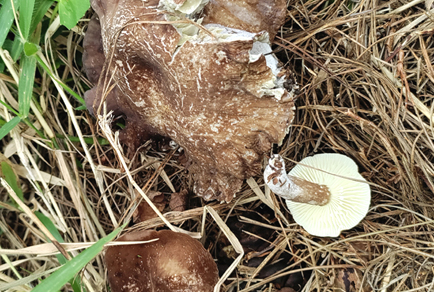
Extensive macrofungal forays to Pine (Pinus kesiya) dominated, temperate, mixed forests of East Khasi Hills, Meghalaya (India), yielded various wild mushrooms. Studies on these collections revealed an interesting and novel taxon of Lactifluus subg. Lactifluus (sect. Gerardii), which is proposed herein as Lactifluus khasianus sp. nov. The new species is presented with both morphological data and a two-gene phylogeny based on the internal transcribed spacer regions (nrITS) of the nuclear ribosomal DNA and the nuclear ribosomal large subunit (nrLSU). Lactifluus khasianus is characterized by the chocolate brown pileus, presence of pleuromacrocystidia, upright short terminal cells in the pileipellis and growth under Pinus. Phylogenetically, the species falls within a major clade with Lf. gerardii s.l. sequences from North America and Asia.
References
- Agrahar-Murugkar, D. & Subbulakshmi, G. (2005) Nutritional value of edible wild mushrooms collected from the Khasi hills of Meghalaya. Food Chemistry 89: 599–603. https://doi.org/10.1016/j.foodchem.2004.03.042
- Barua, P., Adhikary, R.K., Kalita, P., Bordoloi, D., Gogol, P., Singh, R.S. & Ghosh, A.C. (1998) Wild edible mushrooms of Meghalaya. Ancient Science of Life 3 (17): 190–193.
- Buyck, B., Hofstetter, V., Eberhardt, U., Verbeken, A. & Kauff, F. (2008) Walking the thin line between Russula and Lactarius: the dilemma of Russula subsect. Ochricompactae. Fungal Diversity 28: 15–40.
- Buyck, B., Hofstetter, V., Verbeken, A. & Walleyn, R. (2010) Proposal 1919: To conserve Lactarius nom. cons. (Basidiomycota) with a conserved type. Mycotaxon 111: 504–508. https://doi.org/10.1002/tax.591031
- Capella-Gutiérrez, S., Silla-Martínez, J.M. & Gabaldón, T. (2009) trimAl: a tool for automated alignment trimming in large-scale phylogenetic analyses. Bioinformatics 25: 1972–1973. https://doi.org/10.1093/bioinformatics/btp348
- Chakraborty, D., Tudu, D., Das, K. & Ghosh, A. (2025) First Record of Lactarius hatsudake (Russulaceae), a wild edible mushroom from India. Indian Forester 151 (1): 43–48. https://doi.org/10.36808/if/2025/v151i1/170359
- Das, K. & Verbeken, A. (2012) New Species of Lactarius Subg. Plinthogalus and New Records of Lactifluus Subg. Gerardii (Russulaceae) from Sikkim, India. Taiwania 57 (1): 37–48.
- De Crop, E., Delgat, L., Nuytinck, J., Halling, R.E. & Verbeken, A. (2021) A short story of nearly everything in Lactifluus (Russulaceae). Fungal Systematics and Evolution 7 (1): 133–164. https://doi.org/10.3114/fuse.2021.07.07
- De Crop, E., Hampe, F., Wisitrassameewong, K., Stubbe, D., Nuytinck, J. & Verbeken, A. (2018) Novel diversity in Lactifluus section Gerardii from Asia: five new species with pleurotoid or small agaricoid basidiocarps. Mycologia. https://doi.org/10.1080/00275514.2018.1508979
- De Crop, E., Nuytinck, J., Van de Putte, K., Wisitrassameewong, K., Hackel, J., Stubbe, D., Hyde, K.D., Roy, M., Halling, R.E., Moreau, P.-A., Eberhardt, U. & Verbeken, A. (2017) A multi-gene phylogeny of Lactifluus (Basidiomycota, Russulales) translated into a new infrageneric classification of the genus. Persoonia 38: 58–80. https://doi.org/10.3767/003158517X693255
- Farris, J.S., Källersjö, M., Kluge, A.G. & Bult, C. (1995a) Constructing a significance test for incongruence. Systematic Biology 44: 570–572. https://doi.org/10.2307/2413663
- Farris, J.S., Källersjö, M., Kluge, A.G. & Bult, C. (1995b) Testing significance of incongruence. Cladistics 10: 315–319. https://doi.org/10.1111/j.1096-0031.1994.tb00181.x
- Gardes, M. & Bruns, T.D. (1993) ITS primers with enhanced specificity for basidiomycetes-application to the identification of mycorrhizae and rusts. Molecular Ecology 2: 113–118. https://doi.org/10.1111/j.1365-294X.1993.tb00005.x
- Ghosh, A., Bera, I., Chakraborty, D., Hembrom, M.E., Verbeken, A. & Das, K. (2022) A new edible species of Lactifluus (Russulaceae) from Shorea robusta dominated forests in tropical India. Phytotaxa 564 (3): 277–287. https://doi.org/10.11646/phytotaxa.564.3.1
- Gouy, M., Tannier, E., Comte, N. & Parsons, D.P. (2021) Seaview Version 5: A multiplatform software for multiple sequence alignment, molecular phylogenetic analyses, and tree reconciliation. Methods in Molecular Biology 2231: 241–260. https://doi.org/10.1007/978-1-0716-1036-7_15
- Hall, T.A. (1999) BioEdit: a user-friendly biological sequence alignment editor and analysis program for windows 95/98/NT. Nucleic Acids Symposium Series 41: 95–98.
- Heilmann-Clausen, J., Verbeken, A. & Vesterholt, J. (1998) The genus Lactarius Vol. 2—Fungi of Northern Europe. Svampetryk: Danish Mycological Society, Denmark.
- Hesler, L.R. & Smith, A.H. (1979) North American Species of Lactarius. University of Michigan, Ann Arbor.
- Kalita, K., Bezbaroa, R.N., Kumar, R. & Pandey, S. (2016) Documentation of wild edible mushrooms from Meghalaya, Northeast India. Current Research in Environmental & Applied Mycology 6 (4): 238–247. https://doi.org/10.5943/cream/6/4/1
- Kalyaanamoorthy, S., Minh, B.Q., Wong, T.K.F., Heaseler, A.V. & Jermiin, L.S. (2017) ModelFinder: fast model selection for accurate phylogenetic estimates. Nature Methods 14: 587–589. https://doi.org/10.1038/nmeth.4285
- Katoh, K. & Standley, D.M. (2013) MAFFT multiple sequence alignment software version 7: improvements in performance and usability. Molecular Biology and Evolution 30: 772–780. https://doi.org/10.1093/molbev/mst010
- Kornerup, A. & Wanscher, J.H. (1978) Methuen handbook of colour. Methuen, London, 252 pp.
- Latha, K.P.D., Raj, K.N.A., Farook, V.A., Sharafudheen, S.A., Parambil, N.K. & Manimohan, P. (2016) Three new species of Russulaceae from India based on morphology and molecular phylogeny. Phytotaxa 246 (1): 61–77. https://doi.org/10.11646/phytotaxa.246.1.5
- Lee, H., Wissitrassameewong, K., Park, M.S., Fong, J.J., Verbeken, A., Kim, C. & Lim, Y.W. (2021) Taxonomic Revision of the Genus Lactifluus (Russulales, Basidiomycota) of South Korea. Mycobiology. https://doi.org/10.1080/12298093.2021.1943812
- Minh, B.Q., Schmidt, H.A., Chernomor, O., Schrempf, D., Woodhams, M.D., Von Haeseler, A., Lanfear, R. & Teeling, E. (2020) IQ-TREE 2: new models and efficient methods for phylogenetic inference in the genomic era. Molecular Biology and Evolution 37 (5): 1530–1534. https://doi.org/10.1093/molbev/msaa015
- Moncalvo, J.M., Lutzoni, F.M., Rehner, S.A., Johnson, J. & Vilgalys, R. (2000) Phylogenetic relationships of agaric fungi based on nuclear large subunit ribosomal DNA sequences. Systematic Biology 49: 278–305. https://doi.org/10.1093/sysbio/49.2.278
- Nguyen, L.T., Schmidt, H.A., Von Haeseler, A. & Minh, B.Q. (2015) IQ–TREE: a fast and effective stochastic algorithm for estimating maximum–likelihood phylogenies. Molecular Biology Evolution 32: 268–274. https://doi.org/10.1093/molbev/msu300
- Persoon, C.H. (1797) Tentamen dispositionis methodica fungorum in classes, ordines, genera et familias cum suppl. adjecta. Lipsiae. https://doi.org/10.5962/bhl.title.42674
- Roussel, H.F.A. (1806) Flore du Calvados et terrains adjacents, composée suivant la méthode de Jussieu. L.-J. Poisson, Caen, 372 pp.
- Stubbe, D., Le, H.T., Wang, X.H., Nuytinck, J., Van de Putte, K. & Verbeken, A. (2012) The Australasian species of Lactarius subgenus Gerardii (Russulales). Fungal Diversity 52 (1): 141–167. https://doi.org/10.1007/s13225-011-0111-3
- Stubbe, D., Nuytinck, J. & Verbeken, A. (2010) Critical assessment of the Lactarius gerardii species complex (Russulales). Fungal Biology 114: 271–283. https://doi.org/10.1016/j.funbio.2010.01.008
- Stubbe, D., Wang, X.H. & Verbeken, A. (2012) New combinations in Lactifluus. 2. L. subg. Gerardii. Mycotaxon 119: 483–485. https://doi.org/10.5248/119.483
- Swofford, D.L. (2003) PAUP*. Phylogenetic analysis using parsimony (* and other methods). Sinauer Associates, Sunderland.
- Tudu, D., Chakraborty, D. & Ghosh, A. (2024) Morphology and molecular phylogeny of Scleroderma yunnanense and Tricholoma olivaceum, two edible mushrooms new to India. Czech Mycology 76 (2): 111–124. https://doi.org/10.33585/cmy.76201
- Verbeken, A., Nuytinck, J. & Buyck, B. (2011) New combinations in Lactifluus. 1. L. subgenera Edules, Lactariopsis and Russulopsis. Mycotaxon 118: 447–453. https://doi.org/10.5248/118.447
- Verbeken, A., Van de Putte, K. & De Crop, E. (2012) New combinations in Lactifluus. 3. L. subgenera Lactifluus and Piperati. Mycotaxon 120: 443–450. https://doi.org/10.5248/120.443
- Verbeken, A. & Nuytinck, J. (2013) Not every milkcap is a Lactarius. Scripta Botanica Belgica 51: 162–168.
- White, T.J., Bruns, T., Lee, S.S. & Taylor, J. (1990) Amplification and direct sequencing of fungal ribosomal RNA genes for phylogenetics. In: Innis, M.A., Gelfand, D.H., Sninsky, J.J. & White, T.J. (Eds.) PCR protocols: a guide to methods and applications. New York: Academic Press, pp. 315–322. https://doi.org/10.1016/B978-0-12-372180-8.50042-1