

Abstract
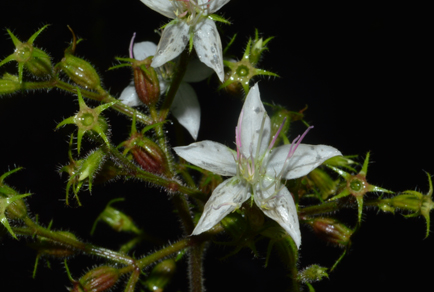
Pseudoernestia (Melastomataceae: Marcetieae) is a genus comprising two species, P. cordifolia and P. glandulosa, with disjunct distributions along the Amazon Rainforest. The genus is characterized by narrow sepals, petals bearing an apical glandular trichome, antesepalous stamens with aristate ventral appendages and calcarate dorsal appendages positioned opposite the ventral ones, a glabrous ovary with three locules, rarely two, and seeds lacking dorsolateral projections. We present a taxonomic review of Pseudoernestia, including a lectotypification for P. cordifolia, the type species of the genus. Based on herbarium data, we confirmed that P. cordifolia occurs in Venezuela and Brazil, typically on rocky outcrops, whereas P. glandulosa is found in French Guiana and Guyana, primarily on lateritic soils. Pseudoernestia cordifolia is categorized as Endangered, while P. glandulosa is assessed as Least Concern. We provide detailed descriptions, photographs of living specimens, scanning electron microscopy images of the seeds, geographic distribution maps, and notes on conservation status, habitat preferences, and phenology.
References
- Bachman, S., Moat, J., Hill, A.W., de la Torre, J. & Scott, B. (2011) Supporting red list threat assessments with GeoCAT: Geospatial conservation assessment tool. ZooKeys 150: 117–126. https://doi.org/10.3897/zookeys.150.2109
- Bartling, F.G. (1830) Ordines naturales plantarum eorumque characteres et affinitates adjecta generum enumeratione. Sumtibus Dieterichianis, Göttingen, 498 pp.
- Beentje, H. (2016) The Kew Plant Glossary: An illustrated dictionary of plant terms. Ed. 2. Royal Botanic Gardens, Kew, Richmond, 185 pp.
- Candolle, A.P. (1828) Melastomaceae. In: Candolle, A.P. (Ed.) Prodromus systematis naturalis regni vegetabilis, sive enumeratio contracta ordinum, generum, specierumque plantarum huc usque cognitarum, juxta methodi naturalis normas digesta, Vol. 3. Sumptibus Sociorum Treuttel et Würtz, Parisiis [Paris], pp. 99–202.
- Clarke, D. & Rhodes, J.H. (2006) Plant diversity of the Central Suriname Nature Reserve: implications for conservation and biogeography. In: Alonso, L.E. & Berrenstein, H.J. (Eds.) A rapid biological assessment of the aquatic ecosystems of the Coppename River Basin, Suriname. RAP Bulletin of Biological Assessment 39. Conservation International, Washington, DC, pp. 47–55.
- Cogniaux, A. (1885) Melastomaceae. Tribus II. Tibouchineae Baill. In: Martius, C.F.P. & Eichler, A.G. (Eds.) Flora brasiliensis, enumeratio plantarum in Brasilia hactenus detectarum: quas suis aliorumque botanicorum studiis descriptas et methodo naturali digestas partim icone illustratas, Vol. 14. Frid. Fleischer, Monachii et Lipsiae [Munich & Leipzig], pp. 205–510. https://doi.org/10.5962/bhl.title.454
- Daly, D.C. & Prance, G.T. (1989) Brazilian Amazon. In: Campbell, D.G. & Hammond, H.D. (Eds.) Floristic inventory of tropical countries. New York Botanical Garden, New York, pp. 401–426.
- DRYFLOR (2016) Plant diversity patterns in neotropical dry forests and their conservation implications. Science 353: 1383–1387. https://doi.org/10.1126/science.aaf5080
- Fearnside, P.M. (2017) Deforestation of the Brazilian Amazon. In: Shugart, H. (Ed.) Oxford Research Encyclopedia of Environmental Science. Oxford University Press, New York, USA. https://doi.org/10.1093/acrefore/9780199389414.013.102
- Gleason, H.A. (1925) Studies on the flora of northern South America–VI. Bulletin of the Torrey Botanical Club 52: 325–340. https://doi.org/10.2307/2479960
- Hoff, M. & Cremers, G. (1996) Index des noms de lieux des récoltes botaniques en Guyane Française. Sylvolab Guyane, Kourou.
- IUCN (2012) IUCN Red List categories and criteria. Version 3.1. Ed. 2. IUCN, Gland, Switzerland and Cambridge, UK.
- IUCN (2024) Guidelines for using the IUCN Red List categories and criteria. Version 16. Prepared by the Standards and Petitions Committee. Available from: https://www.iucnredlist.org/documents/RedListGuidelines.pdf (accessed December 2024)
- Kimball, S., Mattis, P. & the GIMP developer team (1995–2024) GNU Image Manipulation Program (GIMP). Available from: https://www.gimp.org/ (accessed December 2024)
- Krasser, F. (1893) Melastomataceae. In: Engler, A. & Prantl, K. (Eds.) Die Natürlichen Pflanzenfamilien nebst ihren Gattungen und wichtigeren Arten insbesondere den Nutzpflanzen, unter Mitwirkung zahlreicher hervorragender Fachgelehrten. Vol. 3. Wilhelm Engelmann, Leipzig, pp. 130–199. https://doi.org/10.5962/bhl.title.4635
- Kunth, K.S. (1822a) Nova genera et species plantarum. Vol. 5. N. Maze, Bibliopolam, Lutetiæ Parisiorum [Paris], 338 pp.
- Kunth, K.S. (1822b) Notice sur le genre Bambusa. Journal de Physique, de Chimie, d'Histoire Naturelle et des Arts 95: 148–151.
- Magdalena, U.R., Silva, L.A.E., Lima, R.O., Bellon, E., Ribeiro, R., Oliveira, F.A., Siqueira, M.F. & Forzza, R.C. (2018) A new methodology for the retrieval and evaluation of geographic coordinates within databases of scientific plant collections. Applied Geography 96: 11–15. https://doi.org/10.1016/j.apgeog.2018.05.002
- Melo, L.R.F., Vasconcelos, T., Reginato, M., Caetano, A.P.S. & Brito, V.L.G. (2021) Evolution of stamen dimetrism in Melastomataceae, a large radiation of pollen flowers. Perspectives in Plant Ecology, Evolution and Systematics 48: 125589. https://doi.org/10.1016/j.ppees.2021.125589
- R Core Team (2024) R: A language and environment for statistical computing. R Foundation for Statistical Computing. Available from: http://www.R-project.org/ (accessed December 2024)
- Reginato, M. (2016) monographaR: An R package to facilitate the production of plant taxonomic monographs. Brittonia 68: 212–216. https://doi.org/10.1007/s12228-015-9407-z
- Rocha, M.J.R., Guimarães, P.J.F., Michelangeli, F.A. & Batista, J.A.N. (2018) [2017] Taxonomy of Marcetieae: A new neotropical tribe of Melastomataceae. International Journal of Plant Sciences 179: 50–74. https://doi.org/10.1086/694932
- Shorthouse, D.P. (2010) SimpleMappr, an online tool to produce publication-quality point maps. Available from: https://www.simplemappr.net (accessed 1 December 2024)
- ter Steege, H., Bánki, O. & Haripersaud, P. (2007) Plant diversity of the bauxite plateaus of North East Suriname. In: Alonso, L.E. & Mol, J.H. (Eds.) A rapid biological assessment of the Lely and Nassau plateaus, Suriname (with additional information on the Brownsberg Plateau). RAP Bulletin of Biological Assessment 43. Conservation International, Arlington, VA, USA, pp. 76–85.
- Thiers, B. (2025) Index Herbariorum: A global directory of public herbaria and associated staff. Available from: https://sweetgum.nybg.org/science/ih/ (accessed January 2025)
- Triana, J.J. (1872) [1871] Les Mélastomacées. The transactions of the Linnean Society of London 28: 1–188. https://doi.org/10.1111/j.1096-3642.1871.tb00222.x
- Turland, N.J., Wiersema, J.H., Barrie, F.R., Gandhi, K.N., Gravendyck, J., Greuter, W., Hawksworth, D.L., Herendeen, P.S., Klopper, R.R., Knapp, S., Kusber, W.-H., Li, D.-Z., May, T.W., Monro, A.M., Prado, J., Price, M.J., Smith, G.F. & Zamora Señoret, J.C. (2025) International Code of Nomenclature for algae, fungi, and plants (Madrid Code). Regnum Vegetabile 162. The University of Chicago Press, Chicago and London. https://doi.org/10.7208/chicago/9780226839479.001.0001
- Weberling, F. (1989) Morphology of flowers and inflorescences. University Press, Cambridge, UK.
- Wickham, H., Averick, M., Bryan, J., Chang, W., McGowan, L.D., François, R., Grolemund, G., Hayes, A., Henry, L., Hester, J., Kuhn, M., Pedersen, T.L., Miller, E., Bache, S.M., Müller, K., Ooms, J., Robinson, D., Seidel, D.P., Spinu, V., Takahashi, K., Vaughan, D., Wilke, C., Woo, K. & Yutani, H. (2019) Welcome to the tidyverse. Journal of Open Source Software 4: 1686. https://doi.org/10.21105/joss.01686
- Wurdack, J.J. (1973) Flora de Venezuela: Melastomataceae. Instituto Botanico, Cacaracas, 819 pp.
- Wurdack, J.J. (1993) Ernestia (Melastomatoideae). In: Görts-van Rijn, A.R.A. & Jansen-Jacobs, M.J. (Eds.) The Flora of the Guianas: 99. Melastomataceae. Koeltz Scientific Books, Koenigstein, pp. 90–97.