

Abstract
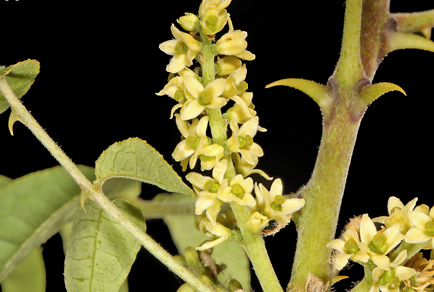
Zanthoxylum kaokoense, previously mistaken for Z. ovatifoliolatum, is formally described here as a new species. It is a range-restricted species, only known from the Kaokoveld Centre of Endemism, located in southwestern Angola and northwestern Namibia. The species typically grows on arid hillsides, in valleys, and along ephemeral rivers and drainage lines. Diagnostic characters for Z. kaokoense include its growth as a shrub or small tree, the presence of curved prickles on the branches, petioles, leaf rachises, and some leaflets, as well as fine pubescence (puberulous) on young branches, petioles, rachises, and inflorescence axes. The leaflets are discolorous and contain both marginal and scattered secretory cavities. The inflorescences are either paniculate or racemose-paniculate, and the female flowers have gynoecia with one or two carpels. Morphologically and genetically, Z. kaokoense is most similar to Z. chalybeum, which is likely its closest relative. The taxonomic status of Z. ovatifoliolatum is still unresolved and will require further fieldwork and comparative analysis, particularly with Z. chalybeum, as the two species may be conspecific. According to IUCN Red List criteria, Z. kaokoense is provisionally assessed as Least Concern (LC) in terms of conservation status.
References
- Appelhans, M.S., Reichelt, N., Groppo, M., Paetzold, C. & Wen, J. (2018) Phylogeny and biogeography of the pantropical genus Zanthoxylum and its closest relatives in the proto-Rutaceae group (Rutaceae). Molecular Phylogenetics and Evolution 126: 31–44. https://doi.org/10.1016/j.ympev.2018.04.013
- Atlas of Namibia Team (2022) Atlas of Namibia: its land, water and life. Namibia Nature Foundation, Windhoek, 390 pp.
- Bachman, S., Moat, J., Hill, A.W., De la Torre, J. & Scott, B. (2011) Supporting Red List threat assessments with GeoCAT: geospatial conservation assessment tool. ZooKeys 150: 117–126. https://doi.org/10.3897/zookeys.150.2109
- Becker, R., Swanepoel, W., Van Jaarsveld, E.J., Gomes, A., Lages, F. & De Cauwer, V. (2021) Helicopter Science: unlocking the botanical secrets of the Kaokoveld Mountains. Conservation and the Environment in Namibia 3: 55–59.
- Beentje, H. (2016) The Kew plant glossary: an illustrated dictionary of plant terms, 2nd ed. Kew Publishing, Kew, 184 pp.
- Christenhusz, M.J.M., Fay, M.F. & Chase, M.W. (2017) Plants of the world: an illustrated encyclopedia of vascular plants. Royal Botanic Gardens, Kew, Richmond, Surrey & The University of Chicago Press, Chicago, 792 pp.
- Coates Palgrave, M. (2002) Keith Coates Palgrave trees of southern Africa, 3rd ed. Struik, Cape Town, 1212 pp.
- Craven, P. (2009) Phytogeographic study of the Kaokoveld Centre of Endemism. Ph.D. Thesis. University of Stellenbosch, Stellenbosch, 234 pp. [https://hdl.handle.net/10019.1/1325]
- Curtis, B.A. & Mannheimer, C.A. (2005) Tree atlas of Namibia. National Botanical Research Institute, Windhoek, 688 pp.
- De Cauwer, V., Becker, R.W., Gomes, A., Lages, F., Swanepoel, W. & Van Jaarsveld, E. (2023) The mountain top flora and vegetation of the remote Ovahimba Highlands in the Kaokoveld Centre of Endemism: a reconnaissance. Transactions of the Royal Society of South Africa 78 (1&2): 109–122. https://doi.org/10.1080/0035919X.2023.2211040
- Edwards, D. & Leistner, O.A. (1971) A degree reference system for citing biological records in southern Africa. Mitteilungen der Botanischen Staatssammlung München 10: 501–509. [https://www.biodiversitylibrary.org/page/15185301#page/509/mode/1up]
- Engler, A. (1895) Rutaceae. Die Pflanzenwelt Ost-Afrikas und der Nachbargebiete 2 (C): 227–229. [https://www.biodiversitylibrary.org/item/10523#page/1/mode/1up]
- Engler, A. (1896) Rutaceae africanae. Botanische Jahrbücher für Systematik, Pflanzengeschichte und Pflanzengeographie 23 (1&2): 146–154. [https://www.biodiversitylibrary.org/page/207406#page/152/mode/1up]
- Figueiredo, E. & Smith, G.F. (2008) Plants of Angola/Plantas de Angola. Strelitzia 22. South African National Biodiversity Institute, Pretoria, 279 pp. [https://www.sanbi.org/documents/plants-of-angola-strelitzia-22/]
- Figueiredo, E. & Smith, G.F. (2020) Friedrich Welwitsch and his overlooked contributions to the Flora of Tropical Africa, with a discussion of the names of Kalanchoe (Crassulaceae subfam. Kalanchooideae) that should be ascribed to Welwitsch alone. Phytotaxa 458 (1): 83–100. https://doi.org/10.11646/phytotaxa.458.1.5
- Germishuizen, G. & Meyer, N.L. (Eds.) (2003) Plants of southern Africa: an annotated checklist. Strelitzia 14. National Botanical Institute, Pretoria, 1231 pp.
- Hewson, H.J. (2019) Plant indumentum: a handbook of terminology, revised ed. Australian Biological Resources Study, Commonwealth Department of the Environment and Energy, Australia, 47 pp. [https://www.biodiversitylibrary.org/bibliography/176095]
- Hiern, W.P. (1896) Rutaceae. In: Hiern, W.P., Catalogue of the African plants collected by Dr Friedrich Welwitsch in 1853–61 […] 1.1. Printed by order of the Trustees [of the British Museum], London, pp. 110–118. [https://www.biodiversitylibrary.org/page/11450823#page/142/mode/1up]
- IUCN (2012) IUCN red list categories and criteria: Version 3.1, 2nd ed. Gland, Switzerland and Cambridge, U.K., iv + 32 pp.
- IUCN Standards and Petitions Committee. (2024) Guidelines for using the IUCN Red List Categories and Criteria. Version 16. Prepared by the Standards and Petitions Committee. [https://www.iucnredlist.org/documents/RedListGuidelines.pdf]
- Kokwaro, J.O. (1978) New taxa and combinations in Rutaceae of E. and N.E. Africa. Kew Bulletin 32 (4): 785–798. https://doi.org/10.2307/4109775
- Linnaeus, C. (1753) Species Plantarum 1. Impensis Laurentii Salvii, Stockholm, 560 pp. https://doi.org/10.5962/bhl.title.37656
- Mannheimer, C.A. & Curtis, B.A. (Eds). (2018) Le Roux and Müller’s field guide to the trees & shrubs of Namibia, 2nd ed. Namibia Publishing House, Windhoek, 546 pp.
- Mendelsohn, J.M. & Huntley B.J. (2023) Introducing the highlands and escarpments of Angola and Namibia. Namibian Journal of Environment 8: 7–22. https://doi.org/10.64640/espy7q72
- POWO (2025) Plants of the World Online. Facilitated by the Royal Botanic Gardens, Kew. Available from: http://powo.science.kew.org/ (accessed 22 May 2025)
- Reichelt, N., Wen, J., Pätzold, C. & Appelhans, M.S. (2021) Target enrichment improves phylogenetic resolution in the genus Zanthoxylum (Rutaceae) and indicates both incomplete lineage sorting and hybridization events. Annals of Botany 128 (4): 497–510. https://doi.org/10.1093/aob/mcab092
- Retief, E. & Finkelstein, N. (1979) Rutaceae: The correct name for Fagara ovatifoliolata. Bothalia 12 (4): 637. https://doi.org/10.4102/abc.v12i4.1439
- Schreiber, A. (1968) Rutaceae. Prodromus einer Flora von Südwestafrika 68: 1–3.
- Thiers, B. (2025) Index Herbariorum: A global directory of public herbaria and associated staff. New York Botanical Garden’s Virtual Herbarium. Available from: http://sweetgum.nybg.org/ih/ (accessed May 2025)
- Van Wyk, A.E. & Smith, G.F. (2001) Regions of floristic endemism in southern Africa: a review with emphasis on succulents. Umdaus Press, Hatfield, Pretoria, 199 pp.
- Van Wyk, B.[A.E.] & Van den Berg, E., Coates Palgrave, M. & Jordaan, M. (2011) Dictionary of names for Southern African trees. Scientific names of indigenous trees, shrubs and climbers with common names from 30 languages. Briza Academic Books, Briza Publications, Pretoria, 956 pp.
- Von Dürckheim, H., Van Wyk, B.[A.E.] & Van den Berg, E., Coates Palgrave, M. & Jordaan, M. (2014) Saklys van Suider-Afrikaanse inheemse bome/Pocket list of Southern African indigenous trees, 5th ed. Briza Academic Books, Briza Publications, Pretoria, 634 pp.
- Von Koenen, E. (1996) Heil-, Gift- und essbare Pflanzen in Namibia. Klaus Hess Verlag, Gӧttingen, 336 pp.