
Abstract
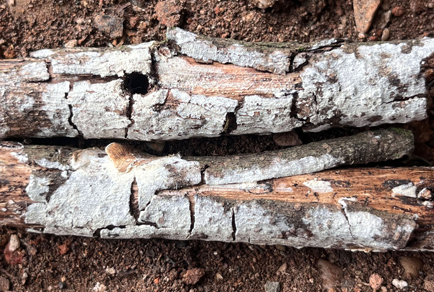
The wood-inhabiting fungi play a crucial role in wood degradation and the cycle of matter within the ecological system. They are considered the “key player” in wood decomposition because of their ability to decompose woody lignin, cellulose, and hemicellulose. Steccherinum farinaceum is described and illustrated based on morphological and molecular evidence. This species is characterized by white to cream basidiomata with farinaceous hymenophore and ellipsoid to subglobose basidiospores (4.0–5.5 × 3.5–4.5 µm). Sequences of the internal transcribed spacer region (ITS) and the large subunit nuclear ribosomal RNA gene (nLSU) from the studied samples were generated, and phylogenetic analyses were performed using Maximum Likelihood, Bayesian Inference, and Maximum Parsimony methods. The phylogenetic analysis indicated that the new species S. farinaceum is nested within the genus Steccherinum and is sister to two related species, S. wumengshanense and S. yunnanense. A description, illustrations, and phylogenetic analysis results of the new species are provided. Additionally, the new species is compared with closely related taxa.
References
- Andjièrèyir, K.S., Samson, N., Sylvie, N.R., Benovana, B., Edouard, S.K.J., Kounbo, D. & Elise, S. (2024) Taxonomic study of five parasitic polypores of the Hymenochaetaceae family of TIN vegetation in Western Burkina Faso. American Journal of Plant Sciences 15: 441–454. https://doi.org/10.4236/ajps.2024.156031
- Bernicchia, A. & Gorjón, S.P. (2010) Fungi europaei 12: Corticiaceae s.l. Edizioni Candusso, Alassio, 1007 pp.
- Binder, M., Hibbett, D.S., Larsson, K.H., Larsson, E., Langer, E. & Langer, G. (2005) The phylogenetic distribution of resupinate forms across the major clades of mushroom-forming fungi (Homobasidiomycetes). Systematics and Biodiversity 3: 113–157. https://doi.org/10.1017/S1477200005001623
- Binder, M., Justo, A., Riley, R., Salamov, A., Lopez-Giraldez, F., Sjokvist, E., Copeland, A., Foster, B., Sun, H., Larsson, E., Larsson, K., Townsend, J. & Grigoriev, I.V. (2013) Phylogenetic and phylogenomic overview of the polyporales. Mycologia 105: 1350–1373. https://doi.org/10.3852/13-003
- Cao, T., Yu, J.R. & Yuan, H.S. (2021) Multiple-marker phylogeny and morphological evidence reveal two new species in steccherinaceae (Polyporales, basidiomycota) from Asia. Mycokeys 78: 169–186. https://doi.org/10.3897/mycokeys.78.57823
- Chen, D.X., Zhang, S.H., Yang, R.F., Li, C.J., Yan, M.L., Dong, J.H. & Zhao, C.L. (2025) Molecular phylogeny and morphology reveal a new species of Radulomyces (Radulomycetaceae, Agaricales) from Southwestern China. Phytotaxa 696 (3): 205–216. https://doi.org/10.11646/phytotaxa.696.3.1
- Crous, P.W., Wingfield, M.J., Jurjević, Ž., Balashov, S., Osieck, E.R., Marin-Felix, Y., Luangsa-Ard, J.J., Mejía, L.C., Cappelli, A., Parra, L.A., Lucchini, G., Chen, J., Moreno, G., Faraoni, M., Zhao, R.L., Weholt, Ø., Borovička, J., Jansen, G.M., Shivas, R.G., Tan, Y.P., Akulov, A., Alfenas, A.C., Alfenas, R.F., Altés, A., Avchar, R., Barreto, R.W., Catcheside, D.E.A., Chi, T.Y., Esteve-Raventós, F., Fryar, S.C., Hanh, L.T.M., Larsbrink, J., Oberlies, N.H., Olsson, L., Pancorbo, F., Raja, H.A., Thanh, V.N., Thuy, N.T., Ajithkumar, K., Akram, W., Alvarado, P., Angeletti, B., Arumugam, E., Khalilabad, A.A., Bandini, D., Baroni, T.J., Barreto, G.G., Boertmann, D., Bose, T., Castañeda Ruiz, R.F., Couceiro, A., Cykowska-Marzencka, B., Dai, Y.C., Darmostuk, V., da Silva, S.B.G., Dearnaley, J.D.W., de Azevedo Santiago, A.L.C.M., Declercq, B., de Freitas, L.W.S,, De la Peña-Lastra, S., Delgado, G., de Lima, C.L.F., Dhotre, D., Dirks, A.C., Eisvand, P., Erhard, A., Ferro, L.O., García, D., García-Martín, A., Garrido-Benavent, I., Gené, J., Ghobad-Nejhad, M., Gore, G., Gunaseelan, S., Gusmão, L.F.P., Hammerbacher, A., Hernández-Perez, A.T., Hernández-Restrepo, M., Hofmann, T.A., Hubka, V., Jiya, N., Kaliyaperumal, M., Keerthana, K.S., Ketabchi, M., Kezo, K., Knoppersen, R., Kolarczyková, D., Kumar, T.K.A., Læssøe, T., Langer, E., Larsson, E., Lodge, D.J., Lynch, M.J., Maciá-Vicente, J.G., Mahadevakumar, S., Mateos, A., Mehrabi-Koushki, M., Miglio, B.V., Noor, A., Oliveira, J.A., Pereira, O.L., Piątek, M., Pinto, A., Ramírez, G.H., Raphael, B., Rawat, G., Renuka, M., Reschke, K., Mateo, A.R., Saar, I., Saba, M., Safi, A., Sánchez, R.M., Sandoval-Denis, M., Savitha, A.S., Sharma, A., Shelke, D., Sonawane, H., Souza, M.G.A.P., Stryjak-Bogacka, M., Thines, M., Thomas, A., Torres-Garcia, D., Traba, J.M., Vauras, J., Vermaas, M., Villarreal, M., Vu, D., Whiteside, E.J., Zafari, D., Starink-Willemse, M. & Groenewald, J.Z. (2024) Fungal Planet description sheets: 1697–1780. Fungal Systematics and Evolution 14: 325–577. https://doi.org/10.3114/fuse.2024.14.19
- Cui, B.K., Li, H.J., Ji, X., Zhou, J.L., Song, J., Si, J., Yang, Z.L. & Dai, Y.C. (2019) Species diversity, taxonomy and phylogeny of Polyporaceae (Basidiomycota) in China. Fungal Diversity 97: 137–392. https://doi.org/10.1007/s13225-019-00427-4
- Dai, Y.C. (2010) Hymenochaetaceae (Basidiomycota) in China. Fungal Diversity 45: 131–343. https://doi.org/10.1007/s13225-010-0066-9
- Dai, Y.C. (2011) A revised checklist of corticioid and hydnoid fungi in China for 2010. Mycoscience 52: 69–79. https://doi.org/10.1007/S10267-010-0068-1
- Deng, Y.L., Chen, M., Liu, L.F., Li, Q.Z., Zhang, S.C., Yuan, H.S. & Zhao, C.L. (2025) Morphological and molecular analyses revealed four new wood-inhabiting fungal species (Hymenochaetales, Basidiomycota) from Yunnan. MycoKeys 117: 29–66. https://doi.org/10.3897/mycokeys.117.146236
- Deng, Y.L., Zhou, H.M., Muhammad, A. & Zhao, C.L. (2024) Species diversity, taxonomy, molecular systematics and divergence time of wood-inhabiting fungi in Yunnan-Guizhou Plateau, Asia. Mycosphere 15: 1110–1293. https://doi.org/10.5943/mycosphere/15/1/10
- Dong, J.H., Li, Q., Yuan, Q., Luo, Y.X., Zhang, X.C., Dai, Y.F., Zhou, Q., Liu, X.F., Deng, Y.L., Zhou, H.M., Muhammad, A. & Zhao, C.L. (2024) Species diversity, taxonomy, molecular systematics and divergence time of wood-inhabiting fungi in Yunnan-Guizhou Plateau, Asia. Mycosphere 15: 1110–1293. https://doi.org/10.5943/mycosphere/15/1/10
- Dong, J.H., Wu, Y.X. & Zhao, C.L. (2022) Two new species of Steccherinum (Polyporales, Basidiomycota) from southern China based on morphology and DNA sequence data. Mycoscience 63: 5–72. https://doi.org/10.47371/mycosci.2022.02.002
- Dong, J.H., Zhang, X.C., Chen, J.J., Zhu, Z.L. & Zhao, C.L. (2023) A phylogenetic and taxonomic study on Steccherinum (Polyporales, Basidiomycota): Focusing on three new Steccherinum species from southern China. Frontiers in Cellular and Infection Microbiology 12: 1103579. https://doi.org/10.3389/fcimb.2022.1103579
- Felsenstein, J. (1985) Confidence intervals on phylogenetics: an approach using bootstrap. Evolution 39: 783–791. https://doi.org/10.1111/j.1558-5646.1985.tb00420.x
- Fries, E.M. (1821) Systema mycologicum vol. 1 (Gryphiswaldia: Sumtibus Ernesti Mauritii).
- Gray, S.F. (1821) A natural arrangement of British plants Vol. 1. Baldwin, Cradock, and Joy, London.
- Guindon, S. & Gascuel, O. (2003) A simple, fast and accurate algorithm to estimate large phylogenies by Maximum Likelihood. Systematic Biology 52 (5): 696–704. https://doi.org/10.1080/10635150390235520
- He, M.Q., Cao, B., Liu, F., Boekhout, T., Denchev, T.T., Schoutteten, N., Denchev, C.M., Kemler, M. Gorjón, S.P., Begerow, D., Valenzuela, R., Davoodian, N., Niskanen, T., Vizzini, A., Redhead, S.A., Ramírez‑Cruz, V., Papp, V., Dudka, V.A., Dutta, A.K., García‑Sandoval, R., Liu, X.Z., Kijpornyongpan, T., Savchenko, A., Tedersoo, L., Theelen, B., Trierveiler‑Pereira, L., Wu, F., Zamora, J,C., Zeng, X.Y., Zhou, L.W., Liu, S.L., Ghobad‑Nejhad, M., Giachin, A.J., Li, G.J., Kakishima, M., Olariaga, I., Haelewaters, D., Sulistyo, B., Sugiyama, J., Svantesson, S., Yurkov, A., Alvarado, P., Antonín, V., Silva, A.F.D., Druzhinina, I., Gibertoni, T.B., Guzmán-Dávalos, L., Justo, A., Karunarathna, S.C., Galappaththi, M.A.C., Toome-Heller, M., Hosoya, T., Liimatainen, K., Márquez, R., Mešić, A., Moncalvo, J.M., Nagy, L.G., Varga, T., Orihara, T., Raymundo, T., Salcedo, I., Silva-Filho, A.G.S., Tkalčec, Z., Wartchow, F., Zhao, C.L., Bau, T., Cabarroi-Hernández, M., Cortés-Pérez, A., Decock, C., Lange, R.D., Weiss, M., Menolli Jr, N., Nilsson, R.H., Fan, Y.G., Verbeken, A., Gafforov, Y., Meiras-Ottoni, A., Mendes-Alvarenga, R.L., Zeng, N.K., Wu, Q., Hyde, K.D., Kirk, P.M. & Zhao, R.L. (2024) Phylogenomics, divergence times and notes of orders in Basidiomycota. Fungal Diversity 126 (1): 127–406. https://doi.org/10.1007/s13225-024-00535-w
- Hu, Y.W., Karunarathna, S.C., Li, H., Galappaththi, M.C., Zhao, C.L., Kakumyan, P. & Mortimer, P.E. (2022) The impact of drying temperature on basidiospore size. Diversity 14: 239. https://doi.org/10.3390/d14040239
- Jiang, Y.T., Wang, L., Zhou, C.Q., Shen, K.Z., Zhang, S.C., Yang, A.L. & Zhao, C.L. (2025) Molecular phylogeny and morphology reveal a new species of Exidia (Auriculariaceae, Auriculariales) from Yunnan Province, China. Phytotaxa 689 (1): 27–39. https://doi.org/10.11646/phytotaxa.689.1.3
- Justo, A., Miettinen, O., Floudas, D., Ortiz-Santana, B., Sjökvist, E., Lindner, D., Nakasone, K., Niemelä, T., Larsson, K., Ryvarden, L. & Hibbett, D.S. (2017) A revised family-level classification of the polyporales (Basidiomycota). Fungal Biology 121: 798–824. https://doi.org/10.1016/j.funbio.2017.05.010
- Larsson, A. (2014) AliView: a fast and lightweight alignment viewer and editor for large data sets. Bioinformatics 30 (22): 3276–3278. https://doi.org/10.1093/bioinformatics/btu531
- Li, W., Wang, X.Y., Chen, D.X., Zhang, S.C., Li, Y.C., Zhao, C.L. & Zhan, Z.Y. (2025) Molecular phylogeny and morphology reveal a new wood-inhabiting fungus Hyphoderma cinereofuscum (Polyporales, Basidiomycota), from southwest China. Phytotaxa 683 (2): 106–118. https://doi.org/10.11646/phytotaxa.683.2.2
- Liu, S., Zhou, J.L., Song, J., Sun, Y.F., Dai, Y.C. & Cui, B.K. (2023a) Climacocystaceae fam. nov. and Gloeoporellaceae fam. nov., two new families of Polyporales (Basidiomycota). Frontiers in Microbiology 14: 1115761. https://doi.org/10.3389/fmicb.2023.1115761
- Liu, Z.B. & Dai, Y.C. (2021) Steccherinum fragile sp. nov. and S. subcollabens comb. nov. (Steccherinaceae, polyporales), evidenced by morphological characters and phylogenetic analysis. Phytotaxa 483: 106–116. https://doi.org/10.11646/phytotaxa.483.2.3
- Liu, Z.B., Zhou, M., Zhang, Q.Y. & Si, J. (2023b) A contribution to the genus Steccherinum (Steccherinaceae, Polyporales): Introducing two new species and two new combinations of the genus. Frontiers in Microbiology 14: 1166267. https://doi.org/10.3389/fmicb.2023.1166267
- Liu, Z.B., Yuan, Y., Dai, Y.C., Liu, H.G., Vlasák, J., Zeng, G.Y., He, S.H. & Wu, F. (2025) Global diversity and systematics of Hymenochaetaceae with non-poroid hymenophore. Fungal Diversity 131 (2). https://doi.org/10.1007/s13225-025-00552-3
- Miettinen, O., Larsson, E., Sjökvist, E. & Larsson, K.H. (2012) Comprehensive taxon sampling reveals unaccounted diversity and morphological plasticity in a group of dimitic polypores (Polyporales, basidiomycota). Cladistics 28: 251–270. https://doi.org/10.1111/j.1096-0031.2011.00380.x
- Miller, M.A., Pfeiffer, W. & Schwartz, T. (2012) The CIPRES science gateway: enabling high–impact science for phylogenetics researchers with limited resources. Association for Computing Machinery 39: 1–8. https://doi.org/10.1145/2335755.2335836
- Petersen, J.H. (1996) Farvekort. the Danish mycological society´s colour-chart. Foreningen til Svampekundskabens Fremme, Greve, 1–6.
- Popa, F., Hertenstein, A., Blumenstein, K., Gantert, L.M.R., Ordynets, O., Rexer, K,H. & Spirin, V. (2024) Steccherinum pudorinum comb. nov. Taxonomie und Ökologie einer missdeuteten Art. Zeitschrift für Mykologie 90 (1): 63–81.
- Posada, D. (2008) jModelTest: Phylogenetic model averaging. Molecular Biology and Evolution 25 (7): 1253–1256. https://doi.org/10.1093/molbev/msn083
- Rathnayaka, A.R., Tennakoon, D.S., Jones, G.E., Wanasinghe, D.N., Bhat, D.J., Priyashantha, A.H., Stephenson, S.L., Tibpromma, S. & Karunarathna, S.C. (2024) Significance of precise documentation of hosts and geospatial data of fungal collections, with an emphasis on plant-associated fungi. New Zealand Journal of Botany 63 (2–3): 462–489. https://doi.org/10.1080/0028825X.2024.2381734
- Rehner, S.A. & Samuels, G.J. (1994) Taxonomy and phylogeny of Gliocladium analysed from nuclear large subunit ribosomal DNA sequences. Mycological Research 98 (6): 625–634. https://doi.org/10.1016/S0953-7562(09)80409-7
- Ronquist, F. & Huelsenbeck, J.P. (2003) MRBAYES 3: Bayesian phylogenetic inference under mixed models. Bioinformatics 19 (12): 1572–1575. https://doi.org/10.1093/bioinformatics/btg180
- Swofford, D.L. (2002) PAUP*: phylogenetic analysis using parsimony (*and other methods). version 4.0b10. Sinauer Associates, Sunderland, Massachusetts.
- Vilgalys, R. & Hester, M. (1990) Rapid genetic identification and mapping of enzymatically amplified ribosomal DNA from several Cryptococcus species. Journal of Bacteriology 172 (8): 4238–4246. https://doi.org/10.1128/jb.172.8.4238-4246.1990
- Wang, L., Su, J.Q., Muhammad, A. & Zhao, C.L. (2024) Two new wood-inhabiting fungal species (Polyporales, Basidiomycota) from Yunnan Province, China. Phytotaxa 647 (1): 1–18. https://doi.org/10.11646/phytotaxa.647.1.1
- Westphalen, M.C., Motato-Vásquez, V., Tomsǒvský, M. & Gugliotta, A.M. (2021) Additions to the knowledge of hydnoid steccherinaceae: Cabalodontia, Etheirodon, Metuloidea, and Steccherinum. Mycologia 113: 791–806. https://doi.org/10.1080/00275514.2021.1894536
- Westphalen, M.C., Rajchenberg, M., Tomsǒvský, M. & Gugliotta, A.M. (2018) A re-evaluation of neotropical Junghuhnia s.lat. (Polyporales, basidiomycota) based on morphological and multigene analyses. Persoonia 41: 130–141. https://doi.org/10.3767/persoonia.2018.41.07
- White, T.J., Bruns, T., Lee, S. & Taylor, J. (1990) Amplification and direct sequencing of fungal ribosomal RNA genes for phylogenetics. In: Innis, M.A., Gelfand, D.H., Sninsky, J.J. & White, T.J. (Ed.) PCR protocols: A guide to methods and applications. pp. 315–322. https://doi.org/10.1016/B978-0-12-372180-8.50042-1
- Wu, F., Zhou, L.W., Vlasák, J. & Dai, Y.C. (2022) Global diversity and systematics of Hymenochaetaceae with poroid hymenophore. Fungal Diversity 113: 1–192. https://doi.org/10.1007/s13225-021-00496-4
- Wu, Y.X., Dong, J.H. & Zhao, C.L. (2021a) Steccherinum puerense and S. rubigimaculatum spp. nov. (Steccherinaceae, polyporales), two new species from southern China. Nova Hedwigia 113: 243–258. https://doi.org/10.1127/nova_hedwigia/2021/0636
- Wu, Y.X., Wu, J.R. & Zhao, C.L. (2021b) Steccherinum tenuissimum and S. xanthum spp. nov. (Polyporales, basidiomycota): New species from China. PloS One 16: e0244520. https://doi.org/10.1371/journal.pone.0244520
- Yang, Y., Li, R., Jiang, Q.Q., Zhou, H.M., Muhammad, A., Wang, H.J. & Zhao, C.L. (2024) Phylogenetic and taxonomic analyses reveal three new wood-inhabiting fungi (Polyporales, Basidiomycota) in China. Journal of Fungi 10 (1): 55: 1–17. https://doi.org/10.3390/jof10010055
- Yang, Y., Li, R., Liu, C.M. & Zhao, C.L. (2023) Morphological and molecular identification for two new species of wood-inhabiting macrofungi (Basidiomycota) from Yunnan-Guizhou Plateau, China. Phytotaxa 591 (1): 1–18. https://doi.org/10.11646/phytotaxa.591.1.1
- Yuan, Y., Bian, L.S., Wu, Y.D., Chen, J.J., Wu, F., Liu, H.G., Zeng, G.Y. & Dai, Y.C. (2023) Species diversity of pathogenic wood-rotting fungi (Agaricomycetes, Basidiomycota) in China. Mycology 14: 20–226. https://doi.org/10.1080/21501203.2023.2238779
- Yurchenko, E, Larsson, K.H., Riebesehl, J. & Miettinen, O. (2023) Steccherinum filiferum sp. nov. from the neotropics, and a new combination for Odontia laxa. Mycotaxon 137 (4): 773–786. https://doi.org/10.5248/137.773
- Zhang, S.C., Dong, J.H., Zhang, X.J., Li, Y.C., Liu, R. & Zhao, C.L. (2025) Gloeocystidiellum sinense sp. nov. (Stereaceae, Russulales), a wood-inhabiting fungus from Yunnan Province, China. New Zealand Journal of Botany 63 (2–3): 370–381. https://doi.org/10.1080/0028825X.2025.2454589
- Zhang, X.C., Li, Y.C., Wang, Y.Y., Xu, Z., Zhao, C.L. & Zhou, H.M. (2024a) Xylodon asiaticus (Hymenochaetales, Basidiomycota), a new species of corticioid fungus from southern China. Phytotaxa 634 (1): 1–15. https://doi.org/10.11646/phytotaxa.634.1.1
- Zhang, X.J., Shi, F.L., Yang, K. & Zhao, C.L. (2024b) The diversity and taxonomy of Tomentella (Thelephoraceae, Thelephorales) with descriptions of four new species from Southwestern China. MycoKeys 109: 1–29. https://doi.org/10.3897/mycokeys.109.132941
- Zhang, X.J., Shi, F.L., Zhang, S.C., Hosen, M.I. & Zhao, C.L. (2024c) The Diversity and Taxonomy of Thelephoraceae (Basidiomycota) with Descriptions of Four Species from Southwestern China. Journal of Fungi 10: 775 (1–26). https://doi.org/10.3390/jof10110775
- Zhao, C.L., Qu, M.H., Huang, R.X. & Karunarathna, S.C. (2023a) Multi-gene phylogeny and taxonomy of the wood-rotting fungal genus Phlebia sensu lato (Polyporales, Basidiomycota). Journal of Fungi 9: 320. https://doi.org/10.3390/jof9030320
- Zhao, H., Ni, Y., Zong, T.K., Wang, K., Lv, M.L., Cui, Y.J., Tohtirjap, A., Chen, J.J., Zhao, C.L., Wu, F., Cui, B.K., Yuan, Y., Dai, Y.C. & Liu, X.Y. (2023b) Species diversity, updated classification and divergence times of the phylum Mucoromycota. Fungal Diversity 123: 49–157. https://doi.org/10.1007/s13225-023-00525-4
- Zhao, H., Wu, Y.D., Yang, Z.R., Liu, H.G., Wu, F., Dai, Y.C. & Yuan, Y. (2024) Polypore funga and species diversity in tropical forest ecosystems of Africa, America and Asia, and a comparison with temperate and boreal regions of the Northern Hemisphere. Forest Ecosystem 11: 100200. https://doi.org/10.1016/j.fecs.2024.100200
- Zhou, M., Dai, Y.C., Vlasák, J., Liu, H.G. & Yuan, Y. (2023) Updated systematics of Trichaptum s.l. (Hymenochaetales, Basidiomycota). Mycosphere 14 (1): 815–917. https://doi.org/10.5943/mycosphere/14/1/11