

Abstract
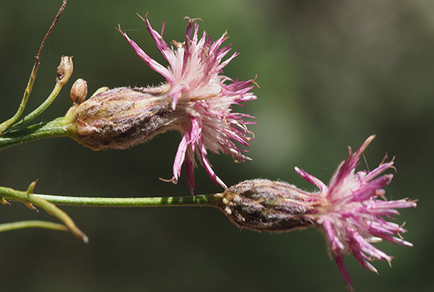
Saussurea qilianshanensis, a new species from Gansu, China, is described and illustrated herein. It differs from S. yabulaiensis by its stems 15–40 cm tall (vs. 12–20 cm), leaf lobes linear (vs. linear or narrowly lanceolate), leaf surfaces sparsely arachnoid and gland-dotted (vs. sparsely gland-dotted or glabrous), phyllaries purple and arachnoid (vs. green and glandular hairy). Molecular systematic analyses based on Hyb-Seq data confirm that S. qilianshanensis is a new species belonging to S. subg. Theodorea.
References
- Bunge, A. von (1833) Enumeratio plantarum quas in China boreali collegit Dr. Al. Bunge.. Saint Petersburg.
- Candolle, A.P.de (1810) Observations sur les plantes Composées ou syngenèses. Premier mémoire. Sur les Composées et les Cinarocéphales en général. Annales du Museum National d'Histoire Naturelle 16: 135–158.
- Cassini, H. (1818) Aperçu des genres ou sous-genres nouveaux formés dans la famille des Synanthérées. Bulletin des Sciences, par la Société Philomatique Paris 1818: 165–169.
- Chen, Y.S. (2015) Asteraceae II: Saussurea DC. In: Hong, D.Y. (Ed.) Flora of Pan-Himalaya, vol. 48 (2). Science Press, Beijing, 340 pp.
- Fischer, F.E.L. von & Meyer, C.A. von (1836) Index seminum, quae Hortus Botanicus Imperialis Petropolitanus pro mutua commutation offert: accedunt Animadversiones botanicae nonnullae. Hortus Botanicus Petropolitanus, Saint Petersburg.
- Fu, H.C. & Wen, D.S. (1993) Saussurea DC. In: Ma, Y.Q. (Ed.) Flora Intramongolica, vol. 4. Inner Mongolia People's Publishing House, Hohhot, pp. 709–750 & 847–848.
- Hall, T.A. (1999) BioEdit: A user-friendly biological sequence alignment program for Windows 95/98/NT. Nucleic Acids Symposium Series 41: 95–98.
- Johnson, M.G., Gardner, E.M., Liu, Y., Medina, R., Goffinet, B., Shaw, A.J., Zerega, N.J. & Wickett, N.J. (2016) HybPiper: Extracting coding sequence and introns for phylogenetics from high-throughput sequencing reads using target enrichment. Applications in Plant Sciences 4 (7): e160016. https://doi.org/10.3732/apps.1600016
- Katoh, K. & Standley, D.M. (2013) MAFFT multiple sequence alignment software version 7: improvements in performance and usability. Molecular Biology and Evolution 30 (4): 772–780. https://doi.org/10.1093/molbev/mst010
- Mandel, J.R., Dikow, R.B., Funk, V.A., Masalia, R.R., Staton, S.E., Kozik, A., Michelmore, R.W., Rieseberg, L.H. & Burke, J.M. (2014) A target enrichment method for gathering phylogenetic information from hundreds of loci: An example from the Compositae. Applications in Plant Sciences 2 (2): e1300085. https://doi.org/10.3732/apps.1300085
- Minh, B.Q., Nguyen, M.A. & von Haeseler, A. (2013) Ultrafast approximation for phylogenetic bootstrap. Molecular Biology and Evolution 30 (5): 1188–1195. https://doi.org/10.1093/molbev/mst024
- Minh, B.Q., Schmidt, H.A., Chernomor, O., Schrempf, D., Woodhams, M.D., von Haeseler, A. & Lanfear, R. (2020) IQ-TREE 2: New Models and Efficient Methods for Phylogenetic Inference in the Genomic Era. Molecular Biology and Evolution 37 (5): 1530–1534. https://doi.org/10.1093/molbev/msaa015
- Price, M.N., Dehal, P.S. & Arkin, A.P. (2010) FastTree 2‐approximately maximum‐likelihood trees for large alignments. PLoS One 5 (3): e9490. https://doi.org/10.1371/journal.pone.0009490
- Raab-Straube, E.von (2017) Taxonomic revision of Saussurea subgenus Amphilaena (Compositae, Cardueae). BGBM Press, Berlin.
- Xu, L.S., Herrando-Moraira, S., Susanna, A. et al. (2019) Phylogeny, origin and dispersal of Saussurea (Asteraceae) based on chloroplast genome data. Molecular Phylogenetics and Evolution 141: e106613. https://doi.org/10.1016/j.ympev.2019.106613
- Yao, Y.Y. (1992) Saussurea DC. In: Liu, Y.X. (Ed.) Flora Desertorum Reipublicae Popularis Sinicae, vol. 3. pp. 368–387 & 472–473.
- Zhang, Y.Z., Chen, J.G. & Sun, H. (2021) Alpine speciation and morphological innovations: revelations from a species-rich genus in the Northern Hemisphere. AoB Plants 13 (3): 1–12. https://doi.org/10.1093/aobpla/plab018