

Abstract
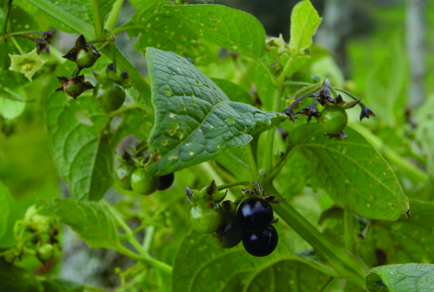
A new species from the state of Veracruz, Mexico, previously identified as Jaltomata bohsiana, is described as Jaltomata veracruzana. This species occurs in the mountain cloud forest of the Sierra de Chiconquiaco. It can be distinguished from its congeners by the combination of a black to blackish calyx when in flower, pubescence sparse, corolla with light-purple veins, green pedicels, and ovate-deltoid leaves with sinuate to sinuate-toothed margins, acute apex, and attenuated-truncated base. A preliminary conservation assessment is provided for this new species based on IUCN Red List guidelines. We provide a detailed comparison of this new species with all Jaltomata species distributed in Mexico, including a full description, illustrations, taxonomic notes, comparative table, and an identification key for the genus in Mexico.
References
- Bachman, S., Moat, J., Hill, A.W., De La Torre, J. & Scott, B. (2011) Supporting Red List threat assessments with GeoCAT: geospatial conservation assessment tool. ZooKeys 150: 117–126. https://doi.org/10.3897/zookeys.150.2109
- Bitter, F.A.G. (1922) Saracha chihuahuensis. Repertorium Specierum Novarum Regni Vegetabilis 18 (507/512): 108–110. https://doi.org/10.1002/fedr.19220180406
- Catalogue of Life Annual Checklist. (2025) Jaltomata procumbens. Amsterdam, The Netherlands. Available from: http://catalogueoflife.org (accessed 10 April 2025)
- CONABIO [Comisión Nacional para el Conocimiento y Uso de la Biodiversidad] (2020) Ecosistemas de México. Available from: https://www.biodiversidad.gob.mx/media/1/ecosistemas/files/EcosistemasMx_extensionDistribucion.pdf (accessed 10 March 2025)
- Cuevas-Reyes, L. (2018) Taxonomía de la familia Solanaceae en el municipio de Coacoatzintla, Veracruz, México. Bachelor’s Thesis. Universidad Veracruzana, Veracruz, Mexico.
- D’Arcy, W.G. (2001) Solanaceae. In: Stevens, W.D., Ulloa, C., Pool, A., Montiel, O.M. (Eds.) Flora de Nicaragua, Vol 85. Botanical Garden Press, St. Louis: Missouri, pp. 2376–2426.
- D’Arcy, W.G., Mione, T. & Davis, T. (1992) Jaltomata grandiflora (Solanaceae): A rare Mexican species. Novon 2 (3): 190–192. https://doi.org/10.2307/3391545
- Davis, T. (1980) The generic relationship of Saracha and Jaltomata (Solanaceae; Solaneae). Rhodora 82: 345–352.
- Davis, T. (1986) Jaltomata in the Tarahumara Indian region of northern Mexico. In: D’Arcy, W.G. (Ed.) Solanaceae Biology and Systematics. Columbia University Press, New York: USA, pp. 405–411.
- Davis, T. & Bye, R.A. (1982) Ethnobotany and progressive domestication of Jaltomata (Solanaceae) in Mexico and Central America. Economic Botany 36: 225–241. https://doi.org/10.1007/BF02858722
- De Candolle, P.P.A.L. (1852) Prodromus Systematis Naturalis Regni Vegetabilis (Prodr). Sumptubu Victoris Masson, Paris: France, 468 pp.
- Dunal, M.F. (1852) Solanaceae. In: De Candolle, P.P.A.L. (Ed.) Prodromus Systematis Naturalis Regni Vegetabilis (Prodr). pp. 431.
- Gentry, J.L. (1973) Jaltomata procumbens. Phytologia 27: 287.
- Gentry, J.L. & Standley, P.C. (1974) Flora of Guatemala. Fieldiana Botany 24, Pt X, (1 and 2): 42. https://doi.org/10.5962/bhl.title.2421
- Hunziker, A.T. (1977) Jaltomata repandidentata. Kurtziana 10: 8.
- Hunziker, A.T. (2001) Genera Solanacearum. A.R.G. Ganther Verlag K.G. Königstein: Germany, 516 pp.
- IUCN. (2024) Guidelines for Using the IUCN Red List Categories and Criteria. Version 16. Prepared by the Standards and Petitions Subcommittee. Available from: https://www.iucnredlist.org/resources/redlistguidelines (accessed 8 April 2025)
- JSTOR Global Plants. (2024) JSTOR Global Plants, Jstore, Ithaka. Available from: http://plants.jstor.org/ (accessed 20 December 2024)
- Leiva, G.S., Mione, T. & Yacher, L. (2017) El género Jaltomata Schltdl. (Solanaceae) en la región La Libertad y un nuevo taxón del Norte de Perú. Arnaldoa 24: 119–206. https://doi.org/10.22497/arnaldoa.241.24106
- Leiva, G.S., Mione, T., Yacher, L. & Rosario, J.B. (2019) Jaltomata andagarae (Solanaceae) una nueva especie del Norte del Perú. Arnaldoa 26: 473–484. https://doi.org/10.22497/arnaldoa.262.26201
- Linnaeus, C. (1753) Species Plantarum. Vol 1. Laurentius Salvius, Stockholm: Sweden, 560 pp.
- Martínez, M., Vargas-Ponce, O., Rodríguez, A., Chiang, F. & Ocegueda, S. (2017) Solanaceae family in Mexico. Botanical Sciences 95: 131–145. https://doi.org/10.17129/botsci.658
- Martínez-Flores, M.M., Burgos-Hernández, M., Sánchez, D. & Vázquez-Sánchez, M. (2024) Leaf morphological variation of Jaltomata (Solanoideae: Solanaceae) in Mexico. Genetic Resources and Crop Evolution 72: 201–215. https://doi.org/10.1007/s10722-024-01975-8
- Miers, J. (1849a) Saracha glabrata. Annals and Magazine of Natural History, ser. 2 3: 449.
- Miers, J. (1849b) Saracha conspersa. Annals and Magazine of Natural History, ser. 2 3: 448.
- Miller, R.J., Mione, T., La Phan, H. & Olmstead, R. (2011) Color by numbers: nuclear gene phylogeny of Jaltomata (Solanaceae), sister genus to Solanum, supports three clades differing in fruit color. Systematic Botany 36: 153–162. https://doi.org/10.1600/036364411X553243
- Mione, T. (1992) Systematics and evolution of Jaltomata (Solanaceae). PhD Thesis, University of Connecticut, Storrs, Connecticut: USA.
- Mione, T. (2023) Jaltomata. In: Flora of North America Editorial Committee (Eds.) Flora of North America. Vol. 14. Oxford University Press, New York and Oxford: USA, 386 pp.
- Mione, T. (2025) Saracha conspersa. Jaltomata website. Central Connecticut State University. Available from: https://sites.ccsu.edu/faculty/mione/conspersa.htm (accessed 15 March 2025)
- Mione, T. & Bye, R. (1996) Jaltomata chihuahuensis (Solanaceae): A new combination and observations on ecology and ethnobotany. Novon 6: 78–81. https://doi.org/10.2307/3392216
- Mione, T. & I.A. Diaz. (2020) Dracula’s mistress: removal of blood-red floral nectar results in secretion of more nectar. Plant Ecology and Evolution 153: 59–66. https://doi.org/10.5091/plecevo.2020.1589
- Mione, T. & Dow, J.P. (2023) Floral nectar production of Jaltomata grandiflora, a rare Mexican Nightshade. Journal of Biology and Nature 15: 28–31. https://doi.org/10.56557/joban/2023/v15i28263
- Mione, T. & Spooner, D.M. (2010) Jaltomata bohsiana: A new species and key to the Jaltomata (Solanaceae) of Mexico. Novon 20: 186–189. https://doi.org/10.3417/2009025
- Mione, T. & Yacher, L.I. (2005) Jaltomata (Solanaceae) of Costa Rica. In: Keating, R.C., Hollowell, V.C., Croat, T.B. (Eds.) A Festschrift for William G. D’Arcy, The Legacy of a Taxonomist. Monographs in Systematic Botany from the Missouri Botanical Garden, volume 104. pp. 117–130.
- Mione, T., Olmstead, R.C., Jansen, R.K. & Anderson, G.J. (1994) Systematic implications of chloroplast DNA variation in Jaltomata and selected physaloid genera (Solanaceae). American Journal of Botany 81: 912–918. https://doi.org/10.1002/j.1537-2197.1994.tb15572.x
- Mione, T., Wilson, P.R., Kudewicz, J.E. & Chakraborty, S. (2023) Delayed self-fertilization and chemical analysis of floral nectar of a perennial relative of the tomato and potato from Mexico. Botany 101: 155–163. https://doi.org/10.1139/cjb-2022-0106
- Mione, T., Taylor, D.W., Kulakowski, K., Wilson, P.R. & Anderson, G.J. (2024) Within flower anther polymorphism and the floral biology of Jaltomata antillana (Solanaceae) of the Greater Antilles. Plant Biosystems—An International Journal Dealing with all Aspects of Plant Biology 158: 1182–1191. https://doi.org/10.1080/11263504.2024.2395847
- Morton, C.V. (1938) Saracha. Proceedings of the Biological Society of Washington 51: 77.
- Motti, R. (2021) The Solanaceae family: Botanical features and diversity. In: Carputo, D., Aversano, R., Ercolano, M.R. (Eds.) The Wild Solanums Genomes. Springer, Cham: Switzerland, pp. 1–9. https://doi.org/10.1007/978-3-030-30343-3_1
- Nee, M. (1986) Jaltomata. Solanaceae I. Part. II. Flora de Veracruz 49: 76–82.
- Olmstead, R., Bohs, L., Migid, H., Santiago-Valentin, E., Garcia, V. & Collier, S. (2008) Molecular phylogeny of the Solanaceae. Taxon 57: 1159–1181. https://doi.org/10.1002/tax.574010
- Partida-Sedas, S. (2017) Análisis de la reducción estructural del bosque mesófilo de montaña en Huatusco, Veracruz, México. AgroProductividad 10: 66–72.
- PBI Solanum Project. (2025) Solanaceae Source. Available from: http://www.solanaceaesource.org/ (accessed 17 April 2025)
- Peláez, E., Cuevas, R., Santiago-Pérez, A. & Rodríguez-Gómez, J. (2014) Ecología y manejo de los bosques mesófilos de montaña en México. In: Gual-Díaz, M., Redón-Correa, A. (Comp.) Bosques mesófilos de montaña de México: diversidad, ecología y manejo. Consejo Nacional para el Conocimiento y Uso de la Biodiversidad, Mexico, pp. 141–187.
- Polsgrove, R., Mione, T. & Anderson, G.J. (1993) Heteranthery and post-anthesis filament elongation: the floral biology of Jaltomata repandidentata (Solanaceae). American Journal of Botany 80: 171.
- POWO (2025) Plants of the World Online. Facilitated by the Royal Botanic Gardens, Kew. Available from: https://powo.science.kew.org/ (accessed 13 February 2025)
- QGIS Development Team. (2023) QGIS Geographic Information System. Open source Geoespatial Foundation Project. Available from: http://qgis.org (accessed 2 May 2025)
- Red de Herbarios Mexicanos (2025) Red de Herbarios Mexicanos, Red de Portales SEINet. Available from: https://herbanwmex.net/portal/ (accessed 20 January 2025)
- Ruíz, L.H. & Pavón, J.A. (1794) Saracha. Florae Peruvianae, et Chilensis Prodromus 31.
- Rzedowski, J. (2020) Jaltomata Schltdl. Solanaceae I. Flora del Bajío y de regiones adyacentes 218: 82–95.
- Sánchez-Ramos, G. & Dirzo, R. (2014) El bosque mesófilo de montaña: un ecosistema prioritario amenazado. In: Gual-Díaz, M., Redón-Correa, A. (Comp.) Bosques mesófilos de montaña de México: diversidad, ecología y manejo. Comisión Nacional para el Conocimiento y Uso de la Biodiversidad, México, pp. 109–140.
- Särkinen, T., Bohs, L., Olmstead, R.G. & Knapp, S. (2013) A phylogenetic framework study of the nightshades (Solanaceae): a dated 1000-tip tree. BMC Evolutionary Biology 13: 2–15. https://doi.org/10.1186/1471-2148-13-214
- Schlechtendal, D.F.L. von. (1838) Jaltomata. Index Seminum [Halle] 8.
- Taylor, J. & Mione, T. (2019) Collection of Jaltomata darcyana (Solanaceae), previously unrecorded in cultivation, from a home garden in Chicago, IL. Renewable Agriculture and Food Systems 35: 490–92. https://doi.org/10.1017/S1742170519000127
- Thiers, B. (2025) [Continuously updated] Index Herbariorum: a global directory of public herbaria and associated staff. New York Botanical Garden’s Virtual Herbarium. Available from: http://sweetgum.nybg.org/science/ih/ (accessed 10 May 2025)
- Vega, I. (2024) Ethnobotany of Jaltomata (Solanaceae). Master’s Thesis. Central Connecticut State University, New Britain, Connecticut: USA.
- Villaseñor, J.L. (2016) Checklist of the native vascular plants of Mexico. Revista Mexicana de Biodiversidad 87: 559–902. https://doi.org/10.1016/j.rmb.2016.06.017
- Weese, T.L. & Bohs, L. (2007) A three-gene phylogeny of the genus Solanum (Solanaceae). Systematic Botany 32: 445–463. https://doi.org/10.1600/036364407781179671
- WFO (2025) World Flora Online. Available from: http://www.worldfloraonline.org (accessed 30 March 2025)
- Williams, D.E. (1985) Tres arvenses solanáceas comestibles y su proceso de domesticación en el estado de Tlaxcala, México. Master’s Thesis. Colegio de Posgraduados, Texcoco: Mexico.
- Williams-Linera, G. (2007) El bosque de niebla del centro de Veracruz: ecología, historia y destino en tiempos de fragmentación y cambio climático. Instituto de Ecología A.C., Comisión Nacional para el Conocimiento y Uso de la Biodiversidad, Xalapa, Veracruz: Mexico, 204 pp.
- Zhang, J., Stevens, P.F. & Zhang, W. (2017) Evolution of floral zygomorphy in androecium and corolla in Solanaceae. Journal of Systematics and Evolution 55: 581–590. https://doi.org/10.1111/jse.12275