
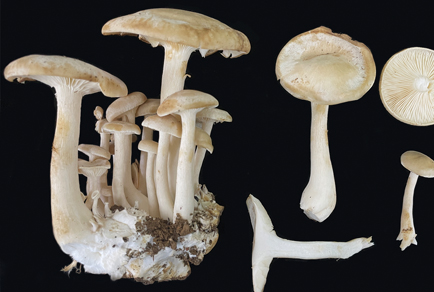

Abstract
A new species of Lyophyllum (Basidiomycota, Agaricomycetes), Lyophyllum aurantiacum sp. nov., is introduced based on morphological characters and multi-gene phylogenetic analysis. Lyophyllum aurantiacum has large basidiomata, grayish-orange pileus, lamellae decurrent, a cylindrical stipe that slightly enlarges towards the base, unchanging in colour when injured, globose to subglobose basidiospores, abundant clamp connections in pileus context, hymenophoral trama and stipe context. Phylogenetic analyses based on internal transcribed spacer (ITS) and nuclear large subunit (nrLSU) sequences confirmed this species as a novel taxon within Lyophyllum. This discovery updates the knowledge of edible fungi in southwestern China.
References
- Avise, J.C. & Robinson, T.J. (2008) Hemiplasy: a new term in the lexicon of phylogenetics. Systematic biology 57 (3): 503–507. https://doi.org/10.1080/10635150802164587
- Bas, C. (Ed.) (1990) Flora agaricina neerlandica (Vol. 2). CRC Press.
- Crous, P.W., Osieck, E.R., Shivas, R.G., Tan, Y.P., Bishop-Hurley, S.L., Esteve-Raventós, F., Larsson, E., Luangsa-ard, J.J., Pancorbo, F., Balashov, S., Baseia, I.G., Boekhout, T., Chandranayaka, S., Cowan, D.A., Cruz, R.H.S.F., Czachura, P., De la Peña-Lastra, S., Dovana, F., Drury, B., Fell, J., Flakus, A., Fotedar, R., Jurjević, Ž., Kolecka, A., Mack, J., Maggs-Kölling, G., Mahadevakumar, S., Mateos, A., Mongkolsamrit, S., Noisripoom, W., Plaza, M., Overy, D.P., Pitek, M., Sandoval-Denis, M., Vauras, J., Wingfield, M.J., Abell, S.E., Ahmadpour, A., Akulov, A., Alavi, F., Alavi, Z., Altés, A., Alvarado, P., Anand, G., Ashtekar, N., Assyov, B., Banc-Prandi, G., Barbosa, K.D., Barreto, G.G., Bellanger, J.M., Bezerra, J.L., Bhat, D.J., Bilański, P., Bose, T., Bozok, F., Chaves, J., Costa-Rezende, D.H., Danteswari, C., Darmostuk, V., Delgado, G., Denman, S., Eichmeier, A., Etayo, J., Eyssartier, G., Faulwetter, S., Ganga, K.G.G., Ghosta, Y., Goh, J., Góis, J.S., Gramaje, D., Granit, L., Groenewald, M., Gulden, G., Gusmão, L.F.P., Hammerbacher, A., Heidarian, Z., Hywel-Jones, N., Jankowiak, R., Kaliyaperumal, M., Kaygusuz, O., Kezo, K., Khonsanit, A., Kumar, S., Kuo, C.H., Laessøe, T., Latha, K.P.D., Loizides, M., Luo, S.M., Maciá-Vicente, J.G., Manimohan, P., Marbach, P.A.S., Marinho, P., Marney, T.S., Marques, G., Martín, M.P., Miller, A.N., Mondello, F., Moreno, G., Mufeeda, K.T., Mun, H.Y., Nau, T., Nkomo, T., Okrasińska, A., Oliveira, J.P.A.F., Oliveira, R.L., Ortiz, D.A., Pawłowska, J., Pérez-De-Gregorio, M.`A., Podile, A.R., Portugal, A., Privitera, N., Rajeshkumar, K.C., Rauf, I., Rian, B., Rigueiro-Rodríguez, A., Rivas-Torres, G.F., Rodriguez-Flakus, P., Romero-Gordillo, M., Saar, I., Saba, M., Santos, C.D., Sarma, P.V.S.R.N., Siquier, J.L., Sleiman, S., Spetik, M., Sridhar, K.R., Stryjak-Bogacka, M., Szczepańska, K., Taşikn, H., Tennakoon, D.S., Thanakitpipattana, D., Trovão, J., Türkekul, A., van Iperen, A.L., van 't Hof, P., Vasquez, G., Visagie, C.M., Wingfield, B.D., Wong, P.T.W., Yang, W.X., Yarar, M., Yarden, O., Yilmaz, N., Zhang, N., Zhu, Y.N., Groenewald, J.Z. (2023) Fungal Planet description sheets: 1478–1549. Persoonia-Molecular Phylogeny and Evolution of Fungi 50 (1): 158–310. https://doi.org/10.3767/persoonia.2023.50.05
- Dai, Y.C. & Yang, Z.L. (2008) A revised checklist of medicinal fungi in China. Mycosystema 27 (6): 801–824.
- Feng, Y., Tang, X., Yu, J.F., Yang, Z.F., Ma, M. & Guo, X. (2019) Recent research progress of Lyophyllum. Vegetables 8: 64–69.
- Hall, T. (2007) BioEdit v7. Available from: [http://www.mbio.ncsu.edu/BioEdit/BioEdit.html].
- Hall, T., Biosciences, I. & Carlsbad, C.J.G.B.B. (2011) BioEdit: an important software for molecular biology. GERF bull biosci 2 (1): 60–61.
- Hofstetter, V., Clémençon, H., Vilgalys, R. & Moncalvo, J.M. (2002) Phylogenetic analyses of the Lyophylleae (Agaricales, Basidiomycota) based on nuclear and mitochondrial rDNA sequences. Mycological Research 106 (9): 1043–1059. https://doi.org/10.1017/S095375620200641X
- Hofstetter, V., Redhead, S.A., Kauff, F., Moncalvo, J.M., Matheny, P.B. & Vilgalys, R. (2014) Taxonomic revision and examination of ecological transitions of the Lyophyllaceae (Basidiomycota, Agaricales) based on a multigene phylogeny. Cryptogamie, mycologie 35 (4): 399–425. https://doi.org/10.7872/crym.v35.iss4.2014.399
- Katoh, K. & Standley, D.M. (2013) MAFFT multiple sequence alignment software version 7: improvements in performance and usability. Molecular Biology and Evolution 30 (4): 772–780. https://doi.org/10.1093/molbev/mst010
- Larsson, E. & Sundberg, H. (2011) Lyophyllum shimeji, a species associated with lichen pine forest in northern Fennoscandia. Mycoscience 52 (5): 289–295. https://doi.org/10.1007/S10267-010-0104-1
- Li, S.H., Tang, S.M., He, J. & Zhou, D.Q. (2023) Two new edible Lyophyllum species from Tibetan areas, China. Diversity 15 (9): 1027. https://doi.org/10.3390/d15091027
- Li, X. & Li, Y. (2009) Present status and future prospects of Lyophyllum Karst. China. Acta Edulis Fungi 16 (3): 75–79. https://10.16488/j.cnki.1005-9873.2009.03.018
- Ma, Y., Liu, P., Zhao, Z., Chen, W. & Zhao, Y. (2022) Lyophyllum pallidofumosum sp. nov. (Lyophyllaceae, Agaricales), from southwestern China. Phytotaxa 576 (2): 173–183. https://doi.org/10.11646/phytotaxa.576.2.3
- Miller, M.A., Pfeiffer, W. & Schwartz, T. (2010, November) Creating the CIPRES Science Gateway for inference of large phylogenetic trees. In: 2010 gateway computing environments workshop (GCE). Ieee, pp. 1–8. https://doi.org/10.1109/GCE.2010.5676129
- Moncalvo, J.M., Rehner, S.A. & Vilgalys, R. (1993) Systematics of Lyophyllum section Difformia based on evidence from culture studies and ribosomal DNA sequences. Mycologia 85 (5): 788–794. https://doi.org/10.1080/00275514.1993.12026333
- Nylander, J.A., Ronquist, F., Huelsenbeck, J.P. & Nieves-Aldrey, J. (2004) Bayesian phylogenetic analysis of combined data. Systematic biology 53 (1): 47–67. https://doi.org/10.1080/10635150490264699
- Rannala, B. & Yang, Z. (1996) Probability distribution of molecular evolutionary trees: a new method of phylogenetic inference. Journal of molecular evolution 43: 304–311. https://doi.org/10.1007/BF02338839
- Ronquist, F., Huelsenbeck, J. & Teslenko, M. (2011) Draft MrBayes version 3.2 manual: tutorials and model summaries. 105 pp. [http://brahms.biology.rochester.edu/software.html]
- Ronquist, F., Teslenko, M., van der Mark, P., Ayres, D.L., Darling, A., Höhna, S., Larget, B., Liu, L., Suchard, M.A. & Huelsenbeck, J.P. (2012) MrBayes 3.2: efficient Bayesian phylogenetic inference and model choice across a large model space. Systematic biology 61 (3): 539–542. https://doi.org/10.1093/sysbio/sys029
- Stamatakis, A. (2014) RAxML version 8: a tool for phylogenetic analysis and post-analysis of large phylogenies. Bioinformatics 30 (9): 1312–1313. https://doi.org/10.1093/bioinformatics/btu033
- Sundberg, H. (2010) Phylogeny of Lyophyllum section Difformia-Does hon-shimeji (L. shimeji) occur in Sweden?. Master thesis of Department of Plant and Environmental Sciences.
- Tang, S.M., Yu, F.M., Karunarathna, S.C., Luo, Z.L., Niu, K.Y., Li, R.Y., Li, L., Su, X.J. & Li, S.H. (2025) Morpho-phylogenetic analyses of two novel edible mushrooms from China and a mini review of Lyophyllum (Agaricales, Lyophyllaceae) cultivation and bioactivities. MycoKeys 112: 307–334. https://doi.org/10.3897/mycokeys.112.141615
- Vaidya, G., Lohman, D.J. & Meier, R. (2011) SequenceMatrix: concatenation software for the fast assembly of multi‐gene datasets with character set and codon information. Cladistics 27 (2): 171–180. https://doi.org/10.1111/j.1096-0031.2010.00329.x
- Vilgalys, R. & Hester, M. (1990) Rapid genetic identification and mapping of enzymatically amplified ribosomal DNA from several Cryptococcus species. Journal of bacteriology 172 (8): 4238–4246. https://doi.org/10.1128/jb.172.8.4238-4246.1990
- Wang, T., Han, J.J., Dai, H.Q., Sun, J.Z., Ren, J.W., Wang, W.Z., Qiao, S.S., Liu, C., Sun, L., Liu, S.J., Li, D.P., Wei, S.L. & Liu, H. (2022) Polysaccharides from Lyophyllum decastes reduce obesity by altering gut microbiota and increasing energy expenditure. Carbohydrate polymers 295: 119862. https://doi.org/10.1016/j.carbpol.2022.119862
- Wang, X.Q., Zhou, D.Q., Zhang, X.L. & Li, S.H. (2013) Taxonomic Study on the Genus Lyophyllum in Sustainable Environment Engineering. Applied Mechanics and Materials 340: 975–978. https://doi.org/10.4028/www.scientific.net/AMM.340.975
- White, T.J., Bruns, T., Lee, S.J.W.T. & Taylor, J. (1990) Amplification and direct sequencing of fungal ribosomal RNA genes for phylogenetics. PCR protocols: a guide to methods and applications 18 (1): 315–322.
- Wu, Q., Liang, B., Wang, J. & Dai, Y. (2025) Ultrasound-Assisted Extraction of Polysaccharides from Lyophyllum decastes: Structural Analysis and Bioactivity Assessment. Molecules 30 (4): 961. https://doi.org/10.3390/molecules30040961
- Zhang, Y., Ma, G., Pei, F., Ma, N., Su, A., Hu, Q. & Wang, M. (2024) Evaluation of active components and pharmacological activities by UPLC-Q/TOF-MS and network pharmacology in Lentinula edodes and Lyophyllum decastes. Quality Assurance and Safety of Crops & Foods 16 (4): 99–123. https://doi.org/10.15586/qas.v16i4.1510