
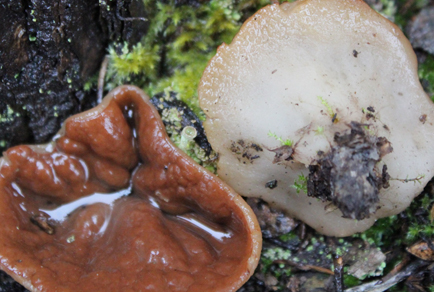

Abstract
Recent molecular studies have significantly reshaped the taxonomy of the family Discinaceae (Pezizales, Ascomycota), leading to the redefinition of several genera, including Discina and the recently described Maublancomyces. Despite these advances, regional records and phylogenetic placements of many taxa remain poorly documented. In this study, we report two new national records from Türkiye: Discina macrospora and Maublancomyces apiculatulus. We combined detailed morphological descriptions with ITS-based phylogenetic analyses to confirm their identity and clarify their systematic positions within Discinaceae. Our results strongly support the distinct generic status of Discina and Maublancomyces, in agreement with recent phylogenetic studies. Phylogenetic trees constructed via maximum likelihood methods revealed high bootstrap support for the monophyly of all major genera within the family, including Discina, Maublancomyces, and Paradiscina, the latter of which we propose should remain within Discinaceae. This study contributes to the mycobiota of Türkiye and provides new molecular data to GenBank, reinforcing the taxonomy of Discina and Maublancomyces.
References
- Abbott, S.P. & Currah, R.S. (1997) The Helvellaceae: systematic revision and occurrence in Northern and Northwestern North America. Mycotaxon 62: 1–125. https://doi.org/10.5962/p.415276
- Breitenbach, J. & Kränzlin, F. (1984) Fungi of Switzerland, Volume 1, Ascomycetes. Verlag Mykologia, Lucerne, 313 pp.
- Dirks, A.C., Methven, A.S., Miller, A.N., Orozco-Quime, M., Maurice, S., Bonito, G., Van Wyk, J., Ahrendt, S., Kuo, A., Andreopoulos, W., Riley, R., Lipzen, A., Chovatia, M., Savage, E., Barry, K., Grigoriev, I.V., Bradshaw, A.J., Martin, F.M., Arnold, A.E. & James, T.Y. (2025) Phylogenomic insights into the taxonomy, ecology, and mating systems of the lorchel family Discinaceae (Pezizales, Ascomycota). Molecular phylogenetics and evolution 205: 108286. https://doi.org/10.1016/j.ympev.2025.108286
- Donadini, J.C. (1986) Le genre Discina (Gyromitra) (2). Les espèces connues. Variabilité des caractères taxonomiques. Scanning (Ascomycètes, Pezizales). Bulletin de la Société linnéenne de Provence 38: 161–187.
- Felsenstein, J. (1985) Confidence limits on phylogenies: An approach using the bootstrap. Evolution 39: 783–791. https://doi.org/10.1111/j.1558-5646.1985.tb00420.x
- Fries, E.M. (1821) Systema Mycologicum. Ex officina Berlingiana, Lund, Sweden. [Google Scholar]
- Fries, E.M. (1849) Summa Vegetabilium Scandinaviae Sectio Posterior; Holmiae & Lipsiae. Uppsala, Sweden, 572 pp. [Google Scholar]
- Hansen, L. & Knudsen, H. (2000) Nordic Macromycetes (Ascomycetes). Nordsvamp, Copenhagen, 270 pp. [Google Scholar]
- Harmaja, H. (1969) A wider and more natural concept of the genus Gyromitra Fr. Karstenia 9: 9–12. https://doi.org/10.29203/ka.1969.53
- Herter, W.G. (1951) Neogyromitra und Maublancomyces, zwei wenig bekannte Morchel-Gattungen. Revista Sudamericana de Botánica 10 (1): 13–24.
- Lukács, Z. (2007) A Gyromitra Nemzetség Értelmezése Napjaınkban. Mikológiai Közlemények - Clusiana 46 (2): 165–186.
- McKnight, K.H. (1969) A note on Discina. Mycologia 61 (3): 614–630. https://doi.org/10.1080/00275514.1969.12018775
- Medardi, G. (2006) Atlante fotografico degli Ascomiceti d’Italia. Rafica Sette, Bagnolo mella, Brescia, Italia, 454 pp.
- Moser, M. (1953) Bemerkungen zur Morphologie der Sporen von Maublancomyces Herter und Fr. Revista Sudamericana de Botánica X (6): 189–194.
- Saitou, N. & Nei, M. (1987) The neighbor-joining method: A new method for reconstructing phylogenetic trees. Molecular Biology and Evolution 4: 406–425.
- Tamura, K., Nei, M. & Kumar, S. (2004) Prospects for inferring very large phylogenies by using the neighbor-joining method. Proceedings of the National Academy of Sciences (USA) 101: 11030–11035. [Google Scholar] https://doi.org/10.1073/pnas.0404206101
- Tamura, K., Stecher, G. & Kumar, S. (2021) MEGA 11: Molecular Evolutionary Genetics Analysis Version 11. Molecular Biology and Evolution 38 (7): 3022–3027. https://doi.org/10.1093/molbev/msab120
- Thompson, J.D., Higgins, D.G. & Gibson, T.J. (1994) Clustal W: improving the sensitivity of progressive multiple sequence alignment through sequence weighting, position-specific gap penalties and weight matrix choice. Nucleic Acids Research 22: 4673–4680. [Google Scholar] https://doi.org/10.1093/nar/22.22.4673
- Van Vooren, N. & Moreau, P.A. (2009) Essai taxinomique sur le genre Gyromitra Fr. sensu lato (Pezizales). Le genre Gyromitra Fr., sous-genre. Ascomycete.org 1 (2): 3–13. [Google Scholar]
- Wang, X.-C., Yang, Z.-L., Chen, S.-L., Bau, T., Li, T.-H., Li, L., Fan, L. & Zhuang, W.-Y. (2023) Phylogeny and taxonomic revision of the family Discinaceae (Pezizales, Ascomycota). Microbiology Spectrum 11: e00207-23. https://doi.org/10.1128/spectrum.00207-23