
Abstract
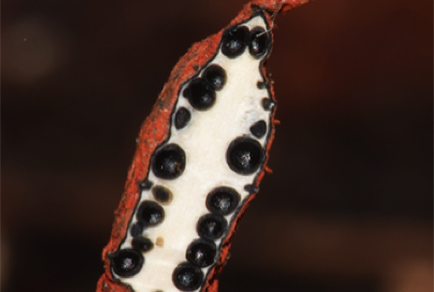
Species of Xylaria are cosmopolitan, endophytic, or saprophytic fungi. This study describes Xylaria sanmartinii, a new species widely distributed in the Mexican tropical montane cloud forest. The macromorphological characteristics of the specimens were analyzed in fresh and dry states, and photographs were taken in situ. Micromorphological characters were revised using an optical microscope. Molecular analysis was undertaken using the internal transcribed spacer (ITS), ß-tubulin (TUB), and the second-largest subunit of the RNA polymerase II gene (rpb2) regions. The specimens studied were deposited in the ENCB herbarium of the Instituto Politécnico Nacional. Xylaria sanmartinii is characterized by red to orange-reddish, red brick stromata and large ascospores, visible during the rainy season and growing on dead wood.
References
- Becerril-Navarrete, A.M., Gómez-Reyes, V.M., Palestina, E.N. & Medel-Ortiz, R. (2018) Nuevos registros de Xylaria (Xylariaceae) para el estado de Michoacán, México. Scientia Fungorum 48: 61–75. https://doi.org/10.33885/sf.2018.48.1199
- Cañón, E., de Albuquerque, M.P., Alves, R.P., Pereira, A.B. & Victoria, F.C. (2019) Morphological and molecular characterization of three endolichenic isolates of Xylaria (Xylariaceae), from Cladonia curta Ahti & Marcelli (Cladoniaceae). Plants 8 (10): 399. https://doi.org/10.3390/plants8100399
- Chacón, S. & González, D. (2019) A new species of penzigioid Xylaria (Xylariaceae) from the cloud forest in eastern México revealed through morphological and phylogenetic analyses. Botany 97 (7): 381–389. https://doi.org/10.1139/cjb-2019-0043
- Espada, A., Rivera-Sagredo, A., De La Fuente, J.M., Hueso-Rodríguez, J.A. & Elson, S.W. (1997) New cytochalasins from the fungus Xylaria hypoxylon. Tetrahedron 53: 6485–6492.
- Fournier, J., Román, A., Balda, J. & Rubio, E. (2014) Xylaria violaceorosea sp. nov. (Xylariaceae), a distinctive species discovered in Spain. Ascomycete.org 6 (2): 35–39.
- Frandsen, P.B., Calcott, B., Mayer, C. & Lanfear, R. (2015) Automatic selection of partitioning schemes for phylogenetic analyses using iterative k-means clustering of site rates. BMC Evolutionary Biology 15: 1–17. https://doi.org/10.1186/s12862-015-0283-7
- Huelsenbeck, J.P. & Ronquist, F. (2001) MrBayes: Bayesian inference of phylogeny. Bioinformatics 17 (8): 754–755. https://doi.org/10.1093/bioinformatics/17.8.754
- Katoh, K. & Standley, D.M. (2013) MAFFT multiple sequence alignment software version 7: improvements in performance and usability. Molecular Biology and Evolution 30 (4): 772–780. https://doi.org/10.1093/molbev/mst010
- Katoh, K., Misawa, K., Kuma, K. & Miyata, T. (2002) MAFFT: a novel method for rapid multiple sequence alignment based on fast Fourier transform. Nucleic Acids Research 30 (14): 3059–3066. https://doi.org/10.1093/nar/gkf436
- Katoh, K., Rozewicki, J. & Yamada, K.D. (2017) MAFFT online service: multiple sequence alignment, interactive sequence choice and visualization. Briefings in Bioinformatics 20 (4): 1160–1166. https://doi.org/10.1093/bib/bbx108
- Kirk, P.M., Cannon, P.F., Minter, D.W. & Stalpers, J.A. (2008) Ainsworth & Bisby’s Dictionary of the Fungi. 10th edition. CAB International, Cromwell Press, Wallingford, USA, 784 pp. https://doi.org/10.1079/9780851998268.0000
- Kornerup, A. & Wanscher, J.H. (1978) Methuen Handbook of Colour. 3rd ed. Eyre Methuen, London, 252 pp.
- Lanfear, R., Calcott, B., Kainer, D., Mayer, C. & Stamatakis, A. (2014) Selecting optimal partitioning schemes for phylogenomic datasets. BMC Evolutionary Biology 14: 1–14. https://doi.org/10.1186/1471-2148-14-82
- Lanfear, R., Frandsen, P.B., Wright, A.M., Senfeld, T. & Calcott, B. (2017) PartitionFinder 2: new methods for selecting partitioned models of evolution for molecular and morphological phylogenetic analyses. Molecular Biology and Evolution 34 (3): 772–773.
- López, A. & García, J. (2017a) Xylocoremium flabelliforme. Funga Veracruzana 149: 1–4.
- López, A. & García, J. (2017b) Guía ilustrada de los hongos del Parque El Haya, Xalapa, Veracruz, México. I. Funga Veracruzana 157: 1–6.
- López, A. & García, J. (2018a) Guía ilustrada de los hongos del Parque El Haya, Xalapa, Veracruz, México. II. Funga Veracruzana 158: 1–6.
- López, A. & García, J. (2018b) Guía ilustrada de los hongos del Parque El Haya, Xalapa, Veracruz, México. III. Funga Veracruzana 159: 1–6.
- López, A. & García, J. (2018c) Guía ilustrada de los hongos del Parque El Haya, Xalapa, Veracruz, México. IV. Funga Veracruzana 160: 1–6.
- Ma, H.X., Vasilyeva, M. & Li, Y. (2013) Xylaria in southern China—8. Xylaria bannaensis sp. nov. and X. brunneovinosa new to the mainland. Mycotaxon 125: 251–256. https://doi.org/10.5248/125.251
- Martínez-González, C.R., Ramírez-Mendoza, R., Jiménez-Ramírez, J., Gallegos-Vázquez, C. & Luna-Vega, I. (2017) Improved method for genomic DNA extraction for Opuntia Mill. (Cactaceae). Plant Methods 13: 1–10. https://doi.org/10.1186/s13007-017-0234-y
- Medel, R., Castillo, R. & Guzmán, G. (2008) Las especies de Xylaria (Ascomycota, Xylariaceae) conocidas de Veracruz, México y discusión de nuevos registros. Revista Mexicana de Micología 28: 101–118.
- Medel, R., Castillo, R. & Guzmán, G. (2010) Adiciones al conocimiento de Xylaria (Ascomycota, Xylariales) en México. Revista Mexicana de Micología 31: 9–18.
- Müller, K., Quandt, D., Müller, J. & Neinhuis, C. (2005) PhyDE®-Phylogenetic data editor. Program distributed by the authors, version 10.0. Available from: https://www.phyde.de (accessed 16 February 2022)
- Osorio-Navarro, Y.S., Valenzuela, R., Bautista-Hernández, S., Mendoza-González, A.C., Mateo-Cid, L.E. & Raymundo, T. (2022) El género Xylaria (Xylariaceae, Ascomycota) en el bosque tropical caducifolio de México. Acta Botanica Mexicana 129: 1–29. https://doi.org/10.21829/abm129.2022.2025
- Rambaut, A., Suchard, M.A., Xie, D. & Drummond, A.J. (2014) Tracer v1.6. Available from: http://beast.bio.ed.ac.uk/Tracer (accessed 16 February 2022)
- Raymundo, T., Soto-Agudelo, R., Hernández, S.B., Morales-Campos, A. & Valenzuela, R. (2016) Catálogo de los ascomicetos del bosque mesófilo de montaña de Tlanchinol, Hidalgo (México). Boletín de la Sociedad Micológica de Madrid 40: 83–108.
- Raymundo, T., Valenzuela, R., García-Martínez, Y., Bravo-Álvarez, M.A., Ramírez-Martínez, J.C., Bautista-Hernández, S., Palacios-Pacheco, M. & Luna-Vega, I. (2019) Ascomycetes (Fungi) from the relic forest of Fagus grandifolia subsp. mexicana in eastern México. Phytotaxa 418 (1): 1–41. https://doi.org/10.11646/phytotaxa.418.1.1
- Rubio, E., Castro Marcote, J.M. & Costa, M.A. (2016) Nuevas aportaciones al conocimiento de Xylaria crozonensis (Ascomycota, Xylariaceae). Ascomycete.org 8 (2): 73–76. https://doi.org/10.25664/art-0173
- San Martín, F. & Rogers, J.D. (1989) A preliminary account of Xylaria of México. Mycotaxon 34: 283–373.
- San Martín, F. & Rogers, J.D. (2005) Distribución de hospederos de Xylariaceae, Hymenoascomycetes. In: Sánchez-Ramos, G., Reyes-Castillo, P. & Dirzo, R. (Eds.) Historia Natural de la Reserva de la Biosfera El Cielo, Tamaulipas, México. Universidad Autónoma de Tamaulipas, México, pp. 292–311.
- Sánchez Flores, M., Valenzuela, R., Hernández-Muñoz, M.A., García Jiménez, J., Martínez-Pineda, M. & Raymundo, T. (2020) Ascomicetos del bosque mesófilo de montaña de Honey, Puebla de los Ángeles, México. Acta Botanica Mexicana 127: e1719. https://doi.org/10.21829/abm127.2020.1719
- Singh, S.B., Zink, D., Polishook, J., Valentino, D., Shafiee, A., Silverman, K., Felock, P., Teran, A., Vilella, D., Hazuda, D.J. & Lingham, R.B. (1999) Structure and absolute stereochemistry of HIV-1 integrase inhibitor integric acid. A novel eremophilane sesquistepenoid produced by a Xylaria sp. Tetrahedron Letters 40: 8775–8779.
- Stamatakis, A. (2014) RAxML version 8: a tool for phylogenetic analysis and post-analysis of large phylogenies. Bioinformatics 30: 1312–1313. https://doi.org/10.1093/bioinformatics/btu033
- Starbäck, K. (1991) Ascomycetsn der Ersten Regnellschen Expedition II. Bihang til Kongliga Svenska Vetenskaps-akademiens Hand-lingar 3: 1–26.
- Ulloa, M. & Hanlin, R.T. (2012) Illustrated Dictionary of Mycology. 2nd ed. APS Press, St. Paul, Minnesota, USA, 762 pp.
- Zhang, Z., Schwartz, S., Wagner, L. & Miller, W. (2000) A greedy algorithm for aligning DNA sequences. Journal of Computational Biology 7: 203–214.