

Abstract
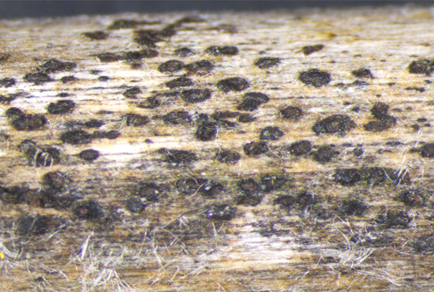
During a survey of the fungal diversity associated with the primary bamboo species consumed by giant pandas in Gansu Province, China, a unique new species, Triseptatospora fargesia, was discovered. The morphological characteristics of this species include: ascomata that are scattered to gregarious and raised above the surface. Asci that are broadly clavate with short pedicels. Ascospores that are fusiform, 3-septate, and guttulate. These morphological features are similar to the sexual morph characteristics of the genus Triseptatospora. In this study, a phylogenetic analysis was conducted based on the sequence data of the large subunit ribosomal RNA gene (LSU), small subunit ribosomal RNA gene (SSU), and translation elongation factor 1-alpha (tef1-α). The results showed that T. fargesia forms a sister lineage with T. calami within the genus Triseptatospora and represents a distinct species. Morpho-phylogenetic evidence reveals significant differences between Triseptatospora fargesia and Triseptatospora calami. This paper also provides information on the phylogenetic placement and detailed morphological description of this new species.
References
- Brahmanage, R.S., Dayarathne, M.C., Wanasinghe, D.N., Thambugala, K.M., Jeewon, R., Chethana, K.W.T., Samarakoon, M.C., Tennakoon, D.S., De Silva, N.I., Camporesi, E., Raza, M., Yan, J.Y. & Hyde, K.D. (2020) Taxonomic novelties of saprobic Pleosporales from selected dicotyledons and grasses. Mycosphere 11: 2481–2541. https://doi.org/10.5943/mycosphere/11/1/15
- Dai, D.Q., Bhat, D.J., Liu, J.K., Chukeatirote, E., Zhao, R.L. & Hyde, K.D. (2012) Bambusicola, a new genus from bamboo with asexual and sexual morphs. Cryptogamie Mycologie 33: 363–379. https://doi.org/10.7872/crym.v33.iss3.2012.363
- Dai, D.Q., Phookamsak, R., Wijayawardene, N.N., Li, W.J., Bhat, D.J., Xu, J.C., Taylor, J.E., Hyde, K.D. & Chukeatirote, E. (2017) Bambusicolous fungi. Fungal Diversity 82: 1–105. https://doi.org/10.1007/s13225-016-0367-8
- Dai, D.Q., Tang, L.Z. & Wang, H.B. (2018) A review of bambusicolous ascomycetes. Bamboo: Current and future prospects pp. 165. https://doi.org/10.5772/intechopen.76463
- Farr, D.F. & Rossman, A.Y. (2025) Fungal Databases, U.S. National Fungus Collections, ARS, USDA. Available from: https://nt.ars-grin.gov/fungaldatabases/ (accessed 18 May 2025)
- Hall, T.A. (1999) BioEdit: a user-friendly biological sequence alignment editor and analysis program for windows 95/98/NT. Nuclc Acids Symposium Series 41: 95–98. https://doi.org/10.14601/phytopathol_mediterr-14998u1.29
- Hyde, K.D., Zhou, D.Q. & Dalisay, T.E. (2002) Bambusicolous fungi: A review. Fungal diversity 9: 1–14.
- Jiang, H.B., Phookamsak, R., Hongsanan, S., Bhat, D.J., Mortimer, P.E., Suwannarach, N., Kakumyan, P. & Xu, J.C. (2022) A review of bambusicolous Ascomycota in China with an emphasis on species richness in southwest China. Studies in Fungi 7: 20. https://doi.org/10.48130/SIF-2022-0020
- Katoh, K., Rozewicki, J. & Yamada, K.D. (2019) MAFFT online service: multiple sequence alignment, interactive sequence choice and visualization. Briefings in Bioinformatics 20: 1160–1166. https://doi.org/10.1093/bib/bbx108
- Konta, S., Tibpromma, S., Karunarathna, S.C., Samarakoon, M.C., Steven, L.S., Mapook, A., Boonmee, S., Senwanna, C., Balasuriya, A., Eungwanichayapant, P.D. & Hyde, K.D. (2023) Morphology and multigene phylogeny reveal ten novel taxa in Ascomycota from terrestrial palm substrates (Arecaceae) in Thailand. Mycosphere 14: 107–152. https://doi.org/10.5943/mycosphere/14/1/2
- Liu, J.K., Hyde, K.D., Jones, E.B.G., Ariyawansa, H.A., Bhat, D.J., Boonmee, S., Maharachchikumbura, S.S.N., McKenzie, E.H.C., Phookamsak, R., Phukhamsakda, C., Shenoy, B.D., Abdel-Wahab, M.A., Buyck, B., Chen, J., Chethana, K.W.T., Singtripop, C., Dai, D.Q., Dai, Y.C., Daranagama, D.A., Dissanayake, A.J., Doilom, M., D’souza, M.J., Fan, X.L., Goonasekara, I.D., Hirayama, K., Hongsanan, S., Jayasiri, S.C., Jayawardena, R.S., Karunarathna, S.C., Li, W.J., Mapook, A., Norphanphoun, C., Pang, K.L., Perera, R.h., Peršoh, D., Pinruan, U., Senanayake, I.C., Somrithipol, S., Suetrong, S., Tanaka, K., Thambugala, K.M., Tian, Q., Tibpromma, S., Udayanga, D., Wijayawardene, N.N., Wanasinghe, D., Wisitrassameewong, K., Zeng, X.Y., Abdel-Aziz, F.A., Adamčík, S., Bahkali, A.H., Boonyuen, N., Bulgakov, T., Callac, P., Chomnunti, P., Greiner, K., Hashimoto, A., Hofstetter, V., Kang, J.C., Lewis, D., Li, X.H., Liu, X.Z., Liu, Z.Y., Matsumura, M., Mortimer, P.E., Rambold, G., Randrianjohany, E., Sato, G., Sri-Indrasutdhi, V., Tian, C.M., Verbeken, A., von Brackel, W., Wang, Y., Wen, T.C., Xu, J.C., Yan, J.Y., Zhao, R.L. & Camporesi, E. (2015) Fungal diversity notes 1–110: taxonomic and phylogenetic contributions to fungal species. Fungal Diversity 72: 1–197. https://doi.org/10.1007/s13225-015-0324-y
- Maddison, W.P. & Maddison, D.R. (2019) Mesquite: A modular system for evolutionary analysis, Version 3.61. [https://www.mesquiteproject.org/]
- Maharachchikumbura, S.S.N., Hyde, K.D., Jones, E.B.G., McKenzie, E.H.C., Huang, S.K., Abdel-Wahab, M.A., Daranagama, D.A., Dayarathne, M., D’souza, M.J., Goonasekara, I.D., Hongsanan, S., Jayawardena, R.S., Kirk, P.M., Konta, S., Liu, J.K., Liu, Z.Y., Norphanphoun, C., Pang, K.L., Perera, R.H., Senanayake, I.C., Shang, Q.J., Shenoy, B.D., Xiao, Y.P., Bahkali, A.H., Kang, J.C., Somrothipol, S., Suetrong, S. & Wen, T.C. (2015) Towards a natural classification and backbone tree for Sordariomycetes. Fungal Diversity 72: 199–301. https://doi.org/10.1007/s13225-015-0331-z
- Miller, M.A., Pfeiffer, W.T. & Schwartz, T. (2010) Creating the CIPRES science gateway for inference of large phylogenetic tree, in Proceedings of the Gateway Computing Environments Workshop (GCE), 14 November 2010, New Orleans: pp. 1–8. https://doi.org/10.1109/GCE.20
- Monkai, J., Wanasinghe, D.N., Jeewon, R., Promputtha, I. & Phookamsak, R. (2021) Morphological and phylogenetic characterization of fungi within Bambusicolaceae: introducing two new species from the Greater Mekong Subregion. Mycological Progress 20: 721–732. https://doi.org/10.1007/s11557-021-01694-9
- Nylander, J.A.A., Wilgenbusch, J.C., Warren, D.L. & Swofford, D.L. (2008) AWTY: A system for graphical exploration of MCMC convergence in Bayesian phylogenetics. Bioinformatics 24: 581–583. https://doi.org/10.1093/bioinformatics/btm388
- Pearce, C.A., Reddell, P. & Hyde, K.D. (2000) A member of the Phyllachora shiraiana complex (Ascomycota) on Bambusa arnhemica: a new record for Australia. Australasian Plant Pathology 29: 205–210. https://doi.org/10.1071/AP00036
- Phookamsak, R., Norphanphoun, C., Tanaka, K., Dai, D.Q., Luo, Z.L., Liu, J.K., Su, H.Y., Bhat, D.J., Bahkali, A.H., Mortimer, P.E., Xu, J.C. & Hyde, K.D. (2015) Towards a natural classifcation of Astrosphaeriella-like species; introducing Astrosphaeriellaceae and Pseudoastrosphaeriellaceae fam. nov. and Astrosphaeriellopsis, gen. nov. Fungal Divers 74: 143–197. https://doi.org/10.1007/s13225-015-0352-7
- Rambaut, A. & Drummond, A. (2016) FigTree: Tree figure drawing tool, version 1.4.3. Available from: [http://tree.bio.ed.ac.uk/software/figtree].
- Rehner, S.A. & Buckley, E. (2005) A Beauveria phylogeny inferred from nuclear ITS and EF1-α sequences: evidence for cryptic diversification and links to Cordyceps teleomorphs. Mycologia 97: 84–98. https://doi.org/10.1080/15572536.2006.11832842
- Ronquist, F. & Huelsenbeck, J.P. (2003) MrBayes 3: Bayesian phylogenetic inference under mixed models. Bioinformatics 19: 1572–1574. https://doi.org/10.1093/bioinformatics/btg180
- Schumacher, R.W., Waters, A.L., Peng, J.N., Schumacher, R.A., Bateman, A., Thiele, J., Mitchell, A.J., Miller, S.G., Goldberg, A., Tripathi, S.K., Agarwal, A.K., Zou, Y.K., Choo, Y.M. & Hamann, M.T. (2022) Structure and Antimicrobial Activity of Rare Lactone Lipids from the Sooty Mold (Scorias spongiosa). Journal of natural products 85: 1436–1441. https://doi.org/10.1021/acs.jnatprod.1c01012
- Senanayake, I.C., Rathnayaka, A.R., Marasinghe, D.S., Calabon, M.S., Gentekaki, E., Lee, H.B., Hurdeal, V.G., Pem, D., Dissanayake, L.S., Wijesinghe, S.N., Bundhun, D., Nguyen, T.T., Goonasekara, I.D., Abeywickrama, P.D., Bhunjun, C.S., Jayawardena, R.S., Wanasinghe, D.N., Jeewon, R., Bhat, D.J. & Xiang, M.M. (2020) Morphological approaches in studying fungi: collection, examination, isolation, sporulation and preservation. Mycosphere 11: 2678–2754. http://doi.org/10.5943/mycosphere/11/1/20
- Stamatakis, A. (2014) RAxML Version 8: A tool for phylogenetic analysis and post analysis of large phylogenies. Bioinformatics 30: 1312–1313. https://doi.org/10.1093/bioinformatics/btu033
- Taylor, J.W., Jacobson, D.J., Kroken, S., Kasuga, T., Geiser, D.M., Hibbett, D.S. & Fisher, M.C. (2000) Phylogenetic species recognition and species concepts in fungi. Fungal Genetics and Biology 31: 21–32. https://doi.org/10.1006/fgbi.2000.1228
- Thompson, J.D., Gibson, T.J., Plewniak, F., Jeanmougin, F. & Higgins, D.G. (1997) The ClustalX windows interface: flexible strategies for multiple sequence alignment aided by quality analysis tools. Nucleic Acids Research 24: 4876–4882. https://doi.org/10.1093/nar/25.24.4876
- Tong, Y.H., Zheng, X.R., Zhang, Y.Y., Qin, Q.M., Ni, J.B., Vu, T.C. & Xia, N.H. (2020) Khoonmengia honbaensis, a new genus and species of temperate bamboo (Poaceae, Bambusoideae) from central-southern Vietnam. PhytoKeys 138: 163–177. https://doi.org/10.3897/phytokeys.138.39512
- Vilgalys, R. & Hester, M. (1990) Rapid genetic identification and mapping of enzymatically amplified ribosomal DNA from several Cryptococcus species. Journal of Bacteriology 172 (8): 4238–4246. https://doi.org/10.1128/jb.172.8.4238-4246.1990
- Wang, G., Chen, F.M., Cheng, H.T. & Fu, J.H. (2020) Special advantage and innovative development of bamboo industry in China. World Bamboo and Rattan 18: 6–13, 29.
- White, T.J., Bruns, T., Lee, S. & Taylor, J.W. (1990) Amplification and direct sequencing of fungal ribosomal RNA genes for phylogenetics. PCR protocols: a guide to methods and applicatons 18: 315–322. https://doi.org/10.1016/b978-0-12-372180-8.50042-1
- Yang, C.L., Xu, X.L., Zeng, Q., Liu, L.J., Liu, F., Deng, Y., Wang, F.H., Sun, Q.R., Jeewon, R., Hyde, K.D., Jayawardena, R.S., McKenzie, E.H.C., Wanasinghe, D.N., Liu, Y.G., Xiao, Q.G., Han, S., Yang, H., Li, S.J., Liu, L. & Xie, J.L. (2024) Bambusicolous mycopathogens in China with an update on taxonomic diversity, novel species, pathogenicity, and new insights. Mycosphere 15: 4788–4918. https://doi.org/10.5943/mycosphere/15/1/21
- Yu, X.D., Zhang, S.N. & Liu, K.J. (2023) Additions to bambusicolous fungi of Savoryellaceae from southwest China. Journal of Fungi 9: 571. https://doi.org/10.3390/jof9050571
- Yu, X.D., Zhang, S.N., Liang, X.D., Zhu, J.T., Hyde, K.D. & Liu, J.K. (2024) Bambusicolous fungi from Southwestern China. Mycosphere 15: 5038–5145. https://doi.org/10.5943/mycosphere/15/1/24
- Zeng, Q., Lv, Y.C., Xu, X.L., Deng, Y., Wang, F.H., Liu, S.Y., Liu, L.J., Yang, C.L. & Liu, Y.G. (2022) Morpho-molecular characterization of microfungi associated with Phyllostachys (poaceae) in Sichuan. China. Journal of Fungi 8: 702. https://doi.org/10.3390/jof8070702
- Zhang, X.G., Xia, J.W. & Wang, Y.J. (2023) Morphological and phylogenetic analyses reveal two new species and a new record of Apiospora (Amphisphaeriales, Apiosporaceae) in China. MycoKeys 95: 27–45. https://doi.org/10.3897/mycokeys.95.96400