

Abstract
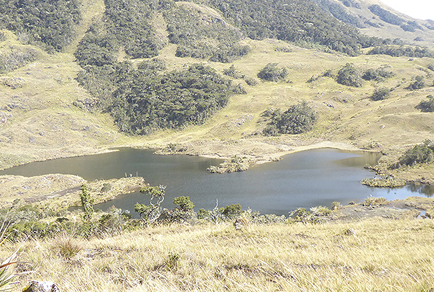
A new species of Polylepis from the humid Puna in the Oxapampa-Asháninka-Yánesha Biosphere Reserve (BIOAY), Pasco Region, Perú, is described and illustrated. This species was found between 3700–3850 m elevation, on Rocky Mountains, in small patches or relict forests of the buffer zone of Yanachaga Chemillén National Park. Polylepis yanesha is similar to P. rocio-rojasii but differs because the leaves have much smaller oblong-elliptic leaflets, the abaxial surface is densely lanuginose with scattered filiform glandular trichomes of golden yellow resin, shorter and thinner petioles, the inflorescence is short, axillary, pendulous, 4.0–8.0 cm long with 5–8 flowers, a greater number of stamens, 17–23; the fruits are much smaller, rounded-ovoid to cylindrical achenes, with short, blunt-tipped spines. We also present details on its geographic distribution, ecological notes, a key to differentiating species of the genus Polylepis sect. Sericeae, a comparative table of characteristics between similar species, and an assessment of the conservation status of the new species.
References
- Amico, G., Vidal-Rusel, R. & Nickrent, D. (2007) Phylogenetic relationships and ecological speciation in the Mistletoe Tristerix (Loranthaceae): The influence of polinators, dispersers, and hots. American Journal of Botany 94: 558–567. https://doi.org/10.3732/ajb.94.4.558
- Bitter, F.A.G. (1911) Revision der Gattung Polylepis. Botanische Jahrbücher für Systematik, Pflanzengeschichte und Pflanzengeographie 45: 564–656.
- Boza Espinoza, T.E. & Quispe, H.R. (2019) Taxonomic Reevaluation of the Polylepis sericea Complex (Rosaceae), with the Description of a New Species. Systematic Botany 44: 324–334. https://doi.org/10.1600/036364419X15562052252225
- Boza Espinoza, T.E. & Kessler, M. (2022) A Monograph of the genus Polylepis (Rosaceae). PhytoKeys 203: 1–274. https://doi.org/10.3897/phytokeys.203.83529
- Carriker, M.A. (1932) Additional new birds from Peru with a synopsis of the races of Hylophylax naevia. Proceedings of the Academy of Natural Sciences of Philadelphia 84: 1–7.
- Carriker, M.A. (1933) Descriptions of new birds from Peru, with notes on other little-known specie. Proceedings of the Academy of Natural Sciences of Philadelphia 85: 1–38.
- Chapman, F.M. (1919) Descriptions of proposed new Birds from Peru, Bolivia, Argentina, and Chile. American Museum of Natural History 41 (5): 323–333.
- Chapman, F.M. (1921) Descriptions of proposed new birds from Colombia, Ecuador, Peru, and Brazil. American Museum Novitates 18: 1–12.
- Fjeldså, J. (1987) Birds of relict forests in the high Andes of Peru and Bolivia. Zoological Museum, University of Copenhagen. Copenhagen, Denmark.
- Fjeldså, J. & Kessler, M. (1996) Conserving the biological diversity of Polylepis woodlands of the Highland of Peru and Bolivia. A contribution to sustainable natural resource management in the Andes. NORDECO, Copenhagen, Denmark, 214 pp.
- Fjeldså, J. (2002) Key areas for conserving the avifauna of Polylepis forests. Ecotropica 8: 125–131.
- Gareca, E.E., Hermy, M., Fjeldså, J. & Honnay, O. (2010) Polylepis woodland remnants as biodiversity islands in the Bolivian high Andes. Biodiversity and Conservation 19 (12): 3327–3346. https://doi.org/10.1007/s10531-010-9895-9
- IUCN (2024) Guidelines for Using the IUCN Red List Categories and Criteria. Version 16. Prepared by the Standards and Petitions committe. Available from: https://www.iucnredlist.org/documents/RedListGuidelines.pdf (accessed 28 February 2025)
- Hertel, D. & Wesche, K. (2008) Tropical moist Polylepis stands at the tree line in East Bolivia: The effect of elevation on stand microclimate, above-and below-ground structure, and regeneration. Trees (Berlin) 22 (3): 303–315. https://doi.org/10.1007/s00468-007-0185-4
- Karger, D.N., Conrad, O., Böhner, J., Kawohl, T., Kreft, H., Soria-Auza, R.W., Zimmermann, N.E., Linder, H.P. & Kessler, M. (2017) Climatologies at high resolution for the earth’s land surface areas. Nature 4: 170122. https://doi.org/10.1038/sdata.2017.122
- Kessler, M. (2002) The “Polylepis problem”: Where do we stand? Ecotropica 8: 97–116.
- Kessler, M., Schmidt-Lebuhn & Nikolai, A. (2006) Taxonomical and distributional notes on Polylepis (Rosaceae). Organisms, Diversity & Evolution 6: 67–70. https://doi.org/10.1016/j.ode.2005.04.001
- Kuijt, J. (1988) Revision of Tristerix (Loranthaceae). Systematic Botany Monographs 19: 1–61. https://doi.org/10.2307/25027693
- Linnaeus, C. (1781) Supplementarum Plantarum. Orphanotrophe, Brunswig, 468 pp.
- Macbride, J.F. (1934) New or renamed spermatophytes mostly Peruvian. Candollea 5: 362–367.
- Philippi, R.A. (1891) Catalogus praevius plantarum in itinere ad Tarapaca a Friderico Philipi Lectarum, Segunda Sección Botánica. Anales del Museo Nacional de Chile 8: 21.
- Pilger, R.K.F. (1906) Rosaceae andinae. Botanische Jahrbücher für Systematik, Pflanzengeschichte und Pflanzengeographie 37: 535–536.
- Pretell, O. (1985) Apuntes sobre algunas especies forestales nativas de la sierra peruana. Proyecto FAO—Holanda. Lima-Perú, 86 pp.
- Quispe, M.H., Llacua, T.Y., Ulloa, A.N. & Kessler, M. (2024) A new species of Polylepis (Rosaceae) from Santuario Nacional Pampa Hermosa, Peru. Phytotaxa 653 (2): 165–174. https://doi.org/10.11646/phytotaxa.653.2.5
- Reichenbach, H.G. (1855) Xenia Orchidaceae: Beiträge zur Kenntniss der Orchideen. P. Bertrand, Paris, 100 pp.
- Ruiz, L.H. & Pavón, J.A. (1794) Florae Peruvianae, et Chilensis Prodromus. Typis Gabrielis de Sancha, Madrid, 154 pp.
- Ruiz, L.H. & Pavón, J.A. (1798) Systema Vegetabilium Florae Peruvianae et Chilensis Prodromi. Typis Gabrielis de Sancha, Madrid, 456 pp. https://doi.org/10.5962/bhl.title.887
- Ruiz, L.H. & Pavón, J.A. (1799) Plantarum peruvianarum et chilensium. Flora Peruviana et Chilensis 2: 42.
- Schlechter, F.R. (1921) Epidendrum micro-cattleya (Kraenzl.) Schltr. Repertorium Specierum Novarum Regni Vegetabilis 9: 150.
- Ståhl, B. (1993) The genus Symplocos (Symplocaceae) in Peru. Candollea 48 (2): 351–382.
- Triana, J. & Planchón, E. (1872) Prodromus Florae Novo-Granatensis. Annales des Sciences Naturelles; Botanique 16: 378.
- Schulenberg, T., Stotz, D., Lane, D., O’Neill, J. & Parker, T. III. (2007) Birds of Peru. Princeton University Press, New Jersey, 664 pp.
- Sclater, P.L. (1869) On Two new Species of Synallaxinae. Proceedings of the Zoological Society of London 3: 636–637. https://doi.org/10.1111/j.1469-7998.1869.tb07380.x
- Sevillano, C.S. & Rodewald, A.D. (2017) Avian community structure and habitat use of Polylepis forests along an elevation gradient. Ecología Austral 28: 216–228. https://doi.org/10.25260/EA.18.28.1.1.519
- Simpson, B. (1979) A revision of the genus Polylepis (Rosaceae: Sanguisorbeae). Smithsonian Contributions to Botany 43: 1–62. https://doi.org/10.5479/si.0081024X.43.1
- Sylvester, S.P., Heitkamp, F., Sylvester, M.D.P.V., Jungkunst, H.F., Sipman, H.J.M. & Thiers, B.M. (2025) Index herbariorum: a global directory of public herbaria and associated staff. New York Botanical Garden’s virtual herbarium. Available from: http://sweetgum.nybg.org/science/ih/ (accessed 31 May 2025)
- Toivonen, J.M., Gonzales, C.A.I., Ospina, J.C. & Kessler, M. (2017) Relict high-Andean ecosystems challenge our concepts of naturalness and human impact. Scientific Reports 7: 3334 (1–13). https://doi.org/10.1038/s41598-017-03500-7
- Tropicos (2025) Missouri Botanical Garden. Available from: http://www.tropicos.org/home (accessed 1 April 2025)
- Valenzuela, G.L. & Villalba, M.I. (2015) A new species of Polylepis (Rosaceae) from Peru. Arnaldoa 22: 329–338.
- Valenzuela, G.L., Villalba, V.M.I., Vásquez, M.R., Monteagudo, M.A. & Flores, M.J. (2022) Orquídeas de la Reserva de Biósfera Oxapampa-Asháninka-Yánesha. Proyect@art.E.I.R.L., Lima, 431 pp.
- Valenzuela, G.L. & Villalba, M.I. (2024) A new species of Polylepis (Rosaceae) from the Bosque de Proteccion Pui-Pui, Peru. Phytotaxa 655 (1): 097–104. https://doi.org/10.11646/phytotaxa.655.1.8
- Weddell, H.A. (1855) Essai d’une Flore de la Région Alpine des Cordilléres de L’Amérique du Sud. Chloris Andina 1: 204–205. https://doi.org/10.5962/bhl.title.217