

Abstract
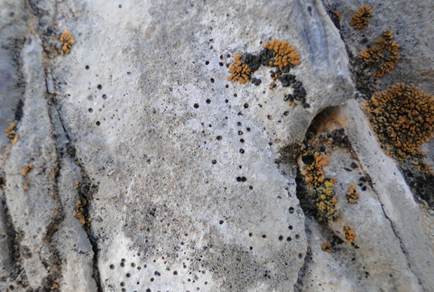
Bagliettoa perseae sp. nov., a novel lichen species, is described from Persepolis, a UNESCO World Heritage Site in Iran. This species is characterized by its endolithic growth within calcareous substrates, a magenta-pigmented involucrellum, and large ascospores. Phylogenetic analyses, utilizing maximum likelihood and Bayesian inference based on nuclear ribosomal ITS and mitochondrial small subunit (mtSSU) regions, unequivocally place the new taxon within the genus Bagliettoa (Verrucariaceae). Bagliettoa perseae forms a well-supported clade with B. marmorea and B. rubrocincta, although phylogenetic resolution within this clade remains ambiguous. Morphological comparisons with closely related Bagliettoa species are provided. Furthermore, the taxonomic identity of Verrucaria buschirensis, described 126 years ago from southern Iran, was reassessed. Based on congruent morphological and molecular data, V. buschirensis is herein proposed as a new synonym of Bagliettoa calciseda.
References
- Bonazza, A., Sabbioni, C., Ghedini, N., Hermosin, B., Jurado, V., Gonzalez, J.M. & Saiz-Jimenez, C. (2007) Did smoke from the Kuwait oil well fires affect Iranian archaeological heritage? Environmental Science and Technology 41: 2378–2386. https://doi.org/10.1021/es062176s
- Bouckaert, R., Heled, J., Kühnert, D., Vaughan, T., Wu, C.H., Xie, D., Suchard, M.A., Rambaut, A. & Drummond, A.J. (2014) BEAST 2: A Software Platform for Bayesian Evolutionary Analysis. PLOS Computational Biology 10: e1003537. https://doi.org/10.1371/journal.pcbi.1003537
- Breuss, O. (2000) New taxa of Pyrenocarpous lichens from the Sonoran region. The Bryologist 103: 705–709. https://doi.org/10.1639/0007-2745(2000)103[0705:NTOPLF]2.0.CO;2
- Brisset, E., Djamali, M., Bard, E., Borschneck, D., Gandouin, E., Garcia, M., Stevens, L. & Tachikawa, K. (2019) Late Holocene hydrology of Lake Maharlou, southwest Iran, inferred from high-resolution sedimentological and geochemical analyses. Journal of Paleolimnology 61: 111–128. https://doi.org/10.1007/s10933-018-0048-6
- Bungartz, F., Garvie, L.A.J. & Nash, T.H. (2004) Anatomy of the endolithic Sonoran Desert lichen Verrucaria rubrocincta Breuss: Implications for biodeterioration and biomineralization. Lichenologist 36: 55–73. https://doi.org/10.1017/S0024282904013854
- Coppins, B.J., Kondratyuk, S.Y., Etayo, J. & Cannon, P.F. (2021) Notes on lichenicolous species of Opegrapha s. lat. (Arthoniales) on Arthoniaceae and Verrucariaceae, with a key to British and Irish lichenicolous Opegraphaceae. The Lichenologist 53 (2): 159–169.
- Ertz, D., Driscoll, K.E. & Clayden, S.R. (2021) Two new lichenicolous species of Opegrapha (Arthoniales) from Canada, Bryologist 124: 39–51.
- Esmaeillou, M., Sohrabi, M. & Ofoghi, H. (2022) The study of the destructive roles of the endolithic lichen Verrucaria buschirensis s.lat., family Verrucariaceae on the World Heritage Site Persepolis. Journal of Research on Archaeometry 8: 171–183. https://doi.org/10.52547/jra.8.1.171
- Esmaeillou, M., Sohrabi, M., Ofoghi, H., Blázquez, M., Pérez-Ortega, S. & de los Ríos, A. (2025) Biodeterioration effects of the endolithic Bagliettoa sp. (lichenized Verrucariaceae) on the limestones of Persepolis, UNESCO World Heritage Site. Journal of Cultural Heritage 73: 82–92. https://doi.org/10.1016/j.culher.2025.02.014
- Favero-Longo, S.E., Borghi, A., Tretiach, M. & Piervittori, R. (2009) In vitro receptivity of carbonate rocks to endolithic lichen-forming aposymbionts. Mycological Research 113: 1216–1227. https://doi.org/10.1016/j.mycres.2009.08.006
- Favero-Longo, S.E., Chiapello, M., Gazzola, V., Abba', S., Messina, A., Perotto, S., Piervittori, R. & Tretiach, M. (2023) Indagini biochimiche e biomolecolari sul ruolo dei licheni endolitici Bagliettoa baldensis e Verrucaria marmorea nella dissoluzione delle rocce carbonatiche. Notiziario della Società Lichenologica Italiana 19: 95.
- Garvie, L.A.J., Knauth, L.P., Bungartz, F., Klonowski, S. & Nash III, T.H. (2008) Life in extreme environments: survival strategy of the endolithic desert lichen Verrucaria rubrocincta. Naturwissenschaften 95: 707–712.
- Gueidan, C. & Roux, C. (2007) Verrucaria calciseda DC. Néotypification, description et transfert dans le genre Bagliettoa, Bull. Soc. linn. Provence, 58: 181–194.
- Gueidan, C., Roux, C. & Lutzoni, F. (2007) Using a multigene phylogenetic analysis to assess generic delineation and character evolution in Verrucariaceae (Verrucariales, Ascomycota). Mycological Research 111: 1145–1168. https://doi.org/10.1016/j.mycres.2007.08.010
- Gueidan, C., Savić, S., Thüs, H., Roux, C., Keller, C., Tibell, L., Prieto, M., Heiomarsson, S., Breuss, O., Orange, A., Fröberg, L., Wynns, A.A., Navarro-Rosinés, P., Krzewicka, B., Pykälä, J., Grube, M. & Lutzoni, F. (2009) Generic classification of the Verrucariaceae (Ascomycota) based on molecular and morphological evidence: Recent progress and remaining challenges. Taxon 58: 184–208. https://doi.org/10.1002/tax.581019
- Halda, J. (2003) A taxonomic study of the calcicolous endolithic species of the genus Verrucaria (Ascomycotina, Verrucariales) with the lid-like and radiately opening involucrellum. Acta Musei Richnoviensis Section Nature 10: 1–148.
- Harada, H. (1993) A taxonomic study on Dermatocarpon and its allied genera (Lichenes, Verrucariaceae) in Japan. Natural History Research 2: 113–152.
- Harada, H. (1994) Taxonomic notes on the lichen family Verrucariaceae in Japan (V). Verrucaria iwatsukii Harada sp. nov. Hikobia 11: 519–522.
- Index Fungorum. (2025) Index Fungorum. Available from: https://www.indexfungorum.org/ (accessed 26 October 2025)
- Lohtander, K., Myllys, L., Sundin, R., Källersjö, M., Tehler, A. & Kallersjo, M. (1998) The species pair concept in the lichen Dendrographa leucophaea (Arthoniales): Analyses based on ITS sequences. The Bryologist 101: 404. https://doi.org/10.2307/3244179
- Maddison, W.P. & Maddison, D.R. (2023) Mesquite: A modular system for evolutionary analysis. Version 3.70. Available from: http://www.mesquiteproject.org (accessed 27 August 2022)
- Miller, M.A., Pfeiffer, W. & Schwartz, T. (2010) Creating the CIPRES Science Gateway for inference of large phylogenetic trees. 2010 Gateway Computing Environments Workshop, GCE 2010. https://doi.org/10.1109/GCE.2010.5676129
- Myllys, L., Lohtander, K., Källersjö, M. & Tehler, A. (1999) Sequence Insertions and ITS Data Provide Congruent Information on Roccella canariensis and R. tuberculata (Arthoniales, Euascomycetes) Phylogeny. Molecular Phylogenetics and Evolution 12: 295–309. https://doi.org/10.1006/mpev.1999.0620
- Nimis, P.L. (2016) The Lichens of Italy: A Second Annotated Catalogue. EUT, Edizioni Università di Trieste, 739 pp.
- Pinna, D., Salvadori, O. & Tretiach, M. (1998) An anatomical investigation of calcicolous endolithic lichens from the Trieste karst (NE Italy). Plant Biosystems 132: 183–195. https://doi.org/10.1080/11263504.1998.10654203
- Riedl, H. (1979) Präadaption bei Flechten iranischer Halbwüsten. Plant Systematics and Evolution 131: 217–233. https://doi.org/10.1007/bf00984255
- Ronquist, F., Huelsenbeck, J. & Teslenko, M. (2011) Draft MrBayes version 3.2 Manual: Tutorials and Model Summaries.
- Schmidt, E.F. (1953) Persepolis I: Structures, Reliefs, Inscriptions. 1st ed. The University of Chicago Press, Chicago, USA, 297 pp.
- Seaward, M.R.D., Sipman, H.J.M., Schultz, M., Maassoumi, A.A., Anbaran, M.H.M. & Sohrabi, M. (2004) A preliminary lichen checklist for Iran. Willdenowia 34: 543. https://doi.org/10.3372/wi.34.34218
- Sohrabi, M., Paukov, A., Pérez-Ortega, S., Nourozi, H., Fadaie, H., Favero-Longo, S.E., Talebian, M.H. & De Los Ríos, A. (2024) Circinaria persepolitana (Megasporaceae), a new lichen species from historic stone surfaces in Persepolis, a UNESCO World Heritage Site in Iran. Lichenologist 56: 93–106. https://doi.org/10.1017/s0024282924000070
- Sohrabi, M. & Sipman, H.J.M. (2007) Lichenized fungi of Golestan National Park (NE Iran). Mycologia Balcanica 4: 87–92.
- Stamatakis, A. (2014) RAxML version 8: a tool for phylogenetic analysis and post-analysis of large phylogenies. Bioinformatics 30: 1312. https://doi.org/10.1093/bioinformatics/btu033
- Stamatakis, A., Hoover, P. & Rougemont, J. (2008) A Rapid Bootstrap Algorithm for the RAxML Web Servers. Syst. Biol 57: 758–771. https://doi.org/10.1080/10635150802429642
- Steiner, J. (1896) Beitrag z. Flechtenflora Südpersiens. Sitzungsber. Kaiserl. Akad. Wiss., Math.-Naturw. Cl. Math-Naturw Cl 105 (1): 436–446.
- Szatala, O. (1957) Prodromus einer Flechtenflora des Irans. Annales historico-naturales Musei Nationalis Hungarici, ser. nov. 8: 101–154.
- Thüs, H., Muggia, L., Pérez-Ortega, S., Favero-Longo, S.E., Joneson, S., O’Brien, H., Nelsen, M.P., Duque-Thüs, R., Grube, M., Friedl, T., Brodie, J., Andrew, C.J., Lücking, R., Lutzoni, F. & Gueidan, C. (2011) Revisiting photobiont diversity in the lichen family Verrucariaceae (Ascomycota). European Journal of Phycology 46: 399–415. https://doi.org/10.1080/09670262.2011.629788
- Valadbeigi, T. & Sipman, H.J.M. (2010) New records of lichens and lichenicolous fungi from Iran and their biogeographical significance. Mycotaxon 113: 191–194. https://doi.org/10.5248/113.191
- Vondrák, J. & Kocourková, J. (2008) New lichenicolous Opegrapha species on Caloplaca from Europe, Lichenologist 40: 171–184.
- Xie, Q., Bu, W. & Zheng, L. (2005) The Bayesian phylogenetic analysis of the 18S rRNA sequences from the main lineages of Trichophora (Insecta: Heteroptera: Pentatomomorpha). Molecular Phylogenetics and Evolution 34: 448–451. https://doi.org/10.1016/j.ympev.2004.10.015
- Yuzon, J., Roux, C., Lendemer, J.C. & Gueidan, C. (2014) Molecular phylogeny and taxonomy of the endolithic lichen genus Bagliettoa (Ascomycota: Verrucariaceae). Taxon 63: 1177–1192. https://doi.org/10.12705/636.10
- Zoller, S., Scheidegger, C. & Sperisen, C. (1999) PCR primers for the amplification of mitochondrial small subunit ribosomal DNA of lichen-forming ascomycetes. Lichenologist 31: 511–516. https://doi.org/10.1006/lich.1999.0220