

Abstract
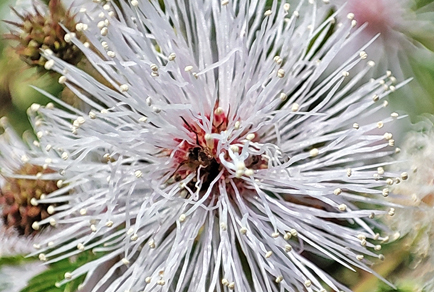
Mimosa humidicola (Leguminosae, Caesalpinioideae) is described and illustrated for the first time. It occurs exclusively in Pantanal, in wetlands and temporary flooded ponds in southern Mato Grosso and the northwest of Mato Grosso do Sul, both in the Brazilian Midwest. Morphological description and taxonomic, ecology and geographical comments are provided. It species can be distinguished by the pubescence of leaflets, the corolla-lobes carmine contrasting with its whitish filaments and the widely-oblong pods dense pubescent. We also present a synopsis for Mimosa subser. Polycarpae with an analysis of the geographical distribution, habit, and an identification key for its species in South America. Additionally, we cited a new occurrence of Mimosa balansae in the Brazilian Chaco.
References
- Amador, G.A., Damasceno-Júnior, G.A., Casagrande, J.C. & Sartori, A.L.B. (2012) Structure of two communities dominated by Copernicia alba and associations with soil and inundation in Pantanal wetland, Brazil. Oecologia Australis 16: 846–858. https://doi.org/10.4257/oeco.2012.1604.09
- Arieira, J. & Nunes da Cunha, C. (2006) Fitossociologia de uma floresta inundável monodominante de Vochysia divergens Pohl (Vochysiaceae), no Pantanal Norte, MT, Brasil. Acta botánica brasileira 20: 569–580. https://doi.org/10.1590/S0102-33062006000300007
- Atahuachi, M. & Hughes, C.E. (2006) Two new species of Mimosa (Fabaceae) endemic to Boliva. Brittonia 58: 59–65. https://doi.org/10.1663/0007-196X(2006)58[59:TNSOMF]2.0.CO;2
- Atahuachi, M., Van Der Bent, M., Wood, J.R.I., Lewis, G.P. & Hughes, C.E. (2016) Bolivian Mimosa (Leguminosae, Mimosoideae): three new species and a species checklist. Phytotaxa 260: 201–222. https://doi.org/10.11646/phytotaxa.260.3.1
- Barneby, R.C. (1991) Sensitivae Censitae: A Description of the Genus Mimosa Linnaeus (Mimosaceae) in the New World. Memoirs of the New York Botanical Garden, New York, 835 pp.
- Barneby, R.C. (1993) Increments to the genus Mimosa (Mimosaceae) from South America. Brittonia 45: 328–332. https://doi.org/10.2307/2807606
- Bessega, C. & Fortunato, R.H. (2011) Section Mimadenia: its phylogenetic relationships within the genus Mimosa (Leguminosae, Mimosoideae) using plastid trnL–F sequence data. Australian Systematic Botany 24: 104–110. https://doi.org/10.1071/SB10022
- Borges, L.M., Simon, M.F., Morales, M., Luckow, M., Ribeiro, P.G. & Grether, R. (2024) Mimosa clade. Advances in Legume Systematics 14. Classification of Caesalpinioideae. Part 2: Higher-level classification. PhytoKeys 240: 339–349. https://doi.org/10.3897/phytokeys.240.101716
- Bueno, M.L., Damasceno-Júnior, G.A., Pott, A., Pontara, V., Seleme, E.P., Fava, W.S., Salomão, A.K.D. & Ratter, J.A. (2014) Structure of arboreal and herbaceous strata in a neotropical seasonally flooded monodominant savanna of Tabebuia aurea. Brazilian Journal of Biology 74: 325–337. https://doi.org/10.1590/1519-6984.16612
- Grohar, M.C., Rosenfeldt, S. & Morales, M. (2016) Leaflet trichome micromorphology in the Dolentes-Brevipedes taxonomic complex (Mimosa L., Mimosoideae). Turkish Journal of Botany 40: 45–58. https://doi.org/10.3906/bot-1412-40
- HDX—The Humanitarian Data Exchange (2025) HDX—The Humanitarian Data Exchange. Available from: https://data.humdata.org/dataset (accessed: February 2025)
- IBGE—Instituto Brasileiro de Geografia e Estatística (2023) Unidades da Federação. Available from: https://www.ibge.gov.br/geociencias/organizacao-do-territorio/malhas-territoriais/15774-malhas.html (accessed: February 2025).
- Jordão, L.S.B., Morim, M.P. & Baumgratz, J.F.A. (2020) Trichomes in Mimosa (Leguminosae): Towards a characterization and a terminology standardization. Flora 272: 151702. https://doi.org/10.1016/j.flora.2020.151702
- Nogueira, L.H.P., Morales, M. & Sartori, A.L.B. (2024) A new species of Mimosa (Leguminosae, ser. Piresianae) from the Brazilian Midwest. Phytotaxa 662: 80–92. https://doi.org/10.11646/phytotaxa.662.1.6
- Pott, A. & Pott, V.J. (2004) Features and conservation of the Brazilian Pantanal wetland. Wetlands Ecology and Management 12: 547–552. https://doi.org/10.1007/s11273-005-1754-1
- QGIS Development Team (2025) QGIS Geographic Information System v. 3.36.0. Open-Source Geospatial Foundation Project. Available from: https://qgis.org/ (accessed: February 2025).
- Queiroz, L.P., Koenen, E.J.M., Hughes, C.E., Luckow, M., Lewis, G.P., Ringelberg, J.J. & Bruneau, A. (2024) Tribe Mimoseae. Advances in Legume Systematics 14. Classification of Caesalpinioideae. Part 2: Higher-level classification. PhytoKeys 240: 203–208. https://doi.org/10.3897/phytokeys.240.101716
- Radford, A.B., Dickson, W.C., Massey, J.R. & Bell, C.R. (1974) Vascular Plant Systematics. Haper & Row, New York, 891 pp.
- Santos-Silva, J., Azevedo-Tozzi, A.M.G., Simon, M.F., Urquiza, N.G. & Morales, M. (2013) Evolution of trichome morphology in Mimosa (Leguminosae, Mimosoideae). Phytotaxa 119: 1–20. https://doi.org/10.11646/phytotaxa.119.1.1
- Sartori, A.L.B., Andrella, G.C., Nogueira, L.H.P., Assunção, V. & Sinani, T.R.F. (2021) Leguminosae in the Pantanal. In: Damasceno-Júnior, G.A. & Pott, A. (Eds.) Flora and Vegetation of the Pantanal Wetland. Springer Cham, pp. 289–314. https://doi.org/10.1007/978-3-030-83375-6_5
- Simon, M.F. & Proença, C. (2000) Phytogeographic patterns of Mimosa (Mimosoideae, Leguminosae) in the Cerrado biome of Brazil: an indicator genus of high-altitude centers of endemism? Biological Conservation 96: 279–296. https://doi.org/10.1016/S0006-3207(00)00085-9
- Simon, M.F., Grether, R., Queiroz, L.P. & Hughes, C.E. (2009) Recent assembly of the Cerrado, a neotropical plant diversity hotspot, by in situ evolution of adaptations to fire. PNAS 106: 20359–20364. https://doi.org/10.1073/pnas.0903410106
- Simon, M.F., Grether, R., Queiroz, L.P., Särkinen, T.E., Dutra, V.F. & Hughes, C.E. (2011) The evolutionary history of Mimosa (Leguminosae): Toward a phylogeny of the sensitive plants. American Journal of Botany 98: 1201–1221. https://doi.org/10.3732/ajb.1000520
- Souza-Lima, E.S., Sinani, T.R.F., Pott, A. & Sartori, A.L.B. (2017) Mimosoideae (Leguminosae) in the Brazilian Chaco of Porto Murtinho, Mato Grosso do Sul. Rodriguesia 68: 263–290. https://doi.org/10.1590/2175-7860201768131
- Thiers, B. (2025 [continuously updated]) Index Herbariorum: a global directory of public herbaria and associated staff. New York Botanical Garden’s Virtual Herbarium. Available from: http://sweetgum.nybg.org/science/ih/ (accessed: 27 March 2025)