

Abstract
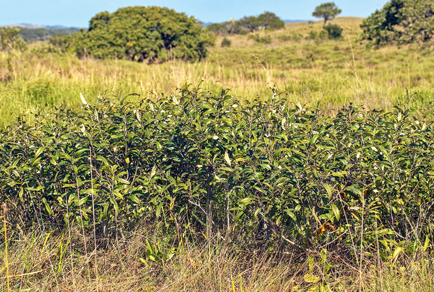
Ozoroa bhangazica, a clonal, fire-adapted geoxylic suffrutex, is formally described as a new species with a highly restricted distribution in the Maputaland Centre of Endemism in KwaZulu-Natal Province, South Africa. It is confined to Maputaland Wooded Grassland on Quaternary coastal sands, a vegetation type notable for its rich diversity of geoxylic suffrutices. The two known populations are included in the iSimangaliso Wetland Park, a World Heritage Site. In southern Africa, Ozoroa species are divided into two groups based on leaf and pollen characters; O. bhangazica belongs to Group A and is unique among KwaZulu-Natal species for its geoxylic growth form. The genus shows significant infraspecific vegetative variation, with O. bhangazica displaying distinct variation in leaf size and shape between new shoots after fire and regrowth that has persisted through one or more fire-free seasons. Morphologically, the new species resembles O. barbertonensis, another geoxylic suffrutex, which is a geographically isolated serpentine endemic confined to the Barberton Centre of Endemism about 250 km from where O. bhangazica occurs. Both share the characteristic of linear to narrowly oblong leaves following fire. However, O. bhangazica can be distinguished by its longer, broader leaves, which are mostly glabrous on the upper surface with flat (non-revolute) margins, a longer petiole, and larger mature drupes. A provisional conservation status of Near Threatened (NT) is recommended under IUCN Red List criteria.
References
- Archer, R.A. (2000) Anacardiaceae. In: Leistner, O.A. (Ed.) Seed plants of southern Africa: families and genera, Strelitzia 10. National Botanical Institute, Pretoria, pp. 56–59.
- Bachman, S., Moat, J., Hill, A.W., De la Torre, J. & Scott, B. (2011) Supporting Red List threat assessments with GeoCAT: geospatial conservation assessment tool. ZooKeys 150: 117–126. https://doi.org/10.3897/zookeys.150.2109
- Boon, R. [R.G.C.] (2010) Pooley’s trees of eastern South Africa. A complete guide. Flora and Fauna Publications Trust, Durban, 626 pp.
- Burtt Davy, J. (1922) The suffrutescent habit as an adaptation to environment. Journal of Ecology 10 (2): 211–219. https://doi.org/10.2307/2255742
- Christenhusz, M.J.M., Fay, M.F. & Chase, M.W. (2018) Plants of the world: an illustrated encyclopaedia of vascular plants. Kew Publishing, Royal Botanic Gardens, Kew and The University of Chicago Press, 792 pp.
- Coates Palgrave, M. (2002) Keith Coates Palgrave trees of southern Africa, 3rd ed. Struik, Cape Town, 1212 pp.
- Courtenay, A.P., Moonlight, P.W., Pennington, R.T. & Lehmann, C.E. (2024) Underground trees inhabit varied environmental extremes across the Afrotropics. Annals of Botany 133 (5 & 6): 757–772. https://doi.org/10.1093/aob/mcad124
- Davies, T.J., Daru, B.H., Van der Bank, M., Maurin, O. & Bond, W.J. (2016) Multiple routes underground. Frost alone cannot explain the evolution of underground trees. New Phytologist 209 (3): 910–912. https://doi.org/10.1111/nph.13795
- De Winter, B. (1974) Notes on African plants. Anacardiaceae. A new combination in Ozoroa. Bothalia 11 (3): 277–290. https://doi.org/10.4102/abc.v11i3.1461
- Edwards, D. & Leistner, O.A. (1971) A degree reference system for citing biological records in southern Africa. Mitteilungen der Botanischen Staatssammlung München 10: 501–509. [https://www.biodiversitylibrary.org/page/15185301#page/509/mode/1up]
- Engler, A. (1888) Plantae Marlothianae II: Dikotyledoneae sympetalae. Botanische Jahrbücher für Systematik, Pflanzengeschichte und Pflanzengeographie 10 (1 & 2): 242–285. [https://www.biodiversitylibrary.org/item/684#page/253/mode/1up]
- Engler, A. (1898) Anacardiaceae africanae II. Botanische Jahrbücher für Systematik, Pflanzengeschichte und Pflanzengeographie 24 (4): 493–502. [https://www.biodiversitylibrary.org/page/208508#page/509/mode/1up]
- Fernandes, R.B. (1966) Estudos nas Anacardiaceae africanas. I – Contribuição para o conhecimento do género Ozoroa Del. Garcia de Orta 14 (1): 19–69.
- Fernandes, R.B. & Fernandes, A. (1965) Anacardiaceae Africanae nova vel minus cognita 1. Boletim da Sociedade Broteriana II, 38: 145–194.
- Fernandes, R.B. & Fernandes, A.C.S. (1966) Anacardiaceae. In: Exell, A.W., Fernandes, A. & Wild, H. (Eds.) Flora Zambesiaca, 2. Crown Agents for Overseas Governments and Administrations, London, pp. 550–615.
- Finckh, M., Revermann, R. & Aidar, M.P.M. (2016) Climate refuges going underground – a response to Maurin et al. (2014). New Phytologist 209 (3): 904–909. https://doi.org/10.1111/nph.13567
- Goyder, D.J., Davies, N., Finckh, M., Gomes, A., Gonçalves, F.M.P., Meller, P. & Paton, A.J. (2023) New species of Asclepias (Apocynaceae), Baphia (Leguminosae), Cochlospermum (Bixaceae) and Endostemon (Lamiaceae) from the Kalahari sands of Angola and NW Zambia, with one new combination in Vangueria (Rubiaceae). PhytoKeys 232: 145–166. https://doi.org/10.3897/phytokeys.232.110110
- Groenewald, Y. (2010) Ndumo reserve hit by invasion, crime. Mail and Guardian. Available from: https://mg.co.za/article/2010-10-15-ndumo-reserve-hit-by-invasion-crime/ (accessed 23 August 2021)
- Hufkie, R.J.P. (1996) A comparative morphological and anatomical study of the leaves and fruit of Heeria (Thunb.) Meissner and selected Western Cape and Namibian species of Ozoroa Delile (Anacardiaceae Lindl.). M.Sc. dissertation, University of the Western Cape, Cape Town, 136 pp.
- iNaturalist. (2025) iNaturalist. Available from: https://www.inaturalist.org (accessed 1 March 2025)
- iSimangaliso Wetland Park. (2025) iSimangaliso Wetland Park. Available from: https://isimangaliso.com (accessed 19 January 2025)
- IUCN. (2012) IUCN Red List Categories and Criteria, version 3.1, 2nd ed. IUCN Species Survival Commission, Gland, Switzerland and Cambridge, UK, iv + 32 pp. [https://www.iucnredlist.org/resources/categories-and-criteria]
- IUCN Standards and Petitions Committee. (2024) Guidelines for using the IUCN Red List Categories and Criteria. Version 16. Prepared by the Standards and Petitions Committee, IUCN Species Survival Commission, Gland, 122 pp. [https://www.iucnredlist.org/documents/RedListGuidelines.pdf]
- Joyce, E.M., Appelhans, M.S., Buerki, S., Cheek, M., De Vos, J.M., Pirani, J.R., Zuntini, A.R., Bachelier, J.B., Bayly, M.J., Callmander, M.W., Devecchi, M.F., Pell, S.K., Groppo, M., Lowry, P.P., Mitchell, J., Siniscalchi, C.M., Munzinger, J., Orel, H.K., Pannell, C.M., Nauheimer, L., Sauquet, H., Weeks, A., Muellner-Riehl, A.N., Leitch, I.J., Maurin, O., Forest, F., Nargar, K., Thiele, K.R., Baker, W.J. & Crayn, D.M. (2023) Phylogenomic analyses of Sapindales support new family relationships, rapid Mid-Cretaceous Hothouse diversification, and heterogeneous histories of gene duplication. Frontiers in Plant Science 14: a1063174. https://doi.org/10.3389/fpls.2023.1063174
- Klaassen, E.S. & Kwembeya, E.G. (Eds.) (2013) A checklist of Namibian indigenous and naturalised plants. Occasional Contributions No. 5, National Botanical Research Institute, Windhoek, Namibia, 592 pp.
- Mannheimer, C.A. & Curtis, B.A. (Eds.) (2018) Le Roux and Müller’s field guide to the trees & shrubs of Namibia, 2nd ed. Namibia Publishing House, Windhoek, 546 pp.
- Maurin, O., Davies, T.J., Burrows, J.E., Daru, B.H., Yessoufou, K., Muasya, A.M., Van der Bank, M. & Bond, W.J. (2014) Savanna fire and the origins of the ‘underground forests’ of Africa. New Phytologist 204 (1): 201–214. https://doi.org/10.1111/nph.12936
- Matthews, W.S., Van Wyk, A.E. & Van Rooyen, N. (1999) Vegetation of the Sileza Nature Reserve and neighbouring areas, South Africa, and its importance in conserving the woody grasslands of Maputaland Centre of Endemism. Bothalia 29 (1): 151–167. https://doi.org/10.4102/abc.v29i1.586
- Meisner, C.F. (1837) Heeria argentea. In: Plantarum vascularium genera :secundum ordines naturales digesta eorumque differentiae et affinitates tabulis diagnostacis expositae, vol. 2. Leipzig, Libraria Weidmannia, 402 pp. https://doi.org/10.5962/bhl.title.44043
- Mucina, L. & Rutherford, M.C. (Eds.) (2006) The vegetation of South Africa, Lesotho and Swaziland. Strelitzia 19. South African National Biodiversity Institute, Pretoria, 807 pp.
- Myre, M. (1964) A vegetação do extremo sul da provincia de Mozambique. Junta de Investigaçoes do Ultramar, Lisbon, 145 pp.
- Oliver, D. (1868) Order XLVL: Anacardiaceae. In: Oliver, D. (Ed.) Flora of tropical Africa 1. L. Reeve & Co., London, pp. 435–450. [https://www.biodiversitylibrary.org/item/123#page/490/mode/1up]
- Pell, S.K. (2004) Molecular systematics of the cashew family (Anacardiaceae). Ph.D. thesis, Louisiana State University and Agricultural and Mechanical College, Baton Rouge, Louisiana, 193 pp. https://doi.org/10.31390/gradschool_dissertations.1472
- Pell, S.K., Mitchell, J.D., Miller, A.J. & Lobova, T.A. (2011) Anacardiaceae. In: Kubitzki, K. (Ed.) The families and genera of vascular plants, vol. 10. Springer, Berlin & Heidelberg, pp. 306–322. https://doi.org/10.1007/978-3-642-14397-7
- POWO. (2025) Plants of the World Online. Facilitated by the Royal Botanic Gardens, Kew. Available from: http://www.powo.science.kew.org/ (accessed 2 February 2025)
- Presl, K.B. (1845) Botanische Bemerkungen. Abhandlungen der Königlichen Böhmischen Gesellschaft der Wissenschaften (Prague) ser. 5 3: 431–584. [https://www.biodiversitylibrary.org/item/164069#page/545/mode/1up]
- Raffeneau-Delile, R. (1843) Note sur quelques plantes nouvelles d’Abyssinie. Annales des Sciences Naturelles, Botanique sér, 2 Botanique, 20: 88–95 + Plate 1, Fig 3. [https://www.biodiversitylibrary.org/item/129773#page/92/mode/1up]
- Retief, E. (1990) Notes on African plants. Anacardiaceae. A new species of Ozoroa from the Transvaal. Bothalia 20 (2): 219–221. https://doi.org/10.4102/abc.v20i2.925
- Schinz, H. & Dinter, K. (1903) Anacardiaceae. In: Schinz, H. (Ed.) Beiträge zur Kenntnis der Afrikanischen Flora. Bulletin de l'Herbier Boissier, sér. 2, 3: 822–823. [https://www.biodiversitylibrary.org/item/105266#page/886/mode/1up]
- Schmidt, E., Lötter, M. & McCleland, W. (2002) Trees and shrubs of Mpumalanga and Kruger National Park. Jacana, Johannesburg, 702 pp.
- Scott-Shaw, C.R. (1999) Rare and threatened plants of KwaZulu-Natal and neighbouring regions. KwaZulu-Natal Nature Conservation Service, Pietermaritzburg, 200 pp.
- Setshogo, M.P. (2005) Preliminary checklist of the plants of Botswana. South African Botanical Diversity Network Report No. 37, SABONET, Pretoria and Gaborone, 161 pp.
- Simon, M.F. & Pennington, T. (2012) Evidence for adaptation to fire regimes in the tropical savannas of the Brazilian Cerrado. International Journal of Plant Sciences 173 (6): 711–723. https://doi.org/10.1086/665973
- Sonder, W. (1860) Order XLVI Terebintaceae Juss. In: Harvey, W.H. & Sonder, O.W. (Eds.) Flora Capensis 1. Hodges & Smith, Dublin, pp. 502–527. [https://www.biodiversitylibrary.org/item/15231#page/558/mode/1up]
- South African National Biodiversity Institute. (2006–2024) The vegetation map of South Africa, Lesotho and Swaziland [Mucina, L., Rutherford, M.C. and Powrie, L.W. (Eds.)], ver. 2024. Available from: https://bgis.sanbi.org/Projects/Detail/2258 (accessed 2 March 2025)
- South African National Biodiversity Institute. (2025) Botanical database of southern Africa (BODATSA). Available from: https://posa.sanbi.org/ (accessed 16 February 2025)
- Sprague, T.A. (1913) Diagnoses Africanae: LIV. Bulletin of Miscellaneous Information (Royal Botanic Gardens, Kew) 1913 (5): 177–183. https://doi.org/10.2307/4107452
- Steenkamp, Y., Kellerman, M.J.S. & Van Wyk, A.E. (2001) Fire, frost, waterlogged soil or something else: what selected for the geoxylic suffrutex form in Africa? PlantLife (SA) 25: 4–6. Available from: https://plantlifesouthafrica.blogspot.com/p/plant-life-no-1.html (accessed 4 August 2025)
- Steenkamp, Y., Van Wyk, A.E., Victor, J., Hoare, D., Smith, G., Dold, T. & Cowling, R. (2004) Maputaland-Pondoland-Albany. In: Mittermeier, R.A., Robles Gil, P., Hoffmann, M., Pilgrim, J., Brooks, T., Goettsch Mittermeier, C., Lamoreux, J. & Da Fonseca, G.A.B. (Eds.) Hotspots revisited: Earth’s biologically richest and most threatened terrestrial ecoregions. Cemex & Conservation International, Washington, pp. 219–228.
- Thiers, B. (2025) Index Herbariorum: a global directory of public herbaria and associated staff. New York Botanical Garden’s Virtual Herbarium. Available from: http://sweetgum.nybg.org/ih/ (accessed 22 February 2025)
- Thornhill, M. & Felton, I. (2000) The underground forests of Maputaland. PlantLife (SA) 23: 9–10. Available from: https://plantlifesouthafrica.blogspot.com/p/plant-life-no-1.html (accessed 4 August 2025)
- Van Wyk, A.E. (1994) Maputaland-Pondoland Region. In: Davis, S.D., Heywood, V.H. & Hamilton, A.C. (Eds.) Centres of plant diversity, a guide and strategy for their conservation, Vol. 1. Information Press, Oxford, pp. 227–235.
- Van Wyk, A.E. (1996) Biodiversity of the Maputaland Centre. In: Van der Maesen, L.J.G., Van der Burgt, X.M. & Van Medenbach de Rooy, J.M. (Eds.) The biodiversity of African plants. Kluwer Academic Publishers, Dordrecht, pp. 198–207.
- Van Wyk, A.E. & Smith, G.F. (2001) Regions of floristic endemism in southern Africa: a review with emphasis on succulents. Umdaus Press, Hatfield, Pretoria, 199 pp.
- Van Wyk, A.E. & Van Wyk, P. (2013) Field guide to trees of southern Africa, 2nd ed. Struik Nature, Cape Town, 732 pp.
- Von Teichman, I. (1993) Development and structure of the seed of Ozoroa paniculosa (Anacardiaceae) and taxonomic notes. Botanical Journal of the Linnean Society 111 (4): 463–470. https://doi.org/10.1111/j.1095-8339.1993.tb01915.x
- Von Teichman, I. & Van Wyk, A.E. (1993) Ontogeny and structure of the drupe of Ozoroa paniculosa (Anacardiaceae). Botanical Journal of the Linnaean Society 111 (2): 253–263. https://doi.org/10.1111/j.1095-8339.1993.tb01902.x
- Von Teichman, I. & Van Wyk, A.E. (1994) The generic position of Protorhus namaquensis Sprague (Anacardiaceae): evidence from fruit structure. Annals of Botany 73 (2): 175–184. [https://www.jstor.org/stable/42759018]
- Von Teichman, I. & Van Wyk, A.E. (1996) Taxonomic significance of pericarp and seed structure in Heeria argentea (Thunb.) Meisn. (Anacardiaceae), including reference to pachychalazy and recalcitrance. Botanical Journal of the Linnean Society 122 (4): 335–352. https://doi.org/10.1111/j.1095-8339.1996.tb02080.x
- White, F. (1976) The underground forests of Africa: a preliminary review. The Gardens’ Bulletin, Singapore 24: 57–71.
- WFO. (2025) World Flora Online. Available from: http://www.worldfloraonline.org/ (accessed 2 February 2025)