

Abstract
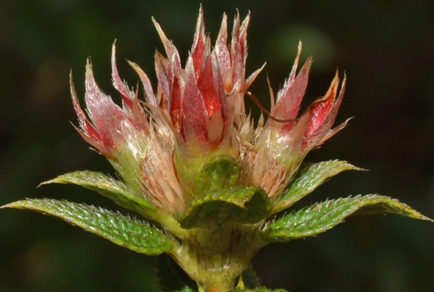
Tibouchina triprovincialis is a new species collected in the Brazilian states of Amazonas, Mato Grosso, and Rondônia. All gatherings from Amazonas and Rondônia come from the “Parque Nacional dos Campos Amazônicos”, while the single gathering outside it comes from northwestern Mato Grosso. Dense and extensive populations of this small shrub occur in “hyperseasonal savannas”, i.e. savannic enclaves in the middle of the Amazonian rainforest, with a thick herbaceous layer and very few shrubs or trees, growing on poorly drained soils. Tibouchina triprovincialis differs from both T. aspera and T. spruceana by the smaller leaves, with shorter petioles, 0.6–1.5 mm long (vs. 3–10 mm in T. spruceana, 2–10 mm in T. aspera) and blades 5–11 mm long (vs. 20–50 mm in T. spruceana, 20–80 in T. aspera), the abaxial surface densely covered with broad scales that conceal the surfaces of veins and the actual surfaces between the veins (vs. moderately covered with slender scales or trichomes that do not conceal the surfaces beneath, on both the veins and the actual surfaces between the veins). As for extinction risk, we suggest that T. triprovincialis should be regarded as “Least Concern” (LC).
References
- Aublet, J.B.C.F. (1775) Histoire des plantes de la Guiane Françoise, tome 1. Pierre‑François Didot, London & Paris. https://doi.org/10.5962/bhl.title.674
- Bachman, S., Moat, J., Hill, A.W., de la Torre, J. & Scott, B. (2011) Supporting Red List threat assessments with GeoCAT: geospatial conservation assessment tool. ZooKeys 150: 117–126. https://doi.org/10.3897/zookeys.150.2109
- Bartling, F.G. (1830) Ordines Naturales Plantarum Eorumque Characteres et Affinitates; Adjecta Generum Enumeration. Sumptibus Dieterichianis, Göttingen.
- Bigio, N.C., Secco, R.S., Esser, H.J., Alves, D.B., Silveira, A.L.P., Ramos, R.S., Anjos, C.B. & Gonçalves, K.S. (2022) Mabea dalyana (Euphorbiaceae-Hippomaneae): a new subshrub with xylopodia endemic to the savannas of the Brazilian Amazon. Acta Botanica Brasilica 36: e2021abb0039. https://doi.org/10.1590/0102-33062021abb0039
- Brade, A.C. (1938) Melastomataceae Novae II. Archivos do Instituto de Biologia Vegetal do Rio de Janeiro 4: 71–94. https://doi.org/10.5962/bhl.title.115964
- Cogniaux, A.C. (1885) Melastomataceae. In: Martius, C.F.P., Eichler, A.G. & Urban, I. (Eds.) Flora Brasiliensis, vol. 14 (3). Frid. Fleischer, Munich. https://doi.org/10.5962/bhl.title.454
- Cogniaux, A.C. (1891) Mélastomaceés. In: Candolle, A. & Candolle, C. (Eds.) Monographiae Phanerogamarum, vol. 7. G. Masson, Paris. https://doi.org/10.5962/bhl.title.45961
- D’Amico, A.R. (coord.) (2016) Plano de Manejo do Parque Nacional dos Campos Amazônicos. Instituto Chico Mendes de Conservação e Biodiversidade, Brasília.
- De Candolle, A.P. (1828) Prodromus Systematis Naturalis Regni Vegetabilis, vol. 3. Treuttel et Würtz, Paris. https://doi.org/10.5962/bhl.title.286
- Don, D. (1823) An Illustration of the Natural Family of Plants Called Melastomataceae. Memoirs of the Wernerian Natural History Society 4 (2): 276–329.
- Dorval, A., Costa, R.B. & Sousa, R.A.T.M. (2012) State conservation units for indirect use in Mato Grosso state, Brazil. Multitemas 43: 105–116.
- ESRI (2016) ArcGIS, version 40.5. Environmental Systems Research Institute, Redlands, California.
- Flora e Funga do Brasil (2025) [continuously updated] Instituto de Pesquisas Jardim Botânico do Rio de Janeiro, Rio de Janeiro, Brazil. Available from: http://floradobrasil.jbrj.gov.br/ (accessed 20 April 2025)
- Gleason, H.A. (1950) The genus Tibouchina in southern Venezuela. Phytologia 3 (5): 238–243.
- Goldenberg, R., Michelangeli, F.A. & Amorim, A.M.A. (2020) First record of Loricalepis (Melastomataceae) from the Brazilian Atlantic Forest, with the description of a new species from Bahia. Brittonia 72: 308–316. https://doi.org/10.1007/s12228-020-09629-6
- Guimarães, P.J.F., Michelangeli, F.A., Sosa, K. & Gomez, J.R.S. (2019) Systematics of Tibouchina and allies (Melastomataceae: Melastomateae): a new taxonomic classification. Taxon 68: 937–1002. https://doi.org/10.1002/tax.12151
- IUCN Standards and Petitions Committee (2024) Guidelines for Using the IUCN Red List Categories and Criteria. Version 16. Prepared by the Standards and Petitions Committee. Available from: [https://www.iucnredlist.org/documents/RedListGuidelines.pdf]
- Jantzen, J.R., Guimarães, P.J.F., Pederneiras, L.C., Oliveira, A.L.F., Soltis, D.E. & Soltis, P.S. (2022) Phylogenomic analysis of Tibouchina s.s. (Melastomataceae) highlights the evolutionary complexity of Neotropical savannas. Botanical Journal of the Linnean Society 199: 372–411. https://doi.org/10.1093/botlinnean/boab086
- Maguire, B. & Wurdack, J.J. (1958) The botany of the Guayana Highland—Part III. Memoirs of the New York Botanical Garden 10: 1–156.
- McConnell, F.V. & Quelch, J.J. (1901) Report on two Botanical Collections made by Messrs. F.V. McConnell and J.J. Quelch at Mount Roraima in British Guiana. Transactions of the Linnean Society of London, 2nd series: Botany 6: 1–108.
- Meyer, F.S., Diniz, D.O., Ziemmer, J.K. & Goldenberg, R. (2023) Two new species of Tibouchina (Melastomataceae) from the Brazilian Cerrado. Phytotaxa 599: 51–64. https://doi.org/10.11646/phytotaxa.599.1.3
- Michelangeli, F.A., Guimarães, P.J.F., Penneys, D.S., Almeda, F. & Kriebel, R. (2013) Phylogenetic relationships and distribution of New World Melastomeae (Melastomataceae). Botanical Journal of the Linnean Society 171: 38–60. https://doi.org/10.1111/j.1095-8339.2012.01295.x
- Miquel, F.A.W. (1840) Commentarii Phytographici, quibus varia rei herbariae capita illustrantur. S. et J. Luchtmans, Leiden. https://doi.org/10.5962/bhl.title.13717
- Naudin, C.V. (1850) Melastomacearum Monographicae Descriptiones. Annales des Sciences Naturelles. Botanique sér. 3 13 (3): 25–362.
- Pittier, H. (1947) Especies venezoelanas nuevas o supuestas como tales. Boletín de la Sociedad Venezoelana de Ciencias Naturales 11: 13–28.
- Ratter, J.A., Bridgewater, S. & Ribeiro, J.F. (2003) Analysis of the floristic composition of the Brazilian cerrado vegetation: comparison of the woody vegetation of 376 areas. Edinburgh Journal of Botany 60: 57–109. https://doi.org/10.1017/S0960428603000064
- Renner, S.S. (1993) Phylogeny and classification of the Melastomataceae and Memecylaceae. Nordic Journal of Botany 13: 519–540. https://doi.org/10.1111/j.1756-1051.1993.tb00096.x
- Schneider, C.A., Rasband, W.S. & Eliceiri, K.W. (2012) NIH Image to ImageJ: 25 years of image analysis. Nature Methods 9: 671–675. https://doi.org/10.1038/nmeth.2089
- Steyermark, J.A. (1952) Contributions to the Flora of Venezuela: From Droseraceae through Umbelliferae. Fieldiana: Botany 28 (2): 424–438. https://doi.org/10.5962/bhl.title.2422
- Steyermark, J.A. (1972) The flora of the Meseta del Cerro Jaua. Memoirs of the New York Botanical Garden 23: 833–892.
- Todzia, C.A. & Almeda, F. (1991) A revision of Tibouchina section Lepidotae (Melastomataceae: Tibouchineae). Proceedings of the California Academy of Sciences 47: 175–206.
- Veranso‑Libalah, M.C., Stone, R.D., Kadereit, G. & Guimarães, P.J.F. (2022) Systematics and Taxonomy of the Tribe Melastomateae. In: Goldenberg, R., Michelangeli, F.A. & Almeda, F. (eds.) Systematics, Evolution, and Ecology of Melastomataceae. Springer, Cham, pp. 429–463. https://doi.org/10.1007/978-3-030-99742-7_21
- Walter, B.M.T., Carvalho, A.M. & Ribeiro, J.F. (2008) O conceito de savana e de seu componente Cerrado. In: Sano, S.M., Almeira, S.P. & Ribeiro, J.F. (eds.) Cerrado—Ecologia e Flora. Embrapa, Brasília.
- Wurdack, J.J. (1973) Melastomataceae. In: Lasser, T (Ed.) Flora de Venezuela, vol. 8. Instituto Botánico, Caracas.
- Wurdack, J.J. (1986) Atlas of Hairs for Neotropical Melastomataceae. Smithsonian Institution Press, Washington. https://doi.org/10.5962/bhl.title.122493
- Wurdack, J.J. (1990) Certamen Melastomataceis XXXIX. Phytologia 69: 316–327.