
Abstract
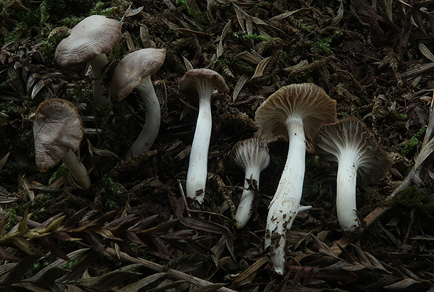
Cuphophyllus striatus is described as a new species from Guizhou Province of China based on morphological and molecular evidence. Morphologically, it is characterized by its small-sized basidiomata, the brownish orange to light brown pileus surface with light orange radial striae, and subglobose basidiospores 6.5–9(9.5) × 6–8(9.5) μm. In the ITS phylogenetic tree, C. striatus forms an independent clade within the genus Cuphophyllus, and close to C. cinerellus, C. esteriae and C. lamarum, but they are clearly distinct in macro- and micro-morphology. Detailed description, illustrations, comparison with related species and the phylogenetic placement are provided.
References
- Bas, C. (1969) Morphology and subdivision of Amanita and a monograph of its section Lepidella. Persoonia 5 (4): 285–579.
- Bellú, F. (1996) Alcune specie mediterranee di recente identificazionecon particulare riguardo al genere Clitocybe. Rivista di Micologia 39: 99–114.
- Binder, M., Larsson, K.H., Matheny, P.B. & Hibbett, D.S. (2010) Amylocorticiales ord. nov. And jaapiales ord. nov.: early diverging clades of agaricomycetidae were dominated by corticioid forms. Mycologia 102: 865–880.
- Bon, M. (1985) [1984] Le genre Cuphophyllus (Donk) sp. nov. Documents Mycologiques 14: 9–12.
- Bon, M. (1997) Les Clitocybes, Omphales et ressemblants. Flore Mycologique d’Europe 4. Documents Mycologiques Mémoire Hors Série 4. CRDP de l’Académie d’Amiens, Amiens, France, 181 pp.
- Chen, J.L. & Li, Y. (2013) The Checklist of Species in Hygrophoraceae from China and Their Distribution. Journal of Fungal Research 11 (1): 3–13, 37.
- Donk, M.A. (1962) The generic names proposed for the Agaricaceae. Beih Nova Hedw 5: 1–320.
- Gardes, M. & Bruns, T.D. (1993) ITS primers with enhanced specificity for basidiomycetes: application to identification of mycorrhizae and rusts. Molecular Ecology 2 (2): 113–118. https://doi.org/10.1111/j.1365-294X.1993.tb00005.x
- He, M., Zhao, R., Hyde, K.D., Begerow, D., Kemler, M., Yurkov, A.M., McKenzie, E.H., Raspé, O., Kakishima, M., Sánchez-Ramírez, S., Vellinga, E.C., Halling, R.E., Papp, V., Zmitrovich, I.V., Buyck, B., Ertz, D., Wijayawardene, N.N., Cui, B., Schoutteten, N., Liu, X., Li, T., Yao, Y., Zhu, X., Liu, A., Li, G., Zhang, M., Ling, Z., Cao, B.T., Antonín, V., Boekhout, T., da-Silva, B.D., De, C.E., Decock, C.A., Dima, B., Dutta, A.K., Fell, J.W., Geml, J., Ghobad-Nejhad, M., Giachini, A.J., Gibertoni, T.B., Gorjón, S.P., Haelewaters, D., He, S., Hodkinson, B.P., Horak, E., Hoshino, T., Justo, A., Lim, Y.W., Menolli, N., Mešić, A., Moncalvo, J., Mueller, G.M., Nagy, L.G., Nilsson, R.H., Noordeloos, M.E., Nuytinck, J., Orihara, T., Ratchadawan, C., Rajchenberg, M., Silva-Filho, A.G., Sulzbacher, M.A., Tkalčec, Z., Valenzuela, R., Verbeken, A., Vizzini, A., Wartchow, F., Wei, T., Weiß, M., Zhao, C. & Kirk, P.M. (2019) Notes, outline and divergence times of Basidiomycota. Fungal Diversity 99: 105–367. https://doi.org/10.1007/s13225-019-00435-4
- He, Z.M. & Yang, Z.L. (2021) A new clitocyboid genus Spodocybe and a new subfamily Cuphophylloideae in the family Hygrophoraceae (Agaricales). MycoKeys 26 (79): 129–148. https://doi.org/10.3897/mycokeys.79.66302
- Hesler, L.R. & Smith, A.H. (1963) North American species of Hygrophorus. University of Tennessee Press, Knoxville, Tennessee, 416 pp. https://doi.org/10.5962/bhl.title.61976
- Jordal, J.B. & Larsson, E. (2021) Cuphophyllus atlanticus (Hygrophoraceae, Agaricales)—a new sister species to the North American C. canescens. Agarica 42: 39–48. https://doi.org/10.5617/agarica.11154
- Kalamees, K. (1989) On the Agaricales flora of the Zaamin National Park II. Folia Cryptogamica Estonica 27: 1–11.
- Kalyaanamoorthy, S., Minh, B.Q., Wong, T.K.F., von-Haeseler, A. & Jermiin, L.S. (2017) ModelFinder: fast model selection for accurate phylogenetic estimates. Nature Methods 14 (6): 587–589. https://doi.org/10.1038/nmeth.4285
- Katoh, K. & Standley, D.M. (2013) Mafft multiple sequence alignment software version 7: improvements in performance and usability. Molecular Biology & Evolution 30 (4): 772–780. https://doi.org/10.1093/molbev/mst010
- Kornerup, A. & Wanscher, J.H. (1978) Methuen Handbook of Colour 3rd edn. Eyre Methuen, London, 252 pp.
- Læssøe, T. & Petersen, J.H. (2019) Fungi of Temperate Europe Volume 1. Princeton University Press, Princeton and Oxford, 1708 pp.
- Larsson, E. & Jordal, J.B. (2023) Cuphophyllus monteverdae and C. hygrocyboides (Hygrophoraceae, Agaricales) in Norway and Sweden. Agarica 43: 3–13. https://doi.org/10.5617/agarica.10974
- Lodge, D.J., Padamsee, M., Matheny, P.B., Aime, M.C., Cantrell, S.A., Boertmann, D., Kovalenko, A., Vizzini, A., Dentinger, B.T.M., Kirk, P.M., Ainsworth, A.M., Moncalvo, J.M., Vilgalys, R., Larsson, E., Lücking, R., Griffith, G.W., Smith, M.E., Norvell, L.L., Desjardin, D.E., Redhead, S.A., Ovrebo, C.L., Lickey, E.B., Ercole, E., Hughes, K.W., Courtecuisse, R., Young, A., Binder, M., Minnis, A.M., Lindner, D.L., Ortiz-Santana, B., Haight, J., Læssøe, T., Baroni, T.J., Geml, J. & Hattori, T. (2014) Molecular phylogeny, morphology, pigment chemistry and ecology in Hygrophoraceae (Agaricales). Fungal Diversity 64: 1–99. https://doi.org/10.1007/s13225-013-0259-0
- Matheny, P.B., Curtis, J.M., Hofstetter, V., Aime, M.C., Moncalvo, J.M., Ge, Z.W., Yang, Z.L., Slot, J.C., Ammirati, J.F., Baroni, T.J., Bougher, N.L., Hughes, K.W., Lodge, D.J., Kerrigan, R.W., Seidl, M.T., Aanen, D.K., DeNitis, M., Daniele, G., Desjardin, D.E., Kropp, B.R., Norvell, L.L., Parker, A., Vellinga, E.C., Vilgalys, R. & Hibbett, D.S. (2006) Major clades of Agaricales: a multilocus phylogenetic overview. Mycologia 98: 982–995. https://doi.org/10.1080/15572536.2006.11832627
- Minh, B.Q., Nguyen, M.A. & von-Haeseler, A. (2013) Ultrafast approximation for phylogenetic bootstrap. Molecular Biology and Evolution 30: 1188–1195. https://doi.org/10.1093/molbev/mst024
- Nguyen, L.T., Schmidt, H.A., von-Haeseler, A. & Minh, B.Q. (2015) IQ-TREE: a fast and effective stochastic algorithm for estimating maximum-likelihood phylogenies. Molecular Biology and Evolution 32 (1): 268–274. https://doi.org/10.1093/molbev/msu300
- Pat, O. (2022) Fascinated by Fungi, 2nd Edition. Coch y Bonddu Books, Devon, 448 pp.
- Rald, E. (1985) Voxhatte som indikatorarter for mykologisk værdifulde overdrevslokaliteter. Svampe 11: 1–9.
- Rambaut, A. (2018) FigTree. Available from: http://tree.bio.ed.ac.uk/software/figtree/ (accessed 13 May 2025)
- Romagnesi, H. (1974) Quelques espèces et variétés méconnues d’Agaricales. Bulletin de la Société mycologique de France 90: 161–169.
- Ronquist, F., Teslenko, M., Mark, P., Ayres, D.L., Darling, A., Höhna, S., Larget, B., Liu, L., Suchard, M.A. & Huelsenbeck, J.P. (2012) MrBayes 3.2: efficient Bayesian phylogenetic inference and model choice across a large model space. Systematic Biology 61 (3): 539–542. https://doi.org/10.1093/sysbio/sys029
- Vizzini, A., Consiglio, G., Setti, L. & Ercole, E. (2012) [2011] The phylogenetic position of Haasiella (Basidiomycota, Agaricomycetes) and the relationship between H. venustissima and H. splendidissima. Mycologia 104: 777–784. https://doi.org/10.3852/11-334
- Vizzini, A., Alvarado, P., Consiglio, G., Marchetti, M. & Xu, J. (2024) Family matters inside the order Agaricales: systematic reorganization and classification of incertae sedis clitocyboid, pleurotoid and tricholomatoid taxa based on an updated 6-gene phylogeny. Studies in Mycology 107: 67–148. https://doi.org/10.3114/sim.2024.107.02
- Voitk, A., Saar, I., Lodge, D.J., Boertmann, D., Berch, S.M. & Larsson, E. (2020) New species and reports of Cuphophyllus from northern North America compared with related Eurasian species. Mycologia 112: 438–452. https://doi.org/10.1080/00275514.2019.1703476
- Wang, C.Q., Zhang, M., Li, T.H., Liang, X.S. & Shen, Y.H. (2018) Additions to tribe Chromosereae (Basidiomycota, Hygrophoraceae) from China, including Sinohygrocybe gen. nov. and a first report of Gloioxanthomyces nitidus. Mycokeys 38: 59–76. https://doi.org/10.3897/mycokeys.38.25427
- Wang, C.Q., Zhang, M., He, X.L., Liu, J.W., Wei, T.Z., Liu, T.Z., Wang, K., Adamčík, S., Li, T.H. & Deng, W.Q. (2023) Species diversity of Hygrophorus in China and a phylogenetic study of the genus. Mycosphere 14 (1): 1742–1834. https://doi.org/10.5943/mycosphere/14/1/21
- Wang, K., Liu, S.L., Liu, X.Z., Hong, P., Wei, H.W., Wang, Y., Phurbu, D., Zhou, L.W. & Wei, T.Z. (2024) Catalogue of fungi in China 3. New taxa of macrofungi from southern Xizang, China. Mycology 16: 91–123. https://doi.org/10.1080/21501203.2024.2392014
- Wood, E. & Dunkelman, J. (2017) Grassland Fungi: A Field Guide. Monmouthshire Meadows Group, Monmouthshire, 336 pp.
- Xiang, C.Y., Gao, F., Jakovlić, I., Lei, H.P., Hu, Y., Zhang, H., Zou, H., Wang, G.T. & Zhang, D. (2023) Using PhyloSuite for molecular phylogeny and tree‐based analyses. IMeta 2 (1): e87. https://doi.org/10.1002/imt2.87
- Ye, L., Mortimer, P.E., Tang, S., Tao, Q., He, G., Yang, W. & Hu, Y. (2025) Cuphophyllus lijiangensis sp. nov. (Hygrophoraceae, Agaricales) from Yunnan, China. New Zealand Journal of Botany 63: 354–369. https://doi.org/10.1080/0028825X.2024.2445273
- Zhang, D., Gao, F., Jakovlić, I., Zou, H., Zhang, J., Li, W.X. & Wang, G.T. (2020) PhyloSuite: An integrated and scalable desktop platform for streamlined molecular sequence data management and evolutionary phylogenetics studies. Molecular Ecology Resources 20 (1): 348–355. https://doi.org/10.1111/1755-0998.13096
- Zhang, M., Xie, D.C., Wang, C.Q., Deng, W.Q. & Li, T.H. (2022) New insights into the genus Gyroporus (Gyroporaceae, Boletales), with establishment of four new sections and description of five new species from China. Mycology 13 (3): 223–242. https://doi.org/10.1080/21501203.2022.2094012
- Zhang, Y.D. (2023) Species Diversity of Hygrophoraceae in Gansu Province. Northwest Normal University, Gansu Province, 69 pp. https://doi.org/10.27410/d.cnki.gxbfu.2023.001419