

Abstract
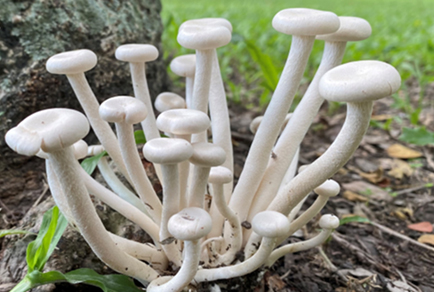
A new edible Lentinus species, described herein as L. saisamorniae, was collected from local markets and natural habitats in northern Thailand between 2019 and 2021. This species is characterized by its small to medium-sized basidiomata, white to yellowish-white pileus, broadly ellipsoid to elongate-shaped basidiospores, dimitic hyphal system, and hyphal pegs. Nonetheless, its longer basidia and smaller basidiospores make it distinguishable from L. cladopus. A molecular phylogenetic analysis of the combined internal transcribed spacer (ITS) large subunit (nrLSU) of nuclear ribosomal DNA, and RNA polymerase II large subunit (rpb1) sequences supported the monophyly of L. saisamorniae as a distinct lineage within the genus Lentinus. Therefore, this new species was introduced based on both morphological characteristics and molecular phylogeny. A full description, illustrations, color photographs, and a phylogenetic tree to show the placement of L. saisamorniae are provided. Comparisons between the new species and morphologically similar and related species are discussed.
References
- Angelini, C. (2022) Macrofungi of the Dominican Republic: a first checklist and introduction to http://www.neotropicalfungi.com. Current Research in Environmental & Applied Mycology 12: 238–258. https://doi.org/10.5943/cream/12/1/15
- Asif, M., Saba, M., Maula, F. & Raza, M. (2024) Lentinus punjabensis (Polyporaceae), a new species from Lal Suhanra National Park, southern Punjab, Pakistan. Phytotaxa 642: 169–181. https://doi.org/10.11646/phytotaxa.642.2.5
- Atri, N.S. & Lata (2013) Studies for culturing and cultivation of Lentinus cladopus Lév. Mycosphere 4: 675–682. https://doi.org/10.5943/mycosphere/4/4/3
- Berkeley, M.J. (1852) Enumeration of some fungi from St. Domingo. Annals and Magazine of Natural History Series 2 9: 192–196.
- Bononi, V.L.R., Oliveira, A.K.M., Quevedo, J.R. & Gugliotta, A.M. (2008) Fungos macroscópicos do Pantanal do Rio Negro, Mato Grosso do Sul, Brasil. Hoehnea 35: 489–511. https://doi.org/10.1590/S2236-89062008000400002
- Chandrasrikul, A., Suwanarit, P., Sangwanit, U., Lumyong, S., Payapanon, A., Sanoamuang, N., Pukahuta, C., Petcharat, V., Sardsud, U., Duengkae, K., Klinhom, U., Thongkantha, S. & Thongklam, S. (2011) Check list of Mushroom (basidiomycetes) in Thailand. Office of Natural Resources and Environmental Policy and Planning, Bangkok.
- Corner, E.J.H. (1981) The agaric genera Lentinus, Panus and Pleurotus with particular reference to Malaysian species. Nova Hedwigia 69: 1–169.
- Cui, B.K., Li, H.-J., Zhou, J.-L., Song, J., Si, J., Yang, Z.-L. & Dai, Y.-C. (2019) Species diversity, taxonomy and phylogeny of Polyporaceae (Basidiomycota) in China. Fungal Diversity 97: 137–392. https://doi.org/10.1007/s13225-019-00427-4
- Darriba, D., Taboada, G.L., Doallo, R. & Posada, D. (2012) jModelTest 2: more models, new heuristics and parallel computing. Nature Methods 9: 772. https://doi.org/10.1038/nmeth.2109
- de Leon, A.M., Reyes, R.G. & dela Cruz, T.E.E. (2013) Lentinus squarrosulus and Polyporus grammocephalus: Newly domesticated, wild edible macrofungi from the Phillipines. The Philippine Agricultural Scientist 96: 411–418.
- Dulay, R.M.R., Cabrera, E.C., Kalaw, S.P. & Reyes, R.G. (2022) Nucleotide sequencing and identification of wild mushrooms from the Philippines. Biocatalysis and Agricultural Biotechnology 27: 1878–8181. https://doi.org/10.1016/j.bcab.2020.101666
- Edgar, R.C. (2004) MUSCLE: multiple sequence alignment with high accuracy and high throughput. Nucleic Acids Research 32: 1792–1797. https://doi.org/10.1093/nar/gkh340
- Fabros, J.A., Dulay, R.M.R., De Leon, A.M., Kalaw, S.P. & Reyes, R.G (2022) Distribution, cultivation, nutritional composition, and bioactivities of Lentinus (Polyporaceae, Basidiomycetes): A review. Current Research in Environmental & Applied Mycology 12: 170–219. https://doi.org/10.5943/cream/12/1/13
- Franco-Molano, A.E., Vasco-Palacios, A.M., López-Quintero, C. & Boekhout, T. (2005) Macrohongos de la Región del Medio Caquetá—Colombia. Universidad de Antioquia, Grupo de Taxonomía y Ecología de Hongos, Medellin.
- Felsenstein, J. (1985) Confidence limits on phylogenies: an approach using bootstrap. Evolution 39: 783–791. https://doi.org/10.2307/2408678
- Fries, E.M. (1838) Epicrisis Systematis Mycologici. Uppsala: Typographia Academica, 633 pp.
- Gafforov, Y., Angelini, P., Cusumana, G., Venanzoni, R., Flores, G.A., Tomšovský, M., Yarasheva, M., Rašeta, M., Bussmann, R.W. & Rapior, S. (2023a) Lentinus arcularius (Batsch) Zmitr.; Lentinus brumalis (Pers.) Zmitr.; Lentinus ciliatus (Fr.) Zmitr.; Lentinus squarrosulus Mont.; Lentinus tigrinus (Bull.) Fr.—POLYPORACEAE. In: Khojimatov, O.K., Gafforov, Y. & Bussmann, R.W. (Eds.) Ethnobiology of Uzbekistan. ethnobiology. Springer, Cham, pp. 1253–1270. https://doi.org/10.1007/978-3-031-23031-8_117
- Gafforov, Y., Rašeta, M., Rapior, S., Yarasheva, M., Wang, X., Zhou, L., Wan-Mohtar, W.A.A.Q.I., Zafar, M., Lim, Y.W., Wang, M., Abdullaev, B., Bassmann, R.W., Zengin, G. & Chen, J. (2023b) Macrofungi as medicinal resources in Uzbekistan: Biodiversity, ethnomycology, and ethnomedicinal practices. Journal of Fungi 9: e922. https://doi.org/10.3390/jof9090922
- Gates, G., Goyes, P., Gundogdu, F., Cruz, J. & Ratkowsky, D. (2021) Small plot surveying reveals high fungal diversity in the Ecuadorian Amazon-a case study. Current Research in Environmental & Applied Mycology 11: 16–36. https://doi.org/10.5943/cream/11/1/2
- Gogoi, G. & Parkash, V. (2023) Ethnomycological knowledge of tea tribe and indigenous communities of Upper Assam, India. Indian Journal of Traditional Knowledge 22: 674–681. https://doi.org/10.56042/ijtk.v22i3.5758
- Grand, E.A., Hughes, K.W. & Petersen, R.H. (2011) Relationships within Lentinus subg. Lentinus (Polyporales, Agaricomycetes), with emphasis on sects. Lentinus and Tigrini. Mycological Progress 10: 399–413. https://doi.org/10.1007/s11557-010-0711-4
- Hall, B.G. (2013) Building phylogenetic trees from molecular data with MEGA. Molecular Biology and Evolution 30: 1229–1235. https://doi.org/10.1093/molbev/mst012
- Hermawan, R. (2021) Study of Lentinus squarrosulus from West Java on the basis of molecular and morphological data. Jurnal Biota 7: 1–8. https://doi.org/10.19109/Biota.v7i1.6378
- Hibbett, D.S. & Vilgalys, R. (1991) Evolutionary relationships of Lentinus to the Polyporaceae: evidence from restriction analysis of enzymatically amplified ribosomal DNA. Mycologia 83: 425–439. https://doi.org/10.2307/3760433
- Hyde, K.D., Norphanphoun, C., Chen, J., Dissanayake, A.J., Doilom, M., Hongsanan, S., Jayawardena, R.S., Jeewon, R., Perera, R.H., Thongbai, B., Wanasinghe, D.N., Wisitrassameewong, K., Tibpromma, S. & Stadler, M. (2018) Thailand’s amazing diversity: up to 96% of fungi in Northern Thailand may be novel. Fungal Diversity 93: 215–239. https://doi.org/10.1007/s13225-018-0415-7
- Hu, Y., Karunarathna, S.C., Li, H., Galappaththi, M.C., Zhao, C.L., Kakumyan, P. & Mortimer, P.E. (2022) The impact of drying temperature on basidiospore size. Diversity 14: e239. https://doi.org/10.3390/d14040239
- Ishaq, M., Galappaththi, M.C.A., Khan, M.B., Ullah, S., Fiaz, M. & Khalid, A.N. (2022) Lentinus squarrosulus an edible macro-fungus reported from Pakistan. Studies in Fungi 7: e6. https://doi.org/10.48130/SIF-2022-0006
- Jeewon, R. & Hyde, K.D. (2016) Establishing species boundaries and new taxa among fungi: Recommendations to resolve taxonomic ambiguities. Mycosphere 7: 1669–1677. https://doi.org/10.5943/mycosphere/7/11/4
- Justo, A., Miettinen, O., Floudas, D., Ortiz-Santana, B., Sjökvist, E., Lindner, D., Nakasone, K., Niemelä, T., Larsson, K.H., Ryvarden, L. & Hibbett, D.S. (2017) A revised family-level classification of the Polyporales (Basidiomycota). Fungal Biology 121: 798–824. https://doi.org/10.1016/j.funbio.2017.05.010
- Kakoti, M., Hazarika, D.J., Parveen, A., Dullah, S., Ghosh, A., Saha, D., Barooah, M. & Boro, R.C. (2021) Nutritional properties, antioxidant and antihaemolytic activities of the dry fruiting bodies of wild edible mushrooms consumed by ethnic communities of Northeast India. Polish Journal of Food and Nutrition Sciences 71: 463–480. https://doi.org/10.31883/pjfns/144044
- Karunarathna, S.C., Yang, Z.L., Zhao, R.L., Vellinga, E.C., Bahkali, A.H., Chukeatirote, E. & Hyde, K.D. (2011) Three new species of Lentinus from northern Thailand. Mycological Progress 10: 389–398. https://doi.org/10.1007/s11557-010-0701-6
- Kornerup, A. & Wanscher, J.H. (1978) Methuen Handbook of Colour, 3rd ed. Eyre Methuen, London, 252 pp.
- Kumla, J., Jatuwong, K., Tanruean, K., Khuna, S., Srinuanpan, S., Lumyong, S. & Suwannarach, N. (2023) A new edible wild mushroom species, Panus sribuabanensis (Panaceae, Polyporales) from northern Thailand and its nutritional composition, total phenolic content, and antioxidant activity. Mycobiology 52: 1–12. https://doi.org/10.1080/12298093.2023.2295633
- Kumla, J., Suwannarach, N. & Wannathes, N. (2021) Hymenagaricus saisamornae sp. nov. (Agaricales, Basidiomycota) from northern Thailand. Chiang Mai Journal of Science 48: 827–836.
- Kumla, J., Suwannarach, N., Wannathes, N. & Lumyong, S. (2022) Survey of Volvariella (Agaricales, Basidiomycota) including two new species, V. neovolvacea and V. thailandensis, from northern Thailand. Diversity 14: e161. https://doi.org/10.3390/d14030161
- Kumla, J., Phonrob, W., Lumyong, S. & Suwannarach, N. (2024) Crinipellis siamensis (Marasmiaceae, Agaricales), a new macrofungus from northern Thailand. Phytotaxa 666: 135–145. https://doi.org/10.11646/phytotaxa.666.2.4
- Largent, D.L., Johnson, D. & Watling, R. (1977) How to Identify Mushrooms to Genus. III. Microscopic features. Mad River, Eureka, California.
- Lau, B.F. & Abdullah, N. (2017) Bioprospecting of Lentinus squarrosulus Mont., an underutilized wild edible mushroom, as a potential source of functional ingredients: A review. Trends in Food Science & Technology 61: 116–131. https://doi.org/10.1016/j.tifs.2016.11.017
- Lee, S.M.L. & Choong, A.M.F. (2023) A Guide of Macrofungi in Singapore. National Park Board, Singapore, 229 pp.
- Lee, S.S., Chang, Y.S. & Noraswati, M.N.R. (2009) Utilization of macrofungi by some indigenous communities for food and medicine in Peninsular Malaysia. Forest Ecology and Management 257: 2062–2065. https://doi.org/10.1016/j.foreco.2008.09.044
- Liu, S., Zhou, J.L., Song, J., Sun, Y.F., Dai, Y.C. & Cui, B.K. (2023) Climacocystaceae fam. nov. and Gloeoporellaceae fam. nov., two new families of Polyporales (Basidiomycota). Frontiers in Microbiology 14: e1115761. https://doi.org/10.3389/fmicb.2023.1115761
- Matheny, P.B., Liu, Y.J., Ammirati, J.F. & Hall, B.D. (2002) Using RPB1 sequences to improve phylogenetic inference among mushrooms (Inocybe, Agaricales). American Journal of Botany 89: 688–698. https://doi.org/10.3732/ajb.89.4.688
- Mensah, D.L.N. & Obodai, M. (2014) Morphological characteristics of mycelia growth of two strains of the indigenous medicinal mushroom, Lentinus squarrosulus Mont. (Singer), on solid media. African Journal of Agriculture Research 9: 1753–1760. https://doi.org/10.5897/AJAR2013.8340
- Minter, D.W., Rodríguez-Hernández, M. & Mena-Portales, J. (2001) Fungi of the Caribbean. An annotated checklist. PDMS Publs, Isleworth, UK, 946 pp.
- Paloi, S., Kumla, J., Karunarathna, S.C., Lumyong, S. & Suwannarach, N. (2023) Taxonomic and phylogenetic evidence reveal two new Russula species (Russulaceae, Russulales) from northern Thailand. Mycological Progress 22: e72. https://doi.org/10.1007/s11557-023-01921-5
- Pegler, D.N. (1977) A preliminary agaric flora of East Africa. Kew Bulletin Additional Series 6: 1–615.
- Pegler, D.N. (1983) The genus Lentinus: a world monograph. Kew Bulletin Additional Series 10: 1–281.
- Pegler, D.N. (1986) Agric flora of Sri Lanka. Kew Bulletin Additional Series 7: 1–519.
- Rambaut, A. (2012) FigTree. Available from: http://tree.bio.ed.ac.uk/software/figtree/ (accessed 27 February 2025)
- Ronquist, F., Teslenko, M., Van der Mark, P., Ayres, D.L., Darling, A., Höhna, S., Larget, B., Liu, L., Suchard, M.A. & Huelsenbeck, J.P. (2012) MrBayes 3.2: efficient Bayesian phylogenetic inference and model choice across a large model space. Systematic Biology 61: 539–542. https://doi.org/10.1093/sysbio/sys029
- Seelan, J.S.S., Justo, A., Nagy, L.G., Grand, E.A., Redhead, S.A. & Hibbett, D. (2015) Phylogenetic relationships and morphological evolution in Lentinus, Polyporellus and Neofavolus, emphasizing southeastern Asian taxa. Mycologia 107: 460–474. https://doi.org/10.3852/14-084
- Singer, R. (1956) The Pleurotus-Hirtus-Complex. Mycologia 48: 852–859. https://doi.org/10.2307/3755711
- Singer, R. (1986) The Agaricales in modern taxonomy, 4th edn. Koeltz, Koenigstein, Germany.
- Sotome, K., Hattori, T., Ota, Y. & Kakishima, M. (2009) Second report of Polyporus longiporus and its phylogenetic position. Mycoscience 50: 415–420. https://doi.org/10.1007/s10267-009-0506-0
- Stamatakis, A. (2006) RAxML-VI-HPC: maximum likelihood-based phylogenetic analyses with thousands of taxa and mixed models. Bioinformatics 22: 2688–2690. https://doi.org/10.1093/bioinformatics/btl446
- Suwannarach, N., Kumla, J., Khuna, S., Wannathes, N., Thongklang, N., Sysouphanthong, P., Luangharn, T., Wongkanoun, S., Karunarathna, S.C., Liu, Y.S., Boonpratuang, T., Wiriyathanawudhiwong, N., Choeyklin, R., Hyde, K.D. & Lumyong, S. (2022a) History of Thai mycology and resolution of taxonomy for Thai macrofungi confused with Europe and American names. Chiang Mai Journal of Science 49: 654–683. https://doi.org/10.12982/CMJS.2022.052
- Suwannarach, N., Kumla, J., Pathom-aree, W., Hyde, K.D. & Lumyong, S. (2022b) Changes in the understanding of fungal diversity based on research in the tropics. Chiang Mai Journal of Science 49: v–viii. https://doi.org/10.12982/CMJS.2022.061
- Suwannarach, N., Kumla, J., Lu, W., Kaewnunta, A., Thongklang, N., Sysouphanthong, P., Liu, S.L., Luangharn, T., Wannathes, N., Walker, A., Kraisitudomsook, N., Nutaratat, P., Wongkanoun, S., Charria-Girón, E., Karunarathna, S.C., Pathom-aree, W. & Lumyong, S. (2025) Revised and updated checklist of Macrofungi in Thailand – II. Chiang Mai Journal of Science 52: e2025027. https://doi.org/10.12982/CMJS.2025.027
- Sysouphanthong, P., Taliam, W., Wannasawang, N. & Thongklang, N. (2023) The genus Lentinus in Thailand: taxonomy, cultivation tests, nutritional analysis and screening for the biological activity of wild strains. Current Research in Environmental & Applied Mycology 13: 136–161. https://doi.org/10.5943/cream/13/1/10
- Tamura, K., Stecher, G., Petersen, D., Filipsky, A. & Kumar, S. (2013) MEGA6: molecular evolutionary genetics analysis version 6.0. Molecular Biology and Evolutionary 30: 2725–2729. https://doi.org/10.1093/molbev/mst197
- Vellinga, E.C. & Noordeloos, M.E. (2001) Glossary. In: Noordeloos, M.E., Kuyper, T.W. & Vellinga, E.C. (Eds.) Flora Agaricina Neerlandica. Vol. 5. A.A. Balkema, Tokyo, Japan, pp. 6–11.
- Vilgalys, R. & Hester, M. (1990) Rapid genetic identification and mapping of enzymatically amplified ribosomal DNA from several Cryptococcus species. Journal of Bacteriology 172: 4238–4246. https://doi.org/10.1128/jb.172.8.4238-4246.1990
- Vinjusha, N. & Kumar, T.K. (2021) Two new combinations in the genus Panus (Panaceae, Polyporales) based on morphology and molecular phylogeny. Phytotaxa 514: 287–294. https://doi.org/10.11646/phytotaxa.514.3.8
- Vasco-Palacios, A.M., Franco-Molano, A.E., López-Quintero, C.A. & Boekhout, T. (2005) Macromycetes (Ascomycota, Basidiomycota) de la región del medio Caquetá, departamentos de Caquetá y Amazonas Colombia. Biota Colombiana 6: 127–140.
- Vu, D., Groenewald, M., de Vries, M., Gehrmann, T., Stielow, B., Eberhardt, U., Al-Hatmi, A., Groenewald, J.Z., Cardinali, G., Houbraken, J., Boekhout, T., Crous, P.W., Robert, V. & Verkley, G.J.M. (2019) Large-scale generation and analysis of filamentous fungal DNA barcodes boosts coverage for kingdom fungi and reveals thresholds for fungal species and higher taxon delimitation. Study in Mycology 92: 135–154. https://doi.org/10.1016/j.simyco.2018.05.001
- Wannathes, N., Suwannarach, N., Khuna, S. & Kumla, J. (2022) Two novel species and two new records within the genus Pluteus (Agaricomycetes, Agaricales) from Thailand. Diversity 14: 156. https://doi.org/10.3390/d14030156
- White, T.J., Burns, T., Lee, S. & Taylor, J.W. (1990) Amplification and direct sequencing of fungal ribosomal RNA genes for phylogenetics. In: Innis, M.A., Gelfand, D.H., Sninsky, J.J. & White, T.J. (Eds.) PCR protocols: a guide to methods and applications. Academic Press, New York, pp. 315–322. https://doi.org/10.1016/B978-0-12-372180-8.50042-1
- Wijayawardene, N.N., Hyde, K.D., Dai, D.Q., Sánchez-García, M., Goto, B.T., Saxena, R.K., Erdoğdu, M., Selçuk, F., Rajeshkumar, K.C., Aptroot, A., Błaszkowski, J., Boonyuen, N., da Silva, G., de Souza, F.A., Dong, W., Ertz, D., Haelewaters, D., Jones, E.B.G., Karunarathna, S.C., Kirk, P.M., Kukwa, M., Kumla, J., Leontyev, D.V., Lumbsch, H.T., Maharachchikumbura, S.S.N., Marguno, F., Martínez-Rodríguez, P., Mešić, A., Monteiro, J.S., Oehl, F., Pawłowska, J., Pem, D., Pfliegler, W.P., Phillips, A.J.L., Pošta, A., He, M.Q., Li, J.X., Raza, M., Sruthi, O.P., Suetrong, S., Suwannarach, N., Tedersoo, L., Thiyagaraja, V., Tibpromma, S., Tkalčec, Z., Tokarev, Y.S., Wanasinghe, D.N., Wijesundara, D.S.A., Wimalaseana, S.D.M.K., Madrid, H., Zhang, G.Q., Gao, Y., Sánchez-Castro, I., Tang, L.Z., Stadler, M., Yurkov, A. & Thines, M. (2022) Outline of Fungi and fungus-like taxa—2021. Mycosphere 13: 53–453. https://doi.org/10.5943/mycosphere/13/1/2
- Zhou, J.L., Zhu, L., Chen, H. & Cui, B.K. (2016) Taxonomy and phylogeny of Polyporus group Melanopus (Polyporales, Basidiomycota) from China. PLoS One 11: e0159495. https://doi.org/10.1371/journal.pone.0159495