

Abstract
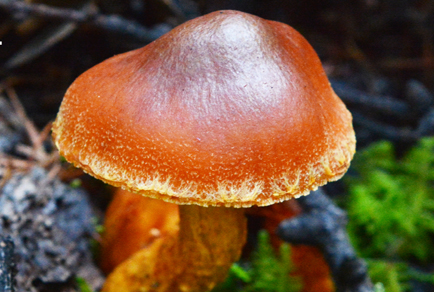
The genus Aureonarius belongs to the family Cortinariaceae. In this study, phylogenetic inferences of Aureonarius were conducted based on sequences from a multi-locus dataset (ITS, nrLSU, RPB1, RPB2). A new species of Aureonarius discovered in Yunnan province of China was described based on morphological and molecular evidence. Aureonarius baimaensis is characterized by its medium-sized basidiomata; brownish-orange to reddish-brown tinge pileus and a pastel yellow tinge in the context; smooth central surface, with yellowish white to butter yellow finely fibrils near the edge; it typically has sterile lamella edges composed of smaller clavate cells. Morphological description, illustrations, and phylogenetic result of the new species are provided, as well as their comparisons to related taxa.
References
- Ammirati, J., Garnica, S., Halling, R.E., Mata, M., Mueller, G.M. & Carranza, J. (2007) New Cortinarius species associated with Quercus and Comarostaphylis in Costa Rica. Canadian Journal of Botany 85 (9): 794–812. https://doi.org/10.1139/b07-067
- Anisimova, M., Gil, M., Dufayard, J.F., Dessimoz, C. & Gascuel, O. (2011) Survey of branch support methods demonstrates accuracy, power, and robustness of fast likelihood-based approximation schemes. Systematic Biology 60 (5): 685–699. https://doi.org/10.1093/sysbio/syr041
- Bhunjun, C.S., Niskanen, T., Suwannarach, N., Wannathes, N., Chen, Y.J., McKenzie, E.H.C., Maharachchikumbura, S.S.N., Buyck, B., Zhao, C.L., Fan, Y.G., Zhang, J.Y., Dissanayake, A.J., Marasinghe, D.S., Jayawardena, R.S., Kumla, J., Padamsee, M., Chen, Y.Y., Liimatainen, K., Ammirati, J.F., Phukhamsakda, C., Liu, J.K., Phonrob, W., Randrianjohany, É., Hongsanan, S., Cheewangkoon, R., Bundhun, D., Khuna, S., Yu, W.J., Deng, L.S., Lu, Y.Z., Hyde, K.D. & Lumyong, S. (2022) The numbers of fungi: are the most speciose genera truly diverse? Fungal Diversity 114 (1): 387–462. https://doi.org/10.1007/s13225-022-00501-4
- Cubeta, M.A. (1991) Characterization of anastomosis groups of binucleate Rhizoctonia species using restriction analysis of an amplified ribosomal RNA gene. Phytopathology 81 (11): 1395. https://doi.org/10.1094/phyto-81-1395
- Dai, X. (2023) Study on resources of Cortinarius s.l. in Northwest China. Northwest Normal University, Lanzhou, 77 pp. [in Chinese]
- Gallone, B., Kuyper, T.W. & Nuytinck, J. (2024) The genus Cortinarius should not (yet) be split. IMA Fungus 15 (1): 24. https://doi.org/10.1186/s43008-024-00159-4
- Garnica, S., Weiß, M. & Oberwinkler, F. (2003) Morphological and molecular phylogenetic studies in South American Cortinarius species. Mycological Research 107 (10): 1143–1156. https://doi.org/10.1017/s0953756203008414
- Garnica, S., Weiß, M., Oertel, B. & Oberwinkler, F. (2005) A framework for a phylogenetic classification in the genus Cortinarius (Basidiomycota, Agaricales) derived from morphological and molecular data. Canadian Journal of Botany 83 (11): 1457–1477. https://doi.org/10.1139/b05-107
- Gray, S.F. (1821) A natural arrangement of British plants. Baldwin, Cradock and Joy.
- Guindon, S., Dufayard, J.F., Lefort, V., Anisimova, M., Hordijk, W. & Gascuel, O. (2010) New algorithms and methods to estimate Maximum-Likelihood phylogenies: assessing the performance of PhyML 3.0. Systematic Biology 59 (3): 307–321. https://doi.org/10.1093/sysbio/syq010
- Harrower, E., Ammirati, J.F., Cappuccino, A.A., Ceska, O., Kranabetter, J.M., Kroeger, P., Lim, S., Taylor, T. & Berbee, M.L. (2011) Cortinarius species diversity in British Columbia and molecular phylogenetic comparison with European specimen sequences. Botany 89 (11): 799–810. https://doi.org/10.1139/b11-065
- Hu, Y., Karunarathna, S.C., Li, H., Galappaththi, M.C.A., Zhao, C.L., Kakumyan, P. & Mortimer, P.E. (2022) The impact of drying temperature on basidiospore size. Diversity 14 (4): 239. https://doi.org/10.3390/d14040239
- Katoh, K. & Standley, D.M. (2013) MAFFT multiple sequence alignment software Version 7: improvements in performance and usability. Molecular Biology and Evolution 30 (4): 772–780. https://doi.org/10.1093/molbev/mst010
- Kornerup, A. & Wanscher, J.H. (1978) Methuen handbook of colour (3rd ed.). Eyre Methuen Ltd, London.
- Lanfear, R., Frandsen, P.B., Wright, A.M., Senfeld, T. & Calcott, B. (2016) PartitionFinder 2: new methods for selecting partitioned models of evolution for molecular and morphological phylogenetic analyses. Molecular Biology and Evolution 34 (3): 772–773. https://doi.org/10.1093/molbev/msw260
- Letunic, I. & Bork, P. (2024) Interactive Tree of Life (iTOL) v6: recent updates to the phylogenetic tree display and annotation tool. Nucleic Acids Research 52 (W1): W78–W82. https://doi.org/10.1093/nar/gkae268
- Liimatainen, K. (2016) Nomenclatural novelties. Index Fungorum 294: 1.
- Liimatainen, K., Kim, J.T., Pokorny, L., Kirk, P.M., Dentinger, B. & Niskanen, T. (2022) Taming the beast: a revised classification of Cortinariaceae based on genomic data. Fungal Diversity 112 (1): 89–170. https://doi.org/10.1007/s13225-022-00499-9
- Matheny, P.B. (2005) Improving phylogenetic inference of mushrooms with RPB1 and RPB2 nucleotide sequences (Inocybe; Agaricales). Molecular phylogenetics and evolution 35 (1): 1–20. https://doi.org/10.1016/j.ympev.2004.11.014
- Minh, B.Q., Nguyen, M.A.T. & von Haeseler, A. (2013) Ultrafast approximation for phylogenetic bootstrap. Molecular Biology and Evolution 30 (5): 1188–1195. https://doi.org/10.1093/molbev/mst024
- Nguyen, L.T., Schmidt, H.A., von Haeseler, A. & Minh, B.Q. (2015) IQ-TREE: a fast and effective stochastic algorithm for estimating Maximum-Likelihood phylogenies. Molecular Biology and Evolution 32 (1): 268–274. https://doi.org/10.1093/molbev/msu300
- Niskanen, T., Liimatainen, K., Kytövuori, I., Lindström, H., Dentinger, B.T.M. & Ammirati, J.F. (2016) Cortinarius subgenus Callistei in North America and Europe—type studies, diversity, and distribution of species. Mycologia 108 (5): 1018–1027. https://doi.org/10.3852/16-033
- Peintner, U., Horak, E., Moser, M.M. & Vilgalys, R. (2002) Phylogeny of Rozites, Cuphocybe and Rapacea inferred from ITS and LSU rDNA sequences. Mycologia 94 (4): 620–629. https://doi.org/10.1080/15572536.2003.11833190
- Rathnayaka, A.R., Tennakoon, D.S., Jones, G.E., Wanasinghe, D.N., Bhat, D.J., Priyashantha, A.H., Stephenson, S.L., Tibpromma, S. & Karunarathna, S.C. (2025) Significance of precise documentation of hosts and geospatial data of fungal collections, with an emphasis on plant-associated fungi. New Zealand Journal of Botany 63 (2–3): 462–489. https://doi.org/10.1080/0028825X.2024.2381734
- Ronquist, F., Teslenko, M., van der Mark, P., Ayres, D.L., Darling, A., Höhna, S., Larget, B., Liu, L., Suchard, M.A. & Huelsenbeck, J.P. (2012) MrBayes 3.2: efficient Bayesian phylogenetic inference and model choice across a large model space. Systematic Biology 61 (3): 539–542. https://doi.org/10.1093/sysbio/sys029
- Soop, K., Cooper, J.A., Nilsen, A.R. & Orlovich, D.A. (2022) Cortinarius subgenus Leprocybe (Agaricales) in New Zealand. New Zealand Journal of Botany 61 (4): 282–303. https://doi.org/10.1080/0028825x.2022.2129077
- Soop, K., Cooper, J.A., Nilsen, A.R., Siegel, N. & Orlovich, D.A. (2023) Review of phlegmacioid Cortinariaceae (Agaricales) in New Zealand. New Zealand Journal of Botany 63 (1): 78–107. https://doi.org/10.1080/0028825x.2023.2255159
- Soop, K., Dima, B., Cooper, J.A., Park, D. & Oertel, B. (2019) A phylogenetic approach to a global supraspecific taxonomy of Cortinarius (Agaricales) with an emphasis on the southern mycota. Persoonia-Molecular Phylogeny and Evolution of Fungi 42 (1): 261–290. https://doi.org/10.3767/persoonia.2019.42.10
- Soop, K., Wallace, M. & Dima, B. (2018) New Cortinarius (Agaricales) species described from New Zealand. New Zealand Journal of Botany 56 (2): 163–182. https://doi.org/10.1080/0028825x.2018.1436574
- Stefani, F.O.P., Jones, R.H. & May, T.W. (2013) Concordance of seven gene genealogies compared to phenotypic data reveals multiple cryptic species in Australian dermocyboid Cortinarius (Agaricales). Molecular phylogenetics and evolution 71: 249–260. https://doi.org/10.1016/j.ympev.2013.10.019
- Stiller, J.W. & Hall, B.D. (1997) The origin of red algae: Implications for plastid evolution. Proceedings of the National Academy of Sciences 94 (9): 4520–4525. https://doi.org/10.1073/pnas.94.9.4520
- Talavera, G. & Castresana, J. (2007) Improvement of phylogenies after removing divergent and ambiguously aligned blocks from protein sequence alignments. Systematic Biology 56 (4): 564–577. https://doi.org/10.1080/10635150701472164
- Vilgalys, R. & Hester, M. (1990) Rapid genetic identification and mapping of enzymatically amplified ribosomal DNA from several Cryptococcus species. Journal of Bacteriology 172 (8): 4238–4246. https://doi.org/10.1128/jb.172.8.4238-4246.1990
- Wang, Z.R., Zhou, S.Y., Liu, F.F. & Yang, Z.L. (2025) The genus Thaxterogaster (Cortinariaceae): phylogeny and species diversity in Western China. Mycology 1–39. https://doi.org/10.1080/21501203.2024.2441178
- White, T.J., Bruns, T., Lee, S. & Taylor, J. (1990) Amplification and direct sequencing of fungal ribosomal RNA genes for phylogenetics. PCR Protocols: a guide to methods and application 18 (1): 315–322.
- Xie, M.L., Wei, T.Z., Fu, Y.P., Li, D., Qi, L.L., Xing, P.J., Cheng, G.H., Ji, R.Q. & Li, Y. (2020) Three new species of Cortinarius subgenus Telamonia (Cortinariaceae, Agaricales) from China. MycoKeys 69: 91–109. https://doi.org/10.3897/mycokeys.69.49437
- Xie, M.L., Chen, J.L., Phukhamsakda, C., Dima, B., Fu, Y.P., Ji, R.Q., Wang, K., Wei, T.Z. & Li, Y. (2021) Cortinarius subsalor and C. tibeticisalor spp. nov., two new species from the section Delibuti from China. PeerJ 9: e11982. https://doi.org/10.7717/peerj.11982
- Zhang, D., Gao, F., Jakovlić, I., Zou, H., Zhang, J., Li, W.X. & Wang, G.T. (2020) PhyloSuite: An integrated and scalable desktop platform for streamlined molecular sequence data management and evolutionary phylogenetics studies. Molecular ecology resources 20 (1): 348–355. https://doi.org/10.1111/1755-0998.13096