

Abstract
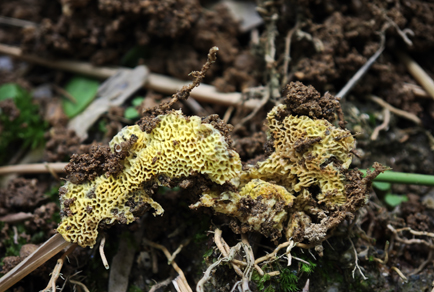
During a survey of macrofungi in Anhui Province, China, two interesting specimens of Lindtneria were collected; based on morphology and multigene phylogenetic analysis, the two specimens are described as a new species, L. terrestris. The species is characterized by poroid basidiomata with irregular pores, buff-yellow to light-yellow pore surface when fresh, a monomitic hyphal system having septate generative hyphae with or without clamp connections, cylindrical to subclavate basidia frequently with cyanophilous globules, and globose to subglobose, yellowish to yellow basidiospores with irregularly arranged conical spines measuring 7–8 × 6.8–7.7 µm. Phylogenetic analyses using the internal transcribed spacer regions (ITS), the large subunit of the nuclear ribosomal RNA gene (nLSU), and the translation elongation factor 1-α gene (tef1-α) provided high support for L. terrestris as a new species in the family Stephanosporaceae. A full description, illustrations, and phylogenetic analysis results of the new species are provided here. A key to Lindtneria is also provided.
References
- Anonymous. (1969) Flora of British fungi. Colour identification chart. Her Majesty’s Stationery Office, London.
- Bernicchia, A. & Gorjón, S.P. (2010) Fungi Europaei 12. Corticiaceae s.l.. Edizioni Candusso, Alassio, 1008 pp.
- Binder, M., Larsson, K.H., Matheny, P.B. & Hibbett, D.S. (2010) Amylocorticiales ord. nov. and jaapiales ord. nov.: early diverging clades of agaricomycetidae dominated by corticioid forms. Mycologia 102 (4): 865–880. https://doi.org/10.3852/09-288
- Dai, Y.C. (2010) Hymenochaetaceae (Basidiomycota) in China. Fungal Diversity 45: 131–343. https://doi.org/10.1007/s13225-010-0066-9
- Dai, Y.C. (2011) A revised checklist of corticioid and hydnoid fungi in China for 2010. Mycoscience 52: 69–79. https://doi.org/10.1007/S10267-010-0068-1
- Dai, Y.C. (2012) Polypore diversity in China with an annotated checklist of Chinese polypores. Mycoscience 53: 49–80. https://doi.org/10.1007/s10267-011-0134-3
- De la Fuente, J.I., Guevara-Guerrero, G., López, C.Y. & García-Jiménez, J. (2018) First record of Mayamontana coccolobae (Stephanosporaceae: Agaricales) from Mexico. Studies in Fungi 3 (1): 34–38. https://doi.org/10.5943/sif/3/1/5
- De la Fuente, J.I., Guevara-Guerrero, G., Oros-Ortega, I., Romeo Jr., Ordova-Lara, I. & Arcia-Jimenez, J. (2019) Stephanospora mayana (Stephanosporaceae, Russulales), a new sequestrate fungus from Yucatan Peninsula, Mexico. MycoKeys 48: 115–124. https://doi.org/10.3897/mycokeys.48.31007
- Dong, J.H., Li, Q., Yuan, Q., Luo, Y.X., Zhang, X.C., Dai, Y.F., Zhou, Q., Liu, X.F., Deng, Y.L., Zhou, H.M., Zhao, C.L. & Muhammad, A. (2024) Species diversity, taxonomy, molecular systematics and divergence time of wood-inhabiting fungi in Yunnan-Guizhou Plateau, Asia. Mycosphere 15 (1): 1110–1293. https://doi.org/10.5943/mycosphere/15/1/10
- Gilbertson, R.L. & Ryvarden, L. (1986) North American Polypores. Vol. 1. 443 pp.
- Hall, T.A. (1999) Bioedit: a user-friendly biological sequence alignment editor and analysis program for Windows 95/98/NT. Nucleic Acids Symposium Series 41: 95–98.
- He, M.Q., Cao, B., Liu, F., Boekhout, T., Denchev, T.T., Power, N., Denchev, C.M., Kemler, M., Gorjón, S.P., Begerow, D., Valenzuela, R., Davoodian, N., Niskanen, T., Vizzini, A., Redhead, S.A., RamírezCruz, V., Papp, V., Dudka, V.A., Dutta, A.K., García-Sandoval, R., Liu, X.Z., Kijpornyongpan, T., Savchenko, A., Tedersoo, L., Theelen, B., Trierveiler-Pereira, L., Wu, F., Zamora, J.C., Zeng, X.Y., Zhou, L.W., Liu, S.L., Ghobad-Nejhad, M., Giachini, A.J., Li, G.J., Kakishima, M., Olariaga, I., Haelewaters, D., Sulistyo, B., Sugiyama, J., Svantesson, S., Yurkov, A., Alvarado, P., Antonín, V., da Silva, A.F., Druzhinina, I., Gibertoni, T.B., Guzmán, D.L., Justo, A., Karunarathna, S.C., Galappaththi, M.C.A., Toome-Heller, M., Hosoya, T., Liimatainen, K., Márquez, R., Mešić, A., Moncalvo, J.M., Nagy, L.C., Varga, T., Orihara, T., Raymundo, T., Salcedo, I., Silva-Filho, A.G.S., Tkalčec, Z., Wartchow, F., Zhao, C.L., Bau, T., Cabarroi-Hernández, M., Cortés, P.A., Decock, C., De Lange, R., Weiss, M., Menolli, N., Nilsson, R.H., Fan, Y.G., Verbeken, A., Gaforov, Y., Meiras-Ottoni, A., Mendes-Alvarenga, R.L., Zeng, N.K., Wu, Q., Hyde, K.D., Kirk, P.M. & Zhao, R.L. (2024) Phylogenomics, divergence times and notes of orders in Basidiomycota. Fungal Diversity 126 (3): 1–280. https://doi.org/10.1007/s13225-024-00535-w
- Hu, Y., Karunarathna, S.C., Li, H., Galappaththi, M.C., Zhao, C.L., Kakumyan, P. & Mortimer, P.E. (2022) The impact of drying temperature on basidiospore size. Diversity 14 (4): 239.
- Kalyaanamoorthy, S., Minh, B.Q., Wong, T.K.F., Haeseler, A.V. & Jermiin, L.S. (2017) ModelFinder: fast model selection for accurate phylogenetic estimates. Nature Methods 14: 587–589. https://doi.org/10.1038/nmeth.4285
- Katoh, K. & Standley, D.M. (2013) MAFFT multiple sequence alignment software version 7: improvements in performance and usability. Molecular Phylogenetics and Evolution 30: 772–780. https://doi.org/10.1093/molbev/mst010
- Larsen, M.J. (1986) Lindtneria thujutsugina sp. nov. (Stephanosporales, Stephanosporaceae) and notes on other resupinate basidiomycetes with ornamented basidiospores. Nova Hedwigia 43: 255–267.
- Larsen, M.J. (2000) Lindtneria lowei sp. nov. (Stephanosporales, Stephanosporaceae). Mycotaxon 75: 131–135.
- Larsson, K.H. (2007) Re-thinking the classification of corticioid fungi. Mycological Research 111: 1040–1063. https://doi.org/10.1016/j.mycres.2007.08.001
- Lebel, T., Castellano, M.A. & Beever, R.E. (2015) Cryptic diversity in the sequestrate genus Stephanospora (Stephanosporaceae: Agaricales) in Australasia. Fungal Biology 119: 201–228. https://doi.org/10.1016/j.funbio.2014.12.007
- Liu, S.L., Wu, F. & He, S.H. (2016) Lindtneria asiae-orientalis sp. nov. (Stephanosporaceae, Basidiomycota) from China based on morphological and molecular characters. Phytotaxa 260 (3): 283–290. https://doi.org/10.11646/phytotaxa.260.3.8
- Liu, Z.B., Liu, H.G., Vlasák, J., Gatesm, G.M., Dai, Y.C. & Yuan, Y. (2025) Global diversity and phylogeny of Incrustoporiaceae (Polyporales, Basidiomycota) with an emphasis on Skeletocutis. Mycology. https://doi.org/10.1080/21501203.2024.2448145
- María, P., Martín, R.S. & Telleria, M.T. (2004) Molecular analyses confirm the relationship between Stephanospora caroticolor and Lindtneria trachyspora. Mycotaxon 90 (1): 133–140.
- Martin, M.P., Raidl, S. & Telleria, M.T. (2004) Molecular analyses confirm the relationship between Stephanospora caroticolor and Lindtneria trachyspora. Mycotaxon 90: 133–140.
- Matheny, P.B., Curtis, J.M., Hofstetter, V., Aime, M.C., Moncalvo, J.M., Ge, Z.W., Slot, J.C., Ammirati, J.F., Baroni, T.J., Bougher, N.L., Hughes, K.W., Lodge, D.J., Kerrigan, R.W., Seidl, M.T., Aanen, D.K., DeNitis, M., Daniele, G.M., Desjardin, D.E., Kropp, B.R., Norvell, L.L., Parker, A. & Hibbett, D.S. (2006) Major clades of Agaricales: a multilocus phylogenetic overview. Mycologia 98 (6): 982–995. https://doi.org/10.1080/15572536.2006.11832627
- Miller, M.A., Pfeiffer, W. & Schwartz, T. (2012) The CIPRES science gateway: enabling high-impact science for phylogenetics researchers with limited resources. In: proceedings of the 1st conference of the extreme science and engineering discovery environment: bridging from the extreme to the campus and beyond. Association for Computing Machinery USA, pp. 1–8. https://doi.org/10.1145/2335755.2335836
- Oberwinkler, F. & Horak, E. (1979) Stephanosporaceae, eine neue familie der Basidiomycetes mit aphyllophoralen und gastroiden fruchtkörpern. Plant Systematics and Evolution 131: 157–164. https://doi.org/10.1007/BF00984129
- Petersen, J.H. (1996) The Danish Mycological Society’s colour-chart. Foreningen til Svampekundskabens Fremme, Greve.
- Rathnayaka, A.R., Tennakoon, D.S., Jones, G.E., Wanasinghe, D.N., Bhat, D.J., Priyashantha, A.H., Stephenson, S.L., Tibpromma, S. & Karunarathna, S.C. (2025) Significance of precise documentation of hosts and geospatial data of fungal collections, with an emphasis on plant-associated fungi. New Zealand Journal of Botany 63 (2–3): 462–489. https://doi.org/10.1080/0028825X.2024.2381734
- Rehner, S.A. & Buckley, E. (2005) Beauveria phylogeny inferred from nuclear ITS and EF1-α sequences: evidence for cryptic diversification and links to Cordyceps teleomorphs. Mycologia 97: 84–98. https://doi.org/10.3852/mycologia.97.1.84
- Reid, D.A. (1975) A new species of Lindtneria (Basidiomycetes). Kew Bulletin 30 (4): 597–600. https://doi.org/10.2307/4102901
- Ronquist, F., Teslenko, M., van der Mark, P., Ayres, D.L., Darling, A., Hӧhna, S., Larget, B., Liu, L., Suchard, M.A. & Huelsenbeck, J.P. (2012) Mrbayes 3.2: efficient Bayesian phylogenetic inference and model choice across a large model space. Systematic Biology 61: 539–542. https://doi.org/10.1093/sysbio/sys029
- Ryvarden, L. & Melo, I. (2014) Poroid fungi of Europe. Synopsis Fungorum 31: 1–455.
- Ryvarden, L. & Gilbertson, R.L. (1993) European polypores. Part 1. Synopsis Fungorum 6: 1–387.
- Thompson, J.D., Gibson, T.J., Plewniak, F., Jeanmougin, F. & Higgins, T.G. (1997) The Clustal_X windows interface: flexible strategies for multiple sequence alignment aided by quality analysis tools. Nucleic Acids Research 25: 4876–4882. https://doi.org/10.1093/nar/25.24.4876
- Wang, C.G., Dai, Y.C., Kout, J., Gates, G.M., Liu, H.G., Yuan, Y. & Vlasák, J. (2024) Multi-gene phylogeny and taxonomy of Physisporinus (Polyporales, Basidiomycota). Mycosphere 15: 1455–1521. https://doi.org/10.1080/21501203.2024.2379476
- Wang, Y.R., Wu, Y.D., Vlasák, J., Yuan, Y. & Dai, Y.C. (2021) Phylogenetic analysis demonstrating four new species in Megasporoporia sensu lato (Polyporales, Basidiomycota). Mycosphere 12 (1): 1012–1037. https://doi.org/10.5943/mycosphere/12/1/11
- White, T.J., Bruns, T., Lee, S. & Taylor, J. (1990) Amplification and direct sequencing of fungal ribosomal RNA genes for phylogenetics. In: Innis, M.A., Gelfand, D.H., Sninsky, J.J. & White, T.J. (Eds.) PCR protocols: a guide to methods and applications. Academic Press, San Diego, pp. 315–322. https://doi.org/10.1016/B978-0-12-372180-8.50042-1
- Wu, F., Zhou, L.W., Vlasák, J. & Dai, Y.C. (2022) Global diversity and systematics of Hymenochaetaceae with poroid hymenophore. Fungal Diversity 113: 1–192. https://doi.org/10.1007/s13225-021-00496-4
- Zhao, C.L., Qu, M.H., Huang, R.X. & Karunarathna, S.C. (2023) Multi-gene phylogeny and taxonomy of the wood-rotting fungal genus Phlebia sensu lato (Polyporales, Basidiomycota). Journal of Fungi 9: 320. https://doi.org/10.3390/jof9030320