

Abstract
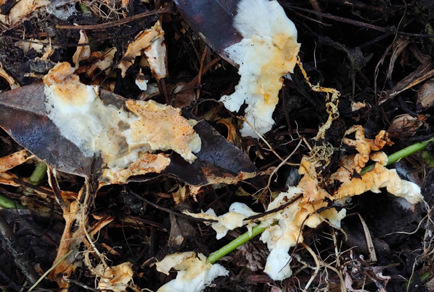
Lindtneria borinquensis sp. nov. is described from Puerto Rico, and characterized by a slightly tuberculate hymenophore, clamped generative hyphae, lack of cystidia and globose- subglobose basidiospores. Phylogenetically, the species presents an isolated position among other undescribed Lidntneria species and environmental samples.
References
- Akaike, H. (1974) A new look at the statistical model identification. IEEE Transactions on Automatic Control 19 (6): 716–723. https://doi.org/10.1109/TAC.1974.1100705
- Bernicchia, A. (2005) Polyporaceae s.l. Fungi Europaei 10. Candusso, Alassio, Italia, 808 pp.
- Bernicchia, A. & Ryvarden, L. (1998) A new species of Lindtneria from Italy. Mycological Research 102 (4): 502–504. https://doi.org/10.1017/S0953756297005121
- Bernicchia, A. & Gorjón, S.P. (2010) Corticiaceae s.l. Fungi Europaei 12. Candusso, Alassio, Italia, 1008 pp.
- Bourdot, H. & Galzin, A. (1925) Hyménomycètes de France (XI. Porés). Bulletin de la Société Mycologique de France 41 (1–2): 98–255.
- Castellano, M.A., Trappe, J.M. & Lodge, D.J. (2007) Mayamontana coccolobae (Basidiomycota), a new sequestrate taxon from Belize. Mycotaxon 100: 289–294.
- Chernomor, O., von Haeseler, A. & Minh, B.Q. (2016) Terrace aware data structure for Phylogenomic inference from Supermatrices. Systematic Biology 65 (6): 997–1008. https://doi.org/10.1093/sysbio/syw037
- Edwards, I.P. & Zak, D.R. (2010) Phylogenetic similarity and structure of Agaricomycotina communities across a forested landscape. Molecular Ecology 19 (7): 1469–1482. https://doi.org/10.1111/j.1365-294X.2010.04566.x
- Eriksson, J. & Ryvarden, L. (1975) The Corticiaceae of North Europe vol 3, Coronicium—Hyphoderma. Fungiflora, pp. 288–546.
- Fraiture, A. (2013) Synopsis du genre Lindtneria. Scripta Botanica Belgica 51: 17–38.
- Gilbertson, R.L. & Ryvarden, L. (1986) North American Polypores 1. 443 pp.
- Ginns, J. (1998) Genera of the North American Corticiaceae sensu lato. Mycologia 90 (1): 1–35. https://doi.org/10.1080/00275514.1998.12026875
- Guindon, S., Dufayard, J.F., Lefort, V., Anisimova, M., Hordijk, W. & Gascuel, O. (2010) New algorithms and methods to estimate Maximum-Likelihood phylogenies: Assessing the Performance of PhyML 3.0. Systematic Biology 59 (3): 307–321. https://doi.org/10.1093/sysbio/syq010
- Hall, T.A. (1999) BioEdit: a user-friendly biological sequence alignment editor and analysis program for Windows 95/ 98/NT. Nucleic Acids Symposium Series 41: 95–98.
- Hennings, P. (1898) Über Lentinus anisatus P. Henn. n. sp. Verhandlungen des Botanischen Vereins der Provinz Brandenburg 39: 95–96.
- Hjortstam, K. (1987) Studies in tropical Corticiaceae (Basidiomycetes) VII. Specimens from East Africa collected by L. Ryvarden. II. Mycotaxon 28 (1): 19–37.
- Hoang, D.T., Chernomor, O., von Haeseler, A., Minh, B.Q. & Vinh, L.S. (2018) UFBoot2: Improving the Ultrafast Bootstrap Approximation. Molecular Biology and Evolution 35 (2): 518–522. https://doi.org/10.1093/molbev/msx281
- Jülich, W. (1977) On two species of the genus Trechispora (Corticeaceae). Persoonia 9 (3): 417–418.
- Jülich, W. (1979) Studies in resupinate Basidiomycetes—V. On some new taxa. Persoonia 10 (3): 325–336.
- Jülich, W. (1982) Higher taxa of Basidiomycetes. Bibliotheca Mycologica, 485 pp.
- Kalyaanamoorthy, S., Minh, B.Q., Wong, T.K.F., von Haeseler, A. & Jermiin, L.S. (2017) ModelFinder: fast model selection for accurate phylogenetic estimates. Nature Methods 14: 587. https://doi.org/10.1038/nmeth.4285
- Kirk, P.M., Cannon, P.F., Minter, D.W. & Stalpers, J.A. (2008) Ainsworth & Bisby’s Dictionary of the Fungi. 10th Edition. CABI Europe–UK, 771 pp. https://doi.org/10.1079/9780851998268.0000
- Larsen, M.J. (1986) Lindtneria thujatsugina sp. nov. (Stephanosporales, Stephanosporaceae) and notes on other resupinate basidiomycetes with ornamented basidiospores. Nova Hedwigia 43 (3–4): 255–267.
- Larsen, M.J. (2000) Lindtneria lowei sp. nov. (Stephanosporales, Stephanosporaceae). Mycotaxon 75: 131–135.
- Larsen, M.J. & Bernicchia, A. (1990) Lindtneria panphyliensis sp. nov. from Po Valley, Italy. Mycotaxon 37: 349–352.
- Larsson, K.H. (2007) Re-thinking the classification of corticioid fungi. Mycological Research 111 (9): 1040–1063. https://doi.org/10.1016/j.mycres.2007.08.001
- Lebel, T., Castellano, M.A. & Beever, R.E. (2015) Cryptic diversity in the sequestrate genus Stephanospora (Stephanosporaceae: Agaricales) in Australasia. Fungal Biology 119 (4): 201–28. https://doi.org/10.1016/j.funbio.2014.12.007
- Liu, S.L., Wu, F. & He, S.H. (2016) Lindtneria asiae-orientalis sp. nov. (Stephanosporaceae, Basidiomycota) from China based on morphological and molecular characters. Phytotaxa 260 (3): 283–290. https://doi.org/10.11646/phytotaxa.260.3.8
- Martín, M.P., Raidl, S. & Telleria, M.T. (2004) Molecular analyses confirm the relationship between Stephanospora caroticolor and Lindtneria trachyspora. Mycotaxon 90: 133–140.
- May, T.W., Milne, J., Shingles, S. & Jones, R.H. (2003) Fungi of Australia, 2B—Catalogue and bibliography of Australian fungi 2 : Basidiomycota p.p. & Myxomycota p.p. ABRS/CSIRO Publishing, Melbourne, xxxii, 452 pp.
- Minh, B.Q., Nguyen, M.A.T. & von Haeseler, A. (2013) Ultrafast approximation for phylogenetic Bootstrap. Molecular Biology and Evolution 30 (5): 1188–1195. https://doi.org/10.1093/molbev/mst024
- Moll, J., Hoppe, B., König, S., Wubet, T., Buscot, F. & Krüger, D. (2016) Spatial Distribution of fungal communities in an arable Soil. PLoS One 11 (2): e0148130. https://doi.org/10.1371/journal.pone.0148130
- Munkacsi, A.B., Pan, J.J., Villesen, P., Mueller, U.G., Blackwell, M. & McLaughlin, D.J. (2004) Convergent coevolution in the domestication of coral mushrooms by fungus-growing ants. Proceedings of the Royal Society B 271 (1550): 1777–1782. https://doi.org/10.1098/rspb.2004.2759
- Nguyen, L.T., Schmidt, H.A., von Haeseler, A. & Minh, B.Q. (2015) IQ-TREE: A fast and effective stochastic algorithm for estimating maximum-likelihood phylogenies. Molecular Biology and Evolution 32 (1): 268–74. https://doi.org/10.1093/molbev/msu300
- Obase, K. & Matsuda, Y. (2014) Culturable fungal endophytes in roots of Enkianthus campanulatus (Ericaceae). Mycorrhiza 24 (8): 635–644. https://doi.org/10.1007/s00572-014-0584-5
- Oberwinkler, F. & Horak, E. (1979) Stephanosporaceae—eine neue Familie der Basidiomycetes mit aphyllophoralen und gastroiden Fruchtkörpern. Plant Systematics and Evolution 131: 157–164. https://doi.org/10.1007/BF00984129
- Parmasto, E. (1968) Corticiaceae U.R.S.S. VI. Subfamily Botryohypochnoideae. Eesti NSV Teaduste Akadeemia Toimetised 17: 404–410.
- Patouillard, N.T. (1914) Quelques Champignons du Congo. Bulletin de la Société Mycologique de France 30 (3): 336–346.
- Pilát, A. (1938) Lindtneria g. n., a new genus of the Phyllacteriaceae with polyporoid hymenophor. Studia Botanica Cechoslovaca I (2): 71–73.
- Posada, D. (2008) jModelTest: Phylogenetic model averaging. Molecular Biology and Evolution 25 (7): 1253–1256. https://doi.org/10.1093/molbev/msn083
- Rauschert, S. (1987) Nomenklatorische Studien bei Höheren Pilze, IV—Nichtblätterpilze (Aphyllophorales) mit Ausschluβ der Porlinge. Feddes Repertorium 98 (11/12): 657–664. https://doi.org/10.1002/fedr.19870981116
- Reid, D.A. (1975) A new species of Lindtneria (Basidiomycetes). Kew Bulletin 30 (4): 597–600. https://doi.org/10.2307/4102901
- Rogers, D.P. (1943) The genus Pellicularia. Farlowia 1: 95–118. https://doi.org/10.5962/p.315974
- Ronquist, F., Teslenko, M., van der Mark, P., Ayres, L., Darling, A., Höhna, S., Larget, B., Liu, L., Suchard, M.A. & Huelsenbeck, J.P. (2012) MrBayes 3.2: efficient Bayesian phylogenetic inference and model choice across a large model space. Systematic Biology 61: 539–542. https://doi.org/10.1093/sysbio/sys029
- Tamura, K., Stecher, G. & Sudhir, K. (2021) MEGA11: Molecular Evolutionary Genetics Analysis version 11. Molecular Biology and Evolution 38: 3022–3027. https://doi.org/10.1093/molbev/msab120
- Thiers, B.M. (2024 [continuously updated]) Index Herbariorum: A Global Directory of Public Herbaria and Associated Staff. New York Botanical Garden’s Virtual Herbarium. [http://sweetgum.nybg.org/science/ih/]
- Truong, C., Mujic, A.B., Healy, R., Kuhar, F., Furci, G., Torres, D., Niskanen, T., Sandoval-Leiva, P.A., Fernández, N., Escobar, J.M., Moretto, A., Palfner, G., Pfister, D., Nouhra, E., Swenie, R., Sánchez-García, M., Matheny, P.B. & Smith, M.E. (2017) How to know the fungi: combining field inventories and DNA-barcoding to document fungal diversity. New Phytologist 214 (3): 913–919. https://doi.org/10.1111/nph.14509
- Underwood, L.M. (1899) Moulds, mildews and mushrooms. 236 pp.
- Vilgalys, R. & Hester, M. (1990) Rapid genetic identification and mapping of enzymatically amplified ribosomal DNA from several Cryptococcus species. Journal of Bacteriology 172: 4238–4246. https://doi.org/10.1128/jb.172.8.4238-4246.1990
- White, T.J., Bruns, T., Lee, S. & Taylor, J. (1990) Amplification and direct sequencing of fungal ribosomal RNA genes for phylogenetics. In: Innis, M.A., Gelfand, D.H., Sninsky, J.J. & White, T.J. (Ed.) PCR protocols: a guide to methods and applications. Academic Press, New York, pp. 315–322. https://doi.org/10.1016/B978-0-12-372180-8.50042-1