

Abstract
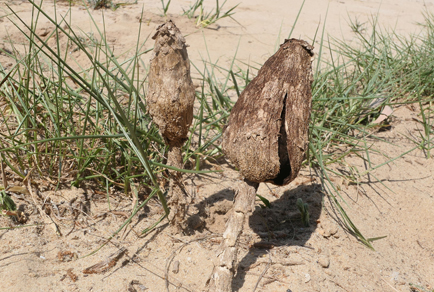
The fungal genus Podaxis has long attracted research interest, with approximately 58 published taxonomic records. Given its ongoing taxonomic expansion, further field surveys are likely to reveal additional novel species within the genus. During recent fieldwork in Hainan Island, a tropical region of China, specimens resembling Podaxis were collected. Through integrated morphological and molecular phylogenetic analyses, a new species, P. littoreus, was described, which is characterized by a whitish brown to dark brown basidioma, relatively large and thick-walled basidiospores (2–3 μm thick), and occurrence in sandy, saline coastal soils. This study provides a detailed description of P. littoreus, clarifies its phylogenetic position, and enhances the taxonomic and biogeographic understanding of the genus Podaxis.
References
- Acharya, K., Tarafder, E., Dutta, A.K., Nandi, S., Pradhan, P., Sarkar, J., Paloi, S., Sikder, R. & Roy, A. (2017a) Contribution to the Macromycetes of West Bengal, India: 8–12. Research Journal of Pharmacy and Technology 10 (3): 823. https://doi.org/10.5958/0974-360X.2017.00155.X
- Acharya, K., Tarafder, E., Pradhan, P., Dutta, A.K., Paloi, S., Datta, M. & Roy, A. (2017b) Contribution to the Macromycetes of West Bengal, India: 18–22. Research Journal of Pharmacy and Technology 10 (9): 3061. https://doi.org/10.5958/0974-360x.2017.00543.1
- Barla, J.B. (1888) Les champignons des Alpes-Maritimes, avec l’indication de leurs propriétés utiles ou nuisibles.
- Bon, M. (1981) Clé monographique des Lépiotes d'Europe (Agaricaceae, Tribus Lepioteae et Leucocoprineae). Documents Mycologiques 11 (43): 1–77.
- Conlon, B.H., Gostincar, C., Fricke, J., Kreuzenbeck, N.B., Daniel, J.M., Schlosser, M.S.L., Peereboom, N., Aanen, D.K., Beer, Z.W., Beemelmanns, C., Gunde-Cimerman, N. & Poulsen, M. (2021) Genome reduction and relaxed selection is associated with the transition to symbiosis in the basidiomycete genus Podaxis. iScience 24: 102680. https://doi.org/10.1016/j.isci.2021.102680
- Conlon, B.H., Aanen, D.K., Beemelmanns, C., de Beer, Z.W., De Fine Licht, H.H., Gunde-Cimerman, N., Schiøtt, M. & Poulsen, M. (2019) Reviewing the taxonomy of Podaxis: opportunities for understanding extreme fungal lifestyles. Fungal Biology 123: 183–187. https://doi.org/10.1016/j.funbio.2019.01.001
- Conlon, B.H., de Beer, Z.W., de Fine Licht, H.H., Aanen, D.K. & Poulsen, M. (2016) Phylogenetic analyses of Podaxis specimens from Southern Africa reveal hidden diversity and new insights into associations with termites. Fungal Biology 120: 1065–1076. https://doi.org/10.1016/j.funbio.2016.05.011
- De Villiers, J.J.R., Eicker, A. & Van der Westhuizen, G.C.A. (1989) A new section and two new species of Podaxis (Gasteromycetes) from South Africa. South African Journal of Botany 55: 159–164. https://doi.org/10.1016/S0254-6299(16)31201-7
- Decaisne, M.J. (1835) Notice sur quelques plantes de la Flore d’Egypte. Annales des Sciences Naturelles Botanique 4: 193–208.
- Desvaux, N.A. (1809) Observations sur quelques genres à établir dans la famille des champignons. Journal de Botanique (Desvaux) 2: 88–105.
- Drechsler-Santos, E.R., Wartchow, F., Baseia, I.G., Gibertoni, T.B. & Cavalcanti, M.A.Q. (2008) Revision of the Herbarium URM I. Agaricomycetes from the semi-arid region of Brazil. Mycotaxon 104: 9–18. https://doi.org/10.1007/s10267-007-0397-x
- Edgar, R.C. (2004) MUSCLE: multiple sequence alignment with high accuracy and high throughput. Nucleic Acids Research 32: 1792–1797. https://doi.org/10.1093/nar/gkh340
- Editorial Committee of Chinese Materia Medica, State Administration of Traditional Chinese Medicine. (1999) Chinese Materia Medica. Shanghai: Shanghai Science and Technology Press.
- Fries, E.M. (1829) Systema Mycologicum 3: 1–260.
- Hall, T.A. (1999) BioEdit: a user-friendly biological sequence alignment editor and analyses program for Windows 95/98/NT. Nucleic Acids Symposium Series 41: 95–98. https://doi.org/10.1021/bk-1999-0734.ch008
- Hennings, P. (1897) Beiträge zur Pilzflora Südamerikas. II. Hedwigia 36: 190–246.
- Hennings, P. (1898) Fungi centro-africani. Hedwigia 37: 283–289.
- Hennings, P. (1904) Fungi Australiensis II. Hedwigia 43: 187–188.
- Huelsenbeck, J.P. & Ronquist, F. (2005) Bayesian analysis of molecular evolution using MrBayes. In: Nielsen, R. (Ed.) Statistical methods in molecular evolution. Springer, New York, pp. 183–226. https://doi.org/10.1007/0-387-27733-1_7
- James, T.Y., Kauff, F., Schoch, C., Matheny, P.B., Hofstetter, V., Cox, C., Celio, G., Gueidan, C., Fraker, E., Miadlikowska, J., Lumbsch, H.T., Rauhut, A., Reeb, V., Arnold, A.E., Amtoft, A., Stajich, J.E., Hosaka, K., Sung, G.H., Johnson, D., O’Rourke, B., Crockett, M., Binder, M., Curtis, J.M., Slot, J.C., Wang, Z., Wilson, A.W., Schüßler, A., Longcore, J.E., O’Donnell, K., Mozley-Standridge, S., Porter, D., Letcher, P.M., Powell, M.J., Taylor, J.W., White, M.M., Griffith, G.W., Davies, D.R., Humber, R.A., Morton, J.B., Sugiyama, J., Rossman, A.Y., Rogers, J.D., Pfister, D.H., Hewitt, D., Hansen, K., Hambleton, S., Shoemaker, R.A., Kohlmeyer, J., Volkmann-Kohlmeyer, B., Spotts, R.A., Serdani, M., Crous, P.W., Hughes, K.W., Matsuura, K., Langer, E., Langer, G., Untereiner, W.A., Lücking, R., Büdel, B., Geiser, D.M., Aptroot, A., Diederich, P., Schmitt, I., Schultz, M., Yahr, R., Hibbett, D., Lutzoni, F., McLaughlin, D., Spatafora, J. & Vilgalys, R. (2006) Reconstructing the early evolution of the fungi using a six gene phylogeny. Nature 443: 818–822. https://doi.org/10.1038/nature05110
- Johnson, J. & Vilgalys, R. (1999) Phylogenetic relationships within Lepiota sensu lato inferred from nuclear and mitochondrial rDNA sequences. Mycologia 91: 443–458. https://doi.org/10.1080/00275514.1999.12061038
- Jumelle, H. & Perrier de la Bathie, H. (1907) Le champignons des termiteres de Madagascar. Comptes Rendus Hebdomadaires desséances de L’Academie des Sciences 145: 274–276.
- Kornerup, A. & Wanscher, J.H. (1981) Taschenlexikon der Farben, 3rd edn. Muster-Schmidt Verlag, Göttingen.
- Li, G.S., Leal-Dutra, C.A., Cuesta-Maté, A., Conlon, B.H., Peereboom, N., Beemelmanns, C., Aanen, D.K., Rosendahl, S., Debeer, Z.W. & Poulsen, M. (2023) Resolution of eleven reported and five novel Podaxis species based on ITS phylogeny, phylogenomics, morphology, ecology, and geographic distribution. Persoonia 51: 257–279. https://doi.org/10.3767/persoonia.2023.51.07
- Linnaeus, C. (1771) Mantissa Plantarum. generum editionis VI et specierum editionis II. Laurentius Salvius, Sweden.
- Massee, G. (1890) A monograph of the geuns Podaxis desv. (=Podaxon Fr.). Journal of Botany 28: 69–77.
- McKnight, K.H. (1985) The small-spored species of Podaxis. Mycologia 77: 24–35. https://doi.org/10.1080/00275514.1985.12025059
- Medina-Ortiz, A.J., Herrera, T., Vasquez-Davila, M.A., Raja, H.A. & Figueroa, M. (2017) The genus Podaxis in arid regions of Mexico: preliminary ITS phylogeny and ethnomycological use. MycoKeys 20: 17–36. https://doi.org/10.3897/mycokeys.20.11570
- Mikheyev, A.S., Mueller, U.G. & Abbot, P. (2006) Cryptic sex and many-to-one coevolution in the fungus-growing ant symbiosis. Proceedings of the National Academy of Sciences of the United States of America 103: 10702–10706. https://doi.org/10.1073/pnas.0601441103
- Moreno, G. & Mornand, J. (1997) Podaxis saharianus sp. nov. (Podaxales, Gasteromycetes), espèce nouvelle du Maroc. Cryptogamie. Mycologie 18: 247–254. https://doi.org/10.5962/p.354479
- Morse, E.E. (1933) A study of the genus Podaxis. Mycologia 25: 1–33. https://doi.org/10.1080/00275514.1933.12020646
- Nylander, J.A.A. (2004) MrModeltest 2.3. Program distributed by the author. Evolutionary Biology Center, Uppsala University.
- Patouillard, N. (1890) Le genre Podaxon. Bulletin Trimestriel de la Société Mycologique de France 6: 159–167.
- Patouillard, N.T. & Hariot, P. (1900) Énumération des champignons récoltés par M.A. Chevalier au Sénégal et dans le Soudan occidental. Journal de Botanique (Morot) 14: 234–246.
- Patouillard, N.T. (1887) Contributions à l'étude des Champignons extra-européens. Bulletin de la Société Mycologique de France 3: 119–131.
- Patouillard, N.T. (1904) Champignons Algero-Tunisiens nouveaux ou peu connus, suite. Bulletin Trimestriel de la Société Mycologique de France 20: 51–54.
- Priest, M.J. & Lenz, M. (1999) The genus Podaxis (Gasteromycetes) in Australia with a description of a new species from tremite mounds. Australian Systematic Botany 12: 109–116. https://doi.org/10.1071/SB95043
- Singh, S.K., Doshi, A., Yadav, M.C. & Kamal, S. (2006) Molecular characterization of specialty mushrooms of western Rajasthan, India. Current Science 91: 1225–1230. https://doi.org/10.1016/S0262-4079(06)60984-6
- Spegazzini, C. (1898) Fungi Argentini novi vel critici. Anales del Museo Nacional de Historia Natural Buenos Aires 6: 81–288.
- Stamatakis, A. (2006) RAxML-VI-HPC: maximum likelihood based phylogenetic analyses with thousands of taxa and mixed models. Bioinformatics 22: 2688–2690. https://doi.org/10.1093/bioinformatics/btl446
- Tamura, K., Stecher, G. & Kumar, S. (2021) MEGA11: Molecular Evolutionary Genetics Analysis version 11. Molecular Biology and Evolution 38: 3022–3027. https://doi.org/10.1093/molbev/msab120
- Tarafder, E., Dutta, A.K. & Acharya, K. (2022) New species and new record in Agaricus subg. Minores from India. Turkish Journal of Botany 46 (2): 183–195. https://doi.org/10.55730/1300-008x.2681
- Tarafder, E., Dutta, A.K., Karunarathna, S.C., He, M.-Q., Tian, F. & Acharya, K. (2023) Agaricus sect. Xanthodermatei (Agaricales) of West Bengal, India. Phytotaxa 630 (4): 245–265. https://doi.org/10.11646/phytotaxa.630.4.1
- Vellinga, E.C. (2003) Chlorophyllum and Macrolepiota (Agaricaceae) in Australia. Australian Systematic Botany 16: 361–370. https://doi.org/10.1071/SB02013
- Vellinga, E.C. (2000) Notes on Lepiota and Leucoagaricus. Type studies on Lepiota magnispora, Lepiota barssii, and Agaricus americanus. Mycotaxon 76: 429–438. https://doi.org/10.5962/p.414755
- Vilgalys, R. & Hester, M. (1990) Rapid genetic identification and mapping of enzymatically amplified ribosomal DNA from several Cryptococcus species. Journal of Bacteriology 172: 4238–4246. https://doi.org/10.1128/jb.172.8.4238-4246.1990
- Vizzini, A., Contu, M., Ghignone, S. & Vellinga, E. (2011) A new volvate Macrolepiota (Agaricomycetes, Agaricales) from Italy, with observations on the M. procera complex. Mycotaxon 117 (1): 149–164. https://doi.org/10.5248/117.149
- Welwitsch, F. & Currey, F. (1868) Fungi Angolenses. A description of the fungi collected by Dr Friedrich Welwitsch in Angola during the years 1850-1861. Part I. Transactions of the Linnaean Society of London 26: 279–294. https://doi.org/10.1111/j.1096-3642.1968.tb00507.x
- White, T.J., Bruns, T., Lee, S. & Taylor, J. (1990) Amplification and direct sequencing of fungal ribosomal RNA genes for phylogenies. In: Innis, M.A., Gelfand, D.H., Sninsky, J.J. & White, T.J. (Eds.) PCR protocols: a guide to methods and applications. Academic Press, New York, pp. 315–322. https://doi.org/10.1016/B978-0-12-372180-8.50042-1
- Zeng, N.K., Tang, L.P., Li, Y.C., Tolgor, B., Zhu, X.T., Zhao, Q. & Yang, Z.L. (2013) The genus Phylloporus (Boletaceae, Boletales) from China: morphological and multilocus DNA sequence analyses. Fungal Diversity 58: 73–101. https://doi.org/10.1007/s13225-012-0184-7