
Abstract
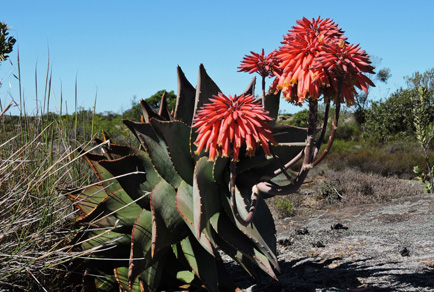
Despite having received significant taxonomic attention over the past more than two-and-a-half centuries, aspects of the nomenclature associated with the genus name Aloe (Asphodelaceae subfam. Alooideae), including its typification, remain in flux. This partly came about because of disparate interpretations of the application of the names A. perfoliata and A. mitriformis. We show that historically these two names have been applied to two morphologically very different taxa. The current (and historical) taxonomic concept associated with the name A. mitriformis is beyond doubt and the name, albeit illegitimate, is applicable to a large-growing, creeping species with stems of up to 2 m long and rather dense, many-flowered capitate inflorescences from southwestern South Africa. A recent attempt to typify the name A. mitriformis on a plate, Fig. 19, t. 17 [with the accompanying text on p. 21], published in 1732 in volume 1 of Hortus elthamensis by Johann Jacob Dillenius (1684–1747) was not effective because the name A. mitriformis is homotypic with the name A. perfoliata. The type of the name A. perfoliata, as well as that of the name A. mitriformis, is an herbarium specimen that consists of a single sparsely-flowered, cylindrical raceme. The name A. perfoliata cannot confidently be applied to material of any known aloe. Yet, the type of the name A. perfoliata is unambiguously the type of the genus name Aloe. The taxonomic concept to date associated with the name A. mitriformis cannot be reconciled with the type of the name A. perfoliata and, furthermore, the name
A. mitriformis is not a heterotypic synonym of A. perfoliata. We here record that the name A. mitriformis is illegitimate because it was, arguably inadvertently, but in effect, published as a superfluous synonym for the legitimate name A. perfoliata by Philip Miller (1691–1771). However, we do not advocate adopting a later, validly published and legitimate name in the stead of the name A. mitriformis because a proposal to conserve this name has been accepted for consideration by the General Committee and distribution to and consideration by the Permanent Nomenclature Committee for Vascular Plants.
References
- Britton, N.L. & Millspaugh, C.F. (1920) The Bahama Flora. Published by the authors, New York, 695 pp. https://doi.org/10.5962/bhl.title.54084
- Dillenius, J.J. (1732) Hortus elthamensis, Vol. 1. Sumptibus Auctris, London, 204 pp., 166 Tab. [https://bibdigital.rjb.csic.es/idurl/1/10700]
- Glen, H.F. & Hardy, D.S. (2000) Aloaceae (First part): Aloe. In: Germishuizen, G. (ed.) Flora of Southern Africa 5, Part 1, Fascicle 1. National Botanical Institute, South Africa, 167 pp. [https://www.biodiversitylibrary.org/item/209564#page/3/mode/1up]
- Hitchcock, A.S. & Green, M.L. (1929) IV.—Proposals by A.S. Hitchcock (Washington) and M.L. Green (Kew): The application of Linnean generic names to be determined by means of specified Standard-species. In: T.A. Sprague (ed.) International Botanical Congress, Cambridge (England), 1930. Nomenclature: proposals by British Botanists. Wyman & Sons, London, pp. 110–199. [https://bibdigital.rjb.csic.es/viewer/13040/?offset=&height_top=50#page=111&viewer=picture&o=bookmark&n=0&q=]
- Jarvis, C.E. (2007) Order out of chaos. Linnaean plant names and their types. The Linnean Society of London in association with Natural History Museum, London, 1016 pp.
- Klopper, R.R., Smith, G.F., Figueiredo, E. & Van Wyk, A.E. (2016) (2469–2472) Proposals to reject the names Aloe perfoliata, A. obscura, A. picta, and A. perfoliata var. saponaria (A. saponaria) (Asphodelaceae: Alooideae). Taxon 65 (5): 1173–1175. https://doi.org/10.12705/655.22
- Klopper, R.R., Smith, G.F. & Van Wyk, A.E. (2025) (0000–0000) Proposals to conserve the name Aloe mitriformis with a conserved type and the name A. microstigma against A. perfoliata (Asphodelaceae: Alooideae). Taxon 74 (3). [in press]
- Linnaeus, C. (1738 [“1737”]) Hortus cliffortianus. Plantas exhibens quas in hortistam vivis quam siccis, Hartecampi in Hollandia, coluit [...] Georgius Clifford [...] reductis varietatibus ad species, speciebus ad genera, generibus ad classes, adjectis locis plantarum natalibus differentusque specierum. Cum tabulis aeneis. Amstelædami [Amsterdam], 501 pp. [“Index”, Ratio”, and “Emendanda pages not numbered.] https://doi.org/10.5962/bhl.title.690
- Linnaeus, C. (1753) Species plantarum, exhibentes plantas rite cognitas, ad generarelatas, cum differentiis specificis, nominibus trivialibus, synonymis selectis, locis natalibus, secundum systema sexuale digestas. Vol. 1. Salvius, Stockholm. [Aloe L. treated on pp. 319–323]. [https://www.biodiversitylibrary.org/item/13829#page/331/mode/1up]
- Miller, P. (1768) The gardeners dictionary: containing the best and newest methods of cultivating and improving the kitchen, fruit, flower garden, and nursery, as also for performing the practical parts of agriculture: including the management of vineyards, with the methods of making and preserving wine, according to the present practice of the most skilful vignerons in the several wine countries in Europe. Together with directions for propagating and improving, from real practice and experience, all sorts of timber trees. 8th edition [revised and altered according to the latest system of botany; and embellished with several copper-plates, which were not in some former editions]. Printed for the author, and sold by John and Francis Rivington, [...] and T. Payne, London, pages not conventionally numbered. [https://www.biodiversitylibrary.org/item/10276#page/47/mode/1up]
- Mottram, R. (2013) Typification and application of the name Aloe perfoliata L. The Cactician 1: 1–15. [https://www.crassulaceae.ch/docs/43ab8f4f61de6cf2c3b32ec36701b9e5_Cactician%201%20HQ.pdf]
- Mottram, R. (2021 [9 June]) Commentary on the taxonomic value of the Ehret, Van Huysum, and Wm. Sartorius illustrations in the archive of the Royal Society of succulent plants grown by Philip Miller at the Chelsea Physic Garden in the eighteenth century. The Cactician 15: 1–17. [https://www.crassulaceae.ch/docs/7a508e83fc6ae730a804c295f92bb2ed_Cactician_15_HQ.pdf]
- Reynolds, G.W. (1950) The aloes of South Africa. Aloes of South Africa Book Fund, Johannesburg, 520 pp.
- Salm-Reifferscheid-Dyck, Prince J.F.M.A.H.I. von. (1854) Monographia generum aloes et mesembryanthemi 6. Henry & Cohen, Düsseldorf & Bonn, 50 tab. https://doi.org/10.5962/bhl.title.153143
- Scopoli, J.A. (1783) Fundamenta botanica praelectionibus publicis accommodata. Horto Botanico Ticinensis. In Typographeo Monast S. Salvatoris, Praesid. Rei Litter. Permitt., Papiæ, 174 pp. + unnumbered ‘Errata’ page + Tab. I–X. [https://wellcomecollection.org/works/jctrpg83/items]
- Smith, G.F., Figueiredo, E., Verloove, F., Klopper, R.R. & Silva, V. (2023) An annotated catalogue of Aloe and Aloiampelos (Asphodelaceae subfam. Alooideae) naturalised and escaped in continental Portugal. Phytotaxa 629 (1): 35–52. https://doi.org/10.11646/phytotaxa.629.1.3
- Turland, N.J., Wiersema, J.H., Barrie, F.R., Greuter, W., Hawksworth, D.L., Herendeen, P.S., Knapp, S., Kusber, W.-H., Li, D.-Z., Marhold, K., May, T.W., McNeill, J., Monro, A.M., Prado, J., Price, M.J. & Smith, G.F. (2018) International Code of Nomenclature for algae, fungi, and plants (Shenzhen Code) adopted by the Nineteenth International Botanical Congress Shenzhen, China, July 2017. [Regnum Vegetabile 159] Koeltz Botanical Books, Glashütten, 254 pp. https://doi.org/10.12705/Code.2018
- Van Wyk, B-E. & Smith, G.F. (2014) Guide to the aloes of South Africa, 3rd edn. Briza, Pretoria, 376 pp.
- Webb, D.A. (1980) Aloe L. In: Tutin, T.G., Heywood, V.H., Burges, N.A., Valentine, D.H., Walters, S.M. & Webb, D.A. (Eds.) Flora Europaea—Alismataceae to Orchidaceae. Vol. 5. Cambridge University Press, Cambridge, pp. 19–21.