

Abstract
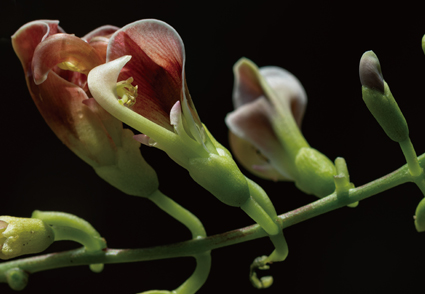
A new species, Apios chindiana K. W. Jiang, J. F. Wang, Z. H. Chen & B. Pan bis, is described and illustrated. This species is currently known only from southern Zhejiang Province and northwestern Fujian Province, China. Phylogenetic analyses based on nuclear ribosomal ITS and chloroplast matK sequences demonstrate that A. chindiana is most closely related to A. fortunei Maxim. However, A. chindiana is readily distinguished from A. fortunei by its membranous-chartaceous leaflets with often shallowly undulate margins and its dull red, bilaterally symmetrical corolla with keel petals that do not twist to one side. Assessments of area of occupancy (AOO) and extent of occurrence (EOO) indicate that Apios chindiana meets the IUCN Red List criteria for Near Threatened (NT). An updated key to Apios species is also provided.
References
- Bachman, S., Moat, J., Hill, A.W., de la Torre, J. & Scott, B. (2011) Supporting Red List threat assessments with GeoCAT: geospatial conservation assessment tool. ZooKeys 150: 117–126. https://doi.org/10.3897/zookeys.150.2109
- Baker, J.G. (1879) Leguminosae. In: Hooker, J.D. (Ed.) The Flora of British India 2. L. Reeve, London, pp. 56–306.
- Bentham, G. (1852) Leguminosae. In: Miquel, F.A.W. (Ed.) Plantae Junghuhniana. A.W. Sythoff, Leiden, pp. 205–269.
- Bronn, H.G. (1822) De formis plantarum leguminosarum primitivus et derivatis. Heidelbergae, sumtibus Caroli Groos, Bibliop. Academ. 152 pp.
- de Candolle, A.P. (1825) Prodromus Systematis Naturalis Regni Vegetabilis 2. Sumptibus Sociorum Treuttel et Würtz, Parisii, 644 pp.
- Dunn, S.T. (1903) Descriptions of new Chinese plants. Journal of the Linnean Society (Botany) 35 (247): 483–518.
- Egan, A.N. & Pan, B. (2015a) Resolution of polyphyly in Pueraria (Leguminosae, Papilionoideae): The creation of two new genera, Haymondia and Toxicopueraria, the resurrection of Neustanthus, and a new combination in Teyleria. Phytotaxa 218 (3): 201–226. https://doi.org/10.11646/phytotaxa.218.3.1
- Egan, A.N. & Pan, B. (2015b) Pueraria stracheyi, a new synonym to Apios carnea (Fabaceae). Phytotaxa 218 (2): 147–155. https://doi.org/10.11646/phytotaxa.218.2.4
- Egan, A.N., Vatanparast, M. & Cagle, W. (2016) Parsing polyphyletic Pueraria: Delimiting distinct evolutionary lineages through phylogeny. Molecular Phylogenetics and Evolution 104: 44–59. https://doi.org/10.1016/j.ympev.2016.08.001
- Elder, D., Klein, J., Antonelli, A. & Silvestro, D. (2020) raxmlGUI 2.0: A graphical interface and toolkit for phylogenetic analyses using RAxML. Methods in Ecology and Evolution 12 (2): 373–377. https://doi.org/10.1111/2041-210X.13512
- Fabricius, P.C. (1759) Enumeratio, Methodica Plantarum. Litteris Ioannis Drimbornii, Helmstadii, 239 pp.
- Franchet, A.R. (1890) Plantae Delavayanae, fasc. 3. P. Klincksieck, Paris, pp. 161–240.
- Handel-Mazzetti, H. (1933) Symbolae Sinicae 7 (3). J. Springer, Wien, pp. 449–730.
- IUCN Standards and Petitions Subcommittee (2024) Guidelines for using the IUCN Red List categories and criteria. Version 16. Available from: https://nc.iucnredlist.org/documents/RedListGuidelines.pdf (accessed 7 January 2025)
- Jiang, K.-W., Chen, Y., Li, H.-D., Ma, D.-D., Pan, B., Song, Z.-Q., Wan, K.-Y., Chen, Z.-H. & Li, G.-Y. (2023) Weizhia (Fabaceae: Phaseoleae), a new endemic genus from East China supported by morphological and molecular evidence. Phytotaxa 603 (3): 235–248. https://doi.org/10.11646/phytotaxa.603.3.3
- Kearse, M., Moir, R., Wilson, A., Stones-Havas, S., Cheung, M., Sturrock, S., Buxton, S., Cooper, A., Markowitz, S., Duran, C., Thierer, T., Ashton, B., Meintjes, P. & Drummond, A. (2012) Geneious Basic: an integrated and extendable desktop software platform for the organization and analysis of sequence data. Bioinformatics 28 (12): 1647–1649. https://doi.org/10.1093/bioinformatics/bts199
- Lee, S.K. & Wei, Y.T. (1995) Apios. In: Lee, S.K. (Ed.) Flora Reipublicae Popularis Sinicae 41. Science Press, Beijing, pp. 199–206.
- Li, G.-Y. (2021) Fabaceae. In: Editorial Board of Flora of Zhejiang (New Edition) (Eds.) Flora of Zhejiang (New Edition) 5. Zhejiang Science and Technology Press, Hangzhou, pp. 58–243.
- Li, J., Jiang, J., Stel, H.V., Homkes, A., Corajod, J., Brown, K. & Chen, Z. (2014) Phylogenetics and biogeography of Apios (Fabaceae) inferred from sequences of nuclear and plastid genes. International Journal of Plant Sciences 175 (7): 764–780. https://doi.org/10.1086/676972
- Maximowicz, C.J. (1873) Diagnoses plantarum novarum Japoniae et Mandshuriae. Bulletin de l’Académie Impériale des Sciences de Saint-Pétersbourg 18: 371–402.
- Medikus, F.C. (1787) Versuch einer neuen Lehrart. Vorlesungen der Churpfälzischen physicalisch-ökonomischen Gesellschaft 2: 354–356.
- Nguyen, L.T., Schmidt, H.A., von Haeseler, A. & Minh, B.Q. (2015) IQTREE: A fast and effective stochastic algorithm for estimating maximum likelihood phylogenies. Molecular Biology and Evolution 32 (1): 268–274. https://doi.org/10.1093/molbev/msu300
- Robinson, B.L. (1898) A new species of Apios from Kentucky. Botanical Gazette 25 (6): 450–453. https://doi.org/10.1086/327705
- Sa, R. & Gilbert, M.G. (2010) Apios. In: Wu, Z.Y., Raven, P.H. & Hong, D.Y. (Eds.) Flora of China 10. Missouri Botanical Garden, St. Louis, pp. 203–204.
- Song, Z.-Q., Li, S.-J. & Mattapha, S. (2022) Huchimingia, a new genus segregated from Millettia (Leguminosae, Millettieae) based on morphological and molecular evidence. Phytotaxa 532 (1): 37–56. https://doi.org/10.11646/phytotaxa.532.1.3
- Thompson, J.D., Higgins, D.G. & Gibson, T.J. (1994) CLUSTAL W: improving the sensitivity of progressive multiple sequence alignment through sequence weighting, position-specific gap penalties and weight matrix choice. Nucleic Acids Research 22 (22): 4673–4680. https://doi.org/10.1093/nar/22.22.4673
- Trifinopoulos, J., Nguyen, L.T., von Haeseler, A. & Minh, B.Q. (2016) W-IQ-TREE: a fast online phylogenetic tool for maximum likelihood analysis. Nucleic Acids Research 44 (W1): W232–W235. https://doi.org/10.1093/nar/gkw256
- Wallich, N. (1830) Plantae Asiaticae Rariores 1. Treuttel and Würtz, London, 68 pp.
- Wei, Z. (1993) Leguminosae. In: Wei, Z. & Ho, Y.C. (Eds.) Flora of Zhejiang 3. Zhejiang Science and Technology Press, Hangzhou, pp. 183–188.
- Woods, M. (2005) A revision of the North American species of Apios (Fabaceae). Castanea 70 (2): 85–100.
- Yan, J & Wang, Y. (2023) The Checklist of Plants in East China. Henan Science and Technology Press, Zhengzhou, 537 pp.
- Yang, Y.K., Liu, L.H., Wu, J.K., Wu, P.L. & Yu, J.J. (2004) New Taxa of the family Leguminosae from China (1). The Chinese Academic Medical Magazine of Organisms 3: 62–76.
- Zhang, F., Feng, S., Zhou, J., Zhang, R., Liu, L., Yang, C., Yu, X. & Pan, B. (2018) Apios chendezhaoana (Fabaceae), an overlooked species and a new combination from China: evidence from morphological and molecular analyses. Phytotaxa 371 (1): 1–16. https://doi.org/10.11646/phytotaxa.371.1.1