

Abstract
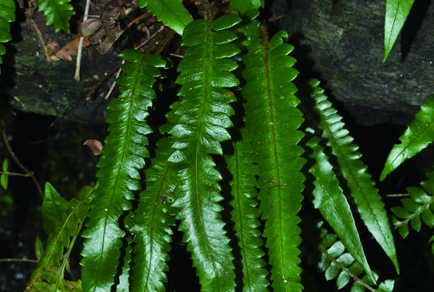
Polystichum ensiforme, a new polystichoid fern species from Guangxi Zhuang Autonomous Region, China, is described and illustrated. Morphologically, the new species most closely resembles P. basipinnatum but differs in having a generally simple lamina, scattered sori, and leathery lamina texture. Phylogenetic analysis placed it as an isolated clade within P. sect. Cyrtomiopsis. A key to the species of P. sect. Cyrtomiopsis is also provided.
References
- Baker, J.G. (1889) New fern from western China. Journal of Botany, British and foreign 27 (6): 176–178.
- Ching, R.C. (1940) The studies of Chinese ferns—XXXIII. Bulletin of the Fan Memorial Institute of Biology/Botanical Series 10 (3): 173–184.
- Ching, R.C. (1957) Cyrtomidictyum Ching, a yet little known Chinese fern genus. Acta Phytotaxonomica Sinica 6: 255–266.
- Deng, M., Lin, L., Liu, L.T., Huang, S.X., Tu, Y., Lu, Z.C. & Huang, J. (2024) Quercus zhekunii M.Deng & J.Huang, a new sclerophyllous oak from Guangxi, southwest China. Nordic Journal of Botany e04512: 1–16. https://doi.org/10.1111/njb.04512
- Diels, L. (1899) Polypodiaceae. In: Engler, H.G.A. & Prantl, K.A.E. (Eds.) Die Natürlichen Pflanzenfamilien 1 (4). pp. 139–339.
- Du, X.Y., Lu, J.M., Zhang, L.B., Wen, J., Kuo, L.Y., Mynssen, C.M., Schneider, H. & Li, D.Z. (2021) Simultaneous diversification of Polypodiales and angiosperms in the Mesozoic. Cladistics 37: 518–539. https://doi.org/10.1111/cla.12457
- Fan, R., Ma, W., Liu, S. & Huang, Q. (2021) Integrated analysis of three newly sequenced fern chloroplast genomes: Genome structure and comparative analysis. Ecology and Evolution 11: 4550–4563. https://doi.org/10.1002/ece3.7350
- Huang, J., Chen, B., Liu, C., Lai, J., Zhang, J. & Ma, K. (2012) Identifying hotspots of endemic woody seed plant diversity in China. Diversity and Distributions 18: 673–688. https://doi.org/10.1111/j.1472-4642.2011.00845.x
- Jiang, Y.L., Li, J.L., Milne, R.I., Nguyen, K.S., Han, Z.T., Huang, Y.S., Xu, W.B., Liu, Y. & Mao, K.S. (2024) Biogeographic, climatic, morphological, cytological and molecular data reveal a new diploid species from China in the genus Xanthocyparis (Cupressaceae). Taxon 73: 1170–1186. https://doi.org/10.1002/tax.13246
- Jin, J.J., Yu, W.B., Yang, J.B., Song, Y., de Pamphilis, C.W., Yi, T.S. & Li, D.Z. (2020) GetOrganelle: a fast and versatile toolkit for accurate de novo assembly of organelle genomes. Genome biology 21: 1–31. https://doi.org/10.1186/s13059-020-02154-5
- Katoh, K. & Standley, D.M. (2013) MAFFT multiple sequence alignment software version 7: improvements in performance and usability. Molecular Biology and Evolution 30: 772–780. https://doi.org/10.1093/molbev/mst010
- Le Péchon, T., He, H., Zhang, L., Zhou, X.M., Gao, X.F. & Zhang, L.B. (2016) Using a multilocus phylogeny to test morphology-based classifications of one of the largest fern genera Polystichum (Dryopteridaceae). BMC Evolutionary Biology 16: 55. https://doi.org/10.1186/s12862-016-0626-z
- Li, C.X., Lu, S.G. & Barrington, D.S. (2008) Phylogeny of Chinese Polystichum (Dryopteridaceae) based on chloroplast DNA sequence data (trnL-F and rps4-trnS). Journal of Plant Research 121: 19–26. https://doi.org/10.1007/s10265-007-0120-1
- Liang, S.H., Qin, B., Huang, Y.H., Tang, L.M., Zhang, Z.J., Li, C., He, Y.H., Jiang, R.H. & Li, J.L. (2023) Prunus quanzhouensis: a newly discovered species of Prunus subgen. Cerasus (Rosaceae) from northeastern Guangxi, China. Phytotaxa 622 (4): 252–259. https://doi.org/10.11646/phytotaxa.622.4.2
- Liu, H.M., Zhang, X.C., Wang, W. & Zeng, H. (2010) Phylogeny and systematic position of two endemic fern genera Cyrtomidictyum and Cyrtogonellum (Dryopteridaceae) from East Asia: evidence from four chloroplast DNA markers. Organisms, Diversity & Evolution 10: 57–68. https://doi.org/10.1007/s13127-010-0010-6
- Luo, J.J., Shang, H., Xue, Z.Q., Wang, Y., Dai, X.L., Shen, H. & Yan, Y.H. (2024) Genome-wide data reveal bi-direction and asymmetrical hybridization origin of a fern species Microlepia matthewii. Frontier in Plant Science 15: 1392990. https://doi.org/10.3389/fpls.2024.1392990
- Nong, Y., Lei, L.Q., Zhao, Z.Y., Wei, G.Y., Xu, C.G., Feng, B., Qu, X.C. & Jiang, R.H. (2024) Cyrtomium adenotrichum (Dryopteridaceae), a new species from Guangxi, China. PhytoKeys 243: 199–207. https://doi.org/10.3897/phytokeys.243.127579
- Presl, C. (1836) Tentamen Pteridographiae. Theophilus Haase, Prague, 290 pp.
- Ronquist, F., Teslenko, M., van der Mark, P., Ayres, D.L., Darling, A., Höhna, S., Larget, B., Liu, L. & Huelsenbeck, J.P. (2012) MrBayes 3.2: efficient Bayesian phylogenetic inference and model choice across a large model space. Systematic Biology 61: 539–542. https://doi.org/10.1093/sysbio/sys029
- Roth, A.W. (1800) Tentamen Florae Germanicae, vol. 3. Gleditsch, Leipzig, 578 pp.
- Shang, H., Xue, Z.Q., Liang, Z.L., Kessler, M., Pollawatn, R., Lu, N.T., Gu, Y.F., Fan, X.P., Tan, Y.H., Zhang, L., Zhou, X.M., Wan, X. & Zhang, L.B. (2023) Splitting one species into 22: an unusual tripling of molecular, morphological, and geographical differentiation in the fern family Didymochlaenaceae (Polypodiales). Cladistics 39: 273–292. https://doi.org/10.1111/cla.12539
- Stamatakis, A. (2006) RAxML-VI-HPC: maximum likelihood-based phylogenetic analyses with thousands of taxa and mixed models. Bioinformatics 22: 2688–2690. https://doi.org/10.1093/bioinformatics/btl446
- Swofford, D. (2003) PAUP*. Phylogenetic Analysis Using Parsimony (*and Other Methods). Version 4.0b10. Sinauer Associates, Sunderland, MA, USA.
- Talavera, G. & Castresana, J. (2007) Improvement of phylogenies after removing divergent and ambiguously aligned blocks from protein sequence alignments. Systematic Biology 56: 564–577. https://doi.org/10.1080/10635150701472164
- Tagawa, M. (1940) Polystichum of Japan, Korea and Formosa I. Acta Phytotaxonomica et Geobotanica 9: 119–138.
- Tu, W.Q., Wang, Y.Z., Gao, Y.D., Zhang, L.B. & Zhang, Y.M. (2020) The first complete chloroplast genome of the fern genus Polystichum (Dryopteridaceae). Mitochondrial DNA Part B 5: 441–442. https://doi.org/10.1080/23802359.2019.1704198
- Zhang, L.B. & Barrington, D.S. (2013) Polystichum. In: Wu, Z.Y., Raven, P.H. & Hong, D.Y. (Eds.) Flora of China, vols. 2–3. Science Press, Beijing & Missouri Botanical Garden Press, St. Louis, pp. 629–713.
- Zhang, L.B. (2012) Taxonomic and nomenclatural notes on the fern genus Polystichum (Dryopteridaceae) from China. Phytotaxa 60: 57–60. https://doi.org/10.11646/phytotaxa.60.1.8
- Zuo, Z.Y., Rouhan, G., Dong, S.Y., Liu, H.M., Du, X.Y., Zhang, L.B. & Lu, J.M. (2024) A revised classification of Dryopteridaceae based on plastome phylogenomics and morphological evidence, with the description of a new genus, Pseudarachniodes. Plant Diversity 47: 34–52. https://doi.org/10.1016/j.pld.2024.07.010