
Abstract
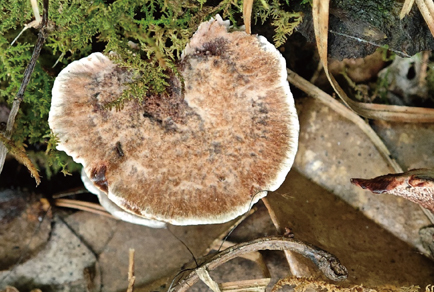
As ectomycorrhizal fungi, the species in Hydnellum can form a mutualistic symbiosis with plant roots to promote the restoration of forest vegetation and the stability of forest ecosystems. Some Hydnellum fungi also have edible and medicinal values generating considerable economic benefits. In this study, a new species of Hydnellum collected from Hangzhou, eastern China, was described by utilizing morphological and phylogenetic analyses. Morphologically, Hydnellum hangzhouense was characterized by its light-colored and relatively thick pileus, simple septated generative hyphae, and subglobose to ellipsoid basidiospores. The phylogenetic analysis was conducted based on the combined sequences dataset (ITS + nLSU + nSSU + rpb2). The results indicated that H. hangzhouense formed an independent lineage which is closely related to H. crassipileatum and H. chocolatum. The detailed description, illustrations and phylogenetic tree for demonstrating the taxonomic positions of H. hangzhouense were provided.
References
- Ainsworth, A., Parfitt, B., Rogers, H. & Boddy, L. (2010) Cryptic taxa within European species of Hydnellum and Phellodon revealed by combined molecular and morphological analysis. Fungal Ecology 3: 65–80. https://doi.org/10.1016/j.funeco.2009.07.001
- Agerer, R. & Bougher, N.L. (2001) Amaurodon aquicoeruleus (Thelephoraceae, Hymenomycetes, Basidiomycota), a new species from Australia with spores distinctly blue in water. Australian Systematic Botany 14 (4): 599–606. https://doi.org/10.1071/SB00030
- Baird, R.E. (1986) Type studies of North American and other related taxa of stipitate hydnums: genera, Bankera, Hydnellum, Phellodon, Sarcodon. Biblotheca Mycologica Cramer, Berlin-Stuttgart 103: 86.
- Baird, R., Wallace, L.E., Baker, G. & Scruggs, M. (2013) Stipitate hydnoid fungi of the temperate southeastern United States. Fungal Diversity 62: 41–114. https://doi.org/10.1007/s13225-013-0261-6
- Banker, H.J. (1906) A contribution to a revision of the North American Hydnaceae. Memoirs of the Torrey Botanical Club 12 (2): 99–194. https://doi.org/10.5962/bhl.title.97394
- Banker, H.J. (1913) Type studies in the Hydnaceae: VI. the genera Creolophus, Echinodontium, Gloiodon, and Hydnodon. Mycologia 5 (6): 293–298. https://doi.org/10.1080/00275514.1913.12018534
- Cui, B.K., Li, H.J., Ji, X., Zhou, J.L., Song, J., Si, J., Yang, Z.L. & Dai, Y.C. (2019) Species diversity, taxonomy and phylogeny of Polyporaceae (Basidiomycota) in China. Fungal Diversity 97: 137–392. https://doi.org/10.1007/s13225-019-00427-4
- Dai, Y.C., Yang, Z.L., Cui, B.K., Yu, C.J. & Zhou, L.W. (2009) Species diversity and utilization of medicinal mushrooms and fungi in China (review). International Journal of Medicinal Mushrooms 11: 287–302. https://doi.org/10.1615/IntJMedMushr.v11.i3.80
- Darriba, D., Taboada, G.L., Doallo, R. & Posada, D. (2012) ModelTest 2: more models, new heuristics and parallel computing. Nature methods 9 (8): 772. https://doi.org/10.1038/nmeth.2109
- Donk, M.A. (1961) Four new families of Hymenomycetes. Persoonia-Molecular Phylogeny and Evolution of Fungi 1 (4): 405–407.
- Erland, S., Taylor, A.F.S. (1999) Resupinate Ectomycorrhizal Fungal Genera. In: Cairney, J.W.G. & Chambers, S.M. (Eds.) Ectomycorrhizal Fungi Key Genera in Profile. Springer, Berlin, pp. 347–363. https://doi.org/10.1007/978-3-662-06827-4_15
- Farris, J.S., Kallersjo, M., Kluge, A.G. & Bult, C. (1994) Testing significance of incongruence. Cladistics 10: 315–319. https://doi.org/10.1111/j.1096-0031.1994.tb00181.x
- Felsenstein, J. (1985) Confidence intervals on phylogenetics: an approach using bootstrap. Evolution; international journal of organic evolution 39 (4): 783–791. https://doi.org/10.1111/j.1558-5646.1985.tb00420.x
- Gardes, M. & Bruns, T.D. (1996) Community structure of ectomycorrhizal fungi in a Pinus muricata forest: above- and below-ground views. Canadian Journal of Botany 74 (10): 1572–1583. https://doi.org/10.1139/b96-190
- Hall, T.A. (1999) Bioedit: A user-friendly biological sequence alignment editor and analysis program for Windows 95/98/NT. Nucleic Acids Symposium Series 41: 95–98.
- Harrison, K.A. (1964) New or little known North American stipitate hydnums. Canadian Journal of Botany 42 (9): 1205–1233. https://doi.org/10.1139/b64-116
- Hibbett, D.S. (1996) Phylogenetic evidence for horizontal transmission of group I introns in the nuclear ribosomal DNA of mushroom-forming fungi. Molecular biology and evolution 13 (7): 903–917. https://doi.org/10.1093/oxfordjournals.molbev.a025658
- Hopple, J.S.Jr. & Vilgalys, R. (1999) Phylogenetic relationships in the mushroom genus Coprinus and dark-spored allies based on sequence data from the nuclear gene coding for the large ribosomal subunit RNA: divergent domains, outgroups, and monophyly. Molecular Phylogenetics and Evolution 13: 1–19. https://doi.org/10.1006/mpev.1999.0634
- IUCN (2024) The IUCN red list of threatened species, version 2024.2. Available from: http://www.iucnredlist.org/ (accessed 16 January 2024)
- Karsten, P.A. (1879) Symbolae ad mycologiam fennica. Meddelanden Soc: Fauna Flora Fennica 5: 15–46.
- Karsten, P.A. (1881) Enumeratio Hydnearum Fr. Fennicarum, systemate novo disposi- tarum. Revue Mycologique 3 (9): 16–19.
- Katoh, K., Rozewicki, J. & Yamada, K.D. (2019) MAFFT online service: multiple sequence alignment, interactive sequence choice and visualization. Briefings in bioinformatics 20 (4): 1160–1166. https://doi.org/10.1093/bib/bbx108
- Kornerup, A. & Wanscher, J.H. (1967) Methuen handbook of colour. Hastings House, University of Virginia.
- Larsson, K.H., Svantesson, S., Miscevic, D., Kõljalg, U. & Larsson, E. (2019) Reassessment of the generic limits for Hydnellum and Sarcodon (Thelephorales, Basidiomycota). MycoKeys 54: 31–47. https://doi.org/10.3897/mycokeys.54.35386
- Lei, L., Luangharn, T., Yu, F., Li, W. & Zhao, Q. (2023) A novel hydnoid species of Hydnellum (Bankeraceae, Thelephorales) from southwest China. Phytotaxa 600 (5): 291–300. https://doi.org/10.11646/phytotaxa.600.5.4
- Liu, S., Chen, Y.Y., Sun, Y.F., He, X.L., Song, C.G., Si, J., Liu, D.M., Gates, G. & Cui, B.K. (2022) Systematic classification and phylogenetic relationships of the brown-rot fungi within the Polyporales. Fungal Diversity 118: 1–94. https://doi.org/10.1007/s13225-022-00511-2
- Liu, S., Shen, L.L., Xu, T.M., Song, C.G., Gao, N., Wu, D.M., Sun, Y.F. & Cui, B.K. (2023) Global diversity, molecular phylogeny and divergence times of the brown‑rot fungi within the Polyporales. Mycosphere 14 (1): 1564–1664. https://doi.org/10.5943/mycosphere/14/1/18
- Liu, Y.J., Whelen, S. & Hall, B.D. (1999) Phylogenetic relationships among ascomycetes: evidence from an RNA polymerse II subunit. Molecular biology and evolution 16 (12): 1799–1808. https://doi.org/10.1093/oxfordjournals.molbev.a026092
- Loizides, M., Alvarado, P., Assyov, B., Arnolds, E. & Moreau, P.A. (2016) Hydnellum dianthifolium sp. nov. (Basidiomycota, Thelephorales), a new tooth-fungus from southern Europe with notes on H. concrescens and H. scrobiculatum. Phytotaxa 280: 23–35. https://doi.org/10.11646/phytotaxa.280.1.2
- Maas Geesteranus, R.A. (1971) Hydnaceous fungi of the eastern old world. Kew Bulletin 27: 573. https://doi.org/10.2307/4114376
- Maas Geesteranus, R.A. (1975) The Terrestrial Hydnums of Europe, (Die terrestrischen Stachelpilze Europas). Verhandelingen der Koninklijke Nederlandse Akademie van Wetenschappen, Afdeling Natuurkunde Tweede Reeks 65: 1‒127. https://doi.org/10.2307/1219512
- Maddison, W.P., Maddison, D.R. (2017) Mesquite: a modular system for evolutionary analysis. Version 3.2. Available from: http://mesquiteproject.org (accessed 15 August 2022)
- Mu, Y.H., Yu, J.R., Cao, T., Wang, X.H. & Yuan, H.S. (2021) Multi-gene phylogeny and taxonomy of Hydnellum (Bankeraceae, Basidiomycota) from China. Journal of fungi 7 (10): 818. https://doi.org/10.3390/jof7100818
- Nitare, J. (2019) Skyddsvärd skog. Naturvårdsarter och andra kriterier for naturvärdesbedömning [Woodland nature conservation-indicator species and other criteria for assessing the protection value of woodland sites]. Skogsstyrelsen, Sweden.
- Nylander, J.A.A. (2004) MrModeltest Version 2. program distributed by the author. Evolutionary Biology Centre, Uppsala University, Uppsala.
- Parfitt, D., Martyn Ainsworth, A., Simpson, D., Rogers, H.J. & Boddy, L. (2007) Molecular and morphological discrimination of stipitate hydnoids in the genera Hydnellum and Phellodon. Mycological research 111 (Pt7): 761–777. https://doi.org/10.1016/j.mycres.2007.05.003
- Rambaut, A (2018) FigTree. Tree Figure Drawing Tool version 1.4.4. 1.4.4 edn. University of Edinburgh, Edinburgh [http://tree.bio.ed.ac.uk/software/figtree/]
- Ronquist, F. & Huelsenbeck, J.P. (2003) MrBayes 3: Bayesian phylogenetic inference under mixed models. Bioinformatics 19 (12): 1572–1574. https://doi.org/10.1093/bioinformatics/btg180
- Ronquist, F., Teslenko, M., van der Mark, P., Ayres, D.L., Darling, A., Höhna, S., Larget, B., Liu, L., Suchard, M.A. & Huelsenbeck, J.P. (2012) MrBayes 3.2: efficient Bayesian phylogenetic inference and model choice across a large model space. Systematic biology 61 (3): 539–542. https://doi.org/10.1093/sysbio/sys029
- Song, C.G., Ji, X., Liu, S., He, X.L. & Cui, B.K. (2021) Taxonomy and molecular phylogeny of Phellodon (Thelephorales) with descriptions of four new species from Southwest China. Forests 12 (7): 932. https://doi.org/10.3390/f12070932
- Song, C.G., Sun, Y.F., Wu, D.M., Gao, N., Liu, S., Xu, T.M. & Cui, B.K. (2022) Morphology and molecular phylogeny reveal five new species of Hydnellum (Bankeraceae, Thelephorales) from China. Frontiers in Microbiology 13: 1049007. https://doi.org/10.3389/fmicb.2022.1049007
- Stamatakis, A. (2014) RAxML version 8: a tool for phylogenetic analysis and post-analysis of large phylogenies. Bioinformatics 30 (9): 1312–1313. https://doi.org/10.1093/bioinformatics/btu033
- Sun, Y.F., Xing, J.H., He, X.L., Wu, D.M., Song, C.G., Liu, S., Vlasák, J., Gates, G., Gibertoni, T.B. & Cui, B.K. (2022) Species diversity, systematic revision and molecular phylogeny of Ganodermataceae (Polyporales, Basidiomycota) with an emphasis on Chinese collections. Studies in mycology 101: 287–415. https://doi.org/10.3114/sim.2022.101.05
- Swofford, D.L. (2002) PAUP*: Phylogenetic analysis using parsimony (*and other methods); Version 4.0b10. Sinauer Associates, Sunderland.
- Schröter, J. (1888) Kryptogamen-Flora von Schlesien. 3.1 (4): 385–512.
- Wang, D., Feng, H., Zhou, J., Liu, T.H., Zhang, Z.Y., Xu, Y.Y., Tang, J., Peng, W.H. & He, X.L. (2024) New insights into the stipitate hydnoid fungi Sarcodon, Hydnellum, and the formerly informally defined Neosarcodon, with emphasis on the edible species marketed in Southwest China. IMA fungus 15 (1): 8. https://doi.org/10.1186/s43008-023-00138-1
- White, T.J., Bruns, T.D., Lee, S.B. & Taylor, J.W. (1990) Amplification and direct sequencing of fungal ribosomal RNA genes for phylogenetics. PCR protocols: a guide to methods and applications 18 (1): 315–322. https://doi.org/10.1016/B978-0-12-372180-8.50042-1