

Abstract
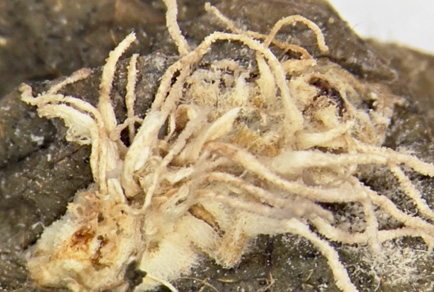
Gibellula species are obligate parasites of spider, gaining extensive attention upon their taxonomy. In this study, we describe Gibellula liaoningensis sp. nov. based on morphological characteristics and molecular evidence. The multi-locus phylogenetic analyses using six molecular markers (SSU, LSU, ITS, TEF-1α, RPB1, and RPB2) robustly resolved its phylogenetic distinctiveness within the genus. Morphologically, G. liaoningensis is characterized by penicillate conidiophores exhibiting a significantly shortened stipe and clavate conidia. This taxon represents the first recorded Gibellula species in the Northeast China region, expanding the known geographic distribution of this ecologically specialized fungal genus.
References
- Cavara, F. (1894) Ulteriore contribuzione alla micologia lombarda. Atti dell’Istituto Botanico della Università e Laboratorio Crittogamico di Pavia. pp. 313–150.
- Castlebury, L.A., Rossman, A.Y., Sung, G., Hyten, A.S. & Spatafora, J.W. (2004) Multigene phylogeny reveals new lineage for Stachybotrys chartarum, the indoor air fungus. Mycological Research 108 (8): 864–872. https://doi.org/10.1017/s0953756204000607
- Chen, W.H., Wang, Y.R., Wang, Y., Han, Y.F., Zou, X. & Liang, Z.Q. (2012) A new record of Gibellula in China. Journal of Mountain Agriculture and Biology 31 (6): 474–476. https://doi.org/10.15958/j.cnki.sdnyswxb.2012.06.014
- Chen, W.H., Han, Y.F., Liang, Z.Q., Wang, Y.R. & Zou, X. (2014) Classification of Gibellula spp. By DELTA system. Microbiology China 41 (2): 399–407. https://doi.org/10.13344/j.microbiol.china.130202
- Chen, W.H., Han, Y.F., Liang, Z.Q. & Zou, X. (2016) Morphological traits, DELTA system, and molecular analysis for Gibellula clavispora sp. nov. from China. Mycotaxon 131 (1): 111–121. https://doi.org/10.5248/131.111
- Chen, M., Wang, T., Lin, Y. & Huang, B. (2021) Gibellula flava sp. nov. (Cordycipitaceae, Hypocreales), a new pathogen of spider from China. Phytotaxa 527 (2): 125–133. https://doi.org/10.11646/phytotaxa.527.2.5
- Chen, M., Wang, T., Lin, Y. & Huang, B. (2022) Morphological and molecular analyses reveal two new species of Gibellula (Cordycipitaceae, Hypocreales) from China. MycoKeys 90: 53–69. https://doi.org/10.3897/mycokeys.90.83801
- Clewley, J.P. (1995) Macintosh sequence analysis software. DNAStar’s LaserGene. Molecular Biotechnology 3 (3): 221–224. https://doi.org/10.1007/BF02789332
- Evans, H.C., Fogg, T., Buddie, A.G., Yeap, Y.T. & Araújo, J.P.M. (2025) The araneopathogenic genus Gibellula (Cordycipitaceae: Hypocreales) in the British Isles, including a new zombie species on orb-weaving cave spiders (Metainae: Tetragnathidae). Fungal Systematics and Evolution 15 (1): 153–178. https://doi.org/10.3114/fuse.2025.15.07
- Jeewon, R. & Hyde, K.D. (2016) Establishing species boundaries and new taxa among fungi: recommendations to resolve taxonomic ambiguities. Mycosphere 7 (11): 1669–1677. https://doi.org/10.5943/mycosphere/7/11/4
- Joseph, R.A., Masoudi, A., Valdiviezo, M.J. & Keyhani, N.O. (2024) Discovery of Gibellula floridensis from Infected Spiders and Analysis of the Surrounding Fungal Entomopathogen Community. Journal of Fungi 10 (10): 694. https://doi.org/10.3390/jof10100694
- Han, Y.F., Chen, W.H., Zou, X. & Liang, Z.Q. (2013) Gibellula curcispora, a new species of Gibellula. Mycosystema 32 (5): 777–780.
- Helaly, S.E., Kuephadungphan, W., Phainuphong, P., Ibrahim, M.A.A., Tasanathai, K., Mongkolsamrit, S., Luangsa-Ard, J.J., Phongpaichit, S., Rukachaisirikul, V. & Stadler, M. (2019) Pigmentosins from Gibellula sp. as antibiofilm agents and a new glycosylated asperfuran from Cordyceps javanica. Beilstein Journal of Organic Chemistry 15: 2968–2981. https://doi.org/10.3762/bjoc.15.293
- Huang, B., Ding, D.G., Fan, M.Z. & Li, Z.Z. (1998) A new entomopathogenic fungus on spiders. Mycosystema 17 (2): 109–113.
- Hughes, D.P., Andersen, S.B., Hywel-Jones, N.L., Himaman, W., Billen, J. & Boomsma, J.J. (2011) Behavioral mechanisms and morphological symptoms of zombie ants dying from fungal infection. BMC Ecology and Evolution 11: 13. https://doi.org/10.1186/1472-6785-11-13
- Hughes, D.P., Araújo, J.P., Loreto, R.G., Loreto, R.G., Quevillon, L.E., Bekker, C.D. & Evans, H.C. (2016) From So Simple a Beginning: The Evolution of Behavioral Manipulation by Fungi. Advances in genetics 94: 437–69. https://doi.org/10.1016/bs.adgen.2016.01.004
- Hyde, K.D., Tennakoon, D.S., Jeewon, R., Bhat, D.J., Maharachchikumbura, S.S., Rossi, W., Leonardi, M., Lee, H.B., Mun, H.Y., Houbraken, J., Nguyen, T.T., Jeon, S.J., Frisvad, J.C., Wanasinghe, D.N., Lücking, R., Aptroot, A., Cáceres, M.E., Karunarathna, S.C., Hongsanan, S., Phookamsak, R., Silva, N.I., Thambugala, K.M., Jayawardena, R.S., Senanayake, I.C., Boonmee, S., Chen, J., Luo, Z., Phukhamsakda, C., Pereira, O.L., Abreu, V.P., Rosado, A.W., Bart, B., Randrianjohany, É., Hofstetter, V., Gibertoni, T.B., Soares, A.M., Plautz, H.L., Sotão, H.M., Xavier, W.K., Bezerra, J.D., Oliveira, T.G., Souza-Motta, C.M., Magalhães, O.M., Bundhun, D., Harishchandra, D.L., Manawasinghe, I.S., Dong, W., Zhang, S., Bao, D., Samarakoon, M.C., Pem, D., Karunarathna, A., Lin, C., Yang, J., Perera, R.H., Kumar, V., Huang, S., Dayarathne, M.C., Ekanayaka, A.H., Jayasiri, S.C., Xiao, Y., Konta, S., Niskanen, T., Liimatainen, K., Dai, Y., Ji, X., Tian, X., Mešić, A., Singh, S.K., Phutthacharoen, K., Cai, L., Sorvongxay, T., Thiyagaraja, V., Norphanphoun, C., Chaiwan, N., Lu, Y., Jiang, H., Zhang, J., Abeywickrama, P.D., Aluthmuhandiram, J.V., Brahmanage, R.S., Zeng, M., Chethana, T., Wei, D., Réblová, M., Fournier, J., Nekvindová, J., Nascimento Barbosa, R., Santos, J., Oliveira, N.T., Li, G., Ertz, D., Shang, Q., Phillips, A.J., Kuo, C., Camporesi, E., Bulgakov, T.S., Lumyong, S., Jones, E.B., Chomnunti, P., Gentekaki, E., Bungartz, F., Zeng, X., Fryar, S.C., Tkalčec, Z., Liang, J., Li, G., Wen, T., Singh, P.N., Gafforov, Y., Promputtha, I., Yasanthika, E., Goonasekara, I.D., Zhao, R., Zhao, Q., Kirk, P.M., Liu, J., Yan, J., Mortimer, P.E. & Doilom, M. (2019) Fungal diversity notes 1036–1150: taxonomic and phylogenetic contributions on genera and species of fungal taxa. Fungal Diversity 96: 1–242. https://doi.org/10.1007/s13225-019-00429-2
- Hyde, K.D., Noorabadi, M.T., Thiyagaraja, V., He, M.Q., Johnston, P.R., Wijesinghe, S.N., Armand, A., Biketova, A.Y., Chethana, K.W.T., Erdoğdu, M., Ge, Z.W., Groenewald, J.Z., Hongsanan, S., Kušan, I., Leontyev, D.V., Li, D.W., Lin, C.G., Liu, N.G., Maharachchikumbura, S.S.N., Matočec, N., May, T.W., McKenzie, E.H.C., Mesic, A., Perera, R.H., Phukhamsakda, C., Piatek, M., Samarakoon, M.C., Selcuk, F., Senanayake, I.C., Tanney, J.B., Tian, Q., Vizzini, A., Wanasinghe, D.N., Wannasawang, N., Wijayawardene, N.N., Zhao, R.L., Abdel-Wahab, M.A., Abdollahzadeh, J., Abeywickrama, P.D., Absalan, S., Acharya, K., Afshari, N., Afshan, N.S., Afzalinia, S., Ahmadpour, S.A., Akulov, A., Alizadeh, A., Alizadeh, M., Al-Sadi, A.M., Alves, A., Alves, V.C.S., Alves-Silva, G., Antonín, V., Aouali, S., Aptroot, A., Apurillo, C.C.S., Arias, R.M., Asgari, B., Asghari, R., Assis, DMA., Assyov, B., Atienza, V., Aumentado, H.D.R., Avasthi, S., Azevedo, E., Bakhshi, M., Bao, D.F., Baral, H.O., Barata, M., Barbosa, K.D., Barbosa, R.N., Barbosa, F.R., Baroncelli, R., Barreto, G.G., Baschien, C., Bennett, R.M., Bera, .I, Bezerra, J.D.P., Bhunjun, C.S., Bianchinotti, M.V., Blaszkowski, J., Boekhout, T., Bonito, G.M., Boonmee, S., Boonyuen, N., Bortnikov, F.M., Bregant, C., Bundhun, D., Burgaud, G., Buyck, B., Caeiro, M.F., Cabarroi-Hernández, M., Cai, M.F., Cai, L., Calabon, M.S., Calaça, F.J.S., Callalli, M., Camara, M.P.S., Cano-Lira, J., Cao, B., Carlavilla, J.R., Carvalho, A., Carvalho, T.G., Castañeda-Ruiz, R.F., Catania, M.D.V., Cazabonne, J., Cedeño-Sanchez, M., Chaharmiri-Dokhaharani, S., Chaiwan, N., Chakraborty, N., Cheewankoon, R., Chen, C., Chen, J., Chen, Q., Chen, Y.P., Chinaglia, S., Coelho-Nascimento, C.C., Coleine, C., Costa-Rezende, D.H., Cortés-Pérez, A., Crouch, J.A., Crous, P.W., Cruz, R.H.S.F., Czachura, P.W., Damm, U., Darmostuk, V., Daroodi, Z., Das, K., Das, K., Davoodian, N., Davydov, E.A., da Silva, G.A., Da Silva, I.R., da Silva, R.M.F., da Silva Santos, A.C., Dai, D.Q., Dai, Y.C., de Groot Michiel, D., De Kesel, A., De Lange, R., de Medeiros, E.V., de Souza, C.F.A., de Souza, F.A., Dela Cruz, T.E.E, Decock, C., Delgado, G., Denchev, T.T., Denchev, C.M., Deng, C.Y., Dentinger, B.T.M., Devadatha, B., Dianese, J.C., Dima, B., Doilom, M., Dissanayake, A.J., Dissanayake, L.S., Diniz, A.G., Dolatabadi, S., Dong, J.H., Dong, W., Dong, Z.Y., Drechsler-Santos, E.R., Druzhinina, I.S., Du, T.Y., Dubey, M.K., Dutta, A.K., Elliott, T.F., Elshahed, M.S., Egidi, E., Eisvand, P., Fan, L., Fan, X., Fan, XL., Fedosova, AG., Ferro, L.O., Fiuza, P.O., Flakus, A., Fonseca, E.O., Fryar, S.C., Gabaldón, T., Gajanayake, A.J., Gannibal, P.B., Gao, F., García-Sánchez, D., Garcia-Sandoval, R., Garrido-Benavent, I., Garzoli, L., Gasca-Pineda, J., Gautam, A.K., Gené, J., Ghobad-Nejhad, M., Ghosh, A., Giachini, A.J., Gibertoni, T.B., Gentekaki, E., Gmoshinskiy, V.I., Góes-Neto, A., Gomdola, D., Gorjón, S.P., Goto, B.T., Granados-Montero, M.M., Griffith, G.W., Groenewald, M., Grossart, H.P., Gu, Z.R., Gueidan, C., Gunarathne, A., Gunaseelan, S., Guo, S.L., Gusmão, L.F.P., Gutierrez, A.C., Guzmán-Dávalos, L., Haelewaters, D., Haituk, H., Halling, R.E., He, S.C., Heredia, G., Hernández-Restrepo, M., Hosoya, T., de Hoog, S., Horak, E., Hou, C.U., Houbraken, J., Htet, Z.H., Huang, S.K., Huang, W.J., Hurdeal, V.G., Hustad, V.P., Inácio, C.A., Janik, P., Jayalal, R.G.U., Jayasiri, S.C., Jayawardena, R.S., Jeewon, R., Jerônimo, G.H., Jin, J, Jones, E.B.G., Joshi, Y., Jurjević, Ž., Justo, A., Kakishima, M., Kaliyaperumal, M., Kang, G.P., Kang, J.C., Karimi, O., Karunarathna, S.C., Karpov, S.A., Kezo, K., Khalid, A.N. & Khan, M.K. (2024) The 2024 Outline of Fungi and fungus-like taxa. Mycosphere 15 (1): 5146–6239. https://doi.org/10.5943/mycosphere/15/1/25
- Kepler, R.M., Luangsa-Ard, J.J., Hywel-Jones, N.L., Quandt, C.A., Sung, G.H., Rehner, S.A., Aime, M.C., Henkel, T.W., Sanjuan, T., Zare, R., Chen, M., Li, Z., Rossman, A.Y., Spatafora, J.W. & Shrestha, B. (2017) A phylogenetically-based nomenclature for Cordycipitaceae (Hypocreales). IMA Fungus 8 (2): 335–353. https://doi.org/10.5598/imafungus.2017.08.02.08
- Khonsanit, A., Thanakitpipattana, D., Mongkolsamrit, S., Kobmoo, N., Phosrithong, N., Samson, R.A., Crous, P.W. & Luangsa-ard, J.J. (2024) A phylogenetic assessment of Akanthomyces sensu lato in Cordycipitaceae (Hypocreales, Sordariomycetes): introduction of new genera, and the resurrection of Lecanicillium. Fungal Systematics and Evolution 14: 271–305. https://doi.org/10.3114/fuse.2024.14.17
- Kubátová, A. (2004) The arachnogenous fungus Gibellula leiopus - second find from the Czech Republic. Czech Mycology 56: 185–191.
- Kuephadungphan, W., Phongpaichit, S., Luangsa-Ard, J.J. & Rukachaisirikul, V. (2014) Antimicrobial activity of invertebrate-pathogenic fungi in the genera Akanthomyces and Gibellula. Mycoscience 55 (2): 127–133. https://doi.org/10.1016/j.myc.2013.06.007
- Kuephadungphan, W., Macabeo, A.P., Luangsa-Ard, J.J., Tasanathai, K., Thanakitpipattana, D., Phongpaichit, S., Yuyama, K.T. & Stadler, M. (2019) Studies on the biologically active secondary metabolites of the new spider parasitic fungus Gibellula gamsii. Mycological Progress 1: 135–146. https://doi.org/10.1007/s11557-018-1431-4
- Kuephadungphan, W., Tasanathai, K., Petcharad, B., Khonsanit, A., Stadler, M. & Luangsa-Ard, J.J. (2020) Phylogeny- and morphology-based recognition of new species in the spider-parasitic genus Gibellula (Hypocreales, Cordycipitaceae) from Thailand. Mycokeys 72: 17–42. https://doi.org/10.3897/mycokeys.72.55088
- Kuephadungphan, W., Petcharad, B., Tasanathai, K., Thanakitpipattana, D., Kobmoo, N., Khonsanit, A., Samson, R.A. & Luangsa-Ard, J.J. (2022) Multi-locus phylogeny unmasks hidden species within the specialised spider-parasitic fungus, Gibellula (Hypocreales, Cordycipitaceae) in Thailand. Studies in Mycology 101: 245–286. https://doi.org/10.3114/sim.2022.101.04
- Larsson, A. (2014) AliView: a fast and lightweight alignment viewer and editor for large datasets. Bioinformatics 30: 3276–3278. https://doi.org/10.1093/bioinformatics/btu531Li, Y., Zhao, X., Wu, L., Wang, Y., Xu, A. & Lin, W. (2023) Blackwellomyces kaihuaensis and Metarhizium putuoense (Hypocreales), Two New Entomogenous Fungi from Subtropical Forests in Zhejiang Province, Eastern China. Forests 14 (12): 2333. https://doi.org/10.3390/f14122333
- Maharachchikumbura, S.S., Hyde, K.D., Jones, E.B., McKenzie, E.H., Huang, S., Abdel-Wahab, M.A., Daranagama, D.A., Dayarathne, M.C., D’souza, M.J., Goonasekara, I.D., Hongsanan, S., Jayawardena, R.S., Kirk, P.M., Konta, S., Liu, J., Liu, Z., Norphanphoun, C., Pang, K., Perera, R.H., Senanayake, I.C., Shang, Q., Shenoy, B.D., Xiao, Y., Bahkali, A.H., Kang, J., Somrothipol, S., Suetrong, S., Wen, T., Xu, J.C. & Xu, J.C. (2015) Towards a natural classification and backbone tree for Sordariomycetes. Fungal Diversity 72: 199–301. https://doi.org/10.1007/s13225-015-0331-z
- Mains, E.B. (1950a) Enotomogenous species of Akanthomyces, Hymenostible and Insecticola in North America. Mycologica 42: 566–589.
- Mains, E.B. (1950b) The genus Gibellula on spiders in North America. Mycologia 42 (2): 306–321.
- Mendes-Pereira, T., de Araújo, J.P.M., Mendes, F.C., Fonseca, E.O., Alves, J.E.D.R., Sobczak, J.F. & Goes-Neto, A. (2022) Gibellula aurea sp. nov (Ascomycota, Cordycipitaceae): a new golden spider-devouring fungus from a Brazilian Atlantic Rainforest. Phytotaxa 573 (1): 85–102. https://doi.org/10.11646/phytotaxa.573.1.5
- Mendes-Pereira, T., de Araújo, J.P.M., Kloss, T.G., Costa-Rezende, D.H., de Carvalho, D.S. & Góes-Neto, A. (2023) Disentangling the Taxonomy, Systematics, and Life History of the Spider-Parasitic Fungus Gibellula (Cordycipitaceae, Hypocreales). Journal of Fungi 9 (4): 457. https://doi.org/10.3390/jof9040457
- Miller, M.A., Pfeiffer, W. & Schwartz, T. (2010) Creating the CIPRES Science Gateway for inference of large phylogenetic trees. In: 2010 Gateway Computing Environments Workshop (GCE). IEEE, New Orleans, LA, USA, pp. 1–8. https://doi.org/10.1109/GCE.2010.5676129.
- Mongkolsamrit, S., Noisripoom, W., Tasanathai, K., Khonsanit, A., Thanakitpipattana, D., Himaman, W., Kobmoo, N. & Luangsa-Ard, J.J. (2020) Molecular phylogeny and morphology reveal cryptic species in Blackwellomyces and Cordyceps (Cordycipitaceae) from Thailand. Mycological Progress 19: 957–983. https://doi.org/10.1007/s11557-020-01615-2
- Mongkolsamrit, S., Noisripoom, W., Tasanathai, K., Kobmoo, N., Thanakitpipattana, D., Khonsanit, A., Petcharad, B. & Himaman, W. (2022) Comprehensive treatise of Hevansia and three new genera Jenniferia, Parahevansia and Polystromomyces on spiders in Cordycipitaceae from Thailand. MycoKeys 91: 113–149. https://doi.org/10.3897/mycokeys.91.83091
- Nylander, J.A.A. (2004) MrModeltest v2. Program distributed by the author. Evolutionary Biology Centre, Uppsala University.
- Peng, X.C., Wen, T.C., Wei, D.P., Liao, Y.H., Wang, Y., Zhang, X., Wang, G.Y., Zhou, Y., Tangtrakulwanich, K. & Liang, J.D. (2024) Two new species and one new combination of Ophiocordyceps (Hypocreales, Ophiocordycipitaceae) in Guizhou. MycoKeys 102: 245–266. https://doi.org/10.3897/mycokeys.102.113351
- Rambaut, A. (2012) FigTree tree figure drawing tool version 1.4. 0. [http://tree.bio.ed.ac.uk/software/figtree/]
- Rehner, S.A. & Buckley, E. (2005) A Beauveria phylogeny inferred from nuclear ITS and TEF1-alpha sequences: evidence for cryptic diversification and links to Cordyceps teleomorphs. Mycologia 97 (1): 84–98. https://doi.org/10.3852/mycologia.97.1.84
- Ronquist, F., Teslenko, M., Van Der Mark, P., Ayres, D.L., Darling, A., Höhna, S., Larget, B., Liu, L., Suchard, M.A. & Huelsenbeck, J.P. (2012) MrBayes 3.2: efficient Bayesian phylogenetic inference and model choice across a large model space. Systematic Biology 61 (3): 539–542. https://doi.org/10.1093/sysbio/sys029
- Samson, R.A. & Evans, H.C. (1992) New Species of Gibellula on Spiders (Araneida) from South America. Mycologia 84: 300–314. https://doi.org/10.1080/00275514.1992.12026143
- Samson, R.A. & Evans, H.C. (1973) Notes on entomogenous fungi from Ghana: I. The genera Gibellula and Pseudogibellula. Acta Botanica Neerlandica 22 (5): 522–528. https://doi.org/10.1111/j.1438-8677.1973.tb00873.x
- Saltamachia, S.J. (2022) Theoretical and empirical evidence for extended phenotypes in a specialized parasite of spiders. Authorea Preprints. https://doi.org/10.22541/au.164604858.89088094/v1
- Shrestha, B., Kubátová, A., Tanaka, E., Oh, J., Yoon, D.H., Sung, J.M. & Sung, G.H. (2019) Spider-pathogenic fungi within Hypocreales (Ascomycota): their current nomenclature, diversity, and distribution. Mycological Progress 18: 983–1003. https://doi.org/10.1007/s11557-019-01512-3
- Stamatakis, A. (2014) RAxML version 8: a tool for phylogenetic analysis and post-analysis of large phylogenies. Bioinformatics 30: 1312–1313. https://doi.org/10.1093/bioinformatics/btu033
- Tan, Y.P. & Shivas, R.G. (2023) Nomenclatural novelties. Index of Australian Fungi 11: 1–11.
- Tang, D., Huang, O., Zou, W., Wang, Y., Wang, Y., Dong, Q. Sun, T., Yang, G. & Yu, H. (2023) Six new species of zombie-ant fungi from Yunnan in China. IMA Fungus 14 (1): 9. https://doi.org/10.1186/s43008-023-00114-9
- Tzean, S.S., Hsieh, L.S. & Wu, W.J. (1997) The genus Gibellula on spiders from Taiwan. Mycologia 89 (2): 309–318.
- Tzean, S.S., Hsieh, L.S. & Wu, W.J. (1998) Torrubiella dimorpha, a new species of spider parasite from Taiwan. Mycological Research 102 (11): 1350–1354. https://doi.org/10.1017/S0953756298006467
- Vilgalys, R. & Hester, M. (1990) Rapid genetic identification and mapping of enzymatically amplified ribosomal DNA from several Cryptococcus species. Journal of Bacteriology 172 (8): 4238–4246. https://doi.org/10.1128/jb.172.8.4238-4246.1990
- Wang, Y., Wang, Z., Luo, R., Souvanhnachit, S., Thanarut, C., Dao, V. & Yu, H. (2024a) Species diversity and major host/substrate associations of the genus Akanthomyces (Hypocreales, Cordycipitaceae). MycoKeys 101: 113–141. https://doi.org/10.3897/mycokeys.101.109751
- Wang, T., Chang, X.Y., Huang, B., Li, Z.Z. & Chen, M.J. (2024b) Species diversity of spider-pathogenic fungi in China. Mycosystema 43 (3): 230243. https://doi.org/10.13346/j.mycosystema.230243
- Wei, D.P., Wanasinghe, D.N., Xu, J.C., To-Anun, C., Mortimer, P.E., Hyde, K.D., Elgorban, A.M., Madawala, S., Suwannarach, N., Karunarathna, S.C., Tibpromma, S. & Lumyong, S. (2021) Three Novel Entomopathogenic Fungi From China and Thailand. Frontiers in Microbiology 11: 608991. https://doi.org/10.3389/fmicb.2020.608991
- Wei, D.P., Gentekaki, E., Wanasinghe, D., Tang, S. & Hyde, K.D. (2023) Diversity, molecular dating and ancestral characters state reconstruction of entomopathogenic fungi in Hypocreales. Mycosphere 13 (2): 281–351. https://doi.org/10.5943/mycosphere/si/1f/8
- White, T.J., Bruns, T., Lee, S. & Taylor, J. (1990) Amplification and direct sequencing of fungal ribosomal RNA genes for phylogenetics. In: Innis, M.A., Gelfand, D.H., Sninsky, J.J. & White, T.J. (Eds.) PCR Protocols: A Guide to Methods and Application. Elsevier, Academic Press, New York, pp. 315–322.
- Wijayawardene, N.N., Hyde, K.D., Lumbsch, H.T., Liu, J., Maharachchikumbura, S.S., Ekanayaka, A.H., Tian, Q. & Phookamsak, R. (2018) Outline of Ascomycota: 2017. Fungal Diversity 88: 167–263. https://doi.org/10.1007/s13225-018-0394-8
- Xiao, Y.P., Wang, Y.B., Hyde, K.D., Eleni, G., Sun, J.Z., Yang, Y., Meng, J., Yu, H. & Wen, T.C. (2023) Polycephalomycetaceae, a new family of clavicipitoid fungi segregates from Ophiocordycipitaceae. Fungal Diversity 120 (1): 1–76. https://doi.org/10.1007/s13225-023-00517-4
- Xiao, Y.P., Wen, T.C., Hongsanan, S., Jeewon, R., Luangsa-Ard, J.J., Brooks, S., Wanasinghe, D.N., Long, F.Y. & Hyde, K.D. (2018) Multigene phylogenetics of Polycephalomyces (Ophiocordycipitaceae, Hypocreales), with two new species from Thailand. Scientific Reports 8 (1): 18087. https://doi.org/10.1038/s41598-018-36792-4
- Zou, X., Chen, W.H., Han, Y.F. & Liang, Z.Q. (2016) A new species of the genus Gibellula. Mycosystema 35 (10): 1161–1168. https://doi.org/10.13346/j.mycosystema.150200