
Abstract
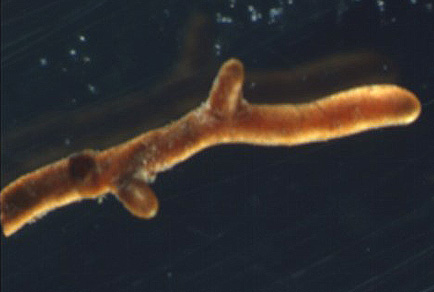
This article introduces Lactarius battagramensis as a novel species along with its ectomycorrhizal association from the temperate forests of Pakistan. Morpho-anatomical data coupled with sequence analyses and phylogeny inference of nrDNA ITS sequences are obtained from fruit bodies and ectomycorrhiza, leading to a better circumscription of new species. This new species is characterized by pale cream to vivid yellow and plano-concave to concave pileus, adnate lamellae that are concolorous to pileus, stipe that is tapering towards base, globose to broadly ellipsoid basidiospores forming partial to nearly complete reticulum, fusiform hymenial macrocystidia, absence of hymenial pseudocystidia, narrowly clavate paracystidia, and a hypoepithelium pileipellis. Phylogenetic estimation based on sequences from the internal transcribed spacer (ITS) region of the nuclear ribosomal DNA (nrDNA) genes inferred that L. battagramensis formed a separate and distinct clade sister to L. mediterraneensis with a strong support value, which represents the uniqueness of this species from other species of L. subgen. Lactarius.
References
- Agerer, R. (1987) Colour atlas of ectomycorrhizae—1st–11th (edn). Einhorn Verlag, Schwäbisch Gmünd.
- Ahmad, S. & Iqbal, S.H. (1997) Fungi of Pakistan. Lahore, Pakistan.
- Atri, N.S., Sharma, S., Saini, M.K. & Das, K. (2016) Researches on russulaceous mushrooms an appraisal. Kavaka 47: 63–82.
- Barge, E.G. & Cripps, C.L. (2016) New reports, phylogenetic analysis, and a key toLactarius Pers. in the Greater Yellowstone Ecosystem informed by molecular data. MycoKeys 15: 1–58. https://doi.org/10.3897/mycokeys.15.9587
- Barkatullah, B. & Ibrar, M. (2011) Plants profile of Malakand Pass Hills, District Malakand, Pakistan. African Journal of Biotechnology 10 (73): 16521–16535. https://doi.org/10.5897/AJB11.1258
- Barroetaveña, C., Pildain, M.B., Salgado Salomón, M.E. & Eberhart, J.L. (2010) Molecular identification of ectomycorrhizas associated with ponderosa pine seedlings in Patagonian nurseries (Argentina). Canadian Journal of Forest Research 40 (10): 1940–1950. https://doi.org/10.1139/X10-135
- Bera, I. & Das, K. (2023) Two new species of genus Lactarius Pers. (Russulaceae) from Arunachal Pradesh, India. Cryptogamie, Mycologie 44 (11): 147–158. https://doi.org/10.5252/cryptogamie-mycologie2023v44a11
- Bera, I., Uniyal, P. & Das, K. (2019) A novel species in Lactarius sect. Atroviridi from Indian Himalaya. Phytotaxa 415: 58–64. https://doi.org/10.11646/phytotaxa.415.1.4
- Buyck, B., Hofstetter, V., Eberhardt, U., Verbeken, A. & Kauff, F. (2008) Walking the thin line between Russula and Lactarius: the dilemma of Russula subsect. Ochricompactae. Fungal Diversity 28: 15–40.
- Cao, S.Q., Wang, X.H., Qin, W.Q., Wu, F., Liu, T., Bau, T. & Liu, D. (2023) New species Lactarius liyuanus in East Asia: a close relative of European L. acerrimus. Mycosystema 42 (1): 252–262. https://doi.org/10.13346/j.mycosystema.220437
- Das, K., Bera, I. & Ghosh, A. (2020) Lactarius brunneoaurantiacus sp. nov. and L. indoscrobiculatus sp. nov. from India. Nordic Journal of Botany 38 (11): 1–10. https://doi.org/10.1111/njb.02940
- David, A. & Gomez, E. (2019) Lactarius acerrimus britzelm. Lactarius 28: 10–15.
- De Crop, E., Nuytinck, J., Van de Putte, K., Wisitrassameewong, K., Hackel, J., Stubbe, D. & Verbeken, A. (2017) A multi-gene phylogeny of Lactifluus (Basidiomycota, Russulales) translated into a new infrageneric classification of the genus. Persoonia-Molecular Phylogeny and Evolution of Fungi 38 (1): 58–80. https://doi.org/10.3767/003158517X693255
- Eberhardt, U. & Verbeken, A. (2004) Sequestrate Lactarius species from tropical Africa: L. angiocarpus sp. nov. and L. dolichocaulis comb. nov. Mycological research 108 (9): 1042–1052. https://doi.org/10.1017/S0953756204000784
- Gardes, M. & Bruns, T.D. (1993) ITS primers with enhanced specificity for basidiomycetes‐application to the identification of mycorrhizae and rusts. Molecular Ecology 2 (2): 113–118. https://doi.org/10.1111/j.1365-294X.1993.tb00005.x
- Giusti, A., Ricci, E., Gasperetti, L., Galgani, M., Polidori, L., Verdigi, F. & Armani, A. (2021) Building of an Internal Transcribed Spacer (ITS) gene dataset to support the Italian Health Service in mushroom identification. Foods 10 (6): 1193. https://doi.org/10.3390/foods10061193
- Hall, T.A. (1999) BioEdit: a user–friendly biological sequence alignment editor and analysis program for Windows 95/98/NT. Nucleic acids symposium series 41 (41): 95–98.
- Haq, F., Ahmad, H., Alam, M., Ahmad, I. & Ullah, R. (2010) Species diversity of vascular plants of Nandiar valley western Himalaya, Pakistan. Pakistan Journal of Botany 42 (87): 213–229.
- He, M.Q., Zhao, R.L., Hyde, K.D., Begerow, D., Kemler, M., Yurkov, A. & Kirk, P.M. (2019) Notes, outline and divergence times of Basidiomycota. Fungal diversity 99: 105–367. https://doi.org/10.1007/s13225-019-00435-4
- He, X. (1996) Lactarius atrosquamulosus sp. nov. from China. Acta Mycologica Sinica 15: 20–24.
- Heilmann-Clausen, J., Verbeken, A. & Vesterholt, J. (1998) The genus Lactarius. In: Fungi of northern Europe vol. 2. Svampetryk, Denmark: Danish Mycological Society, pp. 287–289.
- Hu, Y., Karunarathna, S.C., Li, H., Galappaththi, M.C., Zhao, C.L., Kakumyan, P. & Mortimer, P.E. (2022) The impact of drying temperature on basidiospore size. Diversity 14 (4): 239. https://doi.org/10.3390/d14040239
- Khalid, A.N. (2022) A checklist of macrofungi of Pakistan published from 1998–2020. Pakistan Journal of Botany 54 (5): 1947–1962. https://doi.org/10.30848/PJB2022-5(23)
- Le, H.T., Nuytinck, J., Verbeken, A., Lumyong, S. & Desjardin, D.E. (2007) Lactarius in Northern Thailand: 1. Lactarius subgenus Piperites. Fungal Diversity 24 (1): 173–224.
- Lee, H., Park, J.Y., Wisitrassameewong, K., Kim, M.J., Park, M.S., Kim, N.K. & Lim, Y.W. (2018) First report of eight milkcap species belonging to Lactarius and Lactifluus in Korea. Mycobiology 46 (1): 1–12. https://doi.org/10.1080/12298093.2018.1454012
- Lee, H., Wissitrassameewong, K., Park, M.S., Verbeken, A., Eimes, J. & Lim, Y.W. (2019) Taxonomic revision of the genus Lactarius (Russulales, Basidiomycota) in Korea. Fungal Diversity 95: 275–335. https://doi.org/10.1007/s13225-019-00425-6
- Munsell, A.H. (1975) Munsell soil color charts: Munsell Color. Baltimore, Maryland.
- Miller, M.A., Pfeiffer, W. & Schwartz, T. (2011) The CIPRES science gateway: a community resource for phylogenetic analyses. In: Proceedings of the 2011 Tera Grid Conference: Extreme digital discovery. pp. 1–8.
- Paloi, S. & Acharya, K. (2019) A new species of Lactarius (Russulaceae) from dry deciduous forest of West Bengal, India. Nova Hedwiga 108: 207–216. https://doi.org/10.1127/nova_hedwigia/2018/0505
- Polemis, E., Nuytinck, J., Fryssouli, V., Pera, U. & Zervakis, G.I. (2019) Phylogeny, ecology and distribution of the rare Mediterranean species Lactarius pseudoscrobiculatus (Basidiomycota, Russulales). Plant Systematics and Evolution 305: 755–764. https://doi.org/10.1007/s00606-019-01604-3
- Rambaut, A. (2014) FigTree v1.4.2. Available from: http://tree.bio.ed.ac.uk/software/figtree (accessed 25 February 2025)
- Rathnayaka, A.R., Tennakoon, D.S., Jones, G.E., Wanasinghe, D.N., Bhat, D.J., Priyashantha, A.H., Stephenson, S.L., Tibpromma, S. & Karunarathna, S.C. (2025) Significance of precise documentation of hosts and geospatial data of fungal collections, with an emphasis on plant-associated fungi. New Zealand Journal of Botany 63 (2–3): 462–489.
- Ronquist, F., Teslenko, M., van der Mark, P., Ayres, D.L., Darling, A., Höhna, S., Larget, B., Liu, L., Suchard, M.A. & Huelsenbeck, J.P. (2012) MrBayes 3.2: efficient Bayesian phylogenetic inference and model choice across a large model space. Systematics Biology 61: 539–542. https://doi.org/10.1093/sysbio/sys029
- Sana & Kiran, M. (2025) Morpho-anatomical and nrITS based identification of Lactarius swaticus (Russulaceae, Russulales) from Pakistan: An addition to the global mycoflora. Phytotaxa 690 (1): 47–62. https://doi.org/10.11646/phytotaxa.690.1.4
- Stubbe, D., Nuytinck, J. & Verbeken, A. (2010) Critical assessment of the Lactarius gerardii species complex (Russulales). Fungal biology 114 (2–3): 271–283. https://doi.org/10.1016/j.funbio.2010.01.008
- Trififinopoulos, J., Nguyen, L.T., von Haeseler, A. & Minh, B.Q. (2016) W-IQ-TREE: a fast online phylogenetic tool for maximum likelihood analyses. Nucleic Acids Research 44 (W1): W232–W235. https://doi.org/10.1093/nar/gkw256
- Vellinga, E.C. (1988) Glossary. In: Bas, C., Kuyper, T.W., Noordeloos, M.E. & Vellinga, E.C. (Eds.) Flora Agaricina Neerlandica. Vol 1. A.A. Balkema, Rotterdam, pp. 54–64.
- Verbeken, A., Stubbe, D., Van de Putte, K., Eberhardt, U. & Nuytinck, J. (2014) Tales of the unexpected: angiocarpous representatives of the Russulaceae in tropical South East Asia. Persoonia-Molecular Phylogeny and Evolution of Fungi 32 (1): 13–24. https://doi.org/10.3767/003158514X679119
- Verma, K., Mehmood, T., Uniyal, P. & Sharma, Y.P. (2022) Lactarius indoevosmus and L. kanadii (Russulaceae), two new species from the northwestern Himalayas, India, inferred from morphology and molecular data. Phytotaxa 541 (2): 165–177. https://doi.org/10.11646/phytotaxa.541.2.6
- Verma, K., Mehmood, T., Uniyal, P., Kapoor, R. & Sharma, Y.P. (2021) Two new species of genus Lactarius (Russulaceae) from north-Western Himalaya, India. Phytotaxa 500: 253–265. https://doi.org/10.11646/Phytotaxa.500.4.1
- Vidal, J.M., Alvarado, P., Loizides, M., Konstantinidis, G., Chachuła, P., Mleczko, P. & Llistosella, J. (2019) A phylogenetic and taxonomic revision of sequestrate Russulaceae in Mediterranean and temperate Europe. Persoonia-Molecular Phylogeny and Evolution of Fungi 42 (1): 127–185. https://doi.org/10.1007/s00606-019-01604-3
- Vu, D., Groenewald, M., De Vries, M., Gehrmann, T., Stielow, B., Eberhardt, U. & Verkley, G.J.M. (2019) Large-scale generation and analysis of filamentous fungal DNA barcodes boosts coverage for kingdom fungi and reveals thresholds for fungal species and higher taxon delimitation. Studies in mycology 92 (1): 135–154. https://doi.org/10.1016/j.simyco.2018.05.001
- Wang, X.H. (2016) Three new species of Lactarius sect. Deliciosi from subalpine-alpine regions of central and southwestern China. Cryptogamie, Mycologie 37 (4): 493–508. https://doi.org/10.7872/crym/v37.iss4.2016.493
- White, T.J., Bruns, T., Lee, S. & Taylor, J. (1990) Amplification and direct sequencing of fungal ribosomal RNA genes for phylogenetics. In: Innis, M.A., Gelf, D.H., Sninsky, J.J. & White, T.J. (Eds.) PCR protocols: A guide to methods applications. Academic Press, New York, pp. 315–322. https://doi.org/10.1016/B978-0-12-372180-8.50042-1
- Wisitrassameewong, K., Looney, B.P., Le, H.T., De Crop, E., Das, K., Van de Putte, K. & Nuytinck, J. (2016) Lactarius subgenus Russularia (Basidiomycota, Russulales): novel Asian species, worldwide phylogeny and evolutionary relationships. Fungal biology 120 (12): 1554–1581. https://doi.org/10.1016/j.funbio.2016.08.004
- Xiang‐Hua, W. (2017) Seven new species of Lactarius subg. Lactarius (Russulaceae) from southwestern China. Mycosystema 36 (11). http://dx.doi.org/10.13346/j.mycosystema.170155
- Xing, P., Xu, Y., Gao, T., Li, G., Zhou, J., Xie, M. & Ji, R. (2020) The community composition variation of Russulaceae associated with the Quercus mongolica forest during the growing season at Wudalianchi City, China. Peer J 8: e8527. https://doi.org/10.7717/peerj.8527