

Abstract
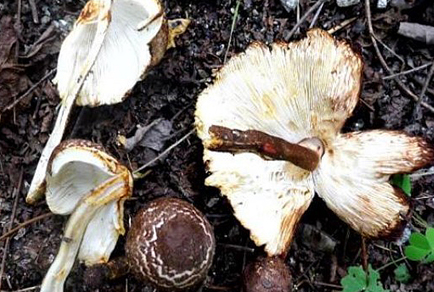
Leucocoprinus atroferrugineus sp. nov. is described from Buner District, Pakistan, based on morphological features and molecular evidence. This species is characterized by the presence of dark, reddish-brown, areolate-fibrillose squamules on the pileus, which become dull reddish brown to reddish brown towards the margin; a hollow stipe with a pale pinkish apex; dark fibrils below the annulus, turn orange and eventually dark when scratched; and the presence of an annulus. The basidiospores are large, ellipsoid to amygdaliform. Detailed morphological characteristics and phylogenetic analysis using the ITS rDNA barcode region confirm the new species. A description with comprehensive discussion, illustrations, and phylogenetic analysis results of the new species are provided.
References
- Acharya, K., Tarafder, E., Pradhan, P., Dutta, A.K., Paloi, S., Datta, M. & Roy, A. (2017) Contribution to the macromycetes of West Bengal, India. Research Journal of Pharmacy and Technology 10 (9): 3061–3068. https://doi.org/10.5958/0974-360X.2017.00543.1
- Aman, N., Khalid, A.N. & Moncalvo, J.M. (2022) A compendium of macrofungi of Pakistan by ecoregions. MycoKeys 89: 171. https://doi.org/10.3897/mycokeys.89.81148
- Ashraf, S., Naseer, A., Usman, M. & Khalid, A.N. (2023) Two new species of genus Leucoagaricus (Agaricaceae, Agaricales) from Pakistan. MycoKeys 96: 159–171. https://doi.org/10.3897/mycokeys.96.101745
- Asif, M., Saba, M., Raza, M. & Vellinga, E.C. (2024) Molecular insights into fungal diversity reveal three novel species of Leucocoprinus from southern Punjab, Pakistan. Mycologia 116 (4): 601–620. https://doi.org/10.1080/00275514.2024.2351769
- Bon, M. (1987) Flore Mycologique d’Europe 1. Les Lepiotes. Editions M. Bon, 152 pp.
- Dentinger, B.T.M., Didukh, M.Y. & Moncalvo, J.M. (2011) Comparing COI and ITS as DNA barcode markers for mushrooms and allies (Agaricomycotina). PLoS One 6: e25081. https://doi.org/10.1371/journal.pone.0025081
- Forin, N., Tatti, A., Vizzini, A., Coppola, A. & Migliozzi, V. (2022) Leucoagaricus cupresseoides (Agaricaceae), a new species in sect. Piloselli and L. aurantiovergens and L. pseudopilatianus redescribed from Italy. Phytotaxa 536: 126–140. https://doi.org/10.11646/phytotaxa.536.2.2
- Gardes, M. & Bruns, T.D. (1993) ITS primers with enhanced specificity for basidiomycetes: application to the identification of mycorrhizae and rusts. Molecular Ecology 2: 113–118. https://doi.org/10.1111/j.1365-294X.1993.tb00005.x
- Glez-Peña, D., Gómez-Blanco, D., Reboiro-Jato, M., Fdez-Riverola, F. & Posada, D. (2010) ALTER: program-oriented conversion of DNA and protein alignments. Nucleic Acids Research 38: 14–18. https://doi.org/10.1093/nar/gkq321
- Hall, T.A. (1999) BioEdit: a user-friendly biological sequence alignment editor and analysis program for Windows 95/98/NT. Nucleic Acids Symposium Series 41: 95–98. https://doi.org/10.1073/pnas.1117018109
- Hu, Y., Karunarathna, S.C., Li, H., Galappaththi, M.C., Zhao, C.L., Kakumyan, P. & Mortimer, P.E. (2022) The impact of drying temperature on basidiospore size. Diversity 14 (4): 239. https://doi.org/10.3390/d14040239
- Ishaq, M., Lu, W., Asif, M., Khan, M.B., Sana, Elgorban, A.M. & Karunarathna, S.C. (2024) Leucocoprinus flavoaurantiacus (Agaricaceae), a new species from Buner District, Pakistan. Applied Cell Biology 12 (3): 44–50. https://doi.org/10.53043/2320-1991.acb12008
- Ishaq, M., Galappaththi, M.C.A., Khan, M.B., Ullah, S., Fiaz, M. & Khalid, A.N. (2022) Lentinus squarrosulus an edible macro-fungus reported from Pakistan. Studies in Fungi 7: 1–3. https://doi.org/10.48130/SIF-2022-0006
- Jabeen, S., Naseer, A., Ijaz, H., Yasmeen, A., Niazi, A.R. & Zhao, C.L. (2024) Leucoagaricus rosuliformis sp. nov. (Agaricales, Basidiomycota) from Changa Manga Forest, Punjab, Pakistan. Phytotaxa 652 (4): 273–283. https://doi.org/10.11646/phytotaxa.652.4.3
- Justo, A., Angelini, C., Bizzi, A. & Vizzini, A. (2015) Leucoagaricus sabinae (Agaricaceae), a new species from the Dominican Republic. North American Fungi 10: 1–15. https://doi.org/10.11646/phytotaxa.226.1.9
- Miller, M.A., Pfeiffer, W. & Schwartz, T. (2010) Creating the CIPRES Science Gateway for inference of large phylogenetic trees. In: Proceedings of the Gateway Computing Environments Workshop (GCE), 14 Nov. 2010. Institute of Electrical and Electronics Engineers, New Orleans, LA, pp. 1–8. https://doi.org/10.1109/GCE.2010.5676129
- Munsell, A.H. (1975) Soil color charts. Munsell™, Baltimore.
- Nabe, M., Kasya, T. & Hosaka, K. (2014) Leucoagaricus viridiflavus (Agaricaceae), new to Japan. Japanese Journal of Mycology 55: 35–40.
- Nylander, J.A. (2004) MrModeltest V2. In: Evolutionary Biology Centre, Uppsala University, Uppsala, Sweden.
- Pegler, D.N. (1983) Agaric Flora of the Lesser Antilles. Kew Bulletin Additional Series 9. Royal Botanic Gardens, Kew.
- Singer, R. (1986) The Agaricales in modern taxonomy, 4th Edition. Koeltz Scientific Books, Königstein, 981 pp.
- Stamatakis, A. (2014) RAxML Version 8: A tool for phylogenetic analysis and post-analysis of large phylogenies. Bioinformatics 30: 1312–1313. https://doi.org/10.1093/bioinformatics/btu033
- Stamatakis, A., Hoover, P. & Rougemont, J. (2008) A rapid bootstrap algorithm for the RAxML web servers. Systematic Biology 57: 758–771. https://doi.org/10.1080/10635150802429642
- Thompson, J.D., Gibson, T.J., Plewniak, F., Jeanmougin, F. & Higgins, D.G. (1997) The Clustal_X windows interface: flexible strategies for multiple sequence alignment aided by quality analysis tools. Nucleic Acids Research 25: 4876–4882. https://doi.org/10.1093/nar/25.24.4876
- Vellinga, E.C. (2010) Lepiotaceous fungi in California, U.S.A. Leucoagaricus sect. Piloselli. Mycotaxon 112: 393–444. https://doi.org/10.5248/112.393
- Vellinga, E.C. (2001) Leucoagaricus. In: Noordeloos, M.E., Kuyper, Th.W. & Vellinga, E.C. (Eds.) Flora Agaricina Neerlandica 5. AA Balkema Publishers, Lisse, pp. 85–108.
- Vellinga, E.C. (2004) Ecology and distribution of lepiotaceous fungi (Agaricaceae)—a review. Nova Hedwigia 78: 273–299. https://doi.org/10.1127/0029-5035/2004/0078-0273
- White, T.J., Bruns, T.D. & Taylor, L.J. (1990) Amplification direct sequencing of fungal ribosomal RNA genes for phylogenetics. In: Innis, M.A., Gelf, D.H., Sninsky, J.J. & White, T.J. (Eds.) PCR protocols: A guide to methods applications. Academic Press, New York, pp. 315–322. https://doi.org/10.1016/b978-0-12-372180-8.50042-1
- Zhu, X.T., Zhang, J., Zhang, G.Q., Fan, J.X. & Dang, Y.X. (2024) Taxonomic description of a new species of Leucoagaricus and utilization of the Pantone Connect app in classification research. Phytotaxa 642 (1): 84–94. https://doi.org/10.11646/phytotaxa.642.1.7