

Abstract
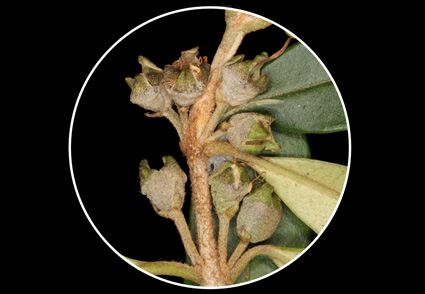
Three new Brazilian Myrceugenia species, all from mountainous regions in the Atlantic Rainforest, are described. Myrceugenia nebulosa and M. oreades are from Serra da Mantiqueira mountain range at the limits of between states of Minas Gerais and São Paulo, and M. bonita is from Serra Bonita mountain range in the state of Bahia. The study provides taxonomic descriptions, distribution maps, and preliminary extinction risk assessments, noting species that are endangered or critically endangered.
References
- Alves, J.V. & Buril, M.T. (2022) Distribution patterns, endemism, richness and diversity of Convolvulaceae in the Espinhaço Range, Brazil. Anais da Academia Brasileira de Ciências 94 (4): 1–18. https://doi.org/10.1590/0001-3765202220211380
- Antonelli, A., Kissling, W.D., Flantua, S.G., Bermúdez, M.A., Mulch, A., Muellner-Riehl, A.N., Kreft, H., Linder, H.P., Badgley, C.; Fjeldså, J., Fritz, S.A., Rahbek, C., Herman, F., Hooghiemstra, H. & Hoorn, C. (2018) Geological and climatic influences on mountain biodiversity. Nature Geoscience 11 (10): 718–725. https://doi.org/10.1038/s41561-018-0236-z
- Bachman, S., Moat, J., Hill, A.W., de la Torre, J. & Scott, B. (2011) Supporting Red List threat assessments with GeoCAT: geospatial conservation assessment tool. ZooKeys 150: 117–126. https://doi.org/10.3897/zookeys.150.2109
- Berg, O.C. (1855–1856) Revisio Myrtacearum Americae. Linnaea 27: 1–142.
- Candolle, A.P. de (1828) Prodromus Systematis Universalis Regni Vegetabilis, vol. 3. pp. 207–296.
- Costa, W.J., Feltrin, C.R., Mattos, J.L.O. & Katz, A.M. (2024) Top mountain areas of subtropical southern Brazil sheltering four new small-ranged catfishes (Siluriformes, Trichomycteridae): relationships and taxonomy. Evolutionary Systematics 8: 199–218. https://doi.org/10.3897/evolsyst.8.126393
- Doumenge, C., Gilmour, D., Pérez, M.R. & Blockhus, J. (1995) Tropical montane cloud forests: conservation status and management issues. In: Hamilton, L.S., Juvik, J.O. & Scatena, F.N. (Eds.) Ecological Studies, vol. 110. New York, Springer, pp. 24–37. https://doi.org/10.1007/978-1-4612-2500-3_2
- Gardner, G. (1845) Contributions towards a Flora of Brazil. II. London Journal of Botany 4: 97–136.
- Gonçalves, E. & Lorenzi, H. (2011) Morfologia vegetal. 2 ed. São Paulo, Plantarum, 544 pp.
- Humboldt, A. von (1849) Ansichten der Natur: mit wissenschaftlichen Erläuterungen. Vol. 2. Stuttgart and Tübingen, J.G. Cotta. https://doi.org/10.5962/bhl.title.64638
- Külkamp, J., Heiden, G. & Iganci, J.R.V. (2018) Endemic plants from the southern Brazilian Highland grasslands. Rodriguésia 69 (2): 429–440. https://doi.org/10.1590/2175-7860201869214
- Landrum, L.R. (1980) New species and new combinations in Myrceugenia (Myrtaceae). Brittonia 32: 372–375. https://doi.org/10.2307/2806736
- Landrum, L.R. (1981a) The phylogeny and geography of Myrceugenia (Myrtaceae). Brittonia 33: 105–129. https://doi.org/10.2307/2806583
- Landrum, L.R. (1981b) A monograph of genus Myrceugenia (Myrtaceae). Flora Neotropica, vol. 29. New York Botanical Garden, New York, 137 pp.
- Landrum, L.R. (1988) The myrtle family (Myrtaceae) in Chile. Proceedings of the California Academy of Sciences (USA) 45: 277–317.
- Legrand, C.D. (1953) Nota preliminar sobre las especies de Myrceugenia austrobrasileñas (Myrtaceae). Comunicaciones Botánicas del Museo de Historia Natural de Montevideo 28: 1–13.
- Legrand, C.D. (1957) Representantes neotropicales de género Myrceugenia. Darwiniana 11: 293–363.
- Legrand, C.D. & Klein, R.M. (1970) Mirtáceas—Myrceugenia. In: Reitz, R. (Org.) Flora Ilustrada Catarinense—Mirtáceas. Barbosa Rodrigues, Herbário, pp. 331–453.
- Liang, Q., Xu, X., Mao, K., Wang, M., Wang, K., Xi, Z. & Liu, J. (2018) Shifts in plant distributions in response to climate warming in a biodiversity hotspot, the Hengduan Mountains. Journal of Biogeography 45: 1334–1344. https://doi.org/10.1111/jbi.13229
- Lucas, E.J., Holst, B., Sobral, M., Mazine, F.F., Nic Lughadha, E., Proença, C.E.B., Costa, I.R. & Vasconcelos, T.N.C. (2019) A new tribal classification of tribe Myrteae (Myrtaceae). Systematic Botany 44 (3): 560–569. https://doi.org/10.1600/036364419X15620113920608
- Martius, C.F.P. von (1840) Tabulae physiognomicae. Brasiliae regionis iconibus expressae descripsit deque vegetatione illius terrae uberius. In: Martius, C.F.P. von, Endlicher, S., Eichler, A.G. & Urban, J. (Eds.) Flora brasiliensis, vol. 1, tomus 1. Lipsaea apud Frid, Fleischer in Comm., Munich.
- Murillo-Aldana, J. & Ruiz, E. (2011) Revalidation of Nothomyrcia (Myrtaceae) an endemic genus from Juan Fernandez Archipelago, Gayana Botánica 68: 129–134. https://doi.org/10.4067/S0717-66432011000200002
- Nobre, C.A., Marengo, J.A. & Soares, W.R. (Eds.) (2019.) Climate change risks in Brazil. Switzerland, Springer, 226 pp. https://doi.org/10.1007/978-3-319-92881-4
- Pacifico, R., Almeda, F., Frota, A. & Fidanza, K. (2020) Areas of endemism on Brazilian mountaintops revealed by taxonomically verified records of Microlicieae (Melastomataceae). Phytotaxa 450: 119–148. https://doi.org/10.11646/phytotaxa.450.2.1
- Pérez-Escobar, O.A., Zizka, A., Bermúdez, M.A., Meseguer, A.S., Condamine, F.L., Hoorn, C. & Chomicki, G. (2022) The Andes through time: evolution and distribution of Andean floras. Trends in Plant Science 27: 364–378. https://doi.org/10.1016/j.tplants.2021.09.010
- Perrigo, A., Hoorn, C. & Antonelli, A. (2020) Why mountains matter for biodiversity. Journal of Biogeography 47: 315–325. https://doi.org/10.1111/jbi.13731
- Proença, C.E.B., Vieira, F.C.S., Sano, P.T. & Villarroel, D. (2024) In splendid isolation: a new cloud forest species expands the distribution of Myrceugenia (Myrtaceae) into Las Yungas and adds a new genus to the flora of Bolivia. Phytotaxa 671 (1): 77–86. https://doi.org/10.11646/phytotaxa.671.1.4
- QGIS Development Team (2024) QGIS Geographic Information System. Open-Source Geospatial Foundation Project. Available from: http://qgis.osgeo.org (accessed 9 September 2024)
- Rahbek, C., Borregaard, M.K., Antonelli, A., Colwell, R.K., Holt, B.G., Nogues-Bravo, D., Rasmussen, C.M.Ø., Richardson, K., Rosing, M.T., Whittaker, R.J. & Fjeldså, J. (2019) Building mountain biodiversity: Geological and evolutionary processes. Science (New York, N.Y.) 365 (6458): 1114–1119. https://doi.org/10.1126/science.aax0151
- Reflora-Herbário Virtual. (2024) Avaliable from: https://reflora.jbrj.gov.br/reflora/herbarioVirtual (accessed 25 September 2024)
- Schwery, O., Onstein, R.E., Bouchenak‐Khelladi, Y., Xing, Y., Carter, R.J. & Linder, H.P. (2015) As old as the mountains: the radiations of the Ericaceae. New Phytologist 207: 355–367. https://doi.org/10.1111/nph.13234
- Sobral, M., Molz, M. & Vieira, F.C.S. (2019) Two new species and one nomenclatural note in Myrtaceae from Santa Catarina, Brazil. Phytotaxa 425: 96–104. https://doi.org/10.11646/phytotaxa.425.2.4
- SpeciesLink network (2024) Avaliable from: specieslink.net/search (accessed 10 September 2024)
- Swenson, J.J., Young, B.E., Beck, S., Comer, P., Córdova, J.H., Dyson, J. & Zambrana-Torrelio, C.M. (2012) Plant and animal endemism in the eastern Andean slope: challenges to conservation. BMC ecology 12: 1–19. https://doi.org/10.1186/1472-6785-12-1
- Thiers, B. (2024) Index Herbariorum: A globaldirectory of public herbaria and associated staff. New York Botanical Garden’s Virtual. Available from: http://sweetgum.nybg.org/ih/ (accessed 5 September 2024)
- Vasconcelos, T.N.C., Alcantara, S., Andrino, C.O., Forest, F., Reginato, M., Simon, M.F. & Pirani, J.R. (2020) Fast diversification through a mosaic of evolutionary histories characterizes the endemic flora of ancient Neotropical mountains. Proceedings of the Royal Society B 287 (1923): 20192933. https://doi.org/10.1098/rspb.2019.2933
- Vieira, F.C.S. (2020) A new species of Myrceugenia (Myrtaceae) from Southern Brazil. Phytotaxa 435: 208–212. https://doi.org/10.11646/phytotaxa.435.2.8
- Vieira, F.C.S. & Meireles, L.D. (2020) Myrceugenia. In: Flora e Funga do Brasil. Jardim Botânico do Rio de Janeiro. Avaliable from: https://floradobrasil.jbrj.gov.br/FB10631 (accessed 5 September 2024)