
Abstract
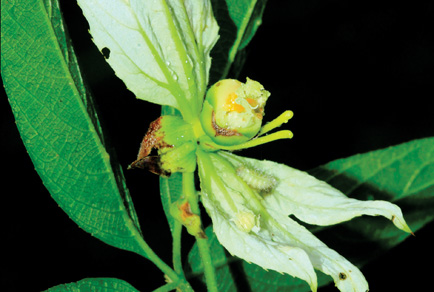
We describe Dalechampia nivea, a new species from high-altitude regions (700–1,190 m) within the rainforests of the Atlantic Forest domain. This species has been recorded in the states of Bahia, Espírito Santo, and Minas Gerais in eastern Brazil. Dalechampia nivea shares morphological similarities with D. pentaphylla, including leaves with five leaflets and pistillate flower calyx with six entire sepals. However, it can be distinguished by the 3-lobed involucral bracts with entire to serrated margins, lanceolate to ovate bracteal stipules, and tomentose ovary. In contrast, D. pentaphylla has 5-partite involucral bracts with lacerate margins, broadly ovate to reniform bracteal stipules, and pilose to pubescent ovary. This article includes detailed photographs, distribution maps, comments on the habitat, and a preliminary assessment of the species’ conservation status. An identification key for the Brazilian Dalechampia vines with compound or palmatisect leaves divided into five partitions is also provided.
References
- Amorim, A.M., Jardim, J.G., Lopes, M.M.M., Fiaschi, P., Borges, R.A.X., Perdiz, R.O. & Thomas, W.W. (2009) Angiospermas em remanescentes de floresta montana no sul da Bahia, Brasil. Biota Neotropica 9: 313–348. https://doi.org/10.1590/S1676-06032009000300028
- Armbruster, W.S., Lee, J. & Baldwin, B.G. (2009) Macroevolutionary patterns of defense and pollination in Dalechampia vines: adaptation, exaptation, and evolutionary novelty. Proceedings of the National Academy of Sciences 106: 18085–18090. https://doi.org/10.1073/pnas.0907051106
- Aublet, J.B.C.F. (1775) Histoire des Plantes de la Guiane Françoise. Pierre-François, London & Paris, 392 pp.
- Baillon, H.E. (1858) Étude générales du groupe des Euphorbiacées. Librairie de Victor Masson, Paris, 684 pp. https://doi.org/10.5962/bhl.title.50439
- Baillon, H.E. (1865) Euphorbiacées Américaines. Adansonia 5: 305–360.
- Beentje, H.J. (2016) The Kew plant glossary—an illustrated dictionary of plant terms. Kew Publishing, Kew.
- Hickey, L.J. (1973) Classification of the architecture of dicotyledonous leaves. American Journal of Botany 60: 17–33. https://doi.org/10.1002/j.1537-2197.1973.tb10192.x
- IUCN (2024) Guidelines for using the IUCN Red List Categories and Criteria, version 16. Prepared by the Standards and Petitions Subcommittee of the IUCN Species Survival Commision. Available from https://www.iucnredlist.org/resources/redlistguidelines (accessed 22 March 2025).
- Lamarck, J.B.A.P.M. de (1786) Encyclopédie Méthodique, Botanique 2 (1). Panckoucke, Paris & Plomteux, Liège, pp. 1–400.
- Linnaeus, C. (1753) Species plantarum. Laurentius Salvius, Stockolm, 1200 pp.
- Mendes, J.C.R., Külkamp, J., Bigio, N.C., Torres-Leite, F. & Pereira-Silva, R.A. (2023) Dalechampia seccoi (Euphorbiaceae), a threatened new species from Southeastern Brazil. Acta Botanica Brasilica 37: e20230027. https://doi.org/10.1590/1677-941x-abb-2023-0027
- Müller Argoviensis, J. (1874) Euphorbiaceae. In: Martius, C.F.P. von & Eichler, A.W. (eds.) Flora Brasiliensis 11 (2). Frid. Fleischer, München, 752 pp.
- Pax, F. & Hoffman, K. (1919) Euphorbiaceae-Dalechampieae. In: Engler, A. (Ed.) Das Pflanzenreich IV.147.XII (Heft 68). Wilhelm Engelmann, Leipzig, pp. 1–57
- Pax, F. & Hoffman, K. (1924) Euphorbiaceae-Additamentum. In: Engler, A. (Ed.) Das Pflanzenreich IV.147.XVII (Heft 85). Wilhelm Engelmann, Leipzig, pp. 1–188.
- Pereira-Silva, R.A., Athiê-Souza, S.M., Melo, A.L. & Armbruster, W.S. (2019) Dalechampia margarethiae (Euphorbiaceae), a new species from Southeastern Brazil. Systematic Botany 44: 832–837. https://doi.org/10.1600/036364419X15710776741350
- Pereira-Silva, R.A., Athiê-Souza, S.M., Secco, R.D.S., Melo, A.L. & Sales, M.F. (2016) Dalechampia erythrostyla (Euphorbiaceae), a new species from Northeastern Brazil. Systematic Botany 41: 989–995. https://doi.org/10.1600/036364416X694116
- Pereira-Silva, R.A., Oliveira, J.C.P., Mendes, J.C.R., Bigio, N.C., Secco, R.S., Gama, B.R.A., Silva, D.F., Leal, B.A., Melo, A.L., Athiê-Souza, S.M., Sales, M.F. de & Cordeiro, W.P.F.S. (2024) Dalechampia in Flora e Funga do Brasil. Jardim Botânico do Rio de Janeiro. Available from https://floradobrasil.jbrj.gov.br/FB17549 (accessed 5 November 2024)
- POWO (2024) Plants of the World Online. Royal Botanic Gardens, Kew. Available from http://www.plantsoftheworldonline.org/ (accessed 5 November 2024)
- Thiers, B. (2024 [continuously update]) Index Herbariorum: A global directory of public herbaria and associated staff. The New York Botanical Garden, New York. Available from http://sweetgum.nybg.org/ih/ (accessed 5 November 2024)
- QGIS Development Team (2023) QGIS Geographic Information System. Open Source Geospatial Foundation Project. Available from http://qgis.osgeo.org (accessed 5 November 2024)
- Vellozo, J.M.C. (1798) Alographia dos Alkalis fixos Vegetal ou Potassa, Mineral ou Soda e dos seus nitratos, segundo as melhores memorias estrangeiras, que se tem escripto a este assumpto. Na Offic. de Simão Thaddeo Ferreira, Lisboa, 245 pp.
- Webster, G.L. (2014) Euphorbiaceae. In: Kubitzki, K. (Ed.) The Families and Genera of Vascular Plants 11. Springer Verlag, Berlin & Heidelberg, pp. 51–216. https://doi.org/10.1007/978-3-642-39417-1_10
- Webster, G.L. & Armbruster, W.S. (1991) A synopsis of the neotropical species of Dalechampia (Euphorbiaceae). Botanical Journal of the Linnean Society 105: 137–177. https://doi.org/10.1111/j.1095-8339.1991.tb00202.x
- Wurdack, K.J., Hoffmann, P. & Chase, M.W. (2005) Molecular phylogenetic analysis of uniovulate Euphorbiaceae (Euphorbiaceae sensu stricto) using plastid rbcL and trnL-F DNA sequences. American Journal of Botany 92: 1397–1420. https://doi.org/10.3732/ajb.92.8.1397