

Abstract
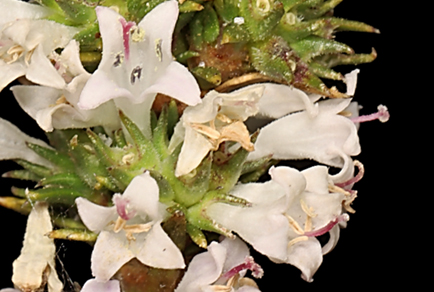
Staelia (Rubiaceae) is a genus endemic to South America identified by the unique capsule that splits into three parts. In Brazil, the genus thrives in diverse habitats in the Caatinga, Cerrado, and Campos Rupestres. Fieldwork carried out in the ecotone between these dominia, in areas of the municipality of Monte Azul, Minas Gerais, evidenced a new microendemic plant species, mainly recognized by its numerous stipular fimbriae on the stem, naming the new Staelia we describe here. We provide an illustration, photographs of the species and its habitat, a preliminary conservation assessment, as well as a comparison with similar species.
References
- Antar, G.M., Harley, R.M., Pastore, J.F.B., Verdi, M. & Soares, A.S. (2024) Eplingiella sanoi sp. nov. (Hyptidinae-Lamiaceae): supports the urgent need for campos rupestres conservation in the Serra do Espinhaço Septentrional, Minas Gerais state, Brazil. Webbia 79 (2): 191–200. https://doi.org/10.36253/jopt-15902
- Araújo, V.F.P., Barbosa, M.R.V., Araújo, J.P. & Vasconcelos, A. (2020) Spatial-temporal variation in litterfall in seasonally dry tropical forests in Northeastern Brazil. Brazilian Journal of Biology 80: 273–284. https://doi.org/10.1590/1519-6984.192113
- Bachman, S., Moat, J., Hill, A., de la Torre, J. & Scott, B. (2011) Supporting Red List threat assessments with GeoCAT: geospatial conservation assessment tool. ZooKeys 150: 117–126. https://doi.org/10.3897/zookeys.150.2109
- Bueno, V.R., Bentes, M.S., Ramos, R., Zavatin, D.A. & Prata-Silveira, A. (2025) Three new species of Calea (Asteraceae, Neurolaeneae) from the sky islands of the Espinhaço Range. Phytotaxa 689 (2): 185–203. https://doi.org/10.11646/phytotaxa.689.2.2
- Cabral, E. & Salas, R. (2015) Staelia. In: Lista de Espécies da Flora do Brasil. Jardim Botânico do Rio de Janeiro. Available from: http://floradobrasil2015.jbrj.gov.br/FB127992 (accessed 22 September 2024)
- Candolle, A.P.D. & Candolle, A. (1824) Prodromus systematis naturalis regni vegetabilis, sive, Enumeratio contracta ordinum generum specierumque plantarum huc usque cognitarium, juxta methodi naturalis, normas digesta. Vol. 4. Parisii: Sumptibus Sociorum Treuttel et Würtz. https://doi.org/10.5962/bhl.title.286
- Carmo, J.A.M., Reginato, M., Sobrado, S.V., Miguel, L.M., Janssens, S.B., Dessein, S., Salas, R.M. & Simões, A.O. (2024) There and back again: molecular phylogenetics of the Brazilian endemic Psyllocarpus (Rubiaceae: Spermacoceae) supports a circumscription of the genus based on its original concept. Botanical Journal of the Linnean Society 206: 1–15. https://doi.org/10.1093/botlinnean/boae059
- Carmo, J.A.M., Sobrado, S.V., Cabral, E.L. & Salas, R.M. (2021) Staelia schumannii (Rubiaceae, Spermacoceae): an old new species from Bahia, Brazil, overlooked for more than a century. Systematic Botany 46 (3): 844–851. https://doi.org/10.1600/036364421X16312067913525
- Carvalho, C.E., Menezes, M.O., Araújo, F.S. & Sfair, J.C. (2022) High endemism of cacti remains unprotected in the Caatinga. Biodiversity and Conservation 31 (4): 1217–1228. https://doi.org/10.1007/s10531-022-02384-y
- Chamisso, L.A. & Schlechtendal, D.F.L. (1828) De plantis in expeditione speculatoria Romanzoffiana observatis. Linnaea 3: 364, t. 3. f. 3.
- Colli‐Silva, M., Vasconcelos, T.N. & Pirani, J.R. (2019) Outstanding plant endemism levels strongly support the recognition of campo rupestre provinces in mountaintops of eastern South America. Journal of Biogeography 46: 1723–1733. https://doi.org/10.1111/jbi.13585
- Echternacht, L., Trovó, M., Oliveira, C.T. & Pirani, J.R. (2011) Areas of endemism in the Espinhaço range in Minas Gerais, Brazil. Flora-Morphology, Distribution, Functional. Ecology of Plants 206 (9): 782–791. https://doi.org/10.1016/j.flora.2011.04.003
- Fader, A.A.C., Salas, R.M. & Cabral, E.L. (2016) Taxonomic identity of Diodia angustata (Rubiaceae) and its transference to Planaltina. Rodriguésia 67: 1061–1065. https://doi.org/10.1590/2175-7860201667415
- Fernandes, M.F., Cardoso, D. & de Queiroz, L.P. (2020) An updated plant checklist of the Brazilian Caatinga seasonally dry forests and woodlands reveals high species richness and endemism. Journal of Arid environments 174: 104079. https://doi.org/10.1016/j.jaridenv.2019.104079
- Flora e Funga do Brasil (2025 [continuously updated]) Projeto Flora e Funga do Brasil. Available from: https://floradobrasil.jbrj.gov.br/reflora/PrincipalUC/PrincipalUC.do?lingua=pt (accessed 3 July 2025)
- Harris, J.G. & Harris, M.W. (2001) Plant identification terminology: an illustrated glossary. Spring Lake Publishing, Payson, Utah, 206 pp.
- INPE. (2023) Fire database. Available from: http://www.inpe.br/queimadas/bdqueimadas (accessed 22 August 2024)
- IUCN Standards and Petitions Committee. (2024) Guidelines for Using the IUCN Red List Categories and Criteria. Version 16. Prepared by the Standards and Petitions Committee. Available from: https://www.iucnredlist.org/documents/RedListGuidelines.pdf (accessed 28 November 2024)
- Kirkbride, J.H. (1997) Manipulus rubiacearum VI. Brittonia 49: 354–379. https://doi.org/10.2307/2807836
- Magri, R., Cabral, A., Prado, J. & Lopes, J. (2024) Two new critically endangered species of Vellozia (Velloziaceae) from the Campos Rupestres of Espinhaço Range, Brazil. Phytotaxa 652 (1): 1–9. https://doi.org/10.11646/phytotaxa.652.1.1
- Martius, K.F.P. & Zuccarini, J.G. (1824) Psyllocarpus. In: Ankiindigung der Fortsetzung eines Werkes uber brasilianische Pflanzen. Flora 7, Suppl. 4: 130–131.
- Martius, K.F.P., Eichler, A.W.E., Urban, I., Endlicher, S., Fenzl, E., Benj, M. & Oldenburg, R. (1840) Flora Brasiliensis, enumeratio plantarum in Brasilia hactenus detectarum :quas suis aliorumque botanicorum studiis descriptas et methodo naturali digestas partim icone illustratas. Vol. 6. Monachii et Lipsiae [Munich & Leipzig]: R. Oldenbourg. https://doi.org/10.5962/bhl.title.454
- Miola, D.T.B., Marinho, A.P., Dayrell, R.L.C. & Silveira, F.A.O. (2019) Silent loss: misapplication of an environmental law compromises conservation in a Brazilian biodiversity hotspot. Perspectives in Ecology and Conservation 17 (2): 84–89. https://doi.org/10.1016/j.pecon.2019.04.001
- QGIS Development Team. (2021) QGIS geographic information system. QGIS Association. Available from: https://www.qgis.org (accessed 15 September 2024)
- Reflora—Herbário Virtual. (2024) Available from: http://reflora.jbrj.gov.br/reflora/herbarioVirtual/ (accessed 15 September 2024)
- Ribeiro, J.F. & B.M.T, Walter. (1998) Fitofisionomias do bioma Cerrado. In: Sano, S.M. & Almeida, S.P. (Eds.) Cerrado: Ambiente e Flora. EMBRAPA, Planaltina, pp. 89–166.
- Salas, R.M. (2011) Revisión de Staelia s.l. (Rubiaceae). Ph.D. Thesis, Universidad Nacional del Nordeste, Corrientes, Argentina.
- Salas, R.M. & E.L. Cabral. (2010a) Planaltina nuevo género de la tribu Spermacoceae (Rubiaceae), endémico del planalto central de Brasil y una nueva especie del estado de Goiás, Brasil. Journal of the Botanical Research Institute of Texas 4: 193–206.
- Salas, R.M. & E.L. Cabral. (2010b) Rehabilitacíón y lectotipificación del género Tessiera, su relación con Diphragmus y Staelia (Rubiaceae: Spermacoceae): Una nueva combinación y un nuevo sinónimo. Journal of the Botanical Research Institute of Texas 4: 181–192.
- Salas, R.M. & E.L. Cabral. (2011) Staelia culcita (Rubiaceae), a new species from Minas Gerais, Brazil. Plant Ecology and Evolution 144: 372–376. https://doi.org/10.5091/plecevo.2011.620
- Salas, R.M. & Cabral, E.L. (2012) Two new shrubby species of the genus Staelia (Rubiaceae) from Serra do Curral Frio, Bahia, Brazil. Systematic Botany 37 (2): 507–515. https://doi.org/10.1600/036364412X635557
- Schmidt, I.B. & Eloy, L. (2020) Fire regime in the Brazilian Savanna: recent changes, policy and management. Flora: Morphology, Distribution, Functional Ecology of Plants 268: 151613. https://doi.org/10.1016/j.flora.2020.151613
- Silva, D.N.D., Antonicelli, M.D.C.A. & Guimarães, P.J.F. (2023) Taxonomic Novelties from the Espinhaço Septentrional: Two New Species of Pleroma and the First Records of Melastomataceae from the Morro das Marombas, Minas Gerais, Brazil. Systematic Botany 48 (1): 44–54. https://doi.org/10.1600/036364423X16758873924090
- SpeciesLink (2022) Sistema de informação distribuído para recuperação de dados de acervos de coleções biológicas e de observação em campo. Available from: http://splink.cria.org.br/ (accessed 1 September 2024)
- Thiers, B. (2025 [continuously updated]) Index Herbariorum: A global directory of public herbaria and associated staff. New York Botanical Garden’s Virtual Herbarium. Available from: http://sweetgum.nybg.org/science/ih/ (accessed 30 March 2025)
- Vandelli, D. (1788) Florae Lusitanicae et Brasiliensis specimen et epistolae ab eruditis viris Carolo a Linné, Antonio de Haen ad Dominicum Vandelli scriptae. Typographia Academico-Regia, Conimbricae, pp. 96, 5 tt. https://doi.org/10.5962/bhl.title.51092
- Vidal, J.D.D., de Souza, A.P. & Koch, I. (2019) Impacts of landscape composition, marginality of distribution, soil fertility and climatic stability on the patterns of woody plant endemism in the Cerrado. Global Ecology and Biogeogreography 28: 904–916. https://doi.org/10.1111/geb.12901
- Zavatin, D.A., Almeida, R.B.P., Ramos, R. & Lombardi, J.A. (2023) Chionanthus monteazulensis (Oleaceae), a new species from the campo rupestre of Espinhaço Range, Brazil. Phytotaxa 603: 289–296. https://doi.org/10.11646/phytotaxa.603.3.8
- Zavatin, D.A., Ramos, R., Salimena, F.R.G. & Cardoso, P.H. (2024) A new species of Lippia (Verbenaceae) from the Espinhaço Range, Minas Gerais, Brazil. Acta Botanica Brasilica 38: e20240024. https://doi.org/10.1590/1677-941x-abb-2024-0024
- Zavatin, D.A., Ramos, R., Monge, M. & Harley, R.M. (2025) A new species of Hypenia (Lamiaceae, Hyptidinae) from the Espinhaço Range, Brazil. Phytotaxa 682 (1): 81–90. https://doi.org/10.11646/phytotaxa.682.1.5