

Abstract
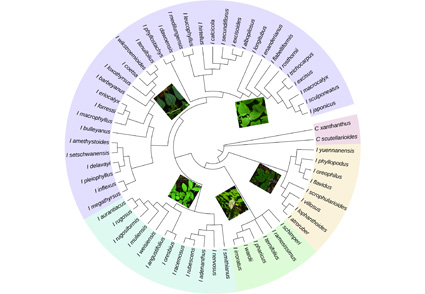
Isodon (Lamiaceae) is recognized as one of the largest and most taxonomically challenging genera worldwide. Nevertheless, research on the collection and taxonomic biases of Isodon remains limited. This study aimed to investigate the original materials’ status of Isodon, thus providing basic data for research on the systematics, biogeography, and conservation of the genus. Firstly, based on the iPlant database, the Catalogue of Life China, and the Catalogue of Life, the accepted species list of Isodon was obtained. Secondly, original materials of each species of Isodon were found by searching the Chinese Virtual Herbarium (CVH), the Global Biodiversity Information Facility (GBIF) and the Journal Storage (JSTOR), and the key information of each original material was recorded and analyzed. Finally, principal component analysis and cluster analysis were performed based on morphological characteristics of specimens, and phylogenetic analysis was performed based on the whole chloroplast genomes of Isodon spp. In this study, a total of 491 original materials of 85 species of Isodon were obtained. The type localities covered 18 countries, mainly distributed in the Hengduan Mountains. The preliminary results of morphological cluster analysis of various species in Isodon indicated that fruiting calyx shape and leaf shape can be used to distinguish species and can serve as auxiliary reference indexes for species classification. Inventory completeness remains deficient, and Isodon species collection suffers from the issues of overcollection and undersampling. Consequently, we recommend that the quality and quantity of Isodon collection should be improved to fully enable scientific research and maximize the application value in future collection digitization efforts.
References
- Bartolucci, F., Domina, G., Ardenghi, N.M.G., Bacaro, G., Bacchetta, G., Ballarin, F., Banfi, E., Barberis, G., Beccarisi, L., Bernardo, L., Bonari, G., Bonini, F., Brullo, S., Buono, S., Buono, V., Calbi, M., Caldararo, F., Calvia, G., Cancellieri, L., Cannavò, S., Dagnino, D., Esposito, A., Fascetti, S., Filibeck, G., Fiorini, G., Forte, L., Galasso, G., Gestri, G., Gigante, D., Gottschlich, G., Gubellini, L., Hofmann, N., Lastrucci, L., Lonati, M., Lorenz, R., Lunardi, L., Magrini, S., Mainetti, A., Maiorca, G., Mereu, G., Messa Ballarin, R.T., Minuto, L., Mossini, S., Musarella, C.M., Nimis, P.L., Passalacqua, N.G., Peccenini, S., Petriglia, B., Podda, L., Potenza, G., Ravetto Enri, S., Roma-Marzio, F., Rosati, L., Ruggero, A., Spampinato, G., Stinca, A., Tiburtini, M., Tietto, C., Tomaselli, V., Turcato, C., Viciani, D., Wagensommer, R.P. & Nepi, C. (2019) Notulae to the Italian native vascular flora: 8. Italian Botanist 8: 95–116. https://doi.org/10.3897/italianbotanist.8.48626
- Baum, B.R. & Sohmer, S.H. (1996) Statistical adequacy of plant collections: innovative concepts of collection, preservation, and storage of plant diversity. Sampling the Green World New York: Columbia University Press, pp. 43–73.
- Cao, J.L., Wang, J., Fu, Z.X., Liu, Y.Y. & Li, J.M. (2022) Statistical analysis of original materials of Corydalis. Guihaia 42 (S1): 142–148.
- Chen, J.P. & Xu, Z.P. (2022) Global specimen digitization and sharing trends. Guihaia 42 (S1): 52–61.
- Chen, T.X., Liu, H.Y., Han, G.X., Bao, B.J., Xu, Z.P. & Qin, H.N. (2022) Curating and administrating the Plant Specimen Sub-Platform and CVH: activities, experience and lessons learned. Guihaia 42 (S1): 18–28.
- Daru, B.H., Park, D.S., Primack, R.B., Willis, C.G., Barrington, D.S., Whitfeld, T.J.S., Seidler, T.G., Sweeney, P.W., Foster, D.R. & Elliso, A.M. (2017) Widespread sampling biases in herbaria revealed from large-scale digitization. The New Phytologist 217 (2): 939–955. https://doi.org/10.1111/nph.14855
- Fenu, G., Bacchetta, G., Bernardo, L., Calvia, G., Citterio, S., Foggi, B., Fois, M., Gangale, C., Galasso, G., Gargano, D., Gennai, M., Gentili, R., Larroux, G., Perrino, E.V., Peruzzi, L., Roma-Marzio, F., Uzunov, D., Vagge, I., Viciani, D., Wagensommer, R.P. & Orsenigo, S. (2016) Global and Regional IUCN Red List Assessments: 2. Italian Botanist 2: 93–115. https://doi.org/10.3897/italianbotanist.2.10975
- Fuentes, N., Ugarte, E., Kühn, I. & Klotz, S. (2008) Alien plants in Chile: inferring invasion periods from herbarium records. Biological Invasions 10 (5): 649–657. https://doi.org/10.1007/s10530-007-9159-0
- Hajdari, A., Mustafa, B., Hyseni, L., Bajrami, A., Mustafa, G., Quave, C.L. & Nebija, D. (2020) Phytochemical study of eight medicinal plants of the lamiaceae family traditionally used as tea in the Sharri Mountains region of the Balkans. The Scientific World Journal 1: 4182064. https://doi.org/10.1155/2020/4182064
- Jaiswal, Y., Liang, Z.T. & Zhao, Z.Z. (2016) Botanical drugs in Ayurveda and Traditional Chinese Medicine. Journal of Ethnopharmacology 194: 245–259. https://doi.org/10.1016/j.jep.2016.06.052
- Jones, C.A. & Daehler, C.C. (2018) Herbarium specimens can reveal impacts of climate change on plant phenology; a review of methods and applications. PeerJ 6: e4576. https://doi.org/10.7717/peerj.4576
- Li, H., Pu, J.X. & Li, J. (2013) Diterpenoids Chemodiversity of the Genus Isodon Spach from Lamiaceae. Plant Divers 35 (01): 81–88. https://doi.org/10.7677/ynzwyj201312057
- Lienert, J., Fischer, M. & Diemer, M. (2002) Local extinctions of the wetland specialist Swertia perennis L. (Gentianaceae) in Switzerland: A revisitation study based on herbarium records. Biological Conservation 103 (1): 65–76. https://doi.org/10.1016/S0006-3207(01)00121-5
- Liu, H.Y., Chen, T.X., Han, G.X., Li, Y., Li, R.G., Li, M., Xu, Z.P. & Qin, H.Y. (2022) On the history and function of the Plant Specimen SubPlatform and Chinese Virtual Herbarium (CVH). Guihaia 42 (S1): 3–17. https://doi.org/10.11931/guihaia.gxzw202209069
- Liu, J., Milne, R.I., Möller, M., Zhu, G.F., Ye, L.J., Luo, Y.H., Yang, J.B., Wambulwa, M.C., Wang, C.N. & Li, D.Z. (2018) Integrating a comprehensive DNA barcode reference library with a global map of yews (Taxus l.) for forensic identification. Molecular Ecology Resources 18 (5): 1115–1131. https://doi.org/10.1111/1755-0998.12903
- Liu, Q.X., Chu, X.F., Dong, X.Y., Hui, H. & Zhou, Y.F. (2022) Development epitome of digitization of plant specimens of herbaria in China: Herbarium of Institute of Botany, Jiangsu Province and Chinese Academy of Sciences (NAS). Guihaia 42 (S1): 71–86. https://doi.org/10.11931/guihaia.gxzw.202209065
- Lohonya, K., Livermore, L. & Penn, M. (2020) Georeferencing the Natural History Museum's Chinese type collection: Of plateaus, pagodas and plants. Biodiversity Data Journal 8: e50503. https://doi.org/10.3897/BDJ.8.e50503
- Ma, H.J., Zhai, K.F., Han, Z.B. & Zhou, S.B. (2022) Isodon suzhouensis (Lamiaceae): A New Species from Anhui. Journal of Suzhou University 37 (03): 41–45. https://doi.org/10.3969/j.issn.1673-2006.2022.03.009
- Ma, J.S. (2014) Current status and challenges of Chinese plant taxonomy. Chinese Science Bulletin 59 (06): 510–521. https://doi.org/10.1360/972013-320
- Marcer, A., Chapman, A.D., Wieczorek, J.R., Xavier, P.F., Uribe, F., Waller, J. & Ariño, A.H. (2022) Uncertainty matters: Ascertaining where specimens in natural history collections come from and its implications for predicting species distributions. Ecography: e06025. https://doi.org/10.1111/ecog.06025
- Merow, C., Allen, J.M., Aiello-lammens, M. & Silander, J.A.J. (2016) Improving niche and range estimates with Maxent and point process models by integrating spatially explicit information. Global ecology and biogeography 25 (8): 1022–1036. https://doi.org/10.1111/geb.12453
- Meyer, C., Weigelt, P. & Kpeft, H. (2016) Multidimensional biases, gaps and uncertainties in global plant occurrence information. Ecology letters 19 (8): 992–1006. https://doi.org/10.1111/ele.12624
- Milevskaya, V.V., Temerdashev, Z.A., Butyl’Skaya, T.S. & Kiseleva, N.V. (2017) Determination of phenolic compounds in medicinal plants from the Lamiaceae family. Journal of Analytical Chemistry 72: 342–348. https://doi.org/10.1134/S1061934817030091
- Nic Lughadha, E., Walker, B.E., Canteiro, C., Chadburn, H., Davis, A.P., Hargreaves, S., Lucas, E.J., Schuiteman, A., Williams, E., Bachman, S.P., Baines, D., Barker, A., Budden, A.P., Carretero, J., Clarkson, J.J., Roberts, A. & Rivers, M.C. (2018) The use and misuse of herbarium specimens in evaluating plant extinction risks. Philosophical Transactions of the Royal Society B: Biological Sciences 374 (1763): 20170402. https://doi.org/10.1098/rstb.2017.0402
- Nualart, N., Ibáez, N., Soriano, I. & López-Pujol, J. (2017) Assessing the relevance of herbarium collections as tools for conservation biology. Botanical Review 83 (3): 303–325. https://doi.org/10.1007/s12229-017-9188-z
- Park, D.S., Xie, Y.Y., Ellison, A.M., Lyra, G.M. & Davis, C.C. (2023) Complex climate-mediated effects of urbanization on plant reproductive phenology and frost risk. New Phytologist 239 (6): 2153–2165. https://doi.org/10.1111/nph.18893
- Orsenigo, S., Bacchetta, G., Calevo, J., Castello, M., Cogoni, D., Gennai, M., Licht, W., Montagnani, C., Perrino, E.V., Pinna, S.M., Silletti, G.N., Vela, E., Viciani, D., Vidali, M., Wagensommer, R.P., Zappa, E. & Fenu, G. (2016) Global and Regional IUCN Red List Assessments: 1. Italian Botanist 1: 61–85. https://doi.org/10.3897/italianbotanist.1.8647
- Perrino, E.V., Wagensommer, R.P., Mezzapesa, G.N. & Trani, A. (2024) Stachys italica Mill.: synecology, functional compounds and potential use of an Italian endemic taxon. Planta 260: 138. https://doi.org/10.1007/s00425-024-04571-3
- Primack, D., Imbres, C., Primack, R.B., Miller‐Rushing, A.J. & Tredici, P.D. (2004) Herbarium specimens demonstrate earlier flowering times in response to warming in Boston. American Journal of Botany 91 (8): 1260–1264. https://doi.org/10.3732/ajb.91.8.1260
- Qin, A.L., Ma, F.Q., Ji, J., Shi, S.Q., Jiang, Z.P. & Shi, Z.M. (2021) Original material Status of Nitrogen-fixing Woody Fabales in China. Terrestrial Ecosystem and Conservation 1 (01): 59–65. https://doi.org/10.12356/j.2096-8884.2020-0002
- Shen, X.L., Zhao, Z.G. & Liu, Y. (2010) Information sharing and integration of plant specimens - a case in IBK. Guihaia 30 (06): 899–902. https://doi.org/CNKI:SUN:GXZW.0.2010-06-039
- Teng, F., Yang, B. & Lin, N.M. (2020) Comparative Study on Antineoplastic Active Components and Rapid Detection of Pharmacodynamic Substances of Lamiaceae Isodon from Zhejiang Province. Journal of Zhejiang Chinese Medical University 44 (03): 297–302. https://doi.org/10.16466/j.issn1005-5509.2020.03.021
- Wagensommer, R.P., Perrino, E.V., Albano, A., Medagli, P. & Passalacqua, N.G. (2016) Lectotypification of four Lacaita’s names in the genus Centaurea (Asteraceae). Phytotaxa 269 (1): 54–58. https://doi.org/10.11646/phytotaxa.269.1.7
- Wang, L.S., Chen, B., Ji, L.Q. & Ma, K.P. (2010) Progress in Biodiversity Informatics. Biodiversity Science 18 (05): 429–443. https://doi.org/10.3724/SP.J.1003.2010.429
- Wolf, A., Zimmerman, N.B., Anderegg, W.R.L., Busby, P.E. & Christensen, J. (2016) Altitudinal shifts of the native and introduced flora of California in the context of 20th‐century warming. Global Ecology & Biogeography 25 (4): 418–429. https://doi.org/10.1111/geb.12423
- Wu, Z.Y. & Li, X.W. (1977) Labiatae: Rabdosia Hassk. In: Wu, Z.Y. (Ed.) Flore of China. Vol. 66. Science Press, Beijing, pp. 416–428.
- Xiang, S.Q. (2021) The isolation and identification of diterpenoids from Rabdosia rubescens. Guangdong, Guangzhou University of Chinese Medicine. 208 pp. https://doi.org/10.27044/d.cnki.ggzzu.2021.000612
- Xie, D., Liu, H.Y. & Qin, H.N. (2022) New opportunities and challenges for data integration of plant original materials. Guihaia 42 (S1): 46–51. https://doi.org/10.11931/guihaia.gxzw202102037
- Xie, D., Chen, T.X., Du, H., Wu, H. & Ran, J.H. (2024) Gymnosperm collecting in China: Past, present, and future. Journal of Systematics & Evolution 8 (01): 1–13. https://doi.org/10.1111/jse.13122
- Yang, Y. (2012) Holdings of original materials of plants in herbaria of China. Biodiversity Science 20 (04): 512–516. https://doi.org/10.3724/SP.J.1003.2012.05076
- Yu, X.Q., Maki, M., Drew, B.T., Paton, A.J., Li, H.W., Zhao, J.L, Conran, J.G. & Li, J. (2014) Phylogeny and historical biogeography of Isodon (lamiaceae): rapid radiation in south-west China and Miocene overland dispersal into Africa. Molecular Phylogenetics & Evolution 77: 183–194. https://doi.org/10.1016/j.ympev.2014.04.017
- Zhang, Y., Li, Y., Ye, J.H., Zhang, J.J., Zou, J. & Pan, L.T. (2019) The Abietane Type Diterpenes from Isodon (BI.) Hassk. Chinese Journal of Ethnomedicine and Ethnopharmacy 28 (11): 40–47. https://doi.org/1007-8517(2019)11-0040-08
- Zhong, J.S. (2008) Phylogenetic study on the genus Isodon (Schrader ex Bentham) Spach and its allies (Labiatae). Yunan: Xishuang Banna Tropical Botanical Garden. 24 pp.