

Abstract
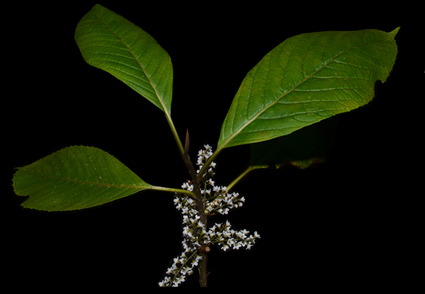
Maesa rugosa C.B. Clarke is a tropical shrub belonging to the family Primulaceae. Despite its prevalent distribution and morphological variation, the infraspecific taxonomy of M. rugosa remains unclear. The present study reevaluates the infraspecific classification of M. rugosa based on a comprehensive analysis of the morphological characters. Our study results in reorganizing three infraspecific taxa including one new variety and one new combination. We also provide an update on the typification of two names M. rugosa C.B. Clarke and M. rugosa var. griffithii C.B. Clarke following Articles 9.2 and 9.17 of the ICN code.
References
- Anderberg, A.A., Stahl, B. & Kallersjo, M. (2000) Maesaceae, a new primuloid family in the order Ericales ser. l. Taxon 49: 183–187. https://doi.org/10.2307/1223834
- Angiosperm Phylogeny Group (2016) An update of the Angiosperm Phylogeny Group classification for the orders and families of flowering plants: APG IV. Botanical Journal of the Linnean Society 181 (1): 1–20. https://doi.org/10.1111/boj.12385
- Bremer, B., Bremer, K., Chase, M.W., Fay, M.F., Reveal, J.L., Bailey, L.H., Soltis, D.E., Soltis, P.S. & Stevens, P.F. (2009) An update of the Angiosperm Phylogeny Group classification for the orders and families of flowering plants: APG III. Botanical Journal of the Linnean Society 161 (2): 105–121. https://doi.org/10.1111/j.1095-8339.2009.00996.x
- Chen, J. & Pipoly-III, J.J. (1996) Myrsinaceae. In: Wu, C.Y., Raven, P.H. & Hong, D.Y. (eds.) Flora China. Vol. 15. Science Press & Missouri Botanical Garden Press, Beijing & St. Louis.
- Clarke, C.B. (1882) Myrsineae. In: Hooker, J.D. (Ed.) Flora of British India. Vol. 3. L. Reeve & Co., London. pp. 507–534.
- Forsskal, P. (1775) Flora Aegyptiaco-Arabica. Hauniae, pp. 1–219.
- Handel-Mazzetti, H.F.von. (1936) Symbolae Sinicae. Vol.7 (4). Verlag von Julius Springer, Wien.
- Kallersjo, M., Bergqvist, G. & Anderberg, A.A. (2000) Generic realignment in Primuloid families of the Ericales s.l.: A phylogenetic analysis based on DNA Sequences from three chloroplast genes and morphology. American Journal of Botany 87 (9): 1325–1341. https://doi.org/10.2307/2656725
- Mabberley, D.J. (2018) Mabberley’s Plant-Book: A portable dictionary of plants, their classification and uses, 4th Edition. Cambridge University Press, Cambridge, 800 pp. https://doi.org/10.1017/9781316335581
- Mez, C. (1902) Myrsinaceae. In: Engler, A. (ed.) Das Pflanzenreich 9 (IV, 236). Leipzig, Berlin, pp. 1–437.
- POWO (2024) Plants of the World Online. Facilitated by the Royal Botanic Gardens, Kew. Available from: http://www.plantsoftheworldonline.org/ (accessed 29 August 2024)
- Rose, J.P., Kleist, T.J., Löfstrand, S.D., Drew, B.T., Schönenberger, J. & Sytsma, K.J. (2018) Phylogeny, historical biogeography, and diversification of angiosperm order Ericales suggest ancient Neotropical and East Asian connections. Molecular Phylogenetics and Evolution 122: 59–79. https://doi.org/10.1016/j.ympev.2018.01.014
- Roy, R. & Pramnaik, A. (2020) Myrsinaceae. In: Dash, S.S. & Mao, A.A. (eds.) Flowering Plants of India- an annotated checklist vol. II. Botanical Survey of India, Kolkata, pp. 48–55.
- Smith, A.C. (1973) Studies of Pacific Island plants, XXV. The Myrsinaceae of the Fijian region. Journal of Arnold Arboretum 54 (1): 1–41. https://doi.org/10.5962/p.324707
- Sumanon, P., Balslev, H., Utteridge, T.M.A. & Eiserhardt, W.L. (2023) A species-level phylogenetic framework and infrageneric classification for the genus Maesa (Primulaceae). Taxon 72 (4): 791–810. https://doi.org/10.1002/tax.12991
- Sumanon, P., Eiserhardt, W.L., Balslev, H. & Utteridge, T.M.A. (2021) Six new species of Maesa (Primulaceae) from Papua New Guinea. Phytotaxa 505 (3): 245–261. https://doi.org/10.11646/phytotaxa.505.3.1
- Thiers, B. (2024) Index Herbariorum: A global directory of public herbaria and associated staff. New York Botanical Garden’s Virtual Herbarium. Available from: http://sweetgum.nybg.org/science/ih/ (accessed 5 July 2024)
- Turland, N.J., Wiersema, J.H., Barrie, F.R., Greuter, W., Hawksworth, D.L., Herendeen, P.S., Knapp, S., Kusber, W.H., Li, D.-Z., Marhold, K., May, T.W., McNeill, J., Monro, A.M., Prado, J., Price, M.J. & Smith, G.F. (2018) International Code of Nomenclature for algae, fungi and plants (Shenzhen Code). Regnum Vegetabile 159. Koeltz Scientific Books, Koenigstein. https://doi.org/10.12705/Code.2018
- Utteridge, T.M.A. & Saunders, R.M.K. (2004) The genus Maesa (Maesaceae) in the Philippines. Botanical Journal of the Linnean Society 145 (1): 17–43. https://doi.org/10.1111/j.1095-8339.2003.00261.x