

Abstract
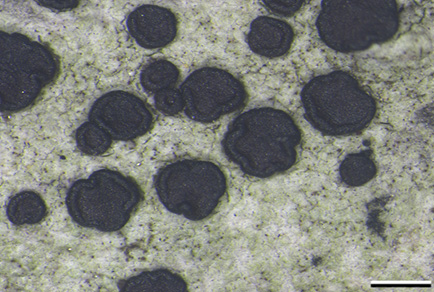
Japewiella jingningensis is a species new to science from China. It is characterized by its thin, smooth, slightly rimose crustose thallus, a red-brown to olive-brown epihymenium, small ascospores 12–13.5 × 5.5–7 μm, and containing an unknown chemical metabolite (bluish fluorescence in UV after the acid/heat treatment). Species identification is based on morphology, anatomy, chemistry, and phylogenetic analyses, which reveals its definitive taxonomic position. Detailed taxonomic descriptions, ecological and chemical characters, and illustrations are provided for the new species. A key to the species of genus Japewiella is also provided.
References
- Allen, J.L. & Lendemer, J.C. (2015) Japewiella dollypartoniana, a new widespread lichen in the Appalachian Mountains of Eastern North America. Castanea 80 (1): 59–65. https://doi.org/10.2179/14-036R2
- Cannon, P., Malíček, J., Ivanovich, C., Printzen, C., Aptroot, A., Coppins, B., Sanderson, N., Simkin, J. & Yahr, R. (2022) Lecanorales: Lecanoraceae including the genera Ameliella, Bryonora, Carbonea, Claurouxia, Clauzadeana, Glaucomaria, Japewia, Japewiella, Lecanora, Lecidella, Miriquidica, Myriolecis, Palicella, Protoparmeliopsis, Pyrrhospora and Traponora. Revisions of British and Irish Lichens 25: 1–83.
- Coppins, B.J. & James, P.W. (1979) New or interesting British lichens IV. The Lichenologist 11 (2): 139–179. https://doi.org/10.1017/S0024282979000190
- Darriba, D., Taboada, G.L., Doallo, R. & Posada, D. (2012) jModelTest 2: more models, new heuristics and parallel computing. Nature Methods 9 (8): 772–772. https://doi.org/10.1038/nmeth.2109
- Elix, J.A. & McCarthy, P.M. (2018) Ten new lichen species (Ascomycota) from Australia. Australasian Lichenology 82: 20–59.
- Gardes, M. & Bruns, T.D. (1993) ITS primers with enhanced specificity for basidiomycetes - application to the identification of mycorrhizae and rusts. Molecular Ecology 2: 113–118. https://doi.org/10.1111/j.1365-294X.1993.tb00005.x
- Kantvilas, G. (2011) The lichen genera Japewia and Japewiella in Tasmania. Muelleria 29 (2): 99–103. https://doi.org/10.5962/p.292516
- Katoh, K., Misawa, K., Kuma, K. & Miyata, T. (2002) MAFFT: a novel method for rapid multiple sequence alignment based on fast Fourier transform. Nucleic Acids Res 30 (14): 3059–3066. https://doi.org/10.1093/nar/gkf436
- Katoh, K., Rozewicki, J. & Yamada, K.D. (2017) MAFFT online service: multiple sequence alignment, interactive sequence choice and visualization. Briefings in Bioinformatics 20: 1160–1166. https://doi.org/10.1093/bib/bbx108
- Katoh, K. & Standley, D.M. (2013) MAFFT multiple sequence alignment software version 7: improvements in performance and usability. Molecular Biology and Evolution 30: 772–780. https://doi.org/10.1093/molbev/mst010
- Liu, R.L., Ye, W.J., Xu, D.M., Shang, L.Z., Liu, H.L., Chen, Z.H. & Zhang, F.Y. (2017) Flora of seed plants in Wangdongyang and Dayanghu nature reserve of Jingning. Journal of Zhejiang Forestry Science and Technology 37 (03): 9–16.
- Miller, M.A., Pfeiffer, W. & Schwartz, T. (2010) Creating the CIPRES Science Gateway for inference of large phylogenetic trees. In: Proceedings of the Gateway Computing Environments Workshop (GCE). New Orleans, Louisiana, pp. 1–8.
- Orange, A., James, P.W. & White, F.J. (2001) Microchemical methods for the identification of lichens. British Lichen Society, London, 101 pp.
- Printzen, C. (1999) Japewiella gen. nov., a new lichen genus and a new species from Mexico. The Bryologist 102 (4): 714–719. https://doi.org/10.2307/3244257
- Rambaut, A. (2012) FigTree, v. 1.4.0 [computer program]. Institute of Evolutionary Biology, University of Edinburgh. Available from: http://tree.bio.ed.ac.uk/software/Figtree/ (accessed 10 July 2024)
- Ronquist, F., Teslenko, M., van der Mark, P., Ayres, D.L., Darling, A., Höhna, S., Larget, B., Liu, L., Suchard, M.A. & Huelsenbeck, J.P. (2012) MrBayes 3.2: efficient Bayesian phylogenetic inference and model choice across a large model space. Systematic Biology 61 (3): 539–542. https://doi.org/10.1093/sysbio/sys029
- Stamatakis, A. (2014) RAxML version 8: a tool for phylogenetic analysis and post-analysis of large phylogenies. Bioinformatics 30 (9): 1312–1313. https://doi.org/10.109.com/bioinformatics/btu033
- Tønsberg, T. (1990) Japewia subaurifera, a new lichen genus and species from north-west Europe and western North America. The Lichenologist 22 (3): 205–212. https://doi.org/10.1017/S0024282990000226
- White, T.J., Bruns, T., Lee, S. & Taylor, J. (1990) Amplification and direct sequencing of fungal ribosomal RNA genes for phylogenetics. PCR protocols 18 (1): 315–322.