

Abstract
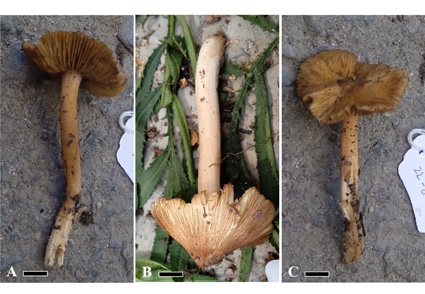
A new species Pseudosperma parvisporum is described and illustrated here, based on morpho-anatomical and molecular phylogenetic characterization. The taxon is characterized by campanulate to becoming plano-convex to convex pileus at maturity, having 3.4–4.5 cm diam., with brown umbo, brownish golden to yellow fibrils spread on; up to 8 cm stipe, hollow, cylindrical and containing longitudinal striations on it; smaller basidiospores (8.86–10.86 × 5.06–6.2 μm); oblong to utriform, appeared in cluster cheilocystidia having 34.3–51.5 × 9.6–14.6 μm size and occurrence of fusiform to lageniform caulocystidia measuring 38.7 × 9.7 μm. In addition to these, the combined nrITS and nrLSU based phylogenetic analysis was done which supports its unique position and confirms it a new species as it forms a separate clade. The photographs, drawings and comparison with similar taxa are also provided here.
References
- Abarenkov, K., Nilsson, R.H., Larsson, K.H., Taylor, A.F., May, T.W., Frøslev, T.G. & Kõljalg, U. (2024) The UNITE database for molecular identification and taxonomic communication of fungi and other eukaryotes: sequences, taxa and classifications reconsidered. Nucleic Acids Research 52 (1): 791–797. https://doi.org/10.1093/nar/gkad1039
- Aïgnon, H.L., Fan, Y.G. & Brandon Matheny, P. (2024) Pseudosperma brunneopilosum, a new species of Inocybaceae from West Africa. Nordic Journal of Botany 2024 (10): e04470. https://doi.org/10.1111/njb.04470
- Alvarado, P., Cabero, J., Moreno-Mateos, D., Vizzini, A., Alonso, J., Lebeuf, R., Siquier, J.L. & Vidal, J.M. (2021) Phylogenetic relationships among false truffle genera of Paxillaceae—Alpova, Melanogaster, Neoalpova, and Paralpova, gen. nov. Mycologia 113: 828–841. https://doi.org/10.1080/00275514.2021.1911552
- Bandini, D. & Oertel, B. (2020) Three new species of the genus Pseudosperma (Inocybaceae). Czech Mycologia 72 (2): 221–250. https://doi.org/10.33585/cmy.72205
- Bandini, D., Oertel, B. & Eberhardt, U. (2023) Even more fibre-caps (4): Fourteen new species of the family Inocybaceae. Mycologia Bavarica 23: 1–50.
- Bau, T. & Fan, Y. (2018) Three new species of Inocybe sect. Rimosae from China. Mycosystema 37 (6): 693–702. https://doi.org/10.13346/j.mycosystema.180033
- Bougher, N.L., Matheny, P.B. & Gates, G.M. (2012) Five new species and records of Inocybe (Agaricales) from temperate and tropical Australia. Nuytsia 22 (2): 57–74. https://doi.org/10.58828/nuy00630
- Bruns, T.D. (1995) Thoughts on the processes that maintain local species diversity of ectomycorrhizal fungi. In: Collins, H.P., Robertson, G.P. & Klug, M.J. (Eds.) The significance and regulation of soil biodiversity. Developments in Plant and Soil Sciences, vol. 63. Springer, Dordrecht, Netherlands, pp. 63–73. https://doi.org/10.1007/978-94-011-0479-1_5
- Edgar, R.C. (2004) MUSCLE: multiple sequence alignment with high accuracy and high throughput. Nucleic Acids Research 32 (5): 1792–1797. https://doi.org/10.1093/nar/gkh340
- Gardes, M. & Bruns, T.D. (1993) ITS primers with enhanced specificity for basidiomycetes‐application to the identification of mycorrhizae and rusts. Molecular Ecology 2 (2): 113–118. https://doi.org/10.1111/j.1365-294X.1993.tb00005.x
- Hall, T.A. (1999) BioEdit: A user–friendly biological sequence alignment editor and analysis program for Windows 95/98/NT. In Nucleic Acids Symposium Series 41: 95–98. https://doi.org/10.4172/2167-0412.1000264
- Jabeen, S., Bashir, H. & Khalid, A.N. (2021) Pseudosperma albobrunneum sp. nov. from coniferous forests of Pakistan. Mycotaxon 136 (2): 361–372. https://doi.org/10.5248/136.361
- Jabeen, S. & Khalid, A.N. (2020) Pseudosperma flavorimosum sp. nov., from Pakistan. Mycotaxon 135 (1): 183–193. https://doi.org/10.5248/135.183
- Kaygusuz, O., Bandini, D., Knudsen, H. & Türkekul, İ. (2023) Pseudosperma pamukkalense (Inocybaceae: Agaricomycetes), a new species from Turkey. Phytotaxa 599 (4): 225–238. https://doi.org/10.11646/phytotaxa.599.4.2
- Kaygusuz, O., Bandini, D., Rühl, A., Sarawi, S., Yorou, N.S. & Piepenbring, M. (2024) Five new species of Pseudosperma (Inocybaceae, Agaricales) from Benin and Turkey based on morphological characteristics and phylogenetic evidence. Mycological Progress 23 (1): 75–100. https://doi.org/10.1007/s11557-024-01964-2
- Kropp, B.R., Matheny, P.B. & Hutchison, L.J. (2013) Inocybe section Rimosae in Utah: phylogenetic affinities and new species. Mycologia 105 (3): 728–747. https://doi.org/10.3852/12-185
- Larsson, E., Ryberg, M., Moreau, P.A., Mathiesen, Å.D. & Jacobsson, S. (2009) Taxonomy and evolutionary relationships within species of section Rimosae (Inocybe) based on ITS, LSU and mtSSU sequence data. Persoonia-Molecular Phylogeny and Evolution of Fungi 23 (1): 86–98. https://doi.org/10.3767/003158509X475913
- Latha, K.D., Haridev, P., Raj, K.A. & Manimohan, P. (2023) Pseudosperma indicum sp. nov., (Inocybaceae, Agaricales) from India. Phytotaxa 620 (1): 47–58. https://doi.org/10.11646/phytotaxa.620.1.4
- Lodge, D.J., Padamsee, M., Matheny, P.B., Aime, M.C., Cantrell, S.A., Boertmann, D. & Hattori, T. (2014) Molecular phylogeny, morphology, pigment chemistry and ecology in Hygrophoraceae (Agaricales). Fungal Diversity 64 (1): 1–99. https://doi.org/10.1007/s13225-013-0259-0
- Mao, N., Xu, Y.Y., Zhao, T.Y., Lv, J.C. & Fan, L. (2022) New Species of Mallocybe and Pseudosperma from North China. Journal of Fungi 8 (3): 256–273. https://doi.org/10.3390/jof8030256
- Matheny, P.B., Hobbs, A.M. & Esteve–Raventós, F. (2020) Genera of Inocybaceae: New skin for the old ceremony. Mycologia 112 (1): 83–120. https://doi.org/10.1080/00275514.2019.1668906
- Miller, M.A., Pfeiffer, W. & Schwartz, T. (2010) Creating the CIPRES science gateway for inference of large phylogenetic trees. In: Proceedings of the Gateway Computing Environments Workshop (GCE). Institute of Electrical and Electronics Engineers, New Orleans. pp. 1–8. https://doi.org/10.1109/GCE.2010.5676129
- Munsell, R. (1975) Soil Color Charts. Munsell Color Company. Inc. Baltimore, Maryland.
- Naseer, A., Jabeen, S., Ashfaq, A., Akbar, M., Hussain, S.I. & Khalid, A.N. (2023) Pseudosperma quercinum sp. nov., (Inocybaceae) from the Himalayan forests of Pakistan. Phytotaxa 622 (4): 260–270. https://doi.org/10.11646/phytotaxa.622.4.3
- Rambaut, A. (2018) Molecular evolution, phylogenetics and epidemiology. FigTree ver.1.4.4 software. Available from: http://tree.bio.ed.ac.uk/software/fgtree/ (accessed 12 October 2024)
- Saba, M., Haelewaters, D., Pfister, D.H. & Khalid, A.N. (2020) New species of Pseudosperma (Agaricales, Inocybaceae) from Pakistan revealed by morphology and multi–locus phylogenetic reconstruction. MycoKeys 69: 1–31. https://doi.org/10.3897/mycokeys.69.33563
- Sanna, M., Mua, A., Porcu, G., Casula, M., Rinaldi, A.C., Mifsud, S. & Garrido-Benavent, I. (2024) Pseudosperma calciphilum (Inocybaceae), a new Mediterranean species from Sardinia (Italy), Malta, and Valencia (Spain). Phytotaxa 633 (3): 253–264. https://doi.org/10.11646/phytotaxa.633.3.5
- Ullah, Z., Jabeen, S., Ahmad, H. & Khalid, A.N. (2018) Inocybe pakistanensis, a new species in section Rimosae s. str. from Pakistan. Phytotaxa 348 (4): 279–288. https://doi.org/10.11646/phytotaxa.348.4.4
- Vilgalys, R. & Hester, M. (1990) Rapid genetic identification and mapping of enzymatically amplified ribosomal DNA from several Cryptococcus species. Journal of Bacteriology 172 (8): 4238–4246. https://doi.org/10.1128/jb.172.8.4238-4246.1990
- White, T.J., Bruns, T., Lee, S.J.W.T. & Taylor, J. (1990) Amplification and direct sequencing of fungal ribosomal RNA genes for phylogenetics. In: Innis, M.A., Gelfand, D.H., Sninsky, J.J. & White, T.J. (Eds.) PCR Protocols: A Guide to Methods and Applications 18 (1): 315–322. https://doi.org/10.1016/B978-0-12-372180-8.50042-1
- Zhao, L.N., Yu, W.J., Deng, L.S., Hu, J.H., Ge, Y.P., Zeng, N.K. & Fan, Y.G. (2022) Phylogenetic analyses, morphological studies, and muscarine detection reveal two new toxic Pseudosperma (Inocybaceae, Agaricales) species from tropical China. Mycological Progress 21 (9): 1–25. https://doi.org/10.1007/s11557-022-01822-z