

Abstract
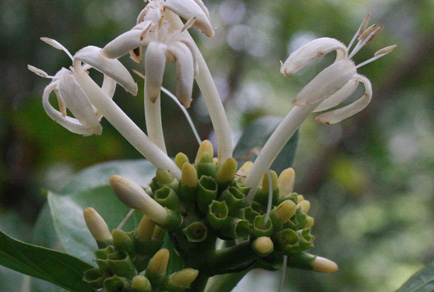
One of the most conflicting groups among Rubiaceae is related to Psychotria-Palicourea, which has always been a subject of debate among taxonomists due to its high number of species, its paraphyly, and its morphological variation. The genus Mexocarpus was described to encompass Palicourea tetragona due to its pyrenes with prominent ridges, atypical within the rest of Palicourea species. Mexocarpus is a genus distributed from southern Mexico to Central America, aside the pyrene morphology is characterized by the long white flowers with nocturnal anthesis and the fruits tetragonal when dry. The species was originally published as Cephaelis, then transferred to Palicourea and finally to Mexocarpus, however, this latter transfer is not accepted by some researchers arguing that the pyrene morphology is variable. We conducted phylogenetic analyses using two nuclear markers (ETS and ITS) and one plastid marker (trnL-F) to test the phylogenetical position of Mexocarpus tetragona. Our molecular phylogeny shows that Mexocarpus tetragonus does not form a separate entity from Palicourea, forming an unresolved clade with Palicourea tomentosa and Palicourea faxlucens. Additionally, the morphological comparison with closely related species indicates that pyrene morphology is highly variable and therefore cannot be used as a diagnostic character to segregate a genus within this complex. Then, based on morphology and molecular evidence our conclusion is not recognize Mexocarpus as a separate genus.
References
- Aguilar-Morales, M., Ochoterena, H. & Terrazas, T. (2022) Seed morphology of Hamelieae with emphasis on the Deppea complex (Cinchonoideae, Rubiaceae). Plant Ecology and Evolution 155 (1): 51–69. https://doi.org/10.5091/plecevo.84486
- Alfaro, M.E. & Holder, M.T. (2006) The posterior and the prior in Bayesian phylogenetics. Annual Review of Ecology, Evolution and Systematics 37: 19–42. https://doi.org/10.1146/annurev.ecolsys.37.091305.110021
- Andersson, L. (2001) Margaritopsis (Rubiaceae, Psychotrieae) is a pantropical genus. Systematics and Geography of Plants 71: 73–85. https://doi.org/10.2307/3668754
- Andersson, L. (2002a) Re-establishment of Carapichea (Rubiaceae, Psychotrieae). Kew Bulletin 57: 363–374. https://doi.org/10.2307/4111112
- Andersson, L. (2002b) Relationships and generic circumscriptions in the Psychotria Complex (Rubiaceae, Psychotrieae). Systematics and Geography of Plants 72 (1): 167–202. https://doi.org/10.2307/3668767
- Aublet, M.F. (1775) Rubiaceae. Palicourea. Histoire des plantes de la Guiane Françoise. Vol. 1. Pierre François Didot, Londres & Paris, 621 pp. https://doi.org/10.5962/bhl.title.674
- Baker, J.G. (1887) Further Contributions to the Flora of Madagascar. The Journal of the Linnean Society 22: 441–537. https://doi.org/10.1111/j.1095-8339.1885.tb00572.x
- Baldwin, B.G. & Markos, S. (1998) Phylogenetic utility of the external transcribed spacer (ETS) of 18S–26S rDNA: Congruence of ETS and ITS trees of Calycadenia (Compositae). Molecular Phylogenetics and Evolution 10: 449–463. https://doi.org/10.1006/mpev.1998.0545
- Barrabé, L., Buerki, S., Mouly, A., Davis, A.P., Munzinger, J. & Maggia, L. (2012) Delimitation of the genus Margaritopsis (Rubiaceae) in the Asian, Australasian and Pacific region, based on molecular phylogenetic inference and morphology. Taxon 61: 1251–1268. https://doi.org/10.1002/tax.616007
- Barrabé, L., Maggia, L., Pillon, Y., Rigault, F., Mouly, A., Davis, A.P. & Buerki, S. (2014) New Caledonian lineages of Psychotria (Rubiaceae) reveal different evolutionary histories and the largest documented plant radiation for the archipelago. Molecular Phylogenetics and Evolution 71: 15–35. https://doi.org/10.1016/j.ympev.2013.10.020
- Bremekamp, C.E.B. (1934) Notes on the Rubiaceae of Surinam. Recueil des Travaux Botanique Néerlandais 31: 248–308.
- Bentham, G. & Hooker, J.D. (1873) Genera plantarum ad exemplaria imprimis in herbariis Kewensibus servata definita. Voluminis Secundi. Pars I. Sistens Dicotyledonum Gamopetalarum Ordines VI, Caprifoliaceas–Compositas. Lovell Reeve & Co., Williams & Norgate, London, 554 pp. https://doi.org/10.5962/bhl.title.747
- Berger, A. (2018) Synopsis and typification of Mexican and Central American Palicourea (Rubiaceae: Palicoureeae), part I: The entomophilous species. Annalen des Naturhistorischen Museums in Wien 120: 52–140. [http://www.jstor.org/stable/26335282]
- Borhidi, A. (2011) Transfer of the Mexican species of Psychotria subgen. Heteropsychotria to Palicourea based on morphological and molecular evidence. Acta Botanica Hungarica 53 (3–4): 241–250. https://doi.org/10.1556/ABot.53.2011.3-4.4
- Borhidi, A. (2017) El subgénero Heteropsychotria (Rubiaceae, Palicoureeae) en México y Mesoamérica. Acta Botanica Hungarica 59 (1–2): 13–23. https://doi.org/10.1556/034.59.2017.1-2.3
- Borhidi, A., Martínez, E. & Ramos, H. (2015) An uncommon pyrene type and two new genera in the neotropical Psychotrieae (Rubiaceae). Acta Botanica Hungarica 57 (3–4): 241–270. https://doi.org/10.1556/034.57.2015.3-4.1
- Bremer, B. & Manen, J.F. (2000) Phylogeny and classification of the subfamily Rubioideae (Rubiaceae). Plant Systematics and Evolution 225: 43–72. https://doi.org/10.1007/BF00985458
- Candolle de, A.P. de (1830) Rubiaceae. In: de Candolle, A.P. (Ed.) Prodromus systematis naturalis regni vegetabilis, Vol. 4. Treuttel and Würtz, Paris, pp. 341–622. https://doi.org/10.5962/bhl.title.286
- Davis, A.P., Govaerts, R., Bridson, D.M., Ruhsam, M., Moat, J. & Brummitt, N.A. (2009) A Global Assessment of Distribution, Diversity, Endemism, and Taxonomic Effort in the Rubiaceae. Annals of the Missouri Botanical Garden 96 (1): 68–78. https://doi.org/10.3417/2006205
- Dessein, S., Andersson, L., Geuten, K., Smets, E. & Robbrecht, E. (2005) Gomphocalyx and Phylohydrax (Rubiaceae): sister taxa excluded from Spermacoceae s.s., featuring a remarkable case of convergent evolution. Taxon 54: 91–107. https://doi.org/10.2307/25065305
- Don, D. (1825) Prodromus Florae Nepalensis. Veneunt Apud J. Gale, Bruton-Street, London, 256 pp. https://doi.org/10.5962/bhl.title.86
- Dombrain, H.H. (1870) Floral Magazine: Comprising Figures and Descriptions of Popular Garden Flowers 9: 1–512.
- Farris, J.S., Albert, V.A., Källersjö, M., Lipscomb, D. & Kluge, A.G. (1996) Parsimony Jackknifing Outperforms Neighbor-Joining. Cladistics 12: 99–124. https://doi.org/10.1111/j.1096-0031.1996.tb00196.x
- Felsenstein, J. & Kishino, H. (1993) Is there something wrong with the bootstrap on phylogenies? A reply to Hillis and Bull. Systematic Biology 42: 193–200. https://doi.org/10.2307/2992541
- Goloboff, P. (1999) Analyzing large data sets in reasonable times: solutions for composite optima. Cladistics 15: 415–428. https://doi.org/10.1006/clad.1999.0122
- Goloboff, P.A., Farris, J.S. & Nixon, K.C. (2008) TNT, a free program for phylogenetic analysis. Cladistics 24: 774–786. https://doi.org/10.1111/j.1096-0031.2008.00217.x
- Hillis, D.M. & Bull, J.J. (1993) An empirical test of bootstrapping as a method for assessing confidence in phylogenetic analysis. Systematic Biology 42: 182–192. https://doi.org/10.1093/sysbio/42.2.182
- Hooker, W.J. (1849) Niger Flora. H. Bailliere, London, 587 pp. https://doi.org/10.5962/bhl.title.594
- Huelsenbeck, J.P. & Ronquist, F. (2001) MRBAYES: Bayesian inference of phylogenetic trees. Bioinformatics 17: 754–755. https://doi.org/10.1093/bioinformatics/17.8.754
- Inkscape Project. (2020) Inkscape. Available from: https://inkscape.org (accessed 7 May 2025)
- Jacquin, N.J. (1760) Enumeratio Systematica Plantarum, quas in insulis Caribaeism, Norimbergae, Christiani de Lavnoy, Zug, Switzerland, 41 pp. https://doi.org/10.5962/bhl.title.123272
- Krüger, A., Razafimandimbison, S. & Bremer, B. (2012) Molecular phylogeny of the tribe Danaideae (Rubiaceae, Rubioideae). Another example of out-of-Madagascar dispersal. Taxon 61: 629–636. https://doi.org/10.1002/tax.613011
- Lamarck, J.B.A. & Poiret, J.L.M. (1812) Encyclopédie Méthodique. Botanique vol. 2. Panckoucke, Paris, 876 pp. https://doi.org/10.5962/bhl.title.49178
- Lemaire, B., Lachenaud, O., Persson, C., Smets, E. & Dessein, S. (2012) Screening for leaf-associated endophytes in the genus Psychotria (Rubiaceae). FEMS Microbiology Ecology 81: 364–372. https://doi.org/10.1111/j.1574-6941.2012.01356.x
- Linnaeus, C. (1753) Species plantarum. Impensis Laurentii Salvii, Stockholm, 560 pp. https://doi.org/10.5962/bhl.title.7081
- Linneaus, C. (1759) Systema naturæ per regna tria naturæ, secundum classes, ordines, genera, species, cum characteribus, differentiis, synonymis, locis. Tomus II. Editio decima, reformata. Laurentius Salvius: Holmiæ, 1384 pp. https://doi.org/10.5962/bhl.title.542
- Löhne, C. & Borsch, T. (2005) Molecular evolution and phylogenetic utility of the petD group II intron: a case study in basal angiosperms. Molecular Biology and Evolution 22: 317–332. https://doi.org/10.1093/molbev/msi019
- Lorence, D.H. (2012) Didymaea. In: Davidse, G., Sousa, M., Knapp, S. & Chiang, F. (Eds.) Flora Mesoamericana, vol. 4, part 2. Missouri Botanical Garden Press, St. Louis Missouri, pp. 79.
- Lorence, D.H. & Dwyer, J. (1987) New taxa in Mexican Psychotria (Rubiaceae, Psychotrieae). Boletin de la Sociedad Botánica de México 52: 49–64. https://doi.org/10.17129/botsci.1331
- Müller, K., Quandt, D., Müller, J. & Neinhuis, C. (2005) PhyDE 0.995. Phylogenetic data editor. Available from: http://www.phyde.de/ (accessed 7 May 2025)
- Negrón-Ortiz, V. & Watson, L. (2002) Molecular phylogeny and biogeography of Erithalis (Rubiaceae), an endemic of the Caribbean Basin. Plant Systematics and Evolution 234: 71–83. https://doi.org/10.1007/s00606-002-0192-2
- Nepokroeff, M. (1997) Systematics of the tropical shrub genus Psychotria L. (Rubiaceae): origins, speciation and breeding systems in Hawai’i. Ph.D. thesis, University of Wisconsin, Madison.
- Nepokroeff, M., Bremer, B. & Sytsma, K. (1999) Reorganization of the Genus Psychotria and Tribe Psychotrieae (Rubiaceae) Inferred from ITS and rbcL Sequence Data. Systematic Botany 24 (1): 5–27. https://doi.org/10.2307/2419383
- Nickrent, D.L., Schuette, K.P. & Starr, E.M. (1994) A molecular phylogeny of Arceuthobium (Viscaceae) based on nuclear ribosomal DNA internal transcribed spacer sequences. American Journal of Botany 81: 1149–1160. https://doi.org/10.1002/j.1537-2197.1994.tb15609.x
- Nixon, K.C. (1999) The Parsimony Ratchet, a new method for rapid parsimony analysis. Cladistics 15: 407–414. https://doi.org/10.1111/j.1096-0031.1999.tb00277.x
- Petit, E. (1964) Les espèces africaines du genre Psychotria L. Rubiaceae. I. Bulletin du Jardin botanique de l’État a Bruxelles 34: 1–228. https://doi.org/10.2307/3667246
- Piesschaert, F., Robbrecht, E., Poulsen, A.D. & Smets, E. (1999) Pyrene and pollen observations in the pantropical genus Geophila (Rubiaceae-Psychotrieae). Nordic Journal of Botany 19: 93–99. https://doi.org/10.1111/j.1756-1051.1999.tb01906.x
- Piesschaert, F., Robbrecht, E. & Smets, E. (2001) Patterns in pyrenes: the systematic significance of pyrene morphology in Chassalia (Rubiaceae-Psychotrieae) and related genera. Flora 196: 121–131. https://doi.org/10.1016/S0367-2530(17)30027-0
- Posada, D. & Crandall, K.A. (1998) MODELTEST: testing the model of DNA substitution. Bioinformatics 14 (9): 817–818. https://doi.org/10.1093/bioinformatics/14.9.817
- Rambaut, A. & Drummond, A. (2012) FigTree v1. 4. Institute of Evolutionary Biology, Edinburgh.
- Razafimandimbison, S., Charlotte, T., Wikström, N., Pailler, T., Khodabandeh, A. & Bremer, B. (2014) Phylogeny and generic limits in the sister tribes Psychotrieae and Palicoureeae (Rubiaceae): Evolution of schizocarps in Psychotria and origins of bacterial leaf nodules of the Malagasy species. American Journal of Botany 110: 1102–1126. https://doi.org/10.3732/ajb.1400076
- Razafimandimbison, S., Lantz, H., Mouly, A. & Bremer, B. (2009) Molecular phylogenetics and generic assessment in the tribe Morindeae (Rubiaceae,Rubioideae): How to circumscribe Morinda L. to be monophyletic?. Molecular Phylogenetics and Evolution 52: 879–886. https://doi.org/10.1016/j.ympev.2009.04.007
- Razafimandimbison, S.G. & Rydin, C. (2024) Phylogeny and classification of the coffee family (Rubiaceae, Gentianales): Overview and outlook. Taxon 73: 673–717. https://doi.org/10.1002/tax.13167
- Razafimandimbison, S., Rydin, C. & Bremer, B. (2008) Evolution and trends in the Psychotrieae alliance (Rubiaceae) A rarely reported evolutionary change of many-seeded carpels from one-seeded carpels. Molecular Phylogenetics and Evolution 48: 207–223. https://doi.org/10.15553/c2019v741a6
- Robbrecht, E. (1988) Tropical woody Rubiaceae. Opera Botanica Belgica 1: 1–272. [https://www.jstor.org/stable/4110534]
- Robbrecht, E. (1975) Hymenocoleus, a new genus of Psychotrieae (Rubiaceae) from tropical Africa. Bulletin du Jardin Botanique de l’État à Bruxelles 45: 274. https://doi.org/10.2307/3667482
- Robbrecht, M. & Manen, J. (2006) The major evolutionary lineages of the coffee family (Rubiaceae, Angiosperms). Combined analysis (nDNA and cpDNA) to Infer the position of Coptosapelta and Luculia, and supertree construction based on rbcL, rps16, trnL-trnF and atpB-rbcL data. A new classification in two subfamilies, Cinchonoideae and Rubioideae. Systematics and Geography of Plants 76: 84–145. https://doi.org/10.2307/20649700
- Roemer, J.J. & Schultes, J.A. (1819) Systema Vegetabilium: secundum classes, ordines, genera, species. Cum characteribus, differentiis et synonymiis. Edition decimo quinta, Vol. 5. Sumtibus J.G. Cottae, Stuttgard, 383 pp. https://doi.org/10.5962/bhl.title.825
- Rydin, C., Razafimandimbison, S.G. & Bremer, B. (2008) Rare and enigmatic genera (Dunnia, Schizocolea, Colletoecema), sisters to species-rich clades: Phylogeny and aspects of conservation biology in the coffee family. Molecular Phylogenetics and Evolution 48: 74–83. https://doi.org/10.1016/j.ympev.2008.04.006
- Schlechtendal, D.F.L. von & von Chamisso, L.K.A. (1830) Plantarum mexicanarum a cel. viris Schiede et Deppe collectarum recensio brevis. Linnaea 5: 72–200.
- Schumann, K.M. (1891) Die natürlichen Pflanzenfamilien nebst ihren Gattungen und wichtigen Arten insbesondere den Nutzpflanzen. IV. In: Engler, A. & Prantl, K. (Eds.) Rubiaceae. Wilhelm Engelmann, Leipzig, pp. 1–156. https://doi.org/10.5962/bhl.title.4635
- Silvestro, D. & Michalak, I. (2012) RaxmlGUI: a graphical front-end for RAxML. Organisms Diversity & Evolution 12: 335–337. https://doi.org/10.1007/s13127-011-0056-0
- Smith, J.D. (1916) Undescribed plants from Guatemala and other Central American Republics XXXIX. Botanical Gazette 61: 373–387. https://doi.org/10.1086/331793
- Standley, P. (1926) Trees and shrubs of Mexico. Contributions from the United States National Herbarium Volume 23, Part 5. Smithsonian Institute-United States National Museum, pp. 1313–1721. https://doi.org/10.5962/bhl.title.15726
- Standley, P. (1930a) Studies of American Plants IV. Publications of the Field Museum of Natural History, Botanical Series 8 (3): 230. https://doi.org/10.5962/bhl.title.2302
- Standley, P. (1930b) The Rubiaceae of Colombia. Publications of the Field Museum of Natural History, Botanical Series 7 (1): 3–175. https://doi.org/10.5962/bhl.title.2299
- Standley, P.C. (1931) The Rubiaceae of Ecuador. Publications of the Field Museum of Natural History, Botanical Series 7 (2): 179–251. https://doi.org/10.5962/bhl.title.2282
- Stamatakis, A. (2014) RAxML version 8: a tool for phylogenetic analysis and post-analysis of large phylogenies. Bioinformatics 30 (9): 1312–1313. https://doi.org/10.1093/bioinformatics/btu033
- Swartz, O. (1788) Nova Genera et Species Plantarum seu Prodromus. M. Swederi, Holmiae-Upsaliae, & Aboae, Switzerland, 158 pp. https://doi.org/10.5962/bhl.title.433
- Taberlet, P., Gielly, L., Pautou, G. & Bouvet, J. (1991) Universal primers for amplification of three non-coding regions of chloroplast DNA. Plant Molecular Biology 17: 1105–1109. https://doi.org/10.1007/BF00037152
- Taylor, C. (1989) Revision of Palicourea (Rubiaceae) in Mexico and Central America. American Society of Plant Taxonomists 26: 1–102. https://doi.org/10.2307/25027720
- Taylor, C. (1996) Overview of the Psychotrieae (Rubiaceae) in the Neotropics. Opera Botanica Belgica 7: 261–270.
- Taylor, C. (1997a) Conspectus of the genus Palicourea (Rubiaceae: Psychotrieae) with the description of some new species from Ecuador and Colombia. Annals of the Missouri Botanical Garden 84: 224–262. https://doi.org/10.2307/2400003
- Taylor, C.M. (1997b) New Species of Palicourea and Psychotria (Rubiaceae: Psychotrieae) from Northwestern Colombia. Novon 7 (2): 191–200. https://doi.org/10.2307/3392195
- Taylor, C. (2001) Overview of the Neotropical genus Notopleura (Rubiaceae, Psychotrieae), with the description of some new species. Annals of the Missouri Botanical Garden 88: 478–515. https://doi.org/10.2307/3298587
- Taylor, C. (2015) Rubiacearum Americanarum Magna Hama Pars XXXIV: The new group Palicourea sect. Tricephalium with eight new species and a new subspecies (Palicoureeae). Novon 24: 296–318. https://doi.org/10.3417/2015001
- Taylor, C. (2005) Margaritopsis (Rubiaceae, Psychotrieae) in the Neotropics. Systematics and Geography of Plants 75: 161–177. https://doi.org/10.2307/3668574
- Taylor, C. (2012) Palicourea. In: Davidse, G., Sousa, M., Knapp, S. & Chiang, F. (Eds.) Flora Mesoamericana, vol. 4, part 2. Missouri Botanical Garden Press, St. Louis Missouri, pp. 163–181.
- Taylor, C. (2019a) Rubiacearum Americanarum Magna Hama Pars XLIV: Review of the Palicourea pilosa group, with some new species and a new subspecies (Palicoureeae). Novon 27 (2): 102–130. https://doi.org/10.3417/2018316
- Taylor, C. (2019b) Rubiacearum Americanarum Magna Hama Pars XLV: More new species and taxonomic changes in Palicourea (Rubiaceae, Palicoureeae) and Psychotria subg. Heteropsychotria. Novon 27 (3): 165–195. https://doi.org/10.3417/2019387
- Taylor, C. & Gereau, R. (2013) The genus Carapichea (Rubiaceae, Psychotrieae). Annals of the Missouri Botanical Garden 99: 100–127. https://doi.org/10.3417/2011064
- Taylor, C., Lorence, D. & Gereau, R. (2010) Rubiacearum Americanarum Magna Hama Pars XXV: The Nocturnally Flowering Psychotria domingensis–Coussarea hondensis Group Plus Three Other Mesoamerican Psychotria Species Transfer to Palicourea. A Journal for Botanical Nomenclature 20 (4): 481–492. https://doi.org/10.3417/2009124
- Taylor, C., Razafimandimbison, S., Barrabé, L., Jardim, J.G. & Barbosa, M.R.V. (2017) Eumachia expanded, a pantropical genus distinct from Psychotria (Rubiaceae, Palicoureeae). Candollea 72: 289–318. https://doi.org/10.15553/c2017v722a6
- Thiers, B.M. (2024 [continuously updated]) Index Herbariorum. New York Botanical Garden. Available from: http://sweetgum.nybg.org/science/ih/ (accessed 25 January 2024)
- Torres-Montúfar, A., Borsch, T., Fuentes, S., Gutierrez, J. & Ochoterena, H. (2020) It is not a disaster: molecular and morphologically based phylogenetic analysis of Rondeletieae and the Rondeletia complex (Cinchonoideae, Rubiaceae). Plant Systematics and Evolution 306: 1–25. https://doi.org/10.1007/s00606-020-01630-6
- Torres-Montúfar, A. & Torres-Díaz, A.N. (2022) Las Rubiáceas de México: ¿Ya está hecho el trabajo? Botanical Sciences 100 (2): 446–468. https://doi.org/10.17129/botsci.2847
- Wikström, N., Neupane, S., Kårehed, J., Motley, T.J. & Bremer, B. (2013) Phylogeny of Hedyotis L. (Rubiaceae: Spermacoceae): redefining a complex Asian–Pacific assemblage. Taxon 62 (2): 357–374. https://doi.org/10.12705/622.2
- Yokoyama, J., Fukuda, T. & Tsukaya, H. (2003) Morphological and molecular variation in Mitchella undulata, with special reference to the systematic treatment of the dwarf form from Yakushima. Journal of Plant Research 116: 309–315. https://doi.org/10.1007/s10265-003-0105-7