

Abstract
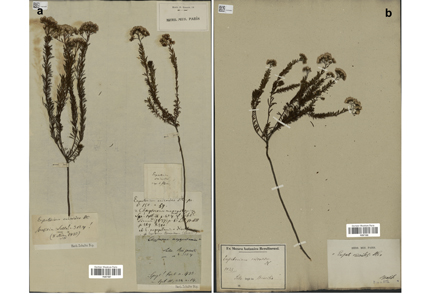
This research aimed to locate and list all specimens belonging to the so-called Herbier Impérial du Brésil (HIB: Imperial Herbarium of Brazil), in the Muséum National d’Histoire Naturelle (P) in Paris. In 1833, Charles Gaudichaud-Beaupré removed this collection from what was then the Imperial and National Museum of Rio de Janeiro, currently the National Museum of Rio de Janeiro (R). Since then, these specimens have been labelled as HIB plus a collection number, with one of four “Provinces” designated as “Mato Grosso”, “Minas Gerais”, “Rio Grande”, “São Paulo” and “C. Gaudichaud 1833”. For this reason, most specimens have erroneously been attributed, both in the literature and database at P (Sonnerat), to collection by Gaudichaud-Beaupré. I located these specimens through virtual searches in the Sonnerat database and two in-person visits to P. As a result, 3,441 specimens were located, but there should be another 262 specimens that are part of the sequential numbering for each “Province”. The specimens located belong to 147 APG IV families, 786 genera, 1,916 species of phanerogams and 14 families, 34 genera, 53 species of cryptogams. Of relevance is that ca. 555 of these specimens are nomenclatural types and another ca. 980 specimens are likely duplicates of types described from Sellow’s collections. Except for specimens from Mato Grosso, where Sellow never collected, evidence that he is the collector of specimens from other provinces comes from 812 specimens that still have his original labels tied to the branches or traces of destroyed labels. Many specimens without Sellow’s original labels belong to species described from his collections in Berlin and, in several cases, were only known at the time from them, including morphological and phenological data. In view of this, some cases are exemplified and detailed in which specific names have nomenclatural priority, but which have been neglected, or remained doubtful, and could be resolved from HIB specimens, by being directly and/or indirectly related to well-documented specimens. It was also possible to resolve or improve the localities and collection periods of many of these specimens, especially those with the original labels, without the laconic “Brasilia” and/or “Montevideo” traditionally associated with the “Sellow s.n.” collections. Still incipiently, information is also presented on the collections (HIB duplicates) in the herbarium of the National Museum of Rio de Janeiro (R), for which collection data are partially digitised (≈ 14%). Finally, it should be noted that this research is a first step towards a more comprehensive study, in which ideally a compilation of all Sellow collections, spread across the four corners of the globe, would be accomplished, enabling a better understanding and resolution of taxonomic and/or nomenclatural issues that still remain untouched or unresolved. Sellow’s collection is, perhaps, the most important of those collected in 19th century Brazil, which has not been given serious consideration. The HIB collections shed light on old and new taxonomic issues, circumscription, geographical distribution and typification, to list only some of the related aspects which will improve knowledge of the primary source of information on our botanical heritage, that is, our flora. As an example, a lectotype is designated for the name Chrysocoma megapotamica Spreng., which has nomenclatural priority over the heterotypic synonym Eupatorium ericoides DC., the basionym of Disynaphia ericoides (DC.) R.M.King & H.Rob., the latter wrongly taken as the correct name of this taxon. Therefore, I here propose a nomenclatural combination for this name in Disynaphia.
References
Ames, M. & Spooner, D.M. (2008) DNA from herbarium specimens settles a controversy about origins of the European potato. American Journal of Botany 95: 252–257. https://doi.org/10.3732/ajb.95.2.252
Amshoff, G.J.H. (1939) On South American Papilionaceae. Mededelingen van het Botanisch Museum en Herbarium van de Rijksuniversiteit te Utrecht 52: 1–78. [https://repository.naturalis.nl/pub/535079]
Andersson, L. (1997) Synopsis of the genus Landenbergia (Rubiaceae). Nordic Journal of Botany 17: 255–299. https://doi.org/10.1111/j.1756-1051.1997.tb00316.x
Anonymous (1833) Nouvelles de M. Ch. Gaudichaud, naturaliste-voyageur, correspondant de l’Institut, etc. Archives de Botanique (Paris) 1: 476–479. [https://hdl.handle.net/2027/hvd.32044106329097?urlappend=%3Bseq=506%3Bownerid=27021597765788489-512]
APG IV. (2016) An update of the Angiosperm Phylogeny Group classification for the orders and families of flowering plants: APG IV. Botanical journal of the Linnean Society 181: 1–20. https://doi.org/10.1111/boj.12385
Ardenghi, N.M.G., Barcheri, G., Ballerini, C., Cauzzi, P. & Guzzon, F. (2016) Gymnocoronis spilanthoides (Asteraceae, Eupatorieae), a new naturalized and potentially invasive aquatic alien in S Europe. Willdenowia 46: 265–273. https://doi.org/10.3372/wi.46.46208
Arechavaleta, J. (1902) Sello ó Sellow, Federico. Anales del Museo Nacional de Montevideo 5: xxxviii. [https://www.biodiversitylibrary.org/page/9518474]
Arquivo Nacional (1961) Flora Fluminensis de Frei José Mariano da Conceição Vellozo. Documentos. Publicações do Arquivo Nacional, vol. 48. Ministério da Justiça e Negócios Interiores, Rio de Janeiro, 397 pp., 30 estampas.
Ascherson, P.F.A. & Graebner, K.O.R.P.P. (1898–1902) Synopsis der mitteleuropäischen Flora, Zweiter Band (Erste Abtheilung), Embryophyta syphonogama (angiospermae [monocotyledones (Glumiflorae 1. Gramina)]). Engelmann, Leipzig, 795 pp. https://doi.org/10.5962/bhl.title.35810
Aublet, J.B.C.F. (1775) Histoire des plantes de la Guiane Françoise, tome premier. Didot, Londres & Paris, 621 pp. https://doi.org/10.5962/bhl.title.674
Baillon, H.E. (1864) Species Euphorbiacearum. Euphorbiacées Américaines, première partie. Amérique Austro-Orientale. (Brésil, Uruguay, Paraguay, Patagonie, etc.). Adansonia 4: 257–377. [https://www.biodiversitylibrary.org/page/6524146]
Baillon, H.E. (1865) Species euphorbiacearum. Euphorbiacées Américaines, première partie. Adansonia 5: 221–240. [https://www.biodiversitylibrary.org/page/4510487]
Baillon, H.E. (1873) Histoire des plantes, tome quatrième. Hachette, Paris, 520 pp. https://doi.org/10.5962/bhl.title.40796
Baillon, H.E. (1880) Sur l’Eupatorium spicatum Lamk. Bulletin Mensuel de la Société Linnéenne de Paris 1: 267–268. [https://www.biodiversitylibrary.org/page/11016832]
Baitello, J.B. (2003) Persea Mill. In: Wanderley, M.G.L., Shepherd, G.J., Giulietti, A.M. & Melhem, T.S. (Coords.) Flora Fanerogâmica do Estado de São Paulo, volume 3. FAPESP/RiMa, São Paulo, pp. 208–213. [https://www.infraestruturameioambiente.sp.gov.br/institutodebotanica/wp-content/uploads/sites/235/2016/06/FFESP-Volume-III_06_24.pdf]
Baker, J.G. (1882) Compositae. III. Asteroideae, Inuloideae. In: Martius, C.F.P. von & Eichler, A.W. (Eds.) Flora Brasiliensis, vol. 6 (3). Oldenbourg, Munich and Leipzig. pp. 1–134, tab. 1–44. https://doi.org/10.5962/bhl.title.454
Baker, J.G. (1884) Compositae. IV. Helianthoideae, Helenioideae, Anthemideae, Senecionideae, Cynaroideae, Ligulatae, Mutisiaceae. In: Martius, C.F.P. von & Eichler, A.W. (Eds.) Flora Brasiliensis, vol. 6 (3). Oldenbourg, Munich and Leipzig. pp. 137–412, tab. 45–108. https://doi.org/10.5962/bhl.title.454
Baker, J.G. (1889) Handbook of the Bromeliaceæ. Bell, London, 243 pp. https://doi.org/10.5962/bhl.title.51681
Barbosa Rodrigues, J. (1898) Palmae Mattogrossenses novae vel minus cognitae. Leuzinger, Rio de Janeiro, 88 pp., 28 tt. [http://www2.senado.leg.br/bdsf/handle/id/242527]
Barneby, R.C. (1996) Neotropical Fabales at NY: asides and oversights. Brittonia 48: 174–187. https://doi.org/10.2307/2807811
Barneby, R.C. & Grimes, J.W. (1996) Silk tree, guanacaste, monkey’s earring: a generic system for the synandrous Mimosaceae of the Americas. Part I. Abarema, Albizia, and allies. Memoirs of The New York Botanical Garden 74: 1–292. [http://opac.nybg.org/record=b1115572]
Barreto, A. (1976) Sellow (Friedrich, 1789–1831). In: Barreto, A. (ed.) Bibliografia Sul-Rio-Grandense 2. Cultura, Rio de Janeiro, pp. 1257–1265.
Barros, M. (1929) Las Ciperáceas de los alrededores de Buenos Aires. Physis 9: 355–398.
Barroso, G.M. (1976) Compositae – Subtribo BACCHARIDINAE Hoffmann: estudo das espécies ocorrentes no Brasil. Rodriguésia 28: 3–273. [https://www.jstor.org/stable/23492507]
Bary, A.H. de (1876) Researches into the nature of the potato-fungus—Phytophthora infestans. Journal of the Royal Agricultural Society of England, ser. 2, 12: 239–269. [https://www.biodiversitylibrary.org/page/47397893]
Bebber, D.P., Carine, M.A., Wood, J.R.I., Wortley, A.H., Harris, D.J., Prance, G.T., Davidse, G., Paige, J., Pennington, T.D., Robson, N.K.B. & Scotland, R.W. (2010) Herbaria are a major frontier for species discovery. Proceedings of the National Academy of Sciences of the United States of America 107: 22169–22171. https://doi.org/10.1073/pnas.1011841108
Beerling, D.J. & Woodward, F.I. (1996) Stomatal density responses to global environmental change. In: Stanhill, G. (ed.) Advances in bioclimatology 4: 171–221. Springer, Berlin. https://doi.org/10.1007/978-3-642-61132-2_4
Bentham, G. (1837) Commentationes de leguminosarum generibus. Sollinger, Vienna, 78 pp. [https://gallica.bnf.fr/ark:/12148/bpt6k969044/f1.item]
Bentham, G. (1844) Notes on Mimoseæ, with a synopsis of species. The London Journal of Botany 3: 82–112, 195–226. [https://www.biodiversitylibrary.org/page/770606]
Bentham, G. (1859) Leguminosae: I. Papilionacearum Tribus I – VIII. In: Martius, C.F.P. von (Ed.) Flora Brasiliensis, vol. 15 (1). Oldenbourg, Munich and Leipzig. pp. 1–216, tab. 1–56. https://doi.org/10.5962/bhl.title.454
Bentham, G. (1870) Leguminosae II. Swartzieae et Caesalpinieae. In: Martius, C.F.P. von & Eichler, A.W. (Eds.) Flora Brasiliensis, vol. 15 (2). Oldenbourg, Munich and Leipzig. pp. 1–254, tab. 1–66. https://doi.org/10.5962/bhl.title.454
Bentham, G. (1875) Revision of the suborder Mimoseæ. The Transactions of the Linnean Society of London 30: 335–664, tt. LXVI–LXX. [https://www.biodiversitylibrary.org/page/27558194]
Berg, C.C. & Carauta, J.P.P. (2002) New species of Ficus (Moraceae) from Brazil. Brittonia 54: 236–250. https://doi.org/10.1663/0007-196X(2003)54[236:NSOFMF]2.0.CO;2
Berg, O.K. (1857) Myrtaceae. In: Martius, C.F.P. von (Ed.) Flora Brasiliensis, vol. 14 (1). Oldenbourg, Munich and Leipzig. pp. 1–656, tab. 1–82. https://doi.org/10.5962/bhl.title.454
Besnard, G., Gaudeul, M., Lavergne, S., Muller, S., Rouhan, G., Sukhorukov, A.P., Vanderpoorten, A. & Jabbour, F. (2018) Herbarium-based science in the twenty-first century. Botany Letters 165: 323–327. https://doi.org/10.1080/23818107.2018.1482783
Bieker, V.C. & Martin, M.D. (2018) Implications and future prospects for evolutionary analyses of DNA in historical herbarium collections. Botany Letters 165: 409–418. https://doi.org/10.1080/23818107.2018.1458651
Bierner, M.W. (1987) Taxonomy of Helenium sect. Actinea (Asteraceae). SIDA, Contributions to Botany 12: 253–271. [https://biostor.org/reference/159098]
Boeckeler, J.O. (1867) Die Cyperaceen des Königlichen Herbariums zu Berlin. 1. Theil. Die Cypereen, Scirpeen und Hypolytreen. Linnaea 35: 397–612. [https://www.biodiversitylibrary.org/page/120815]
Boeckeler, J.O. (1873) Die Cyperaceen des Königlichen Herbariums zu Berlin. 1. Theil. (Die monoclinischen Cyperaceen.) 2. Stück. Die Rhynchosporeen. Linnaea 37: 520–647. [https://www.biodiversitylibrary.org/page/133875]
Boeckeler, J.O. (1888) Beiträge zur Kenntniss der Cyperaceen. Heft 1. Cyperaceae novae. Breitschädel & Vogt, Varel, 53 pp. https://doi.org/10.5962/bhl.title.51622
Bohs, L. (1994) Cyphomandra (Solanaceae). Flora Neotropica monograph 63: 1–176. [https://www.jstor.org/stable/4393848]
Bokermann, W.C.A. (1957) Atualização do itinerário da viagem do Príncipe de Wied ao Brasil (1815–1817). Arquivos de Zoologia do Estado de São Paulo 10: 209–251.
Bommer, J.E. (1870) Notice sur le Jardin Botanique de Bruxelles. Bulletin de la Société Royale de Botanique de Belgique 9: 418–444. [https://www.biodiversitylibrary.org/page/8842528]
Bonal, D., Ponton, S., Le Thiec, D., Richard, B., Ningre, N., Hérault, B., Ogée, J., Gonzalez, S., Pignal, M., Sabatier, D. & Guehl, J.M. (2011) Leaf functional response to increasing atmospheric CO2 concentrations over the last century in two northern Amazonian tree species: a historical ?13C and ?18O approach using herbarium samples. Plant, Cell and Environment 34: 1332–1344. https://doi.org/10.1111/j.1365-3040.2011.02333.x
Bongard, A.H. von (1831) Essai monographique sur les espèces d’Eriocaulon du Brésil. Mémoires de l’Académie Impériale des Sciences de St. Petersbourg, sixième série, Sciences Mathématiques, Physiques et Naturelles 1: 601–655. [https://www.biodiversitylibrary.org/page/29753647]
Bonifacino, J.M., Sancho, G. & Marchesi, E.H. (2009) A new combination in Asteropsis (Compositae: Astereae), and a synopsis of the genus. Brittonia 61: 1–7. https://doi.org/10.1007/s12228-008-9050-z
Bove, C.P. & Philbrick, C.T. (2014) Rediscovery of a Neotropical rheophyte (Podostemaceae) after 160 years: implications for the location of conservation unit boundaries (Tocantins, Brazil). Check List 10: 1170–1173. https://doi.org/10.15560/10.5.1170
Brenan, J.P.M. (1955) Notes on Mimosoideae: I. Kew Bulletin 10: 161–192. https://doi.org/10.2307/4108864
Bridel, S.E. von (1819) Muscologiae recentiorum supplementum. Pars iv seu mantissa generum specierumque muscorum frondosorum universa. Ukertum, Gotha, V–XVIII, 220 pp., tt. I–II.
Brown, R. (1810) Prodromus floræ Novæ Hollandiæ et Insulæ Van-Diemen, vol. I. Taylor, London, 590 pp. https://doi.org/10.5962/bhl.title.3678
Burkart, A.E. (1966) Notas sobre las especies argentinas de Vicia (Leguminosae) del área mesopotámico-pampeana. Darwiniana 14: 161–194. [https://www.jstor.org/stable/23212957]
Burkart, A.E. (1970) Las Leguminosas-Faseóleas argentinas de los géneros Mucuna, Dioclea y Camptosema. Darwiniana 16: 175–218. [https://www.jstor.org/stable/23213877]
Cabrera, A.L. (1971) Revision del genero «Gochnatia» (Compositae). Revista del Museo de La Plata, Nueva Serie, Sección Botánica, 12: 1–160. [https://publicaciones.fcnym.unlp.edu.ar/rmlp/article/view/1907]
Candolle, A.L.P.P. de (1844) Apocynaceæ. In: Candolle, A.L.P.P. de (Ed.) Prodromus systematis naturalis regni vegetabilis, pars octava: sistens Corolliflorarum ordines XIII. Fortin & Masson, Paris, pp. 317–489. https://doi.org/10.5962/bhl.title.286
Candolle, A.L.P.P. de (1861) Begoniaceae. In: Martius, C.F.P. von (Ed.) Flora Brasiliensis, 4 (1): 337–396, tab. 91–101. Oldenbourg, Munich and Leipzig. https://doi.org/10.5962/bhl.title.454
Candolle, A.C.P. de (1878) Meliaceae. In: Martius, C.F.P. von & Eichler, A.W. (Eds.) Flora Brasiliensis, 11 (1): 165–228, tab. 50–65. Oldenbourg, Munich and Leipzig. https://doi.org/10.5962/bhl.title.454
Candolle, A.P. de (1811) Monographie des Ochnacées et des Simaroubées. Annales du Muséum d’Histoire Naturelle 17: 398–425, tt. I–XX. [https://www.biodiversitylibrary.org/page/29407195]
Candolle, A.P. de (1825) Notice sur quelques genres et espèces nouvelles de légumineuses, extraite de divers mémoires présentés à Société d’Histoire naturelle de Genève, pendant le cours des années 1823 et 1824. Annales des Sciences Naturelles 4: 90–103. [https://www.biodiversitylibrary.org/page/13383808]
Candolle, A.P. de (1828) Prodromus systematis naturalis regni vegetabilis, pars tertia: sistens Calyciflorarum ordines XXVI. Treuttel & Würtz, Paris, 494 pp. https://doi.org/10.5962/bhl.title.286
Candolle, A.P. de (1836) Prodromus systematis naturalis regni vegetabilis, pars quinta: sistens Calycereas et Compositarum tribus priores. Treuttel & Würtz, Paris, 706 pp. https://doi.org/10.5962/bhl.title.286
Candolle, A.P. de (1837) Prodromus systematis naturalis regni vegetabilis, pars sexta: sistens Compositarum continuationem. Treuttel & Würtz, Paris, 687 pp. https://doi.org/10.5962/bhl.title.286
Candolle, A.P. de (1845) Ordo CXXXIII. Bignoniaceæ. In: Candolle, A.L.P.P. de (Ed.) Prodromus systematis naturalis regni vegetabilis, pars nona: sistens Corolliflorarum ordines IX. Fortin & Masson, Paris, pp. 142–248. https://doi.org/10.5962/bhl.title.286
Carine, M.A., Cesar, E.A., Ellis, L., Hunnex, J., Paul, A.M., Prakash, R., Rumsey, F.J., Wajer, J., Wilbraham, J. & Yesilyurt, J.C. (2018) Examining the spectra of herbarium uses and users. Botany Letters 165: 328–336. https://doi.org/10.1080/23818107.2018.1482782
Carvalho, C.S., Lima, H.C., Moraes, P.L.R. de & Cardoso, D.B.O.S. (2023) Assessing the nomenclatural history of the sucupira-branca trees: Friedrich Sellow’s (1789–1831) collections, typification and checklist of the Neotropical legume genus Pterodon. Taxon 72: 159–173. https://doi.org/10.1002/tax.12823
Caspary, R. (1878) Nymphaeaceae. In: Martius, C.F.P. von & Eichler, A.W. (Eds.) Flora Brasiliensis, 4 (2): 129–184, tab. 28–38. Oldenbourg, Munich and Leipzig. https://doi.org/10.5962/bhl.title.454
Cassini, A.H.G. de (1826) PRAXÉLIDE, Praxelis. In: Cuvier, F. (Ed.) Dictionnaire des sciences naturelles, tome XLIII. Levrault, Strasbourg, pp. 261–262. https://doi.org/10.5962/bhl.title.42219
Cavanilles, A.J. (1797) Icones et descriptiones plantarum, quæ aut sponte in Hispania crescunt, aut in hortis hospitantur, volumen IV. Regia Typographia, Madrid, [i–iii], pp. [1]–82, tt. 301–400. [https://bibdigital.rjb.csic.es/idurl/1/9682]
Chamisso, L.K.A. von (1829) De plantis in expeditione speculatoria Romanzoffiana observatis. Boragineae Juss. Linnaea 4: 435–496. [https://www.biodiversitylibrary.org/page/95831]
Chamisso, L.K.A. von (1832) De plantis in expeditione Romanzoffiana et in Herbariis Regiis observatis disserere pergitur. Bignoniaceae. Linnaea 7: 542–560, 653–723. [https://www.biodiversitylibrary.org/page/98501]
Chamisso, L.K.A. von (1833a) Spicilegium plantarum e familiis jam prius recensitis, praesertim Brasiliensium serius a Sellowio missarum. Polygoneae. Linnaea 8: 130–140. [https://www.biodiversitylibrary.org/page/99023]
Chamisso, L.K.A. von (1833b) Lacidis speciem novam Brasiliensem. Linnaea 8: 653–654. [https://www.biodiversitylibrary.org/page/99546]
Chamisso, L.K.A. von (1834) Spicilegium plantarum e familiis jam prius recensitis praesertim brasiliensium. Linnaea 9: 214–261. [https://www.biodiversitylibrary.org/page/1942]
Chamisso, L.K.A. von (1835) De plantis in expeditione speculatoria Romanzoffiana et in Herbariis Regiis Berolinensibus observatis dicere pergit Adelbertus de Chamisso. Melastomaceae americanae. Linnaea 10: 32–50. [https://www.biodiversitylibrary.org/page/99842]
Chamisso, L.K.A. von & Schlechtendal, D.F.L. von (1826) De plantis in expeditione speculatoria Romanzoffiana observatis. Linnaea 1: 1–73, 165–226, 333–405, 511–570. [https://www.biodiversitylibrary.org/page/93775]
Chevalier, A. (1932) Nouvelle contribution à l’étude systématique des Oryza. Revue de Botanique Appliquée et d’Agriculture Coloniale 12: 1014–1032. [https://www.persee.fr/doc/jatba_0370-3681_1932_num_12_136_5183]
Choi, J., Lee, H. & Shipunov, A. (2015) All that is gold does not glitter? Age, taxonomy, and ancient plant DNA quality. PeerJ 3: e1087. https://doi.org/10.7717/peerj.1087
Christenhusz, M.J.M. & Chase, M.W. (2014) Trends and concepts in fern classification. Annals of Botany 113: 571–594. https://doi.org/10.1093/aob/mct299
Clarke, C.B. (1886) On the Indian species of Cyperus; with remarks on some others that specially illustrate the subdivisions of the genus. The Journal of the Linnean Society, Botany, 21: 1–202. https://doi.org/10.1111/j.1095-8339.1884.tb00540.x
Clarke, C.B. (1902) Cyperaceae (praeter Caricinas) Chilenses. Botanische Jahrbücher für Systematik, Pflanzengeschichte und Pflanzengeographie 30 (2, Beibl. 68): 1–44. [https://www.biodiversitylibrary.org/page/211844]
Clarke, C.B. (1903) Cyperace?. In: Chodat, R. & Hassler, E., Plant? Hasslerian? soit énumération des plantes récoltées au Paraguay. Bulletin de l’Herbier Boissier, 2me série, 3: 225–252. [https://www.biodiversitylibrary.org/page/33743210]
Cogniaux, C.A. (1883) Melastomaceae. Tribus I. Microlicieae. In: Martius, C.F.P. von & Eichler, A.W. (Eds.) Flora Brasiliensis, vol. 14 (3). Oldenbourg, Munich and Leipzig. pp. 1–204, tab. 1–48. https://doi.org/10.5962/bhl.title.454
Conceição Vellozo, J.M. da (1829) [1825] Floræ fluminensis, seu descriptionum plantarum præfectura Fluminensi sponte nascentium Liber Primus. Typographia Nationali, Rio de Janeiro, 352 pp. https://doi.org/10.5962/bhl.title.745
Conceição Vellozo, J.M. da (1831) [1827] Florae fluminensis icones, nunc primo eduntur, vol. XI. Knecht, Paris, tt. 1–127, pp. [1]–21 (index), pp. [1]–14. https://doi.org/10.5962/bhl.title.70380
Conert, H.J. (1961) Die Systematik und Anatomie der Arundineae. Cramer, Weinheim, 208 pp.
Connor, H.E. & Edgar, E. (1974) Names and types in Cortaderia Stapf (Gramineae). Taxon 23: 595–605. https://doi.org/10.2307/1218786
Contreras-Ortiz, N., Rodríguez-García, T., Quintanilla, S., Bernal-Villegas, J., Madriñán, S. & Gómez-Gutiérrez, A. (2019) The origin of Humboldt and Bonpland’s holotype of Oncidium ornithorhynchum, clarified using +200-year-old DNA. Taxon 68: 471–480. https://doi.org/10.1002/tax.12067
Costa, J.A.S. & Queiroz, L.P. (2010) Lectotypifications and nomenclatural notes in Copaifera L. (Leguminosae-Caesalpinioideae-Detarieae). Kew Bulletin 65: 475–478. https://doi.org/10.1007/s12225-010-9219-y
Dallière, A. (Ed.) (1874) Les plantes ornamentales à feuillage panaché et coloré. Stroobant, Ghent, tt. 31–60.
Dalton, R. (2003) Natural history collections in crisis as funding is slashed. Nature 423: 575. https://doi.org/10.1038/423575a
Deble, L.P. & Marchiori, J.N.C. (2006) O gênero Pseudognaphalium Kirp. (Asteraceae-Gnaphalieae) no Sul do Brasil. Balduinia 6: 1–13. https://doi.org/10.5902/2358198014026
Decaisne, J. (1838) Études sur quelques genres et espèces de la famille des Asclépiadées. Annales des Sciences Naturelles, Botanique, sér. 2, 9: 257–278, 321–348. [https://www.biodiversitylibrary.org/page/36217919]
Decaisne, J. (1844) Asclepiadeæ. In: Candolle, A.L.P.P. de (Ed.) Prodromus systematis naturalis regni vegetabilis, pars octava: sistens Corolliflorarum ordines XIII. Fortin & Masson, Paris, pp. 490–665. https://doi.org/10.5962/bhl.title.286
Dematteis, M. (2004) Taxonomía del complejo Vernonia rubricaulis (Vernonieae, Asteraceae). Bonplandia 13: 5–13. http://dx.doi.org/10.30972/bon.131-41396
Deng, B. (2015) Plant collections get pruned back. North America’s herbaria wilt under budget pressure. Nature 523: 16. https://doi.org/10.1038/523016a
Desfontaines, R.L. (1821) Observations sur le genre Copaifera; description de deux nouvelles espèces qui lui appartiennent. Mémoires du Muséum d’Histoire Naturelle 7: 373–378, tt. 13–14. [https://www.biodiversitylibrary.org/page/34818133]
Dietrich, A.G. (1832) Isolepis megapotamica. In: Linnaeus, C. Species plantarum, 6th ed. Nauck, Berlin, p. 132. [https://www.biodiversitylibrary.org/page/59124772]
Don, G. (1837) A general history of the dichlamydeous plants, vol. IV – Corollifloræ. Rivington, London, 908 pp. https://doi.org/10.5962/bhl.title.502
Ducke, A. (1957) Critical notes on Brazilian Leguminosae. Anais da Academia Brasileira de Ciências 29: 421–429.
Dunal, M.F. (1852) Solanaceæ. In: Candolle, A.L.P.P. de (Ed.) Prodromus systematis naturalis regni vegetabilis, pars decima tertia, sectio prior: sistens Corollifloras supra omissas, nempe Solanaceas, Diapensieas et Plantaginaceas. Masson, Paris and Michelsen, Leipzig, pp. 1–690. https://doi.org/10.5962/bhl.title.286
Dwyer, J.D. (1951) The Central American, West Indian, and South American species of Copaifera (Caesalpiniaceae). Brittonia 7: 143–172. https://doi.org/10.2307/2804703
Dwyer, J.D. (1954) Further studies on the New World species of Copaifera. Bulletin of the Torrey Botanical Club 81: 179–187. https://doi.org/10.2307/2481808
Ee, B.W. van (2011) The contribution of Johann Friedrich Klotzsch to the taxonomy of Croton (Euphorbiaceae) and associated genera. Willdenowia 41: 15–33. https://doi.org/10.3372/wi.41.41102
Eichler, A.W. (1864) Magnoliaceae, Winteraceae, Ranunculaceae, Menispermaceae, Berberideae. In: Martius, C.F.P. von & Eichler, A.W. (Eds.) Flora Brasiliensis, vol. 13 (1). Oldenbourg, Munich and Leipzig. pp. 121–236, tab. 28–53. https://doi.org/10.5962/bhl.title.454
Eichler, A.W. (1869) Das Herbarium Martii. Wolf & Sohn, Munich, 24 pp.
Engler, H.G.A. (1876) Anacardiaceae. In: Martius, C.F.P. von & Eichler, A.W. (Eds.) Flora Brasiliensis, vol. 12 (2). Oldenbourg, Munich and Leipzig. pp. 367–418, tab. 78–88. https://doi.org/10.5962/bhl.title.454
Espindola, H.S. (2007) A navegação do Rio Doce: 1800–1850. Navigator 3: 50–72. [https://www.portaldeperiodicos.marinha.mil.br/index.php/navigator/article/view/256]
Espinosa, F. & Castro, M.P. (2018) On the use of herbarium specimens for morphological and anatomical research. Botany Letters 165: 361–367. https://doi.org/10.1080/23818107.2018.1451775
Feres, F. & Amaral, M.C.E. (2003) Cabombaceae. In: Wanderley, M.G.L., Shepherd, G.J., Giulietti, A.M. & Melhem, T.S. (Coords.) Flora Fanerogâmica do Estado de São Paulo, Volume 3. FAPESP: RiMa, São Paulo, pp. 9–11. [https://www.infraestruturameioambiente.sp.gov.br/institutodebotanica/wp-content/uploads/sites/235/2016/06/FFESP-Volume-III_06_24.pdf]
Fernández Casas, F.J. (2014a) El género Spigelia Linnaeus (1753) en el herbario CTES (Corrientes, Argentina). Adumbrationes ad Summæ Editionem 56: 1–46. [https://bibdigital.rjb.csic.es/idurl/1/1526263]
Fernández Casas, F.J. (2014b) El género Spigelia Linnaeus (1753) en três herbarios fluminenses: HB, R, RB. Adumbrationes ad Summæ Editionem 59: 1–68. [https://bibdigital.rjb.csic.es/idurl/1/1526269]
Fertig, W. (2016a) Are herbaria still relevant in the 21st century? Sego Lily 39: 6–8. [https://www.unps.org/segolily/Sego2016JanMar.pdf]
Fertig, W. (2016b) How prevalent are plant misidentifications? Sego Lily 39: 4. [https://www.unps.org/segolily/Sego2016AprJun.pdf]
Flann, C. (Ed.) (2022) GCC: Global Compositae checklist (version 5 (Beta), Jun. 2014). In: (Roskov, Y., Abucay, L., Orrell, T., Nicolson, D., Flann, C., Bailly, N., Kirk, P., Bourgoin, T., DeWalt, R.E., Decock, W. & De Wever, A. (Eds.) Species 2000 & ITIS Catalogue of Life, 2016 Annual Checklist. Digital resource at www.catalogueoflife.org/annual-checklist/2016/. Species 2000: Naturalis, Leiden, the Netherlands. ISSN 2405-884X.
Flora do Brasil 2020 (2019) Cyperaceae. Jardim Botânico do Rio de Janeiro. Available at: http://reflora.jbrj.gov.br/reflora/floradobrasil/FB28513 (Accessed 29 September 2019). Current citation: Matzenauer, W., Pereira-Silva, L. & Hefler, S.M. Cyperus in Flora e Funga do Brasil. Jardim Botânico do Rio de Janeiro. Available at: https://floradobrasil.jbrj.gov.br/FB28513 (Acessed 22 October 2022)
Förther, H. (1994) Die Geschichte des Martius-Herbariums: seine Brasilienkollektion und Empfehlungen zur Typuswahl. Sendtnera 2: 5–24. [https://biostor.org/reference/144786]
Fournier, E.P.N. (1885) Asclepiadaceae. In: Martius, C.F.P. von & Eichler, A.W. (Eds.) Flora Brasiliensis, vol. 6 (4). Oldenbourg, Munich and Leipzig. pp. 189–332, tab. 50–98. https://doi.org/10.5962/bhl.title.454
Frahm, J.-P. (1991) Dicranaceae: Campylopodioideae, Paraleucobryoideae. Flora Neotropica monograph 54: 1–237. [https://www.jstor.org/stable/4393822]
Freire, S.E., Monti, C., Bayón, N.D. & Migoya, M.A. (2018) Taxonomic studies in Pseudognaphalium Kirp. (Asteraceae, Gnaphalieae) from Peru. Systematic Botany 43: 325–343. https://doi.org/10.1600/036364418X696914
Fresenius, G. (1857) Cordiaceae, Heliotropieae, Borragineae. In: Martius, C.F.P. von, Eichler, A.W. & Urban, I. (Eds.) Flora Brasiliensis, vol. 8 (1). Oldenbourg, Munich and Leipzig. pp. 1–64, tab. 1–13. https://doi.org/10.5962/bhl.title.454
Fürnrohr, A.E. (1832) Nachricht die Sammlungen des Hrn. Dr. Lhotsky betreffend. Flora 15 (2, Intelligenzblatt): 25–40. [https://www.biodiversitylibrary.org/page/29650]
Funk, V. (2003) 100 uses for an herbarium (well at least 72). American Society of Plant Taxonomists Newsletter 17: 17–19. [http://hdl.handle.net/10088/11385]
Gandoger, M. (1913) Manipulus plantarum novarum præcipue America australioris. Bulletin de la Societé Botanique de France 60: 22–29. https://doi.org/10.1080/00378941.1913.10836566
Gardner, G. (1844) Tab. DCXLI. Cabomba piauhyensis. Gardn. In: Hooker, W.J. (ed.) Icones, vol. VII. Baillière, London. https://doi.org/10.5962/bhl.title.16059
Gaudichaud-Beaupré, C. (1833) Extrait d’une lettre de M. Gaudichaud. Archives de Botanique 1: 576. [https://babel.hathitrust.org/cgi/pt?id=hvd.32044106329097&view=1up&seq=610]
Gentry, A.H. (1992) Bignoniaceae—Part II (Tribe Tecomeae). Flora Neotropica monograph 25 (II): 1–370. [https://www.jstor.org/stable/4393739]
Goldenberg, R., Caddah, M.K. & Martin, C.V. (2010) Taxonomic notes on South American Miconia (Melastomataceae). II. Rodriguésia 61 (Sup.): S23–S28. https://doi.org/10.1590/2175-7860201061127
Goodwin, Z.A., Harris, D.J., Filer, D., Wood, J.R.I. & Scotland, R.W. (2015) Widespread mistaken identity in tropical plant collections. Current Biology 25: R1066–R1067. https://doi.org/10.1016/j.cub.2015.10.002
Govaerts, R. & Simpson, D.A. (2007) World checklist of Cyperaceae. Sedges. The Board of Trustees of the Royal Botanic Gardens, Kew, 765 pp.
Grisebach, A.H.R. (1879) Symbolae ad Floram argentinam. Zweite Bearbeitung argentinischer Pflanzen. Abhandlungen der Königlichen Gesellschaft der Wissenschaften zu Göttingen 24: [3]–345. https://doi.org/10.5962/bhl.title.60503
Gropp, R.E. (2003) Are university natural science collections going extinct? BioScience 53: 550. https://doi.org/10.1641/0006-3568(2003)053[0550:AUNSCG]2.0.CO;2
Grotz, K. & Lack, H.W. (2013) »Aus jenem Lande können wir alles brauchen« Die botanischen Sammlungen von Friedrich Sellow im Botanischen Museum Berlin-Dahlem. In: Zischler, H., Hackethal, S. & Eckert, C. (Orgs.) Die Erkundung Brasiliens. Friedrich Sellows unvollendete Reise. Galiani, Berlin, pp. 221–229.
Guaglianone, E.R. (1995) Nuevas combinaciones en Cyperaceae y Liliaceae. Hickenia 2: 137. [https://www.hickenia.darwin.edu.ar/index.php/hickenia/article/view/180]
Gutaker, R.M. & Burbano, H.A. (2017) Reinforcing plant evolutionary genomics using ancient DNA. Current Opinion in Plant Biology 36: 38–45. https://doi.org/10.1016/j.pbi.2017.01.002
Gutaker, R.M., Weiß, C.L., Ellis, D., Anglin, N.L., Knapp, S., Fernández-Alonso, J.L., Prat, S. & Burbano, H.A. (2019) The origins and adaptation of European potatoes reconstructed from historical genomes. Nature Ecology & Evolution 3: 1093–1101. https://doi.org/10.1038/s41559-019-0921-3
Hackethal, S. (1995) Friedrich Sellow (1789–1831) – Skizzen einer unvollendeten Reise durch Südamerika. Fauna und Flora in Rheinland-Pfalz 17: 215–228.
Hackethal, S. (2010) Sellow, Friedrich. In: Neue Deutsche Biographie 24: 225–226 [Online-Version]. [https://www.deutsche-biographie.de/pnd138180881.html#ndbcontent]
Hackethal, S. (2013) »Eine Beschäftigung, worin ich das Glück meines Lebens finde« Sellows Forschungsreisen in Brasilien. In: Zischler, H., Hackethal, S. & Eckert, C. (Orgs.) Die Erkundung Brasiliens. Friedrich Sellows unvollendete Reise. Galiani, Berlin, pp. 79–95.
Hackethal, S. & Tillack, F. (2016) Im Auftrag Preußens: Friedrich Sellow in Brasilien (1814–1831). Mertensiella 23: 64–79.
Harms, H.A.T. (1924) Leguminosae. In: Pilger, R. (ed.) Plantae Luetzelburgianae brasilienses III. Notizblatt des Botanischen Gartens und Museums zu Berlin-Dahlem 8: 711–716. [https://www.biodiversitylibrary.org/page/28675189]
Hauman, L. & Vanderveken, G. (1917) Catalogue des phanérogames de l’Argentine. Anales del Museo Nacional de Historia Natural de Buenos Aires 29: 1–351. [https://www.biodiversitylibrary.org/page/14612031]
Hayne, F.G. (1827) Getreue Darstellung und Beschreibung der in der Arzneykunde gebräuchlichen Gewächse, wie auch Solcher, welche mit ihnen Verwechselt werden Können. Zehnter Band. Verfassers, Berlin, tt. 1–48 + text.
Hermannstädter, A. (2001) Frühe Etnographie in Brasilien 1815–1831: Die Sammlung Friedrich Sellow und Ignaz von Olfers. Eine Berlin-Brandenburgische Kooperation. In: Wolff, G. (Org.) Die Berliner und Brandenburger Latinamerikaforschung in Geschichte und Gegenwart – Personen und Institutionen. Wissenschaftlicher, Berlin, pp. 313–328. [https://publications.iai.spk-berlin.de/servlets/MCRFileNodeServlet/Document_derivate_00000189/Berliner_und_Brandenburger_Lateinamerikaforschung.pdf]
Herter, W.G. (1945) Auf den Spuren der Naturforscher Sellow und Saint-Hilaire. Botanische Jahrbücher für Systematik, Pflanzengeschichte und Pflanzengeographie 74: 119–149.
Herter, W.G. & Rambo, B. (1953) Nas pegadas dos naturalistas Sellow e Saint-Hilaire. Revista Sudamericana de Botánica 10: 61–99.
Hiepko, P. (1987) The collections of the Botanical Museum Berlin-Dahlem (B) and their history. Englera 7: 219–252. https://doi.org/10.2307/3776724
Hoehne, F.C. (1941) Notas bio-bibliográficas de naturalistas botânicos que pretendemos homenagear com a denominação de caminhos e picadas no Jardim Botânico e na Estação Biológica do Alto da Serra. In: F.C. Hoehne, M. Kuhlmann & O. Handro (eds.) O Jardim Botânico de São Paulo. Secretaria da Agricultura, Indústria e Comércio de São Paulo, São Paulo, pp. 2–246.
Holmes, M.W., Hammond, T.T., Wogan, G.O.U., Walsh, R.E., LaBarbera, K., Wommack, E.A., Martins, F.M., Crawford, J.C., Mack, K.L., Bloch, L.M. & Nachman, M.W. (2016) Natural history collections as windows on evolutionary processes. Molecular Ecology 25: 864–881. https://doi.org/10.1111/mec.13529
Hooker, W.J. (1842) Martius on the botany of Brazil. The Journal of Botany (Hooker) 4: 1–37. [https://www.biodiversitylibrary.org/page/2911784]
Hooker, W.J. & Arnott, G.A.W. (1833) Contributions towards a flora of South America and the islands of the Pacific. Botanical Miscellany 3: 129–212, 302–367. [https://www.biodiversitylibrary.org/page/779070]
Hooker, W.J. & Arnott, G.A.W. (1834) Contributions towards a flora of South America and the islands of the Pacific. The Journal of Botany (Hooker) 1: 276–296. [https://www.biodiversitylibrary.org/page/796160]
Hooker, W.J. & Arnott, G.A.W. (1835) Contributions towards a flora of South America and the islands of the Pacific. Companion to the Botanical Magazine 1: 29–38, 102–111, 234–244. [https://www.biodiversitylibrary.org/page/34221125]
Hooker, W.J. & Arnott, G.A.W. (1841) Contributions towards a Flora of South America, and the islands of the Pacific. The Journal of Botany (Hooker) 3: 19–47, 310–348. [https://biodiversitylibrary.org/page/2917639]
Hornschuch, C.F. (1840) Musci. In: Martius, C.F.P. von, Eichler, A.W. & Urban, I. (eds.) Flora Brasiliensis, vol. 1 (2). Oldenbourg, Munich and Leipzig. pp. 1–94, tab. 1–4. https://doi.org/10.5962/bhl.title.454
Humboldt, F.W.H.A. von, Bonpland, A.J.A. & Kunth, K.S. (1816) Nova genera et species plantarum, tomus primus. Librariæ Græco-Latino-Germanicæ, Paris, [III]–LVIII, 377 pp, tt. 1–96 (quarto ed.). https://doi.org/10.5962/bhl.title.640
Humboldt, F.W.H.A. von, Bonpland, A.J.A. & Kunth, K.S. (1817) Nova genera et species plantarum, tomus secundus. Librariæ Græco-Latino-Germanicæ, Paris, 406 pp., tt. 97–192 (quarto ed.). https://doi.org/10.5962/bhl.title.640
Hunziker, J.H. (1949) Dos binomios confusos en el género Ephedra: E. tweediana y E. triandra. Boletin de la Sociedad Argentina de Botanica 2: 278–286. [https://botanicaargentina.org.ar/wp-content/uploads/2018/09/278-286006.pdf]
Jacquin, N.J. von (1760) Enumeratio systematica plantarum, quas in insulis Caribaeis vicinaque Americes continente detexit novas, aut jam cognitas emandavit. Haak, Leiden, 41 pp. https://doi.org/10.5962/bhl.title.737
Jacquin, N.J. von (1800–1809) Fragmenta botanica. Schmidt, Vienna, 86 pp., tt. 1–138. https://doi.org/10.5962/bhl.title.538
Jaeger, A. (1872) Genera et species muscorum systematice disposita seu Adumbratio floræ muscorum totius orbis terrarum. Bericht über die Thätigkeit der St. Gallischen Naturwissenschaftlichen Gesellschaft 12 (1870–1871): 357–451. http://doi.org/10.5169/seals-834755
Johnston, I.M. (1928) Studies in the Boraginaceae–VII. Contributions from the Gray Herbarium of Harvard University 81: 3–83. [https://www.jstor.org/stable/41764048]
Jussieu, A.H.L. de (1843) Monographie de la familie des Malpighiacées. Archives du Muséum d’Histoire Naturelle 3: 5–151. [https://www.biodiversitylibrary.org/page/25099510]
Jussieu, A.L. de (1789) Genera plantarum. Herissant & Barrois, Paris, pp. 3–24, i–lxxii, 1–498. https://doi.org/10.5962/bhl.title.127435
Jussieu, A.L. de (1803) Mémoire sur le Kleinia et l’Actinea, deux genres nouveaux de plantes de la famille des Corymbifères. Annales du Muséum National d’Histoire Naturelle 2: 423–426, pl. LXI. [https://biodiversitylibrary.org/page/3496770]
King, R.M. & Robinson, H. (1971a) Studies in the Eupatorieae (Asteraceae). LIII. A new genus, Raulinoreitzia. Phytologia 22: 113–114. [https://www.biodiversitylibrary.org/page/13786377]
King, R.M. & Robinson, H. (1971b) Studies in the Eupatorieae (Asteraceae). LVII. The genus, Disynaphia. Phytologia 22: 123–125. [https://biostor.org/reference/207442]
Klatt, F.W. (1861) Monographia generis Sisyrinchium. Linnaea 31: 63–100. [https://www.biodiversitylibrary.org/page/117331]
Klotzsch, J.F. (1841) Neue und weniger gekannte südamerikanische Euphorbiaceen-Gattungen. Archiv für Naturgeschichte 7: 175–204, tt. VII–IX
Klotzsch, J.F. (1846) [Tab.] (15) Cinchona glandulifera Ruiz und Pavon. In: Hayne, F.G. (ed.) Getreue Darstellung und Beschreibung der in der Arzneykunde gebra?uchlichen Gewa?chse, wie auch Solcher, welche mit ihnen Verwechselt werden Ko?nnen. Verfassers, Berlin.
Koch, K.H.E. (1873) Conspectus generum et subgenerum Bromeliacearum. In: Index seminum in horto botanico berolinensi anno 1873 collectorum. Feister, Berlin, 7 pp. [https://seedlists.naturalis.nl/content/tillandsia-selloa-ckoch]
Koehne, E. (1915) Zur Kenntnis von Prunus Grex Calycopadus und Grex Gymnopadus Sect. Laurocerasus. Botanische Jahrbücher für Systematik, Pflanzengeschichte und Pflanzengeographie 52: 279–333. [https://www.biodiversitylibrary.org/page/189965]
Kopp, L.E. (1966) A taxonomic revision of the genus Persea in the Western Hemisphere (Perseae-Lauraceae). Memoirs of the New York Botanical Garden 14: 1–120.
Kostermans, A.J.G.H. (1937) Revision of the Lauraceae II. The genera Endlicheria, Cryptocarya (American species) and Licaria. Recueil des Travaux Botaniques Néerlandais 34: 500–609. [https://repository.naturalis.nl/pub/534701]
Kostermans, A.J.G.H. (1938) Revision of the Lauraceae III. The genera Aiouea, Systemonodaphne, Urbanodendron, Mezilaurus; additions and corrections to Licaria and Cryptocarya. Recueil des Travaux Botaniques Néerlandais 35: 56–129. [https://repository.naturalis.nl/pub/534769]
Krapovickas, A. (2003) Tropidococcus Krapov., nuevo género de Malváceas. Bonplandia 12: 63–66. http://dx.doi.org/10.30972/bon.121-41405
Krausch, H.-D. (2002) Friedrich Sello, ein vergessener Pflanzensammler aus Potsdam. Zandera 17: 73–76. [https://www.jstor.org/stable/44696554]
Kükenthal, G. (1936) Cyperaceae – Scirpoideae – Cypereae. In: Engler, H.G.A. & Diels, L. (eds.) Das Pflanzenreich Regni vegetabilis conspectus. IV. 20 (Heft 101): 1–671. Engelmann, Leipzig. [https://www.biodiversitylibrary.org/page/22004067]
Kuhlmann, J.G. (1922) Gramineas. Commissão de Linhas Telegraphicas Estrategicas de Matto-Grosso ao Amazonas, Publicação n.o 67, Annexo n.o 5, Botanica parte XI. Macedo, Rio de Janeiro, 95 pp., tt. I–VI. [https://www.obrasraras.fiocruz.br/media.details.php?mediaID=333]
Kunth, K.S. (1837) Cyperographia synoptica sive enumeratio Cyperacearum omnium hucusque cognitarum, adjectis characteribus, differentiis et synonymis. Cotta, Stuttgart and Tübingen, 591 pp. https://doi.org/10.5962/bhl.title.67381
Kunth, K.S. (1841) Enumeratio plantarum omnium hucusque cognitarum, secundum familias naturales disposita, adjectis characteribus, differentiis et synonymis, tomus tertius. Cotta, Stuttgart and Tübingen, 644 pp. https://doi.org/10.5962/bhl.title.67381
Kuntze, C.E.O. (1898) Enumeratio plantarum in meridie Americae etiam Africa australi collectarum. In: Revisio generum plantarum, pars IIIIII. Gressner & Schramm, Leipzig and Felix, Leipzig, pp. 1–576. https://doi.org/10.5962/bhl.title.327
Lacerda, J.B. (1905) Fastos do Museu Nacional do Rio de Janeiro. Recordações historicas e scientificas fundadas em documentos authenticos e informações veridicas. Imprensa Nacional, Rio de Janeiro, 188 pp. [http://bdor.sibi.ufrj.br/handle/doc/25]
Lack, H.W. (2013) »Freundlich, munter und lehrbegierig.« Friedrich Sellows Bildungsreisen. In: Zischler, H., Hackethal, S. & Eckert, C. (Orgs.) Die Erkundung Brasiliens. Friedrich Sellows unvollendete Reise. Galiani, Berlin, pp. 35–43.
Lamarck, J.B.A.P.M. de (1785) Encyclopédie méthodique. Botanique, tome premier. Panckoucke, Paris and Plomteux, Liège, pp. 1–752. https://doi.org/10.5962/bhl.title.824
Lamarck, J.B.A.P.M. de (1786) Encyclopédie méthodique. Botanique, tome second, pars 1. Panckoucke, Paris and Plomteux, Liège, pp. 1–400. https://doi.org/10.5962/bhl.title.824
Lamarck, J.B.A.P.M. de (1788) Encyclopédie méthodique. Botanique, tome second, pars 2. Panckoucke, Paris and Plomteux, Liège, pp. 401–774. https://doi.org/10.5962/bhl.title.824
Landsberg, H. (1996) Die Historische Bild- und Schriftgutsammlung des Museums für Naturkunde Berlin und ihre Bedeutung für die Geologie- und Mineralogiegeschichte. Berichte der Geologischen Bundesanstalt 35: 239–243. [https://www.zobodat.at/pdf/BerichteGeolBundesanstalt_35_0239-0243.pdf]
Lang, P.M., Willems, F.M., Scheepens, J.F., Burbano, H.A. & Bossdorf, O. (2019) Using herbaria to study global environmental change. New Phytologist 221: 110–122. https://doi.org/10.1111/nph.15401
Langsdorff, G.H. von & Fischer, F.E.L. von (1810) Plantes recueillies pendant le voyage des russes autour du monde. Expédition dirigée par M. de Krusenstern. Cotta, Tübingen, 26 pp., tt. 1–30. https://doi.org/10.5962/bhl.title.168134
Lasègue, A. (1845) Musée botanique de M. Benjamin Delessert. Fortin & Masson, Paris, 588 pp. https://doi.org/10.5962/bhl.title.134793
Leandri, J. (1971) Botanique et marine a voile: Charles Gaudichaud (1789–1854) et le Muséum. Adansonia, sér. 2, 11: 405–424. [https://www.biodiversitylibrary.org/page/59839578]
Le Bras, G., Pignal, M., Jeanson, M.L., Muller, S., Aupic, C., Carré, B., Flament, G., Gaudeul, M., Gonçalves, C., Invernón, V.R., Jabbour, F., Lerat, E., Lowry, P.P., Offroy, B., Pimparé, E.P., Poncy, O., Rouhan, G. & Haevermans, T. (2017) The French Muséum National d’Histoire Naturelle vascular plant herbarium collection dataset. Scientific Data 4:170016. https://doi.org/10.1038/sdata.2017.16
Legrand, C.D. (1961) Mirtáceas del estado de Santa Catarina (Brasil). Sellowia 13: 265–363.
Lehmann, J.G.C. (1817) Decas novarum e Borraginearum familia plantarum. Göttingische Gelehrte Anzeigen 1817: 1513–1515.
[https://doi.org/10.26015/adwdocs-236]
Lemaire, C. (1855) L’Illustration horticole, deuxième volume. Gyselnyck, Ghent, 100 pp. [https://www.biodiversitylibrary.org/page/92531]
Lessing, C.F. (1829) De Synanthereis Herbarii Regii Berolinensis dissertatio prima. Linnnaea 4: 240–288. [https://www.biodiversitylibrary.org/page/95613]
Lessing, C.F. (1830) De Synanthereis Herbarii Regii Berolinensis dissertatio secunda. Linnnaea 5: 1–42. [https://www.biodiversitylibrary.org/page/96009]
Lessing, C.F. (1831) De plantis in expeditione Romanzoffiana observatis disserere pergitur. Synanthereae Rich. et Synanthereae addendae. Linnaea 6: 83–170, 209–260, 501–526. [https://biodiversitylibrary.org/page/96991]
Lieblein, F.C. (1784) Flora Fuldensis oder Verzeichniss der im dem Fürstenthume Fuld wildwachsenden Bäume, Sträuche und Pflanzen zum Gebrauch der hiesigen academischen Vorlesungen entworfen. Andreaischen, Frankfurt, 482 pp.
Lima, D.F., Goldenberg, R. & Lucas, E. (2018) Taxonomic novelties in Myrcia guianensis and allied species (Myrtaceae: Myrteae), including mass-typification in a large and taxonomically challenging group. Kew Bulletin 73: 5. https://doi.org/10.1007/s12225-017-9729-y
Lima, L.R. & Pirani, J.R. (2008) Revisão taxonômica de Croton sect. Lamprocroton (Müll.Arg.) Pax (Euphorbiaceae s.s.). Biota Neotropica 8: 177–231. https://doi.org/10.1590/S1676-06032008000200018
Lindley, J. (1841) Miscellaneous notices. Edwards’s Botanical Register 27: [1]–92. [https://www.biodiversitylibrary.org/page/241878]
Lindley, J. (1842) Miscellaneous matter of the Botanical Register 1842. Edwards’s Botanical Register 28: [1]–86. [https://www.biodiversitylibrary.org/page/6064824]
Linnaeus, C. von (1753) Species plantarum, tomus I. Salvius, Stockholm, pp. 1–560. https://doi.org/10.5962/bhl.title.37656
Linnaeus, C. von (1753) Species plantarum, tomus II. Salvius, Stockholm, pp. 561–1200. https://doi.org/10.5962/bhl.title.37656
Linnaeus, C. von (1759) Systema naturæ, tomus II. Editio decima, reformata. Salvius, Stockholm, pp. 825–1384. https://doi.org/10.5962/bhl.title.542
Linnaeus, C. von (1762) Species plantarum, tomus I. Editio secunda, aucta. Salvius, Stockholm, 784 pp. https://doi.org/10.5962/bhl.title.11179
Linnaeus, C., filius [1781] (1782) Supplementum plantarum systematis vegetabilium editionis decimæ tertiæ. Orphanotrophei, Brunswick, 467 pp. https://doi.org/10.5962/bhl.title.555
Loesener, L.E.T. (1901) Monographia Aquifoliacearum. Pars I. Nova Acta Academiae Caesareae Leopoldino-Carolinae Germanicae Naturae Curiosorum 78: 1–598. [https://www.biodiversitylibrary.org/page/12818168]
Loureiro, J. de (1790) Flora cochinchinensis, tomus I. Academia Real das Sciencias, Lisbon, [i]–[xx], pp. [1]–353. https://doi.org/10.5962/bhl.title.560
Lueberg, F. (2013) (2206) Proposal to conserve the name Fontenellea brasiliensis (Quillaja brasiliensis) against Q. lancifolia (Quillajaceae). Taxon 62: 1068–1069. [https://www.jstor.org/stable/taxon.62.5.1068]
Lughadha, E.N., Walker, B.E., Canteiro, C., Chadbun, H., Davis, A.P., Hargreaves, S., Lucas, E.J., Schuiteman, A., Williams, E., Bachman, S.P., Baines, D., Barker, A., Budden, A.P., Carretero, J., Clarkson, J.J., Roberts, A. & Rivers, M.C. (2018) The use and misuse of herbarium specimens in evaluating plant extinction risks. Philosophical Transactions of the Royal Society B 374: 20170402. https://doi.org/10.1098/rstb.2017.0402
Maas, P.J.M., Westra, L.Y.T., Rainer, H., Lobão, A.Q. & Erkens, R.H.J. (2011) An updated index to genera, species, and infraspecific taxa of Neotropical Annonaceae. Nordic Journal of Botany 29: 257–356. https://doi.org/10.1111/j.1756-1051.2011.01092.x
Magalhães, B. de (1919) Biographia de Antonio Luiz Patricio da Silva Manso. Archivos do Museu Nacional do Rio de Janeiro 22: 79–96. [https://www.biodiversitylibrary.org/page/27147306]
Malagarriga Heras, R.P. [as Irmão Teodoro Luis] (1957) Para o estudo da flora sul-riograndense qual o valor da “Flora brasiliensis” de Martius? Contribuições do Instituto Geobiológico La Salle 8: 1–61.
Malagarriga Heras, R.P. [as Irmão Teodoro Luis] (1958) Notes critiques a propos des Baccharidinae de l’herbier du Laboratoire de Phanérogamie du Muséum d’Histoire Naturelle de Paris. Notulae Systematicae 15: 275–298. [https://biostor.org/reference/200737]
Malme, G.O.A. (1927) Asclepiadaceae Dusenianae in Paraná collectae. Arkiv för Botanik 21A: 1–48, 4 tt.
Malme, G.O.A. (1931) Die Compositen der zweiten Regnellschen Reise. I. Rio Grande do Sul. Arkiv för Botanik 24A: 1–89.
Manso, A.L.P.S. (1836) Enumeração das substancias brazileiras, que podem promover a catarze. Typographia Nacional, Rio de Janeiro, 52 pp. https://doi.org/10.5962/bhl.title.42855
Marchiori, J.N.C. & Durlo, M.A. (1998) Friedrich Sellow e sua contribuição para as Ciências Naturais. Ciência & Ambiente 16: 29–50. [https://cienciaeambiente.com.br/shared-files/3791/?029-050.pdf]
Marchiori, J.N.C., Pontes, R.C. & Marchiori Neto, D.L. (2016) Textos inéditos de Friedrich Sellow. 1 – Viagem às missões jesuíticas da Província de São Pedro do Rio Grande do Sul. Balduinia 51: 12–24. https://doi.org/10.5902/2358198021422
Marchiori, J.N.C., Büneker, H.M. & Marchiori Neto, D.L. (2018) Textos inéditos de Friedrich Sellow. 3 – Viagem pela Província de São Pedro do Rio Grande do Sul (1823–1825). Balduinia 61: 1–22. https://doi.org/10.5902/2358198032386
Martin, M.D., Zimmer, E.A., Olsen, M.T., Foote, A.D., Gilbert, M.T.P. & Brush, G.S. (2014) Herbarium specimens reveal a historical shift in phylogeographic structure of common ragweed during native range disturbance. Molecular Ecology 23: 1701–1716. https://doi.org/10.1111/mec.12675
Martins, A.B. & Almeda, F. (2017) A monograph of the Brazilian endemic genus Lavoisiera (Melastomataceae: Microlicieae). Phytotaxa 315: 1–194. https://doi.org/10.11646/phytotaxa.315.1.1
Martius, C.F.P. von (1824) Nova genera et species plantarum, volumen primum. Lindauer, Munich. https://doi.org/10.5962/bhl.title.450
Martius, C.F.P. von (1828–1834) Icones plantarum cryptogamicarum. Published by the author, Munich, 138 pp., tt. I–LXXVI. https://doi.org/10.5962/bhl.title.16100
Martius, C.F.P. von (1837–1841) Herbarium Florae Brasiliensis. Flora 20 (2, Beibl. 4): 1–128; 1838: Flora 21 (2, Beibl. 4): 49–96; 1839: Flora 22 (1, Beibl.): 1–64; 1841: Flora 24 (2, Beibl. 1–7): 1–112. [https://biodiversitylibrary.org/page/149660]
Martius, C.F.P. von (1843) Systema materiae medicae vegetabilis brasiliensis. Fleischer, Leipzig and Beck, Vienna, 155 pp. https://doi.org/10.5962/bhl.title.9541
Mattuschka, H.G. von (1777) Flora Silesiaca. Korn, Wroclaw and Leipzig, pp. [1]–8, 1–468. https://doi.org/10.5962/bhl.title.45106
Maury, P.J.B. (1889) Contributions a la Flore du Paraguay. Cypéracées. Mémoires de la Société de Physique et d’Histoire Naturelle de Genève 31: 117–146. [https://www.biodiversitylibrary.org/page/36167144]
Meissner, C.F. (1863) Ericaceae. In: Martius, C.F.P. von & Eichler, A.W. (eds.) Flora Brasiliensis, 7: 119–182, tab. 65–66. Oldenbourg, Munich and Leipzig. https://doi.org/10.5962/bhl.title.454
Meissner, C.F. (1864) Lauraceæ. In: Candolle, A.L.P.P. de (ed.) Prodromus systematis naturalis regni vegetabilis, pars decima quinta: sectio prior, sistens Lauraceas, Begoniaceas, Datiscaceas, Papayaceas, Aristolochiaceas et Stackhousiaceas. Masson, Paris, pp. 1–260, 503–516. https://doi.org/10.5962/bhl.title.286
Meissner, C.F. (1866) Lauraceae et Hernandiaceae. In: Martius, C.F.P. von (ed.) Flora Brasiliensis, 5 (2): 137–302, 309–310, tab. 45–107. Oldenbourg, Munich and Leipzig. https://doi.org/10.5962/bhl.title.454
Meissner, C.F. (1869) Convolvulaceae. In: Martius, C.F.P. von & Eichler, A.W. (eds.) Flora Brasiliensis, 7: 199–362, tab. 72–124. Oldenbourg, Munich and Leipzig. https://doi.org/10.5962/bhl.title.454
Melo, J.I.M. de & Semir, J. (2009) Two new Brazilian species and new combinations in Euploca (Heliotropiaceae). Kew Bulletin 64: 285–289. [https://www.jstor.org/stable/20649652]
Mez, C.C. (1889) Lauraceae americanae monographice descripsit. Jahrbuch des Königlichen Botanischen Gartens und des Botanischen Museums zu Berlin 5: 1–556. [https://www.biodiversitylibrary.org/page/44047354]
Mez, C.C. (1892) Spicilegium laureanum. Arbeiten aus dem Königl. Botanischen Garten zu Breslau 1: 71–166. [https://sammlungen.ub.uni-frankfurt.de/botanik/periodical/titleinfo/4430007]
Mez, C.C. (1891, 1892, 1894) Bromeliaceae. In: Martius, C.F.P. von, Eichler, A.W. & Urban, I. (eds.) Flora Brasiliensis, 3 (3): 173–280, 281–424, 425–634, tab. 51–114. Oldenbourg, Munich and Leipzig. https://doi.org/10.5962/bhl.title.454
Miller, P. (1754) PERSEA, The avocado, or avocado pear. In: The gardeners dictionary, vol. III, fourth edition. Printed for the author, London, unnumbered. https://doi.org/10.5962/bhl.title.79061
Miller, P. (1768) The gardeners dictionary, eighth edition. Printed for the author, London, unnumbered. https://doi.org/10.5962/bhl.title.541
Miquel, F.A.W. (1853) Urticineae. In: Martius, C.F.P. von (ed.) Flora Brasiliensis, vol. 4 (1). Oldenbourg, Munich and Leipzig. pp. 77–222, tab. 25–70. https://doi.org/10.5962/bhl.title.454
Miquel, F.A.W. (1867) Annotationes de Ficus speciebus. Annales Musei Botanici Lugduno-Batavi 3: 260–300. [https://www.biodiversitylibrary.org/page/680897]
Mitten, W. (1869) Musci Austro-Americani, sive Enumeratio Muscorum omnium Austro-Americanorum mihi hucusque cognitorum, eorum præcipue in terris Amazonicis Andinisque Ricardo Spruceo lectorum. The Journal of the Linnean Society, Botany 12: 1–659. [https://www.biodiversitylibrary.org/page/224247]
Montagne, J.P.F.C. (1845) Sur la maladie qui ravage les pommes de terre. L’Institut (Journal Universel des Sciences et des Sociétés Savantes en France et a l’étrangèr), 1re sect. Sciences Mathématiques, Physiques et Naturelles, 13: 312–314.
Moraes, P.L.R. de (2005) Lectotypification of names of Brazilian species of Cryptocarya (Lauraceae). Taxon 54: 789–795. https://doi.org/10.2307/25065435
Moraes, P.L.R. de (2007) Taxonomy of Cryptocarya species of Brazil. Abc Taxa 3: 1–191. [http://www.abctaxa.be/volumes/volume-3-taxonomy-cryptocarya-species-brazil/]
Moraes, P.L.R. de (2008) The lauraceous collections of Friedrich Sellow. Komarovia 6: 1–67.
Moraes, P.L.R. de (2009a) A new name in Justicia (Acanthaceae). Neodiversity 4: 5–6. [http://neodiversity.org/showarticle/13]
Moraes, P.L.R. de (2009b) The Brazilian herbarium of Maximilian, Prince of Wied. Neodiversity 4: 16–51. [http://neodiversity.org/showarticle/17]
Moraes, P.L.R. de (2012a) Notes and lectotypification of names based on Brazilian collections of Prince Maximilian of Wied. Kew Bulletin 66: 493–503. https://doi.org/10.1007/s12225-011-9315-7
Moraes, P.L.R. de (2012b) The Lauraceae collected in Brazil by Ludwig Riedel–I. Harvard Papers in Botany 17: 185–216. https://doi.org/10.3100/025.017.0121
Moraes, P.L.R. de (2012c) The Lauraceae collected in Brazil by Ludwig Riedel–II. Ocotea. Harvard Papers in Botany 17: 245–273. https://doi.org/10.3100/025.017.0205
Moraes, P.L.R. de (2014) As Lauraceae reportadas pela “Expedição Filosófica pelas Capitanias do Pará, Rio Negro, Mato Grosso e Cuyabá” (1783–1792) e seu corolário. In: XI Congreso Latinoamericano de Botánica e LXV Congresso Nacional de Botânica, 2014, Salvador. Resumos.
Moraes, P.L.R. de (2019) Notes on the identities of the new genera and species published by Domenico (Domingos) Vandelli in the Florae Lusitanicae et Brasiliensis specimen. Feddes Repertorium 130: 19–64. https://doi.org/10.1002/fedr.201800009
Moraes, P.L.R. de (2020a) A coleção do Herbier Impérial du Brésil no Muséum national d’Histoire naturelle (MNHN – Paris). Tese de Livre Docência (Habilitation Thesis). Universidade Estadual Paulista “Júlio de Mesquita Filho”, Instituto de Biociências, Rio Claro, 347 pp.
Moraes, P.L.R. de (2020b) Nomenclatural notes on the taxonomic identity of Sprengel’s Erigeron dubius, E. montevidensis, E. resinosus and E. filiformis (Asteraceae). Phytotaxa 438: 95–106. https://doi.org/10.11646/phytotaxa.438.2.3
Moraes, P.L.R. de (2020c) The taxonomic identity of two neglected Sprengel names, Galinsoga megapotamica and G. uniflora (Asteraceae), with remarks upon Friedrich Sellow’s collections galore. Phytotaxa 438: 163–181. https://doi.org/10.11646/phytotaxa.438.3.1
Moraes, P.L.R. de (2022) Leaf venation of living species of Persea (Lauraceae), with taxonomic and nomenclatural notes. Phytotaxa 539: 77–129. https://doi.org/10.11646/phytotaxa.539.2.1
Moraes, P.L.R. de & Falcade, A. (2015) The lauraceous collections of Carl Friedrich Philipp von Martius in the Flora brasiliensis. Harvard Papers in Botany 20: 167–197. https://doi.org/10.3100/hpib.v20iss2.2015.n7
Moraes, P.L.R. de & Sennikov, A.N. (2021) On the taxonomic identity and nomenclature of Cyperus megapotamicus (Cyperaceae). Nordic Journal of Botany 39: e03227. https://doi.org/10.1111/njb.03227
Moraes, P.L.R. de, Robbrecht, E., De Smedt, S., Dressler, S., Heinrichs, J., Reiner-Drehwald, M.H., Drescher, A., Scharfetter, A., Frödén, P., Esser, H.-J., Gallagher, C., Guglielmone, L. & Rainer, H. (2013) Catalogue of Brazilian plants collected by Prince Maximilian of Wied. Scripta Botanica Belgica 49: 1–249. National Botanic Garden of Belgium, Meise.
Moraes, P.L.R. de, De Smedt, S. & Esser, H.-J. (2016) Supplement to the “Catalogue of Brazilian plants collected by Prince Maximilian of Wied”. Plant Ecology and Evolution 149: 308–315, electronic appendix: 54 pp. https://doi.org/10.5091/plecevo.2016.1160
Morales, J.F. (2010) La familia Apocynaceae s. str. (Apocynoideae, Rauvolfioideae) en Uruguay. Darwiniana 48: 68–86. [http://www.scielo.org.ar/scielo.php?script=sci_arttext&pid=S0011-67932010000100008&lng=es&nrm=iso]
Müller Argoviensis, J. (1860) Apocynaceae. In: Martius, C.F.P. von (ed.) Flora Brasiliensis, 6 (1): 1–184, tab. 1–53. Oldenbourg, Munich and Leipzig. https://doi.org/10.5962/bhl.title.454
Müller Argoviensis, J. (1863) Euphorbiaceae. Vorläufige Mittleilungen aus dem für DeCandolle’s Prodromus bestimmten Manuscript über diese Familie. Linnaea 32: 1–126. [https://www.biodiversitylibrary.org/page/118092]
Muller, S. (2015) Intérêt des herbiers pour la connaissance des dynamiques spatio-temporelles des invasions biologiques. Revue d’Ecologie (Terre et Vie) 70 (supl. 12): 229–235. [https://hal.archives-ouvertes.fr/hal-03530353]
Nees von Esenbeck, C.G.D. (1829) Gramineae. In: Martius, C.F.P. von (ed.) Flora Brasiliensis seu Enumeratio plantarum in Brasilia, vol. II, pars prior. Cotta, Stuttgart and Tübingen, 608 pp. https://doi.org/10.5962/bhl.title.6159
Nees von Esenbeck, C.G.D. (1833) Revisio laurinarum ab Sellowio in Brasilia collectarum et iam in Herbario Regio Berolinensi asservatarum. Adiecti sunt generum et specierum characteres. Linnaea 8: 36–51. [https://www.biodiversitylibrary.org/page/98929]
Nees von Esenbeck, C.G.D. (1836) Systema laurinarum. Veit, Berlin, VIII + 720 pp. https://doi.org/10.5962/bhl.title.422
Nees von Esenbeck, C.G.D. (1839) Neja filiformis. Delectus Seminum in horto botanico Vratislaviensi collectorum a. 1839. Wroclaw, unpaged (3 pp.). [https://seedlists.naturalis.nl/content/delectus-seminum-horto-botanico-vratislaviensi-collectorum-1839]
Nees von Esenbeck, C.G.D. (1840) Delectus seminum in horto botanico Vratislaviensi collectorum a. 1839. 4. Linnaea 14: 167–169. [https://biodiversitylibrary.org/page/35419264]
Nees von Esenbeck, C.G.D. (1842) Cyperographia sive descriptio Cyperacearum in Brasilia provenientum. In: Martius, C.F.P. von (ed.) Flora Brasiliensis, vol. 2 (1). Oldenbourg, Munich and Leipzig. pp. 1–358, tab. 12–49. https://doi.org/10.5962/bhl.title.454
Nees von Esenbeck, C.G.D. (1847a) Acanthaceae. In: Martius, C.F.P. von (ed.) Flora Brasiliensis, vol. 9. Oldenbourg, Munich and Leipzig. pp. 1–164, tab. 1–31. https://doi.org/10.5962/bhl.title.454
Nees von Esenbeck, C.G.D. (1847b) Acanthaceae. In: Candolle, A.L.P.P. de (ed.) Prodromus systematis naturalis regni vegetabilis, pars undecima: sistens pr?sertim Acanthaceas et Verbenaceas. Masson, Paris and Michelsen, Leipzig, pp. 46–519. https://doi.org/10.5962/bhl.title.286
Nelson, G. & Ellis, S. (2018) The history and impact of digitization and digital data mobilization on biodiversity research. Philosophical Transactions of the Royal Society B 374: 20170391. https://doi.org/10.1098/rstb.2017.0391
Netto, L. (1870) Investigações historicas e scientificas sobre o Museu Imperial e Nacional do Rio de Janeiro, acompanhadas de uma breve noticias de suas colleções e publicadas por ordem do Ministerio da Agricultura. Instituto Philomathico, Rio de Janeiro, 310 pp. [http://www2.senado.leg.br/bdsf/handle/id/221729]
Ng, F.S.P. (1988) Problems in the organization of plant taxonomic work. Flora Malesiana Bulletin 10: 39–44. [https://repository.naturalis.nl/pub/532913]
O’Leary, N. (2006) Typifications in Verbena (Verbenaceae). Darwiniana 44: 493–499. https://www.jstor.org/stable/23226698
Orchard, A.E. & Cross, E.W. (2013) A revision of the Australian species of Eclipta (Asteraceae: Ecliptinae) with discussion of extra-Australian taxa. Nuytsia 23: 43–62. [https://florabase.dpaw.wa.gov.au/nuytsia/article/648]
Ørgaard, M. (1991) The genus Cabomba (Cabombaceae) – a taxonomic study. Nordic Journal of Botany 11: 179–203. https://doi.org/10.1111/j.1756-1051.1991.tb01819.x
Osten, C. (1931) Las Ciperáceas del Uruguay. Anales del Museo de Historia Natural de Montevideo, ser. 2a, 3: 109–256, tab. 33–45.
Pacheco, J.F. & Whitney, B.M. (2001) Um tributo ao naturalista Friedrich Sellow (1789–1831). Recontando a sua passagem pela Bahia e o destino desafortunado de seu acervo ornitológico. Atualidades Ornitológicas 100: 6–7.
Palisot de Beauvois, A.M.F.J. (1816) [1807] Flore d’Oware et de Benin, en Afrique, tome second. Fain, Paris, 95 pp., tt. LXI–CXX. https://doi.org/10.5962/bhl.title.101798
Papavero, N. (1971) Essays on the history of Neotropical dipterology, with special reference to collectors (1750–1905), vol. 1. Museu de Zoologia, Universidade de São Paulo, São Paulo, 216 pp. https://doi.org/10.5962/bhl.title.101715
Pawlak, A.R., Mack, R.N., Busch, J.W. & Novak, S.J. (2015) Invasion of Bromus tectorum (L.) into California and the American Southwest: rapid, multi-directional and genetically diverse. Biological Invasions 17: 287–306. https://doi.org/10.1007/s10530-014-0728-8
Pedersen, T.M. (1997) Studies in South American Amaranthaceae. IV. Adansonia, sér. 3, 19: 217–251. [https://sciencepress.mnhn.fr/en/periodiques/adansonia/19/2/studies-south-american-amaranthaceae-iv]
Pennington, T.D., Styles, B.T. & Taylor, D.A.H. (1981) Meliaceae, with accounts of Swietenioideae and chemotaxonomy. Flora Neotropica monograph 28: 1–470. [https://www.jstor.org/stable/4393748]
Peralta, P.F. & Múlgura, M.E. (2011) El género Glandularia (Verbenaceae) en Argentina. Annals of the Missouri Botanical Garden 98: 358–412. https://doi.org/10.3417/2007185
Pereira, J.F. (1979a) Contribuição ao estudo das Asclepiadaceae brasileiras, XII. Novos sinônimos e uma nova combinação. Bradea 3: 5–9.
Pereira, J.F. (1979b) Contribuição ao estudo das Asclepiadaceae brasileiras, XIII. Ditassa tomentosa (Decaisne) Fontella, uma nova combinação. Boletim do Museu Botanico Municipal de Curitiba 39: 1–4.
Pereira, J.F. & Schwarz, E.A. (1982) Contribuição ao estudo das Asclepiadaceae brasileiras, XVII. Novos sinônimos e novas combinações. Boletim do Museu Botânico Municipal de Curitiba 57: 1–8.
Persoon, C.H. (1807) Synopsis plantarum, seu Enchiridium botanicum, complectens enumerationem systematicam specierum hucusque cognitarum. Pars secunda. Treuttel & Würth, Paris and Cotta, Tübingen, 656 pp. https://doi.org/10.5962/bhl.title.638
Pfeiffer, H.H. (1937) Androtrichum trigynum (Spreng.) H. Pfeiff. Ein oft verkanntes, halophiles Sauergras Südamerikas. Repertorium Novarum Specierum Regni Vegetabilis 42: 10–14. https://doi.org/10.1002/fedr.19370420105
Pfeiffer, H.H. (1943) Decas Cyperacearum criticarum vel emendatarum VI. Revista Sudamericana de Botánica 7: 128–132.
Pinto, O. (1989) [Refusão e anotações]. In: Wied-Neuwied, M.A.P., Prinz zu, Viagem ao Brasil. Tradução de Edgard Süssekind de Mendonça e Flávio Poppe de Figueiredo, refundida e anotada por Olivério Pinto. Editora Itatiaia, Belo Horizonte, & EDUSP, São Paulo. 536 pp. [Coleção Reconquista do Brasil, 2.a Série, vol. 156]
Planchon, J.E. (1873) Ulmaceæ. In: Candolle, A.L.P.P. de (ed.) Prodromus systematis naturalis regni vegetabilis, pars decima septima: sistens ultimos Dicotyledonearum ordines, historiam, conclusionem atque indicem totius operis. Masson, Paris, pp. 151–210. https://doi.org/10.5962/bhl.title.286
Pohl, J.B.E. (1826) Plantarum Brasiliae icones et descriptiones, vol. 1. Strauss, Vienna, pp. [V]–XII, [1]–[136]. https://doi.org/10.5962/bhl.title.451
Poiret, J.L.M. (1804) Periploque effilé. Periploca virgata. In: Lamarck, J.B.A.P.M. de (ed.) Encyclopédie méthodique. Botanique. Tome Cinquième. Agasse, Paris, p. 192. https://doi.org/10.5962/bhl.title.824
Poiret, J.L.M. (1805) Sainfoin à fleurs de deux couleurs. Hedysarum bicolorum. In: Lamarck, J.B.A.P.M. de (ed.) Encyclopédie méthodique. Botanique. Tome Sixième. Agasse, Paris, p. 448. https://doi.org/10.5962/bhl.title.824
Presl, C.B. (1836) Tentamen pteridographiae. Haase, Prague, 290 pp., tt. I–XII. https://doi.org/10.5962/bhl.title.630
Raddi, G. (1820) Quaranta piante nuove del Brasile raccolte e descritte da Giuseppe Raddi. Memorie di Matematica e di Fisica della Società Italiana delle Scienze Residente in Modena, Parte contenente le Memorie di Fisica 18: 382–414, t. V. [https://www.biodiversitylibrary.org/page/8304544]
Raddi, G. (1823) Agrostografia Brasiliensis sive enumeratio plantarum ad familias naturales Graminum et ciperoidarum spectantium, quas in Brasilia collegit et descripsit Josephus Raddius. Tipografia Ducale, Lucca, 58 pp., tab. I. https://doi.org/10.5962/bhl.title.4436
Rainer, H. (2007) Monographic studies in the genus Annona L. (Annonaceae): inclusion of the genus Rollinia A.St.-Hil. Annalen des Naturhistorischen Museums in Wien 108B: 191–205. [https://www.zobodat.at/pdf/ANNA_108B_0191-0205.pdf]
Raven, P.H. (1963) The Old World species of Ludwigia (including Hissiaea), with a synopsis of the genus (Onagraceae). Reinwardtia 6: 327–427. [https://e-journal.biologi.lipi.go.id/index.php/reinwardtia/article/view/224]
Reichardt, H.W. (1878) Hypericaceae. In: Martius, C.F.P. von, Eichler, A.W. & Urban, I. (eds.) Flora Brasiliensis, vol. 12 (1). Oldenbourg, Munich and Leipzig. pp. 181–212, tab. 33–39. https://doi.org/10.5962/bhl.title.454
Ricketson, J.M. & Pipoly III, J.J. (2010) A synopsis of Neotropical Stylogyne (Myrsinaceae). Novon 20: 437–447. https://doi.org/10.3417/2010027
Rikli, M. (1895) Beiträge zur vergleichenden Anatomie der Cyperaceen mit besonderer Berücksichtigung der inneren Parenchymscheide. Jahrbücher für Wissenschaftliche Botanik 27: 485–580, tab. XVIII & XIX.
Rohwer, J.G. (1986) Prodromus einer Monographie der Gattung Ocotea Aubl. (Lauraceae) sensu lato. Mitteilungen aus dem Institut für Allgemeine Botanik in Hamburg 20: 1–278.
Ruiz López, H. & Pavón y Jiménez-Villanueva, J.A. (1794) Florae peruvianae. Sancha, Madrid, I–XXII, 1–153 pp., [154, “Menda typographica”], tt. I–XXXVII. [http://bibdigital.rjb.csic.es/ing/Libro.php?Libro=106&Pagina=3]
Saint-Hilaire, A.F.C.P. de (1824–1826) Histoire de plantes les plus remarquables du Brésil et du Paraguay, tome premier. Belin, Paris, 355 pp, tt. I–XXX. https://doi.org/10.5962/bhl.title.164083
Saint-Hilaire, A.F.C.P. de (1833) Flora Brasiliæ Meridionalis, tomus tertius, fasciculus 23, 24. Belin, Paris, pp. 87–160, pl. 177–192 (Quarto ed.). https://doi.org/10.5962/bhl.title.45474
Saint-Hilaire, A.F.C.P. de, Jussieu, A.H.L. de & Cambessedes, J. (1832) Flora Brasiliæ Meridionalis, tomus tertius. Belin, Paris, 192 pp., pl. 161–192 (Folio ed.). [https://bibdigital.rjb.csic.es/idurl/1/14427]
Saint-Hilaire, A.F.C.P. de & Tulasne, L.R. (1842) Revue de la Flore du Brésil méridional. Annales des Sciences Naturelles, Botanique, sér. 2, 17: 129–143. [https://www.biodiversitylibrary.org/page/36219469]
Sampaio, A.J. de (1916) A Flora de Matto Grosso, capítulo I. Archivos do Museu Nacional do Rio de Janeiro 19: 5–25. [https://www.biodiversitylibrary.org/page/57806787]
Sampaio, A.J. de (1919) A secção de Botanica no primeiro seculo de existencia do Museu Nacional. Archivos do Museu Nacional do Rio de Janeiro 22: 39–47. [https://www.biodiversitylibrary.org/page/27147258]
Sargent, C.S. (1895) The silva of North America: a description of the trees which grow naturally in North America exclusive of Mexico, volume VII. Lauraceæ–Juglandaceæ. Houghton Mifflin, Boston and New York, 173 pp. https://doi.org/10.5962/bhl.title.14668
Schach, P. (1995) Maximilian, Prince of Wied, encounters “Landsleute” in the New World. Fauna und Flora in Rheinland-Pfalz 17: 155–170.
Schlechtendal, D.F.L. von (1835) Plantarum novarum et minus cognitarum adumbrationes. Linnaea 10: 473–480. [https://www.biodiversitylibrary.org/page/100283]
Schultes, J.A. & Schultes filius, J.H. (1827) Mantissa in volumen tertium Systematis vegetabilium. Cotta, Stuttgart, 412 pp., pp. [77]–114 (Additamentum II), pp. 215–264 (Additamentum II), pp. 383–416 (Additamentum II), pp. 523–672 (Additamentum I), pp. [673]–717 (Index), [718]–[719] (Errata). https://doi.org/10.5962/bhl.title.552
Schultes, J.A. & Schultes filius, J.H. (1830) Caroli a Linné, equitis, systema vegetabilium, volumis Septmi, pars secunda. Cotta, Stuttgart, [I]–IV + [XLV]–CVII + pp. 755–1816. https://doi.org/10.5962/bhl.title.825
Schultz-Bipontinus, C.H. (1866) Beitrag zur Geschichte und geographischen Verbreitung der Cassiniaceen des Pollichiagebietes. Jahresbericht der Pollichia 22–24: 241–258.
Schumann, K. (1888) Rubiaceae. Tribus VII–IX. In: Martius, C.F.P. von, Eichler, A.W. & Urban, I. (eds.) Flora Brasiliensis, vol. 6 (6). Oldenbourg, Munich and Leipzig. pp. 1–124, tab. 68–93. https://doi.org/10.5962/bhl.title.454
Schumann, K. (1889) Rubiaceae. Tribus X–XIX. In: Martius, C.F.P. von, Eichler, A.W. & Urban, I. (eds.) Flora Brasiliensis, vol. 6 (6). Oldenbourg, Munich and Leipzig. pp. 125–442, tab. 94–151. https://doi.org/10.5962/bhl.title.454
Seckt, H.K.F.H. (1930) Flora Cordobensis. Clave para la determinación de las familias y de los géneros de las plantas que se encuentram silvestres o cultivadas en la Provincia de Córdoba (Conclusión). Revista de la Universidad Nacional de Córdoba 17 (9–10): 3–86. [https://revistas.unc.edu.ar/index.php/REUNC/article/view/7354/8435]
Seemann, B. (1870) Botanical news. The Journal of Botany, British and Foreign 8: 136, 165. [https://www.biodiversitylibrary.org/page/8040547]
Silva, M.J. da, Sodré, R.C. & Berry, P.E. (2015) An enigmatic species of Croton (Euphorbiaceae) is rediscovered after more than 100 years in midwestern Brazil. Phytotaxa 221: 83–88. https://doi.org/10.11646/phytotaxa.221.1.9
Silva Filho, P.J.S., Trevisan, R. & Boldrini, I.I. (2017) Revision of Rhynchospora (Cyperaceae) sect. Luzuliformes. Systematic Botany 42: 175–184. https://doi.org/10.1600/036364417X694917
Smith, L.B. (1962) Notes on Bromeliaceae, XVIII. Phytologia 8: 217–230. [https://www.biodiversitylibrary.org/page/14580359]
Spegazzini, C. (1902) Nova addenda ad floram Patagonicam, pars III. Anales del Museo Nacional de Buenos Aires 7: 135–203. [https://www.biodiversitylibrary.org/page/14592568]
Sprengel, A. (1828) Tentamen supplementi ad Systematis vegetabilium Linnaeani editionem deciman sextam. Dieterich, Göttingen, 35 pp. [https://www.biodiversitylibrary.org/page/792309]
Sprengel, K.P.J. (1819) Novi proventus Hortorum academicorum Halensis et Berolinensis. Gebauer, Halle, 48 pp. [https://mdz-nbn-resolving.de/details:bsb10303402]
Sprengel, K.P.J. (1821) Neue Entdeckungen im ganzen Umfang der Pflanzenkunde. Zweyter Band. Fleischer, Leipzig, 363 pp. [https://biodiversitylibrary.org/page/14338129]
Sprengel, K.P.J. (1825a) Caroli Linnæi, . . . Systema vegetabilium. Editio decima sexta. Volumen I. Classis 1–5. Dieterich, Göttingen, 992 pp. https://doi.org/10.5962/bhl.title.822
Sprengel, K.P.J. (1825b) Caroli Linnæi, . . . Systema vegetabilium. Editio decima sexta. Volumen II. Classis 6 – 15. Dieterich, Göttingen, 939 pp. https://doi.org/10.5962/bhl.title.822
Sprengel, K.P.J. (1826) Caroli Linnæi, . . . Systema vegetabilium. Editio decima sexta. Volumen III. Classis 16–23. Dieterich, Göttingen, 936 pp. https://doi.org/10.5962/bhl.title.822
Sprengel, K.P.J. (1827) Caroli Linnæi, . . . Systema vegetabilium. Editio decima sexta. Voluminis IV. Pars II. Curae posteriores. Dieterich, Göttingen, 402 pp. https://doi.org/10.5962/bhl.title.822
Stafleu, F.A. & Cowan, R.S. (1981) Taxonomic literature, vol. 3: Lh–O, 2nd ed. Regnum Vegetabile 105, Bohn, Scheltema & Holkema, Utrecht. https://doi.org/10.5962/bhl.title.48631
Stafleu, F.A. & Cowan, R.S. (1985) Taxonomic literature, vol. 5: Sal–Ste, 2nd ed. Regnum Vegetabile 112, Bohn, Scheltema & Holkema, Utrecht. https://doi.org/10.5962/bhl.title.48631
Stapf, O. (1897) The botanical history of the uva, pampas grass and their allies. The Gardeners’ Chronicle, ser. 3, 22: 358, 378, 396. [https://www.biodiversitylibrary.org/page/25902866]
Stern, S., Bohs, L., Giacomin, L., Stehmann, J. & Knapp, S. (2013) A revision of Solanum section Gonatotrichum. Systematic Botany 38: 471–496. https://doi.org/10.1600/036364413X666624
Stresemann, E. (1948) Der Naturforscher Friedrich Sellow (†1831) und sein Beitrag zur Kenntnis Brasiliens. Zoologische Jahrbücher, Abteilung für Systematik, Ökologie und Geographie der Tiere 77: 401–425.
Swartz, O. (1788) Nova genera & species plantarum. Sweder, Stockholm, V–X, [1]–152, [153–158]. https://doi.org/10.5962/bhl.title.433
Swartz, O. (1817) Nya arter af Ormbunkar, (Filices) från Brasilien. Kongl[iga] Svenska Vetenskaps Akademiens Handlingar 1817: 53–80, tt. III–IV. [https://www.biodiversitylibrary.org/page/34543044]
Sweet, R. (1831) The British flower garden, volume I. Ridgway, London, tt. 1–100.
Taunay, A. d’E. (1875) A expedição do Consul Langsdorff ao interior do Brasil. Revista Trimensal do Instituto Historico Geographico e Ethnographico do Brasil 38: 337–354. [https://ihgb.org.br/publicacoes/revista-ihgb/itemlist/filter.html?category=9&moduleId=147]
Testoni, D. & Linder, H.P. (2017) Synoptic taxonomy of Cortaderia Stapf (Danthonioideae, Poaceae). PhytoKeys 76: 39–69. https://doi.org/10.3897/phytokeys.76.10808
Testoni, D. & Villamil, C.B. (2014) Estudios en el género Cortaderia (Poaceae). I. Systemática y nomenclatura de la sect. Cortaderia. Darwiniana, nueva serie, 2: 260–276. [http://www.scielo.org.ar/scielo.php?script=sci_arttext&pid=S0011-67932014000200007&lng=es&nrm=iso]
The Plant List (2013) Version 1.1. Published on the Internet; http://www.theplantlist.org/ (accessed 27 January 2019).
Thiers, B. (2022) Index herbariorum: a global directory of public herbaria and associated staff. New York Botanical Garden’s Virtual Herbarium. Available at: http://sweetgum.nybg.org/science/ih/ (accessed 17 June 2022).
Tieghem, P.E.L. van (1902) Sur les Ochnacées. Annales des Sciences Naturelles, Botanique, sér. 8, 16: 161–416. [https://www.biodiversitylibrary.org/page/43611031]
Tieghem, P.E.L. van (1904) Sur les Luxembourgiacées. Annales des Sciences Naturelles, Botanique, sér. 8, 19: 1–96. [https://www.biodiversitylibrary.org/page/4507274]
Trécul, A.A.L. (1847) Mémoire sur la famille des Artocarpées. Annales des Sciences Naturelles, Botanique, sér. 3, 8: 38–157, tt. 1–6. [https://www.biodiversitylibrary.org/page/41548441]
Triana, J.J. (1871) Les Mélastomacées. Transactions of the Linnean Society of London 28: 1–188, tt. 1–7. [https://www.biodiversitylibrary.org/page/27557179]
Trinius, C.B. von. (1830–1836) Species graminum iconibus et descriptionibus illustravit, vol. III. Academia Imperialis Scientiarum, Saint Petersburg, tt. 241–360.
Troncoso, N.S. (1964) Dilucidación de las especies platenses de Glandularia (Verbenáceas) de hojas disectas. Darwiniana 13: 468–485. [https://www.jstor.org/stable/23212985]
Tropicos (2022) Tropicos.org. Missouri Botanical Garden. Available from: http://www.tropicos.org (accessed: 17 June 2022).
Tulasne, L.R. (1844) Légumineuses arborescentes de l’Amérique du Sud. Archives du Muséum d’Histoire Naturelle 4: 65–195. [https://www.biodiversitylibrary.org/page/25230704]
Turland, N.J., Wiersema, J.H., Barrie, F.R., Greuter, W., Hawksworth, D.L., Herendeen, P.S., Knapp, S., Kusber, W.H., Li, D.–Z., Marhold, K., May, T.W., McNeill, J., Monro, A.M., Prado, J., Price, M.J. & Smith, G.F. (Eds.) (2018) International code of nomenclature for algae, fungi, and plants (Shenzhen Code) adopted by the Nineteenth International Botanical Congress Shenzhen, China, July 2017. Regnum Vegetabile 159. Koeltz, Glashütten, XXXVIII, 254 pp. [https://www.iapt-taxon.org/nomen/main.php]
Ulibarri, E. (2008) Los géneros de Caesalpinioideae (Leguminosae) presentes en Sudamérica. Darwiniana 46: 69–163. [https://www.jstor.org/stable/23227936]
Urban, I. (1883) Turneraceae. In: Martius, C.F.P. von & Eichler, A.W. (eds.) Flora Brasiliensis, vol. 13 (3). Oldenbourg, Munich and Leipzig. pp. 85–170, tab. 31–48. https://doi.org/10.5962/bhl.title.454
Urban, I. (1893) Biographische Skizzen. 1. Friedrich Sellow (1789–1831). Botanische Jahrbücher für Systematik, Pflanzengeschichte und Pflanzengeographie 17: 177–198. [https://www.biodiversitylibrary.org/page/202428]
Urban, I. (1894) Biographische Skizzen. II. 2. Georg Heinrich von Langsdorff (1774–1852) und 3. Ludwig Riedel (1790–1861). Botanische Jahrbücher für Systematik, Pflanzengeschichte und Pflanzengeographie 18 (44, Beibl.): 6–21. [https://www.biodiversitylibrary.org/page/203633]
Urban, I. (1906) Vitae itineraque collectorum botanicorum, Notae collaboratorum biographicae, Flora Brasiliensis ratio edendi chronologica, Systema, Index Familiarum. In: Martius, C.F.P. von, Eichler, A.W. & Urban, I. (eds.) Flora Brasiliensis, vol. 1 (1). Oldenbourg, Munich and Leipzig. pp. 1–268. https://doi.org/10.5962/bhl.title.454
Urban, I. (1917) Geschichte des Königlichen Botanischen Museums zu Berlin-Dahlem (1815–1913) nebst Aufzählungen seiner Sammlungen. Beihefte zum Botanischen Centralblatt 34 (1/2): 1–457. [https://www.biodiversitylibrary.org/page/51611475]
Vahl, M. (1805) Enumeratio plantarum, vel ab aliis, vel ab ipso observatarum, cum earum differentiis specificis, synonymis selectis et descriptionibus succinctis, volumen II. Möller, Copenhagen, 423 pp. https://doi.org/10.5962/bhl.title.272
Vanzolini, P.E. & Myers, C.W. (2015) The herpetological collection of Maximilian, Prince of Wied (1782–1867), with special reference to Brazilian materials. Bulletin of the American Museum of Natural History 395: 1–155. [http://hdl.handle.net/2246/6594]
Vogel, J.R.T. (1837) De Caesalpinieis Brasiliae. Linnnaea 11: 381–422. [https://www.biodiversitylibrary.org/page/101194]
Wallnöfer, B. (2015) A revision of Neotropical Diospyros (Ebenaceae): part 8. Annalen des Naturhistorischen Museums in Wien, B, 117: 151–218. [https://www.zobodat.at/pdf/ANNA_117B_0151-0218.pdf]
Wang, W. (2018) A primer to the use of herbarium specimens in plant phylogenetics. Botany Letters 165: 404–408. https://doi.org/10.1080/23818107.2018.1438311
Weddell, H.A. (1848) Revue du genre Cinchona. Annales des Sciences Naturelles, Botanique, sér. 3, 10: 5–14. [https://www.biodiversitylibrary.org/page/41546278]
Weddell, H.A. (1849) Histoire naturelle des quinquinas ou monographie du genre Cinchona, suivie d’une description du genre Cascarilla et de quelques autres plantes de la méme tribu. Masson, Paris, 108 pp., tab. I–XXXIV. [https://www.biusante.parisdescartes.fr/histmed/medica/cote?pharma_res000521]
Weddell, H.A. (1854) Revue de la famille des Urticées. Annales des Sciences Naturelles, Botanique, série 4, 1: 173–212. [https://www.biodiversitylibrary.org/page/41555694]
Weddell, H.A. (1873) Podostemaceæ. In: Candolle, A.L.P.P. de (ed.) Prodromus systematis naturalis regni vegetabilis, pars decima septima: sistens ultimos dicotyledonearum ordines, historiam, conclusionem atque indicem totius operis. Masson, Paris, pp. 39–89. https://doi.org/10.5962/bhl.title.286
Weiss, C.S. (1830) Über das südliche Ende des Gebirgszuges von Brasilien in der Provinz S. Pedro do Sul und der Banda oriental oder dem Staate von Monte Video; nach den Sammlungen des Herrn Fr. Sellow. Abhandlungen der Königlichen Akademie der Wissenschaften zu Berlin, Physikalischen Klasse 1827 (1830): 217–293. Taf. I–V.
Weiss, C.S. (1941) Sôbre a extremidade meridional da cordilheira do Brasil, na Província de S. Pedro do Sul e na Banda Oriental ou Estado de Monte Video; conforme às coleções do sr. Fr. Sellow, por Weiss. Translated to Portuguese by Gal. Bertholdo Klinger. Boletim do Centro Rio-Grandense de Estudos Históricos 2: 35–98.
Willdenow, C.L. von (1806) Species plantarum, tomus IV, pars II. Nauk, Berlin, pp. [631]–1157. https://doi.org/10.5962/bhl.title.37657
Willdenow, C.L. von. (1807) Einige Bemerkungen über die Pflanzen der Klasse Syngenesia. Magazin für die Neuesten Entdeckungen in der Gesammten Naturkunde, Gesellschaft Naturforschender Freunde zu Berlin 1 (2): 132–141. [http://resolver.sub.uni-goettingen.de/purl?PPN608227714_0001]
Woodward, F.I. (1987) Stomatal numbers are sensitive to increases in CO2 from pre-industrial levels. Nature 327: 617–618. https://doi.org/10.1038/327617a0
Zanoni, T.A. & Schofield, E.K. (1981) Otto Kuntze, botanist. III. Type specimens of fern, gymnosperm and monocotyledon taxa from his Revisio Generum Plantarum. Brittonia 33: 250–253. https://doi.org/10.2307/2806334
Zardini, E.M., Gu, H.Y. & Raven, P.H. (1991) On the separation of two species within the Ludwigia uruguayensis complex (Onagraceae). Systematic Botany 16: 242–244. https://doi.org/10.2307/2419276
Zepernick, B. (1995) “… ein Herbarium, welches unbezweifelt das meiste Neue für den Naturforscher enthält ...” – Botanische Ergebnisse der Amerikareisen des Prinzen Maximilian zu Wied-Neuwied. Fauna und Flora in Rheinland-Pfalz 17: 229–246.
Zischler, H., Hackethal, S. & Eckert, C. (Orgs.) (2013) Die Erkundung Brasiliens. Friedrich Sellows unvollendete Reise. Galiani, Berlin, 253 pp.