

Abstract
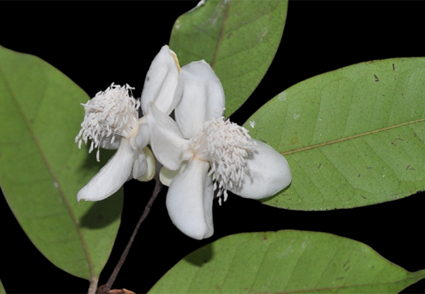
Eugenia pisonis is an Amazonian species here reestablished as distinguished from Eugenia moschata by leaf blades with conspicuous black dots ca. 1 mm from each other abaxially, apex abruptly long-acuminate, hypanthium glabrous or glabrate, sepals glabrous, petal globe in the bud markedly 4-costate, and fruit obovoid or oblate. Diagnostic characters are provided and imaged.
References
<p align="justify"><span style="color: #000000;"><span style="font-family: Times New Roman, serif;"><span style="font-size: small;"><span lang="en-GB">Aublet, J.B.C.F. (1775) </span>Histoire des plantes de la Guiane Françoise. Vol. 1. 621 pp.</span></span></span>
<p align="justify"><span style="color: #000000;"><span style="font-family: Times New Roman, serif;"><span style="font-size: small;">Berg, O.C. (1855–1856) Revisio Myrtacearum Americae. Linnaea 27: 1–472.</span></span></span>
<p align="justify"><span style="color: #000000;"><span style="font-family: Times New Roman, serif;"><span style="font-size: small;">Berg, O.C. (1857) Myrtaceae. In: Martius, C.F.P von (ed.) Flora Brasiliensis, v. 14, Frid. Fleischer in Comm., Monachii [Munich], pp. 1–528. </span></span></span>
<p align="justify"><span style="color: #000000;"><span style="font-family: Times New Roman, serif;"><span style="font-size: small;">Bünger, M.O., Mazine, F.F. & Stehmann, J.R. (2020) Revision of Eugenia section Phyllocalyx (Myrtaceae). Phytotaxa 474: 99–118. https://doi.org/10.11646/phytotaxa.474.2.1</span></span></span>
<p align="justify"><span style="color: #000000;"><span style="font-family: Times New Roman, serif;"><span style="font-size: small;">Bünger, M.O., Mazine, F.F., Forest, F., Bueno, M.L., Stehmann, J.R. & Lucas, E.J. (2016) The evolutionary history of Eugenia sect. Phyllocalyx (Myrtaceae) corroborates historically stable areas in the southern Atlantic forests. Annals of Botany 118: 1209–1223. https://doi.org/10.1093/aob/mcw209</span></span></span>
<p align="justify"><span style="color: #000000;"><span style="font-family: Times New Roman, serif;"><span style="font-size: small;">Durand, T. & Jacks, B.D. (1902) Nomina et synonyma omnium generum et specierum ab initio anni MDCCCLXXXVI usque ad finem anni MDCCCXCV complectens confecerunt. Index Kewensis Plantarum Phanerogamarum, Suppl. 1: 164.</span></span></span>
<p align="justify"><span style="color: #000000;"><span style="font-family: Times New Roman, serif;"><span style="font-size: small;">Giaretta, A. & Sano, P.T. (2020) A new Eugenia (Myrtaceae) from Suriname with “six petals” display. Phytotaxa 461 (2): 125–130. https://doi.org/10.11646/phytotaxa.461.2.4</span></span></span>
<p align="justify"><span style="color: #000000;"><span style="font-family: Times New Roman, serif;"><span style="font-size: small;">Giaretta, A., Lucas, E. & Sano, P.T. (2021) Taxonomic monograph of Eugenia sect. Schizocalomyrtus (Myrtaceae: Myrteae), a group within Eugenia with unusual flowers. Phytotaxa 524: 135–177. https://doi.org/10.11646/phytotaxa.524.3.1 </span></span></span>
<p align="justify"><span style="color: #000000;"><span style="font-family: Times New Roman, serif;"><span style="font-size: small;">Giaretta, A., Murphy, B., Maurin, O., Mazine, F.F., Sano, P. & Lucas, E. (2022) Phylogenetic relationships within the hyper-diverse genus Eugenia (Myrtaceae: Myrteae) based on target enrichment sequencing. Frontiers in Plant Science 12: 1–20. https://doi.org/10.3389/fpls.2021.759460</span></span></span>
<p align="justify"><span style="color: #000000;"><span style="font-family: Times New Roman, serif;"><span style="font-size: small;">Giaretta, A., Vasconcelos, T.N.C., Mazine, F.F., Faria, J.E.Q., Flores, R., Holst, B., Sano, P.T. & Lucas, E. (2019) Calyx (con)fusion in a hyper-diverse genus: Parallel evolution of unusual flower patterns in Eugenia (Myrtaceae). Molecular Phylogenetics and Evolution 139: 106553. https://doi.org/10.1016/j.ympev.2019.106553 </span></span></span>
<p align="justify"><span style="color: #000000;"><span style="font-family: Times New Roman, serif;"><span style="font-size: small;">Holst, B.K. & Kawasaki, M.L. (2006) New species of Myrtaceae from Ecuador and Peru. SIDA 22 (2): 931–934.</span></span></span>
<p align="justify"><span style="color: #000000;"><span style="font-family: Times New Roman, serif;"><span style="font-size: small;">Linnaeus, C. (1753) Species Plantarum, v. 1. Stockholm, 560 pp.</span></span></span>
<p align="justify"><span style="color: #000000;"><span style="font-family: Times New Roman, serif;"><span style="font-size: small;">Lucas, E.J., Amorim, B.S., Lima, D.F., Lima-Lourenço, A.R., Nic Lughadha, E.M., Proença, C.E.B., Rosa, P.O., Rosário, A.S., Santos, L.L., Santos, M.F., Souza, M.C., Staggemeier, V.G., Vasconcelos, T.N.C. & Sobral, M. (2018) A new infra-generic classification of the species-rich Neotropical genus Myrcia s.l. Kew Bulletin 73 (9): 1–12. https://doi.org/10.3389/fpls.2021.75946010.1007/s12225-017-9730-5 </span></span></span>
<p align="justify"><span style="color: #000000;"><span style="font-family: Times New Roman, serif;"><span style="font-size: small;">Mazine, F.F., Eustáquio, J., Faria, Q., Giaretta, A., Vasconcelos, T., Forest, F. & Lucas, E. (2018) Phylogeny and biogeography of the hyper-diverse genus Eugenia (Myrtaceae: Myrteae), with emphasis on E. sect. Umbellatae, the most unmanageable clade. Taxon 67: 752–769. https://doi.org/10.12705/674.5 </span></span></span>
<p align="justify"><span style="color: #000000;"><span style="font-family: Times New Roman, serif;"><span style="font-size: small;">Mazine, F.F., Souza, V.C., Sobral, M., Forest, F. & Lucas, E. (2014) A preliminary phylogenetic analysis of Eugenia (Myrtaceae: Myrteae), with a focus on Neotropical species. Kew Bulletin 69: 9497. https://doi.org/10.1007/s12225-014-9497-x </span></span></span>
<p align="justify"><span style="color: #000000;"><span style="font-family: Times New Roman, serif;"><span style="font-size: small;">McVaugh, R. (1956) Tropical American Myrtaceae: Notes on generic concepts and descriptions of previously unrecognized species. Fieldiana 29 (3): 145–228.</span></span></span>
<p align="justify"><span style="color: #000000;"><span style="font-family: Times New Roman, serif;"><span style="font-size: small;">McVaugh, R. (1958a) Flora of Peru—Myrtaceae. Field Museum Publications in Botany 13: 569–818. https://doi.org/10.5962/bhl.title.2317</span></span></span>
<p align="justify"><span style="color: #000000;"><span style="font-family: Times New Roman, serif;"><span style="font-size: small;">McVaugh, R. (1969) The Botany of the Guayana Highland - Part VIII: Myrtaceae. In: Maguire, B. (Ed.) Memoirs of the New York Botanical Garden 18 (2): 55–286.</span></span></span>
<p align="justify"><span style="color: #000000;"><span style="font-family: Times New Roman, serif;"><span style="font-size: small;">Parra-O, C. (2021) Thirteen new species, new records, and a new combination on Colombian Myrtaceae. Phytotaxa 497: 175–210. https://doi.org/10.11646/phytotaxa.497.3.1</span></span></span>
<p align="justify"><span style="color: #000000;"><span style="font-family: Times New Roman, serif;"><span style="font-size: small;">Pinheiro, F., Dantas-Queiroz, M.V. & Palma-Silva, C. (2018) Plant species complexes as models to understand speciation and evolution: A review of South American studies. Critical Reviews in Plant Sciences 37: 54–80. https://doi.org/10.1109/PSCE.2011.5772458 </span></span></span>
<p align="justify"><span style="color: #000000;"><span style="font-family: Times New Roman, serif;"><span style="font-size: small;">POWO (2023) Plants of the World Online. Facilitated by the Royal Botanic Gardens, Kew. Available from: https://powo.science.kew.org/ (accessed 6 March 2023).</span></span></span>
<p align="justify"><span style="color: #000000;"><span style="font-family: Times New Roman, serif;"><span style="font-size: small;">Prata, E.M.B., Sass, C., Rodrigues, D.P., Fabricius, M.C., Domingos, B., Specht, C.D., Damasco, G., Ribas, C.C., Fine, P.V.A. & Vicentini, A. (2018) Towards integrative taxonomy in Neotropical botany: disentangling the Pagamea guianensis species complex (Rubiaceae). Botanical Journal of the Linnean Society 188: 213–231. https://doi.org/10.1093/botlinnean/boy051</span></span></span>
<p align="justify"><span style="color: #000000;"><span style="font-family: Times New Roman, serif;"><span style="font-size: small;">Santos, M.F., Lucas, E. & Sano, P.T. (2018) A taxonomic monograph of Myrcia sect. Sympodiomyrcia (Myrteae, Myrtaceae). Phytotaxa 380: 1–114. https://doi.org/10.11646/phytotaxa.380.1.1</span></span></span>
<p align="justify"><span style="color: #000000;"><span style="font-family: Times New Roman, serif;"><span style="font-size: small;">Souza, M.A.D. (2017) Erratum for “Two new species of Eugenia (Myrtaceae) from Central Amazonia, Brazil”. Phytotaxa 298 (3): 300. https://doi.org/10.11646/phytotaxa.298.3.11</span></span></span>
<p align="justify"><span style="color: #000000;"><span style="font-family: Times New Roman, serif;"><span style="font-size: small;">Souza, M.A.D., Scudeller, V.V. & Mendonça, M.S. (2015) Three new species of Eugenia (Myrtaceae) from Brazilian Amazonia. Phytotaxa 212: 87–94. https://doi.org/10.11646/phytotaxa.212.1.4</span></span></span>
<p align="justify"><span style="color: #000000;"><span style="font-family: Times New Roman, serif;"><span style="font-size: small;">Berg, O.C. (1855–1856) Revisio Myrtacearum Americae. Linnaea 27: 1–472.</span></span></span>
<p align="justify"><span style="color: #000000;"><span style="font-family: Times New Roman, serif;"><span style="font-size: small;">Berg, O.C. (1857) Myrtaceae. In: Martius, C.F.P von (ed.) Flora Brasiliensis, v. 14, Frid. Fleischer in Comm., Monachii [Munich], pp. 1–528. </span></span></span>
<p align="justify"><span style="color: #000000;"><span style="font-family: Times New Roman, serif;"><span style="font-size: small;">Bünger, M.O., Mazine, F.F. & Stehmann, J.R. (2020) Revision of Eugenia section Phyllocalyx (Myrtaceae). Phytotaxa 474: 99–118. https://doi.org/10.11646/phytotaxa.474.2.1</span></span></span>
<p align="justify"><span style="color: #000000;"><span style="font-family: Times New Roman, serif;"><span style="font-size: small;">Bünger, M.O., Mazine, F.F., Forest, F., Bueno, M.L., Stehmann, J.R. & Lucas, E.J. (2016) The evolutionary history of Eugenia sect. Phyllocalyx (Myrtaceae) corroborates historically stable areas in the southern Atlantic forests. Annals of Botany 118: 1209–1223. https://doi.org/10.1093/aob/mcw209</span></span></span>
<p align="justify"><span style="color: #000000;"><span style="font-family: Times New Roman, serif;"><span style="font-size: small;">Durand, T. & Jacks, B.D. (1902) Nomina et synonyma omnium generum et specierum ab initio anni MDCCCLXXXVI usque ad finem anni MDCCCXCV complectens confecerunt. Index Kewensis Plantarum Phanerogamarum, Suppl. 1: 164.</span></span></span>
<p align="justify"><span style="color: #000000;"><span style="font-family: Times New Roman, serif;"><span style="font-size: small;">Giaretta, A. & Sano, P.T. (2020) A new Eugenia (Myrtaceae) from Suriname with “six petals” display. Phytotaxa 461 (2): 125–130. https://doi.org/10.11646/phytotaxa.461.2.4</span></span></span>
<p align="justify"><span style="color: #000000;"><span style="font-family: Times New Roman, serif;"><span style="font-size: small;">Giaretta, A., Lucas, E. & Sano, P.T. (2021) Taxonomic monograph of Eugenia sect. Schizocalomyrtus (Myrtaceae: Myrteae), a group within Eugenia with unusual flowers. Phytotaxa 524: 135–177. https://doi.org/10.11646/phytotaxa.524.3.1 </span></span></span>
<p align="justify"><span style="color: #000000;"><span style="font-family: Times New Roman, serif;"><span style="font-size: small;">Giaretta, A., Murphy, B., Maurin, O., Mazine, F.F., Sano, P. & Lucas, E. (2022) Phylogenetic relationships within the hyper-diverse genus Eugenia (Myrtaceae: Myrteae) based on target enrichment sequencing. Frontiers in Plant Science 12: 1–20. https://doi.org/10.3389/fpls.2021.759460</span></span></span>
<p align="justify"><span style="color: #000000;"><span style="font-family: Times New Roman, serif;"><span style="font-size: small;">Giaretta, A., Vasconcelos, T.N.C., Mazine, F.F., Faria, J.E.Q., Flores, R., Holst, B., Sano, P.T. & Lucas, E. (2019) Calyx (con)fusion in a hyper-diverse genus: Parallel evolution of unusual flower patterns in Eugenia (Myrtaceae). Molecular Phylogenetics and Evolution 139: 106553. https://doi.org/10.1016/j.ympev.2019.106553 </span></span></span>
<p align="justify"><span style="color: #000000;"><span style="font-family: Times New Roman, serif;"><span style="font-size: small;">Holst, B.K. & Kawasaki, M.L. (2006) New species of Myrtaceae from Ecuador and Peru. SIDA 22 (2): 931–934.</span></span></span>
<p align="justify"><span style="color: #000000;"><span style="font-family: Times New Roman, serif;"><span style="font-size: small;">Linnaeus, C. (1753) Species Plantarum, v. 1. Stockholm, 560 pp.</span></span></span>
<p align="justify"><span style="color: #000000;"><span style="font-family: Times New Roman, serif;"><span style="font-size: small;">Lucas, E.J., Amorim, B.S., Lima, D.F., Lima-Lourenço, A.R., Nic Lughadha, E.M., Proença, C.E.B., Rosa, P.O., Rosário, A.S., Santos, L.L., Santos, M.F., Souza, M.C., Staggemeier, V.G., Vasconcelos, T.N.C. & Sobral, M. (2018) A new infra-generic classification of the species-rich Neotropical genus Myrcia s.l. Kew Bulletin 73 (9): 1–12. https://doi.org/10.3389/fpls.2021.75946010.1007/s12225-017-9730-5 </span></span></span>
<p align="justify"><span style="color: #000000;"><span style="font-family: Times New Roman, serif;"><span style="font-size: small;">Mazine, F.F., Eustáquio, J., Faria, Q., Giaretta, A., Vasconcelos, T., Forest, F. & Lucas, E. (2018) Phylogeny and biogeography of the hyper-diverse genus Eugenia (Myrtaceae: Myrteae), with emphasis on E. sect. Umbellatae, the most unmanageable clade. Taxon 67: 752–769. https://doi.org/10.12705/674.5 </span></span></span>
<p align="justify"><span style="color: #000000;"><span style="font-family: Times New Roman, serif;"><span style="font-size: small;">Mazine, F.F., Souza, V.C., Sobral, M., Forest, F. & Lucas, E. (2014) A preliminary phylogenetic analysis of Eugenia (Myrtaceae: Myrteae), with a focus on Neotropical species. Kew Bulletin 69: 9497. https://doi.org/10.1007/s12225-014-9497-x </span></span></span>
<p align="justify"><span style="color: #000000;"><span style="font-family: Times New Roman, serif;"><span style="font-size: small;">McVaugh, R. (1956) Tropical American Myrtaceae: Notes on generic concepts and descriptions of previously unrecognized species. Fieldiana 29 (3): 145–228.</span></span></span>
<p align="justify"><span style="color: #000000;"><span style="font-family: Times New Roman, serif;"><span style="font-size: small;">McVaugh, R. (1958a) Flora of Peru—Myrtaceae. Field Museum Publications in Botany 13: 569–818. https://doi.org/10.5962/bhl.title.2317</span></span></span>
<p align="justify"><span style="color: #000000;"><span style="font-family: Times New Roman, serif;"><span style="font-size: small;">McVaugh, R. (1969) The Botany of the Guayana Highland - Part VIII: Myrtaceae. In: Maguire, B. (Ed.) Memoirs of the New York Botanical Garden 18 (2): 55–286.</span></span></span>
<p align="justify"><span style="color: #000000;"><span style="font-family: Times New Roman, serif;"><span style="font-size: small;">Parra-O, C. (2021) Thirteen new species, new records, and a new combination on Colombian Myrtaceae. Phytotaxa 497: 175–210. https://doi.org/10.11646/phytotaxa.497.3.1</span></span></span>
<p align="justify"><span style="color: #000000;"><span style="font-family: Times New Roman, serif;"><span style="font-size: small;">Pinheiro, F., Dantas-Queiroz, M.V. & Palma-Silva, C. (2018) Plant species complexes as models to understand speciation and evolution: A review of South American studies. Critical Reviews in Plant Sciences 37: 54–80. https://doi.org/10.1109/PSCE.2011.5772458 </span></span></span>
<p align="justify"><span style="color: #000000;"><span style="font-family: Times New Roman, serif;"><span style="font-size: small;">POWO (2023) Plants of the World Online. Facilitated by the Royal Botanic Gardens, Kew. Available from: https://powo.science.kew.org/ (accessed 6 March 2023).</span></span></span>
<p align="justify"><span style="color: #000000;"><span style="font-family: Times New Roman, serif;"><span style="font-size: small;">Prata, E.M.B., Sass, C., Rodrigues, D.P., Fabricius, M.C., Domingos, B., Specht, C.D., Damasco, G., Ribas, C.C., Fine, P.V.A. & Vicentini, A. (2018) Towards integrative taxonomy in Neotropical botany: disentangling the Pagamea guianensis species complex (Rubiaceae). Botanical Journal of the Linnean Society 188: 213–231. https://doi.org/10.1093/botlinnean/boy051</span></span></span>
<p align="justify"><span style="color: #000000;"><span style="font-family: Times New Roman, serif;"><span style="font-size: small;">Santos, M.F., Lucas, E. & Sano, P.T. (2018) A taxonomic monograph of Myrcia sect. Sympodiomyrcia (Myrteae, Myrtaceae). Phytotaxa 380: 1–114. https://doi.org/10.11646/phytotaxa.380.1.1</span></span></span>
<p align="justify"><span style="color: #000000;"><span style="font-family: Times New Roman, serif;"><span style="font-size: small;">Souza, M.A.D. (2017) Erratum for “Two new species of Eugenia (Myrtaceae) from Central Amazonia, Brazil”. Phytotaxa 298 (3): 300. https://doi.org/10.11646/phytotaxa.298.3.11</span></span></span>
<p align="justify"><span style="color: #000000;"><span style="font-family: Times New Roman, serif;"><span style="font-size: small;">Souza, M.A.D., Scudeller, V.V. & Mendonça, M.S. (2015) Three new species of Eugenia (Myrtaceae) from Brazilian Amazonia. Phytotaxa 212: 87–94. https://doi.org/10.11646/phytotaxa.212.1.4</span></span></span>