
Abstract
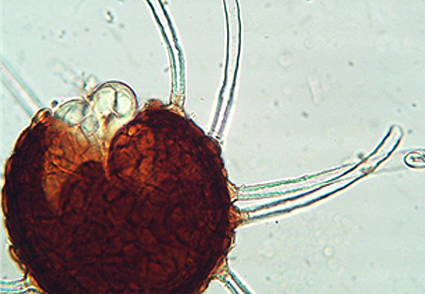
A new species of Erysiphe infecting Duthie’s bay tree in Azad Jammu & Kashmir, Pakistan, is described and illustrated based on molecular and morphological analyses. Erysiphe machilicola sp. nov. is morphologically distinct from other Erysiphe species on hosts of the Lauraceae by having longer conidiophores, larger chasmothecia with longer appendages, above all, it is distinguished from E. machiliana, the only so far known Erysiphe species on Machilus, by lacking bristle-like appendages (remnant of anchor hyphae) and a different phylogenetic position, confirmed by sequence analyses of the type material of the latter species. The phylogenetic relationship of the new species to other closely related species is discussed based on ITS rDNA sequences, which phylogenetically supports its identity as a new species within the genus Erysiphe. A comprehensive description along with photographs and a phylogram showing its exact phylogenetic position and a comparison with closely related taxa is provided.
References
<p align="justify"><span style="color: #000000;"><span style="font-family: Times New Roman, serif;"><span style="font-size: small;">Ajaib, M., Khan, Z., Khan, N. & Wahab, M. (2010) Ethnobotanical studies on useful shrubs of district Kotli, Azad Jammu & Kashmir, Pakistan. Pakistan Journal of Botany 42 (3): 1407–1415.</span></span></span>
<p align="justify"><span style="color: #000000;"><span style="font-family: Times New Roman, serif;"><span style="font-size: small;">Afshan, N.S., Zafar, I. & Khalid, A.N. (2021) Checklist of powdery mildew fungi (Erysiphaceae) in Pakistan. Mycotaxon 136 (3): 689–689. https://doi.org/10.5248/136.689</span></span></span>
<p align="justify"><span style="color: #000000;"><span style="font-family: Times New Roman, serif;"><span style="font-size: small;">Bradshaw, M. & Tobin, P.C. (2020) Sequencing herbarium specimens of a common detrimental plant disease (powdery mildew). Phytopathology 110 (7): 1248–1254. https://doi.org/10.1094/PHYTO-04-20-0139-PER</span></span></span>
<p align="justify"><span style="color: #000000;"><span style="font-family: Times New Roman, serif;"><span style="font-size: small;">Braun, U. & Paul, Y.S. (2009) The Indian Erysiphaceae revisited. Nova Hedwigia 89 (3–4): 371–395. https://doi.org/10.1127/0029-5035/2009/0089-0371</span></span></span>
<p align="justify"><span style="color: #000000;"><span style="font-family: Times New Roman, serif;"><span style="font-size: small;">Braun, U. & Takamatsu, S. (2000) Phylogeny of Erysiphe, Microsphaera, Uncinula (Erysiphe) and Cystotheca, Podosphaera, Sphaerotheca (Cystotheceae) inferred from rDNA ITS sequences: some taxonomic consequences. Schlechtendalia 4: 1–33. </span></span></span>
<p align="justify"><span style="color: #000000;"><span style="font-family: Times New Roman, serif;"><span style="font-size: small;">Braun, U., Cook, R.T.A., Inman, A.J. & Shin, H.D. (2002) The taxonomy of the powdery mildew fungi. In: Belanger, R.R., Bushnell, W.R. & Dik, A.J. (eds.) The powdery mildews: a comprehensive treatise. APS Press, St. Paul, Minnesota, pp. 13–55.</span></span></span>
<p align="justify"><span style="color: #000000;"><span style="font-family: Times New Roman, serif;"><span style="font-size: small;">Cunnington, J.H., Takamatsu, S., Lawrie, A.C. & Pascoe, I.G. (2003) Molecular identification of anamorphic powdery mildews (Erysiphales). Australasian Plant Pathology 32 (3): 421–428. https://doi.org/10.1071/AP03045</span></span></span>
<p align="justify"><span style="color: #000000;"><span style="font-family: Times New Roman, serif;"><span style="font-size: small;">Hall, T.A. (1999) Bioedit: a user-friendly biological sequence alignment editor and analysis program, for windows 95/98/NT. Nucleic Acid Symposium Series (41): 95–98.</span></span></span>
<p align="justify"><span style="color: #000000;"><span style="font-family: Times New Roman, serif;"><span style="font-size: small;">Ishtiaq, M., Mahmood, A. & Maqbool, M. (2015) Indigenous knowledge of medicinal plants from Sudhanoti district (AJK), Pakistan. Journal of ethnopharmacology 168: 201–207. https://doi.org/10.1016/j.jep.2015.01.054</span></span></span>
<p align="justify"><span style="color: #000000;"><span style="font-family: Times New Roman, serif;"><span style="font-size: small;">Jin, D.N., Kiss, L., Takamatsu, S., Zhang, Z.Y., Cabrera, M.G., Li, Z., Li, Y. & Liu, S.Y. (2021) Hidden diversity of powdery mildews belonging to the recently re-discovered genus Salmonomyces. Mycological Progress 20 (9): 1009–1018. https://doi.org/10.1007/s11557-021-01679-8</span></span></span>
<p align="justify"><span style="color: #000000;"><span style="font-family: Times New Roman, serif;"><span style="font-size: small;">Liu, L., Bradshaw, M., Braun, U., Götz, M., Khodaparast, S.A., Liu, T., Bulgakov, T.S., Li, Y., Liu, S., Darsaraei, H. & Hofbauer, W.K. (2022) Phylogeny and taxonomy of Erysiphe berberidis (s. lat.) revisited. Mycoscience 63 (5): 222–234. https://doi.org/10.47371/mycosci.2022.07.005</span></span></span>
<p align="justify"><span style="color: #000000;"><span style="font-family: Times New Roman, serif;"><span style="font-size: small;">Löytynoja, A. & Goldman, N. (2010) webPRANK: a phylogeny-aware multiple sequence aligner with interactive alignment browser. BMC Bioinformatics 11 (1): 1–7. https://doi.org/10.1186/1471-2105-11-579</span></span></span>
<p align="justify"><span style="color: #000000;"><span style="font-family: Times New Roman, serif;"><span style="font-size: small;">Marmolejo, J., Siahaan, S.A.S., Takamatsu, S. & Braun, U. (2018) Three new records of powdery mildews found in Mexico with one genus and one new species proposed. Mycoscience 59: 1–7. https://doi.org/10.1016/j.myc.2017.06.010</span></span></span>
<p align="justify"><span style="color: #000000;"><span style="font-family: Times New Roman, serif;"><span style="font-size: small;">Meeboon, J., Divarangkoon, R. & Takamatsu, S. (2013) Two new species of Erysiphe sect. Uncinula (Erysiphales): Erysiphe fernandoae and E. michikoae. Mycoscience 54 (1): 2–7. https://doi.org/10.1016/j.myc.2012.06.001</span></span></span>
<p align="justify"><span style="color: #000000;"><span style="font-family: Times New Roman, serif;"><span style="font-size: small;">Mori, Y., Sato, Y. & Takamatsu, S. (2000) Evolutionary analysis of the powdery mildew fungi using nucleotide sequences of the nuclear ribosomal DNA. Mycologia 92 (1): 74–93. https://doi.org/ 10.1080/00275514.2000.12061132</span></span></span>
<p align="justify"><span style="color: #000000;"><span style="font-family: Times New Roman, serif;"><span style="font-size: small;">Padalia, R.C., Joshi, S.C., Bisht, D.S. & Mathela, C.S. (2009) Essential oil composition of Persea duthiei. Chemistry of Natural Compounds 45 (5): 745–747. https://doi.org/10.1007/s10600-009-9418-7</span></span></span>
<p align="justify"><span style="color: #000000;"><span style="font-family: Times New Roman, serif;"><span style="font-size: small;">Sambrook, J. & Russel, D.W. (2001) Rapid isolation of yeast DNA. In: Sambrook, J. & Russel, D.W. (eds.) Molecular cloning: a laboratory manual. Cold Spring Harbor Laboratory Press, New York, pp. 631–632.</span></span></span>
<p align="justify"><span style="color: #000000;"><span style="font-family: Times New Roman, serif;"><span style="font-size: small;">Tamura, K., Stecher, G., Peterson, D., Filipski, A. & Kumar, S. (2013) MEGA6: molecular evolutionary genetics analysis version 6.0. Molecular Biology and Evolution 30 (12): 2725–2729. https://doi.org/10.1093/molbev/mst197</span></span></span>