

Abstract
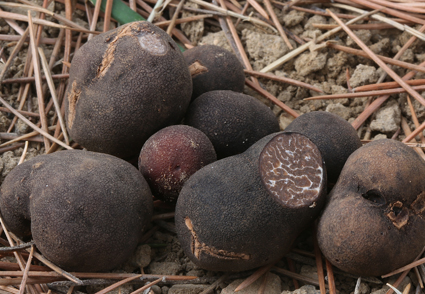
Tuber melanorufum and T. tomentellum spp. nov. are described and illustrated in this paper based on the morphological and phylogenetic data. Tuber melanorufum is diagnosed by the red-brown to blackish ascomata covered with distinctly fine warts and the ellipsoid to long ellipsoid ascospores ornamented with very crowded spine-reticulations. Tuber tomentellum is characterized by the large ascospores and two types of hairs arising from the outer cells of the peridium. Phylogenetic analyses place T. melanorufum and T. tomentellum in the Rufum and Puberulum clades, respectively.
References
<p align="justify"><span style="color: #000000;"><span style="font-family: Times New Roman, serif;"><span style="font-size: small;">Alfaro, M.E., Zoller, S. & Lutzoni, F. (2003) Bayes or bootstrap? A simulation study comparing the performance of Bayesian Markov chain Monte Carlo sampling and bootstrapping in assessing phylogenetic confidence. Molecular Biology & evolution 20 (2): 255–266. https://doi.org/10.1093/molbev/msg028</span></span></span>
<p align="justify"><span style="color: #000000;"><span style="font-family: Times New Roman, serif;"><span style="font-size: small;">Bonito, G., Smith, M.E., Nowak, M., Healy, R.A., Guevara, G., Ca´zares, E., Kinoshita, A., Nouhra, E.R., Domý´nguez, L.S., Tedersoo, L., Murat, C., Wang, Y., Moreno, B.A., Pfister, D.H., Nara, K., Zambonelli, A., Trappe, J.M. & Vilgalys, R. (2013) Historical biogeography and diversification of truffles in the Tuberaceae and their newly identified southern hemisphere sister lineage. PLoS One 8 (1): e52765. https://doi.org/10.1371/journal.pone.0052765 </span></span></span>
<p align="justify"><span style="color: #000000;"><span style="font-family: Times New Roman, serif;"><span style="font-size: small;">Castresana, J. (2000) Selection of conserved blocks from multiple alignments for their use in phylogenetic analysis. Molecular biology and evolution 17 (4): 540–552. https://doi.org/10.1093/oxfordjournals.molbev.a026334 </span></span></span>
<p align="justify"><span style="color: #000000;"><span style="font-family: Times New Roman, serif;"><span style="font-size: small;">Courty, P.E., Bucbe, M., Diedhiou, A.G., Frey-Klett, P., Tacon, F.L., Rineau, F., Uroz, S. & Garbaye, J. (2010) The role of ectomycorrhizal communities in forest ecosystem processes: New perspectives and emerging concepts. Soil Biology & Biochemistry 42: 679–698. https://doi.org/10.1016/j.soilbio.2009.12.006</span></span></span>
<p align="justify"><span style="color: #000000;"><span style="font-family: Times New Roman, serif;"><span style="font-size: small;">Deng, X.J., Liu, P.G., Liu, C.Y. & Wang, Y. (2013) A new white truffle species, Tuber panzhihuanense from China. Mycological Progress 12 (3): 557–561. https://doi.org/10.1007/s11557-012-0862-6</span></span></span>
<p align="justify"><span style="color: #000000;"><span style="font-family: Times New Roman, serif;"><span style="font-size: small;">Deng, X.J., Yu, F.Q. & Liu, P.G. (2014) Contribution to confirmed & synthesized on mycorrhizae of Tuber indicum s.l. with two dominated & subalpine broad- leaf trees in southwestern China. American Journal of Plant Sciences 5: 3269–3279. https://doi.org/10.4236/ajps.2014.521341</span></span></span>
<p align="justify"><span style="color: #000000;"><span style="font-family: Times New Roman, serif;"><span style="font-size: small;">Dring, D.M. (1971) Chapter III techniques for microscopic preparation. Methods in Microbiology 4: 95–111. https://doi.org/10.1016/S0580-9517(09)70008-X</span></span></span>
<p align="justify"><span style="color: #000000;"><span style="font-family: Times New Roman, serif;"><span style="font-size: small;">Fan, L. & Cao, J.Z. (2012) Two new species of white truffle from China. Mycotaxon 121: 297–305. https://doi.org/10.5248/121.297</span></span></span>
<p align="justify"><span style="color: #000000;"><span style="font-family: Times New Roman, serif;"><span style="font-size: small;">Fan, L., Cao, J.Z. & Hou, C.L. (2013) Tuber subglobosum and T. wenchuanense—two new species with spino-reticulate ascospores. Mycotaxon 123: 95–101. https://doi.org/10.5248/123.95</span></span></span>
<p align="justify"><span style="color: #000000;"><span style="font-family: Times New Roman, serif;"><span style="font-size: small;">Fan, L., Hou, C.L. & Li, Y. (2012) Tuber microverrucosum and T. huizeanum two new species from China with reticulate ascospores. Mycotaxon 122: 161–169. https://doi.org/10.5248/122.161 </span></span></span>
<p align="justify"><span style="color: #000000;"><span style="font-family: Times New Roman, serif;"><span style="font-size: small;">Fan, L., Li, T., Xu, Y.Y. & Yan, X.Y. (2022) Species diversity, phylogeny, endemism and geography of the truffle genus Tuber in China based on morphological and molecular data. Persoonia 48: 175–202. https://doi.org/10.3767/persoonia.2022.48.05</span></span></span>
<p align="justify"><span style="color: #000000;"><span style="font-family: Times New Roman, serif;"><span style="font-size: small;">Fan, L., Zhang, J.L., Li, T., Sun, H.J., Xiong, W.P. & Li, Y. (2018) Chinese black truffles: Tuber yigongense sp. nov., taxonomic reassessment of T. indicum s.l., and re-examination of the T. sinense isotype. Mycotaxon 133: 183–196. https://doi.org/10.5248/133.185 </span></span></span>
<p align="justify"><span style="color: #000000;"><span style="font-family: Times New Roman, serif;"><span style="font-size: small;">Gardes, M. & Bruns, T.D. (1993) ITS primers with enhanced specificity for basidiomycetes—application to the identification of mycorrhizae and rusts. Molecular ecology 2 (2): 113–118. https://doi.org/10.1111/j.1365-294X.1993.tb00005.x </span></span></span>
<p align="justify"><span style="color: #000000;"><span style="font-family: Times New Roman, serif;"><span style="font-size: small;">He, X.Y., Li, H.M. & Wang, Y. (2004) Tuber zhongdianense sp. nov. from China. Mycotaxon 90 (1): 213–216.</span></span></span>
<p align="justify"><span style="color: #000000;"><span style="font-family: Times New Roman, serif;"><span style="font-size: small;">Hillis, D.M. & Bull, J.J. (1993) An empirical test of bootstrapping as a method for assessing confidence in phylogenetic analysis. Systematic Biology 42 (2): 182–192. https://doi.org/10.1093/sysbio/42.2.182 </span></span></span>
<p align="justify"><span style="color: #000000;"><span style="font-family: Times New Roman, serif;"><span style="font-size: small;">Katoh, K. & Frith, M.C. (2012) Adding unaligned sequences into an existing alignment using MAFFT and BLAST. Bioinformatics 28 (22): 3144–3146. https://doi.org/10.1093/bioinformatics/bts578 </span></span></span>
<p align="justify"><span style="color: #000000;"><span style="font-family: Times New Roman, serif;"><span style="font-size: small;">Kinoshita, A., Sasaki, H. & Nara, K. (2011) Phylogeny and diversity of Japanese truffles (Tuber spp.) inferred from sequences of four nuclear loci. Mycologia 103 (4): 779–794. https://doi.org/10.3852/10-138 </span></span></span>
<p align="justify"><span style="color: #000000;"><span style="font-family: Times New Roman, serif;"><span style="font-size: small;">Kumar, S., Stecher, G. & Tamura, K. (2016) Mega7: molecular evolutionary genetics analysis version 7.0 for bigger datasets. Molecular Biology & Evolution (7): 1870. https://doi.org/10.1093/molbev/msw054</span></span></span>
<p align="justify"><span style="color: #000000;"><span style="font-family: Times New Roman, serif;"><span style="font-size: small;">Nylander, J. (2004) MrModeltest 2.2. Computer software distributed by the University of Uppsala. Evolutionary Biology Centre, Sweden.</span></span></span>
<p align="justify"><span style="color: #000000;"><span style="font-family: Times New Roman, serif;"><span style="font-size: small;">Page, R.D. (2001) TreeView. Glasgow University, Glasgow.</span></span></span>
<p align="justify"><span style="color: #000000;"><span style="font-family: Times New Roman, serif;"><span style="font-size: small;">Pegler, D.N., Spooner, B.M. & Young, T.W.K. (1993) British truffles: A revision of British hypogeous fungi. Royal Botanic Gardens, England. https://doi.org/10.2307/4110224</span></span></span>
<p align="justify"><span style="color: #000000;"><span style="font-family: Times New Roman, serif;"><span style="font-size: small;">Picco, V. (1788) Melethemata Inauguralia. Ioan. Mich. Briolus,Turin.</span></span></span>
<p align="justify"><span style="color: #000000;"><span style="font-family: Times New Roman, serif;"><span style="font-size: small;">Pollini, C. (1816) Tuber rufum. Giornale di Fisica, Chimica, Storia Naturale, Medicina ed Arti 9: 182. </span></span></span>
<p align="justify"><span style="color: #000000;"><span style="font-family: Times New Roman, serif;"><span style="font-size: small;">Qiao, P., Liu, P.G., Hu, H.T. & Wang, Y. (2013) Typification of Tuber formosanum (Tuberaceae, Pezizales, Ascomycota) from Taiwan, China. Mycotaxon 123 (1): 293–299. https://doi.org/10.5248/123.293</span></span></span>
<p align="justify"><span style="color: #000000;"><span style="font-family: Times New Roman, serif;"><span style="font-size: small;">Ronquist, F. & Huelsenbeck, J.P. (2003) MrBayes 3: Bayesian phylogenetic inference under mixed models. Bioinformatics 19 (12): 1572–1574. https://doi.org/10.1093/bioinformatics/btg180 </span></span></span>
<p align="justify"><span style="color: #000000;"><span style="font-family: Times New Roman, serif;"><span style="font-size: small;">Song, M.S. (2005) Taxonomic and molecular systematic studies on Tuber in China. PhD thesis, Graduate School of Chinese Academy of Sciences, Beijing. [In Chinese]</span></span></span>
<p align="justify"><span style="color: #000000;"><span style="font-family: Times New Roman, serif;"><span style="font-size: small;">Stamatakis, A. (2014) RAxML version 8: a tool for phylogenetic analysis and post-analysis of large phylogenies. Bioinformatics 30 (9): 1312–1313. https://doi.org/10.1093/bioinformatics/btu033 </span></span></span>
<p align="justify"><span style="color: #000000;"><span style="font-family: Times New Roman, serif;"><span style="font-size: small;">Tao, K. & Liu, B. (1990) Ecology and nutritive value of Tuber sinense. Journal of Shanxi University (Nat Sci Ed) 13 (3): 319–321.</span></span></span>
<p align="justify"><span style="color: #000000;"><span style="font-family: Times New Roman, serif;"><span style="font-size: small;">Trappe, J.M. (1975) Generic synonyms in the Tuberales. Mycotaxon 2: 109–122.</span></span></span>
<p align="justify"><span style="color: #000000;"><span style="font-family: Times New Roman, serif;"><span style="font-size: small;">Trappe, J.M., Molina, R., Luoma, D.L., Cazares, E., Pilz, D., Smith, J.E., Castellano, M.A., Miller, S.L. & Trappe, M.J. (2009) Diversity, ecology, and conservation of truffle fungi in forests of the Pacific Northwest. Pacific Northwest Research Station. https://doi.org/10.2737/PNW-GTR-772</span></span></span>
<p align="justify"><span style="color: #000000;"><span style="font-family: Times New Roman, serif;"><span style="font-size: small;">Vittadini, C. (1831) Monographia tuberacearum. F. Rusconi, Milan, 88 pp. </span></span></span>
<p align="justify"><span style="color: #000000;"><span style="font-family: Times New Roman, serif;"><span style="font-size: small;">Wan, S., Liu, J., Huang, L., Qin, X., Liu, W. & Yu, F. (2021) Tuber qujingense and T. songlu, two new species from Yunnan, China. Phytotaxa 527 (4): 248–256. https://doi.org/10.11646/phytotaxa.527.4.2 </span></span></span>
<p align="justify"><span style="color: #000000;"><span style="font-family: Times New Roman, serif;"><span style="font-size: small;">White, T.J., Bruns, T., Lee, S. & Taylor, J. (1990) Amplification and direct sequencing of fungal ribosomal RNA genes for phylogenetics. In: Innis, M., Gelfand, D., Sninsky, J. & White, T. (Eds.) PCr Protocols, A guide to Methods and Applications. SanDiego Academic Press, SanDiego. pp. 315–322. https://doi.org/10.1016/B978-0-12-372180-8.50042-1 </span></span></span>
<p align="justify"><span style="color: #000000;"><span style="font-family: Times New Roman, serif;"><span style="font-size: small;">Xu, A.S. (1999) A taxonomic study of the genus Tuber in Xizang. Mycosystema 18 (4): 361–365. [in Chinese] https://doi.org/10.1007/BF03052911</span></span></span>
<p align="justify"><span style="color: #000000;"><span style="font-family: Times New Roman, serif;"><span style="font-size: small;">Yan, X.Y., Cao, J.Z. & Fan, L. (2018) Four new Tuber species added to the Rufum group from China based on morphological and molecular evidence. Mycologia 110 (4): 771–779. https://doi.org/10.1080/00275514.2018.1490120 </span></span></span>
<p align="justify"><span style="color: #000000;"><span style="font-family: Times New Roman, serif;"><span style="font-size: small;">Bonito, G., Smith, M.E., Nowak, M., Healy, R.A., Guevara, G., Ca´zares, E., Kinoshita, A., Nouhra, E.R., Domý´nguez, L.S., Tedersoo, L., Murat, C., Wang, Y., Moreno, B.A., Pfister, D.H., Nara, K., Zambonelli, A., Trappe, J.M. & Vilgalys, R. (2013) Historical biogeography and diversification of truffles in the Tuberaceae and their newly identified southern hemisphere sister lineage. PLoS One 8 (1): e52765. https://doi.org/10.1371/journal.pone.0052765 </span></span></span>
<p align="justify"><span style="color: #000000;"><span style="font-family: Times New Roman, serif;"><span style="font-size: small;">Castresana, J. (2000) Selection of conserved blocks from multiple alignments for their use in phylogenetic analysis. Molecular biology and evolution 17 (4): 540–552. https://doi.org/10.1093/oxfordjournals.molbev.a026334 </span></span></span>
<p align="justify"><span style="color: #000000;"><span style="font-family: Times New Roman, serif;"><span style="font-size: small;">Courty, P.E., Bucbe, M., Diedhiou, A.G., Frey-Klett, P., Tacon, F.L., Rineau, F., Uroz, S. & Garbaye, J. (2010) The role of ectomycorrhizal communities in forest ecosystem processes: New perspectives and emerging concepts. Soil Biology & Biochemistry 42: 679–698. https://doi.org/10.1016/j.soilbio.2009.12.006</span></span></span>
<p align="justify"><span style="color: #000000;"><span style="font-family: Times New Roman, serif;"><span style="font-size: small;">Deng, X.J., Liu, P.G., Liu, C.Y. & Wang, Y. (2013) A new white truffle species, Tuber panzhihuanense from China. Mycological Progress 12 (3): 557–561. https://doi.org/10.1007/s11557-012-0862-6</span></span></span>
<p align="justify"><span style="color: #000000;"><span style="font-family: Times New Roman, serif;"><span style="font-size: small;">Deng, X.J., Yu, F.Q. & Liu, P.G. (2014) Contribution to confirmed & synthesized on mycorrhizae of Tuber indicum s.l. with two dominated & subalpine broad- leaf trees in southwestern China. American Journal of Plant Sciences 5: 3269–3279. https://doi.org/10.4236/ajps.2014.521341</span></span></span>
<p align="justify"><span style="color: #000000;"><span style="font-family: Times New Roman, serif;"><span style="font-size: small;">Dring, D.M. (1971) Chapter III techniques for microscopic preparation. Methods in Microbiology 4: 95–111. https://doi.org/10.1016/S0580-9517(09)70008-X</span></span></span>
<p align="justify"><span style="color: #000000;"><span style="font-family: Times New Roman, serif;"><span style="font-size: small;">Fan, L. & Cao, J.Z. (2012) Two new species of white truffle from China. Mycotaxon 121: 297–305. https://doi.org/10.5248/121.297</span></span></span>
<p align="justify"><span style="color: #000000;"><span style="font-family: Times New Roman, serif;"><span style="font-size: small;">Fan, L., Cao, J.Z. & Hou, C.L. (2013) Tuber subglobosum and T. wenchuanense—two new species with spino-reticulate ascospores. Mycotaxon 123: 95–101. https://doi.org/10.5248/123.95</span></span></span>
<p align="justify"><span style="color: #000000;"><span style="font-family: Times New Roman, serif;"><span style="font-size: small;">Fan, L., Hou, C.L. & Li, Y. (2012) Tuber microverrucosum and T. huizeanum two new species from China with reticulate ascospores. Mycotaxon 122: 161–169. https://doi.org/10.5248/122.161 </span></span></span>
<p align="justify"><span style="color: #000000;"><span style="font-family: Times New Roman, serif;"><span style="font-size: small;">Fan, L., Li, T., Xu, Y.Y. & Yan, X.Y. (2022) Species diversity, phylogeny, endemism and geography of the truffle genus Tuber in China based on morphological and molecular data. Persoonia 48: 175–202. https://doi.org/10.3767/persoonia.2022.48.05</span></span></span>
<p align="justify"><span style="color: #000000;"><span style="font-family: Times New Roman, serif;"><span style="font-size: small;">Fan, L., Zhang, J.L., Li, T., Sun, H.J., Xiong, W.P. & Li, Y. (2018) Chinese black truffles: Tuber yigongense sp. nov., taxonomic reassessment of T. indicum s.l., and re-examination of the T. sinense isotype. Mycotaxon 133: 183–196. https://doi.org/10.5248/133.185 </span></span></span>
<p align="justify"><span style="color: #000000;"><span style="font-family: Times New Roman, serif;"><span style="font-size: small;">Gardes, M. & Bruns, T.D. (1993) ITS primers with enhanced specificity for basidiomycetes—application to the identification of mycorrhizae and rusts. Molecular ecology 2 (2): 113–118. https://doi.org/10.1111/j.1365-294X.1993.tb00005.x </span></span></span>
<p align="justify"><span style="color: #000000;"><span style="font-family: Times New Roman, serif;"><span style="font-size: small;">He, X.Y., Li, H.M. & Wang, Y. (2004) Tuber zhongdianense sp. nov. from China. Mycotaxon 90 (1): 213–216.</span></span></span>
<p align="justify"><span style="color: #000000;"><span style="font-family: Times New Roman, serif;"><span style="font-size: small;">Hillis, D.M. & Bull, J.J. (1993) An empirical test of bootstrapping as a method for assessing confidence in phylogenetic analysis. Systematic Biology 42 (2): 182–192. https://doi.org/10.1093/sysbio/42.2.182 </span></span></span>
<p align="justify"><span style="color: #000000;"><span style="font-family: Times New Roman, serif;"><span style="font-size: small;">Katoh, K. & Frith, M.C. (2012) Adding unaligned sequences into an existing alignment using MAFFT and BLAST. Bioinformatics 28 (22): 3144–3146. https://doi.org/10.1093/bioinformatics/bts578 </span></span></span>
<p align="justify"><span style="color: #000000;"><span style="font-family: Times New Roman, serif;"><span style="font-size: small;">Kinoshita, A., Sasaki, H. & Nara, K. (2011) Phylogeny and diversity of Japanese truffles (Tuber spp.) inferred from sequences of four nuclear loci. Mycologia 103 (4): 779–794. https://doi.org/10.3852/10-138 </span></span></span>
<p align="justify"><span style="color: #000000;"><span style="font-family: Times New Roman, serif;"><span style="font-size: small;">Kumar, S., Stecher, G. & Tamura, K. (2016) Mega7: molecular evolutionary genetics analysis version 7.0 for bigger datasets. Molecular Biology & Evolution (7): 1870. https://doi.org/10.1093/molbev/msw054</span></span></span>
<p align="justify"><span style="color: #000000;"><span style="font-family: Times New Roman, serif;"><span style="font-size: small;">Nylander, J. (2004) MrModeltest 2.2. Computer software distributed by the University of Uppsala. Evolutionary Biology Centre, Sweden.</span></span></span>
<p align="justify"><span style="color: #000000;"><span style="font-family: Times New Roman, serif;"><span style="font-size: small;">Page, R.D. (2001) TreeView. Glasgow University, Glasgow.</span></span></span>
<p align="justify"><span style="color: #000000;"><span style="font-family: Times New Roman, serif;"><span style="font-size: small;">Pegler, D.N., Spooner, B.M. & Young, T.W.K. (1993) British truffles: A revision of British hypogeous fungi. Royal Botanic Gardens, England. https://doi.org/10.2307/4110224</span></span></span>
<p align="justify"><span style="color: #000000;"><span style="font-family: Times New Roman, serif;"><span style="font-size: small;">Picco, V. (1788) Melethemata Inauguralia. Ioan. Mich. Briolus,Turin.</span></span></span>
<p align="justify"><span style="color: #000000;"><span style="font-family: Times New Roman, serif;"><span style="font-size: small;">Pollini, C. (1816) Tuber rufum. Giornale di Fisica, Chimica, Storia Naturale, Medicina ed Arti 9: 182. </span></span></span>
<p align="justify"><span style="color: #000000;"><span style="font-family: Times New Roman, serif;"><span style="font-size: small;">Qiao, P., Liu, P.G., Hu, H.T. & Wang, Y. (2013) Typification of Tuber formosanum (Tuberaceae, Pezizales, Ascomycota) from Taiwan, China. Mycotaxon 123 (1): 293–299. https://doi.org/10.5248/123.293</span></span></span>
<p align="justify"><span style="color: #000000;"><span style="font-family: Times New Roman, serif;"><span style="font-size: small;">Ronquist, F. & Huelsenbeck, J.P. (2003) MrBayes 3: Bayesian phylogenetic inference under mixed models. Bioinformatics 19 (12): 1572–1574. https://doi.org/10.1093/bioinformatics/btg180 </span></span></span>
<p align="justify"><span style="color: #000000;"><span style="font-family: Times New Roman, serif;"><span style="font-size: small;">Song, M.S. (2005) Taxonomic and molecular systematic studies on Tuber in China. PhD thesis, Graduate School of Chinese Academy of Sciences, Beijing. [In Chinese]</span></span></span>
<p align="justify"><span style="color: #000000;"><span style="font-family: Times New Roman, serif;"><span style="font-size: small;">Stamatakis, A. (2014) RAxML version 8: a tool for phylogenetic analysis and post-analysis of large phylogenies. Bioinformatics 30 (9): 1312–1313. https://doi.org/10.1093/bioinformatics/btu033 </span></span></span>
<p align="justify"><span style="color: #000000;"><span style="font-family: Times New Roman, serif;"><span style="font-size: small;">Tao, K. & Liu, B. (1990) Ecology and nutritive value of Tuber sinense. Journal of Shanxi University (Nat Sci Ed) 13 (3): 319–321.</span></span></span>
<p align="justify"><span style="color: #000000;"><span style="font-family: Times New Roman, serif;"><span style="font-size: small;">Trappe, J.M. (1975) Generic synonyms in the Tuberales. Mycotaxon 2: 109–122.</span></span></span>
<p align="justify"><span style="color: #000000;"><span style="font-family: Times New Roman, serif;"><span style="font-size: small;">Trappe, J.M., Molina, R., Luoma, D.L., Cazares, E., Pilz, D., Smith, J.E., Castellano, M.A., Miller, S.L. & Trappe, M.J. (2009) Diversity, ecology, and conservation of truffle fungi in forests of the Pacific Northwest. Pacific Northwest Research Station. https://doi.org/10.2737/PNW-GTR-772</span></span></span>
<p align="justify"><span style="color: #000000;"><span style="font-family: Times New Roman, serif;"><span style="font-size: small;">Vittadini, C. (1831) Monographia tuberacearum. F. Rusconi, Milan, 88 pp. </span></span></span>
<p align="justify"><span style="color: #000000;"><span style="font-family: Times New Roman, serif;"><span style="font-size: small;">Wan, S., Liu, J., Huang, L., Qin, X., Liu, W. & Yu, F. (2021) Tuber qujingense and T. songlu, two new species from Yunnan, China. Phytotaxa 527 (4): 248–256. https://doi.org/10.11646/phytotaxa.527.4.2 </span></span></span>
<p align="justify"><span style="color: #000000;"><span style="font-family: Times New Roman, serif;"><span style="font-size: small;">White, T.J., Bruns, T., Lee, S. & Taylor, J. (1990) Amplification and direct sequencing of fungal ribosomal RNA genes for phylogenetics. In: Innis, M., Gelfand, D., Sninsky, J. & White, T. (Eds.) PCr Protocols, A guide to Methods and Applications. SanDiego Academic Press, SanDiego. pp. 315–322. https://doi.org/10.1016/B978-0-12-372180-8.50042-1 </span></span></span>
<p align="justify"><span style="color: #000000;"><span style="font-family: Times New Roman, serif;"><span style="font-size: small;">Xu, A.S. (1999) A taxonomic study of the genus Tuber in Xizang. Mycosystema 18 (4): 361–365. [in Chinese] https://doi.org/10.1007/BF03052911</span></span></span>
<p align="justify"><span style="color: #000000;"><span style="font-family: Times New Roman, serif;"><span style="font-size: small;">Yan, X.Y., Cao, J.Z. & Fan, L. (2018) Four new Tuber species added to the Rufum group from China based on morphological and molecular evidence. Mycologia 110 (4): 771–779. https://doi.org/10.1080/00275514.2018.1490120 </span></span></span>