

Abstract
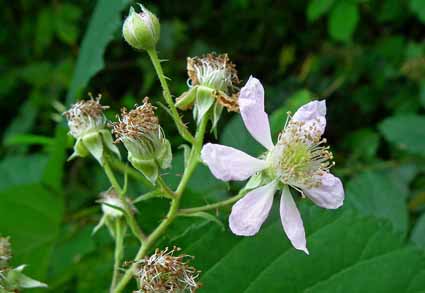
A new nemophilous tetraploid bramble species, Rubus lentianus of the series Radula, occurring in Central Europe (Upper Austria and Lower Bavaria), is described. Deeply incised terminal leaflets of primocane leaves and a long, abruptly narrowing apex separate it from species of this series. An identification key, a distribution map, a list of revised specimens, a scan of the type specimen, pen drawings and photographs of living specimens are provided.
References
<p align="justify"><span style="color: #000000;"><span style="font-family: Times New Roman, serif;"><span style="font-size: small;">Bluff, M.J. & Fingerhuth, C.A. (1825) Compendium florae Germaniae. Plantae Phanerogamicae seu Vasculosae, Tomus 1, I. L. Schrag, Norimbergae, 755 pp. https://doi.org/10.5962/bhl.title.6676</span></span></span>
<p align="justify"><span style="color: #000000;"><span style="font-family: Times New Roman, serif;"><span style="font-size: small;">Bönninghausen, C.M.F. (1824) Prodromus florae Monasteriensis Westphalorum Phanerogamia. Monasterii, F. Regensberg, 928 pp. https://doi.org/10.5962/bhl.title.6344</span></span></span>
<p align="justify"><span style="color: #000000;"><span style="font-family: Times New Roman, serif;"><span style="font-size: small;">Danner, J. (2003) Rubus muhelicus, sp. nova, eine neue Art der ser. Radulae, nebst einem Vorschlag zur batologischen Arealgrößenterminologie.Neilreichia 2–3: 165–176.</span></span></span>
<p align="justify"><span style="color: #000000;"><span style="font-family: Times New Roman, serif;"><span style="font-size: small;">Ehrendorfer, F. & Hamann, U. (1965) Vorschläge zu einer floristischen Kartierung von Mitteleuropa. Berichte der Deutschen Botanischen Gesellschaft 78: 35–50. https://doi.org/10.1111/j.1438-8677.1965.tb02004.x</span></span></span>
<p align="justify"><span style="color: #000000;"><span style="font-family: Times New Roman, serif;"><span style="font-size: small;">Focke, W.O. (1877) Synopsis Ruborum Germaniae. Müller, Bremen, 434 pp.</span></span></span>
<p align="justify"><span style="color: #000000;"><span style="font-family: Times New Roman, serif;"><span style="font-size: small;">Focke, W.O. (1914) Species ruborum: Monographiae generis rubi prodromus. Bibliotheca Botanica 17: 1–274. </span></span></span>
<p align="justify"><span style="color: #000000;"><span style="font-family: Times New Roman, serif;"><span style="font-size: small;">Gaggermeier, H. (2007) Rubus silvae-bavaricae, eine neue Brombeerart aus dem Bayerischen Wald. Hoppea, Denkschriften der Regensburgischen Botanischen Gesellschaft 68: 69–80.</span></span></span>
<p align="justify"><span style="color: #000000;"><span style="font-family: Times New Roman, serif;"><span style="font-size: small;">Haveman, R. & Ronde, I. de (2013) The role of the Weberian reform in European Rubus research and the taxonomy of locally distributed species – which species should we describe? Nordic Journal of Botany 31: 145–150. https://doi.org/10.1111/j.1756-1051.2012.01558.x</span></span></span>
<p align="justify"><span style="color: #000000;"><span style="font-family: Times New Roman, serif;"><span style="font-size: small;">Hohla, M., Pagitz, K. & Király, G. (2021) Hidden on both sides of the Alps: Rubus noricus, a new species of bramble (Rosaceae) from Austria and Germany. Phytotaxa 489 (1): 1–9. https://doi.org/10.11646/phytotaxa.489.1.1</span></span></span>
<p align="justify"><span style="color: #000000;"><span style="font-family: Times New Roman, serif;"><span style="font-size: small;">Holub, J. (1997) Some considerations and thoughts on the pragmatic classification of apomictic Rubus taxa. Osnabrücker Naturwissenschaftliche Mitteilungen 23: 147–155.</span></span></span>
<p align="justify"><span style="color: #000000;"><span style="font-family: Times New Roman, serif;"><span style="font-size: small;">Krahulcová, A., Trávní?ek, B. & Šarhanová, P. (2013) Karyological variation in the genus Rubus, subgenus Rubus: new data from the Czech Republic and synthesis of the current knowledge of European species. Preslia 85: 19–39.</span></span></span>
<p align="justify"><span style="color: #000000;"><span style="font-family: Times New Roman, serif;"><span style="font-size: small;">Kurtto, A., Weber, H.E., Lampinen, R. & Sennikov, A.N. (eds.) (2010) Atlas Florae Europaeae. Distribution of vascular plants in Europe. 15. Rosaceae (Rubus). The Committee for Mapping the Flora of Europe & Societas Biologica Fennica Vanamo, Helsinki.</span></span></span>
<p align="justify"><span style="color: #000000;"><span style="font-family: Times New Roman, serif;"><span style="font-size: small;">Lepší, M. & Lepší, P. (2006) Rubus kletensis, a new species from South Bohemia and Upper Austria. Preslia 78: 103–114.</span></span></span>
<p align="justify"><span style="color: #000000;"><span style="font-family: Times New Roman, serif;"><span style="font-size: small;">Lepší, M. & Lepší, P. (2009) Rubus silvae-norticae, a new species from Bohemia, Austria and Bavaria and the significance of brambles for regional migrations and phytogeography. Preslia 81: 43–62.</span></span></span>
<p align="justify"><span style="color: #000000;"><span style="font-family: Times New Roman, serif;"><span style="font-size: small;">Linnaeus, C. (1753) Species Plantarum 1. Impensis Laurentii Salvii, Holmiae, 560 pp.</span></span></span>
<p align="justify"><span style="color: #000000;"><span style="font-family: Times New Roman, serif;"><span style="font-size: small;">Sochor, M. & Trávní?ek, B. (2016) Melting pot of biodiversity: first insights into the evolutionary patterns of the Colchic bramble flora (Rubus subgenus Rubus, Rosaceae). Botanical Journal of the Linnean Society 181: 610–620. https://doi.org/10.1111/boj.12436</span></span></span>
<p align="justify"><span style="color: #000000;"><span style="font-family: Times New Roman, serif;"><span style="font-size: small;">Sochor, M., Vašut, R.J., Sharbel, T.F. & Trávní?ek, B. (2015) How just a few makes a lot: speciation via reticulation and apomixis on example of European brambles (Rubus subgen. Rubus, Rosaceae). Molecular Phylogenetics and Evolution 89: 13–27. https://doi.org/10.1016/j.ympev.2015.04.007</span></span></span>
<p align="justify"><span style="color: #000000;"><span style="font-family: Times New Roman, serif;"><span style="font-size: small;">Šarhanová, P., Sharbel, T.F., Sochor, M., Vašut, R.J., Dan?ák, M. & Trávní?ek, B. (2017) Hybridization drives evolution of apomicts in Rubus subgenus Rubus: evidence from microsatellite markers. Annals of Botany 120: 317–328. https://doi.org/10.1093/aob/mcx033</span></span></span>
<p align="justify"><span style="color: #000000;"><span style="font-family: Times New Roman, serif;"><span style="font-size: small;">Šarhanová, P., Vašut, R.J., Dan?ák, M., Bureš, P. & Trávní?ek, B. (2012) New insights into the variability of reproduction modes in European population of Rubus subgen. Rubus: how sexual are polyploid brambles? Sexual Plant Reproduction 25: 319–335. https://doi.org/10.1007/s00497-012-0200-9</span></span></span>
<p align="justify"><span style="color: #000000;"><span style="font-family: Times New Roman, serif;"><span style="font-size: small;">Temsch, E.M., Greilhuber, J. & Krisai, R. (2010) Genome size in liverworts. Preslia 82: 63–80. </span></span></span>
<p align="justify"><span style="color: #000000;"><span style="font-family: Times New Roman, serif;"><span style="font-size: small;">Thiers, B. (2022) Index Herbariorum: A global directory of public herbaria and associated staff. New York Botanical Garden’s Virtual Herbarium. Available from: http://sweetgum.nybg.org/science/ih/ (accessed: 15 May 2022).</span></span></span>
<p align="justify"><span style="color: #000000;"><span style="font-family: Times New Roman, serif;"><span style="font-size: small;">Trávní?ek, B., Lepší, M., Lepší, P. & Žíla, V. (2018) Taxonomy of Rubus ser. Radula in the Czech Republic. Preslia 90: 387–424. https://doi.org/10.23855/preslia.2018.387</span></span></span>
<p align="justify"><span style="color: #000000;"><span style="font-family: Times New Roman, serif;"><span style="font-size: small;">Weber, H.E. (1997) Untersuchungen zur Gattung Rubus im Chiemgau. Berichte der Bayerischen Botanischen Gesellschaft 68: 67–96.</span></span></span>
<p align="justify"><span style="color: #000000;"><span style="font-family: Times New Roman, serif;"><span style="font-size: small;">Žíla, V. & Weber, H.E. (2005) A new species of Rubus from Bavaria, Bohemia and Austria. Preslia 77: 433–437.</span></span></span>
<p align="justify"><span style="color: #000000;"><span style="font-family: Times New Roman, serif;"><span style="font-size: small;">Bönninghausen, C.M.F. (1824) Prodromus florae Monasteriensis Westphalorum Phanerogamia. Monasterii, F. Regensberg, 928 pp. https://doi.org/10.5962/bhl.title.6344</span></span></span>
<p align="justify"><span style="color: #000000;"><span style="font-family: Times New Roman, serif;"><span style="font-size: small;">Danner, J. (2003) Rubus muhelicus, sp. nova, eine neue Art der ser. Radulae, nebst einem Vorschlag zur batologischen Arealgrößenterminologie.Neilreichia 2–3: 165–176.</span></span></span>
<p align="justify"><span style="color: #000000;"><span style="font-family: Times New Roman, serif;"><span style="font-size: small;">Ehrendorfer, F. & Hamann, U. (1965) Vorschläge zu einer floristischen Kartierung von Mitteleuropa. Berichte der Deutschen Botanischen Gesellschaft 78: 35–50. https://doi.org/10.1111/j.1438-8677.1965.tb02004.x</span></span></span>
<p align="justify"><span style="color: #000000;"><span style="font-family: Times New Roman, serif;"><span style="font-size: small;">Focke, W.O. (1877) Synopsis Ruborum Germaniae. Müller, Bremen, 434 pp.</span></span></span>
<p align="justify"><span style="color: #000000;"><span style="font-family: Times New Roman, serif;"><span style="font-size: small;">Focke, W.O. (1914) Species ruborum: Monographiae generis rubi prodromus. Bibliotheca Botanica 17: 1–274. </span></span></span>
<p align="justify"><span style="color: #000000;"><span style="font-family: Times New Roman, serif;"><span style="font-size: small;">Gaggermeier, H. (2007) Rubus silvae-bavaricae, eine neue Brombeerart aus dem Bayerischen Wald. Hoppea, Denkschriften der Regensburgischen Botanischen Gesellschaft 68: 69–80.</span></span></span>
<p align="justify"><span style="color: #000000;"><span style="font-family: Times New Roman, serif;"><span style="font-size: small;">Haveman, R. & Ronde, I. de (2013) The role of the Weberian reform in European Rubus research and the taxonomy of locally distributed species – which species should we describe? Nordic Journal of Botany 31: 145–150. https://doi.org/10.1111/j.1756-1051.2012.01558.x</span></span></span>
<p align="justify"><span style="color: #000000;"><span style="font-family: Times New Roman, serif;"><span style="font-size: small;">Hohla, M., Pagitz, K. & Király, G. (2021) Hidden on both sides of the Alps: Rubus noricus, a new species of bramble (Rosaceae) from Austria and Germany. Phytotaxa 489 (1): 1–9. https://doi.org/10.11646/phytotaxa.489.1.1</span></span></span>
<p align="justify"><span style="color: #000000;"><span style="font-family: Times New Roman, serif;"><span style="font-size: small;">Holub, J. (1997) Some considerations and thoughts on the pragmatic classification of apomictic Rubus taxa. Osnabrücker Naturwissenschaftliche Mitteilungen 23: 147–155.</span></span></span>
<p align="justify"><span style="color: #000000;"><span style="font-family: Times New Roman, serif;"><span style="font-size: small;">Krahulcová, A., Trávní?ek, B. & Šarhanová, P. (2013) Karyological variation in the genus Rubus, subgenus Rubus: new data from the Czech Republic and synthesis of the current knowledge of European species. Preslia 85: 19–39.</span></span></span>
<p align="justify"><span style="color: #000000;"><span style="font-family: Times New Roman, serif;"><span style="font-size: small;">Kurtto, A., Weber, H.E., Lampinen, R. & Sennikov, A.N. (eds.) (2010) Atlas Florae Europaeae. Distribution of vascular plants in Europe. 15. Rosaceae (Rubus). The Committee for Mapping the Flora of Europe & Societas Biologica Fennica Vanamo, Helsinki.</span></span></span>
<p align="justify"><span style="color: #000000;"><span style="font-family: Times New Roman, serif;"><span style="font-size: small;">Lepší, M. & Lepší, P. (2006) Rubus kletensis, a new species from South Bohemia and Upper Austria. Preslia 78: 103–114.</span></span></span>
<p align="justify"><span style="color: #000000;"><span style="font-family: Times New Roman, serif;"><span style="font-size: small;">Lepší, M. & Lepší, P. (2009) Rubus silvae-norticae, a new species from Bohemia, Austria and Bavaria and the significance of brambles for regional migrations and phytogeography. Preslia 81: 43–62.</span></span></span>
<p align="justify"><span style="color: #000000;"><span style="font-family: Times New Roman, serif;"><span style="font-size: small;">Linnaeus, C. (1753) Species Plantarum 1. Impensis Laurentii Salvii, Holmiae, 560 pp.</span></span></span>
<p align="justify"><span style="color: #000000;"><span style="font-family: Times New Roman, serif;"><span style="font-size: small;">Sochor, M. & Trávní?ek, B. (2016) Melting pot of biodiversity: first insights into the evolutionary patterns of the Colchic bramble flora (Rubus subgenus Rubus, Rosaceae). Botanical Journal of the Linnean Society 181: 610–620. https://doi.org/10.1111/boj.12436</span></span></span>
<p align="justify"><span style="color: #000000;"><span style="font-family: Times New Roman, serif;"><span style="font-size: small;">Sochor, M., Vašut, R.J., Sharbel, T.F. & Trávní?ek, B. (2015) How just a few makes a lot: speciation via reticulation and apomixis on example of European brambles (Rubus subgen. Rubus, Rosaceae). Molecular Phylogenetics and Evolution 89: 13–27. https://doi.org/10.1016/j.ympev.2015.04.007</span></span></span>
<p align="justify"><span style="color: #000000;"><span style="font-family: Times New Roman, serif;"><span style="font-size: small;">Šarhanová, P., Sharbel, T.F., Sochor, M., Vašut, R.J., Dan?ák, M. & Trávní?ek, B. (2017) Hybridization drives evolution of apomicts in Rubus subgenus Rubus: evidence from microsatellite markers. Annals of Botany 120: 317–328. https://doi.org/10.1093/aob/mcx033</span></span></span>
<p align="justify"><span style="color: #000000;"><span style="font-family: Times New Roman, serif;"><span style="font-size: small;">Šarhanová, P., Vašut, R.J., Dan?ák, M., Bureš, P. & Trávní?ek, B. (2012) New insights into the variability of reproduction modes in European population of Rubus subgen. Rubus: how sexual are polyploid brambles? Sexual Plant Reproduction 25: 319–335. https://doi.org/10.1007/s00497-012-0200-9</span></span></span>
<p align="justify"><span style="color: #000000;"><span style="font-family: Times New Roman, serif;"><span style="font-size: small;">Temsch, E.M., Greilhuber, J. & Krisai, R. (2010) Genome size in liverworts. Preslia 82: 63–80. </span></span></span>
<p align="justify"><span style="color: #000000;"><span style="font-family: Times New Roman, serif;"><span style="font-size: small;">Thiers, B. (2022) Index Herbariorum: A global directory of public herbaria and associated staff. New York Botanical Garden’s Virtual Herbarium. Available from: http://sweetgum.nybg.org/science/ih/ (accessed: 15 May 2022).</span></span></span>
<p align="justify"><span style="color: #000000;"><span style="font-family: Times New Roman, serif;"><span style="font-size: small;">Trávní?ek, B., Lepší, M., Lepší, P. & Žíla, V. (2018) Taxonomy of Rubus ser. Radula in the Czech Republic. Preslia 90: 387–424. https://doi.org/10.23855/preslia.2018.387</span></span></span>
<p align="justify"><span style="color: #000000;"><span style="font-family: Times New Roman, serif;"><span style="font-size: small;">Weber, H.E. (1997) Untersuchungen zur Gattung Rubus im Chiemgau. Berichte der Bayerischen Botanischen Gesellschaft 68: 67–96.</span></span></span>
<p align="justify"><span style="color: #000000;"><span style="font-family: Times New Roman, serif;"><span style="font-size: small;">Žíla, V. & Weber, H.E. (2005) A new species of Rubus from Bavaria, Bohemia and Austria. Preslia 77: 433–437.</span></span></span>