

Abstract
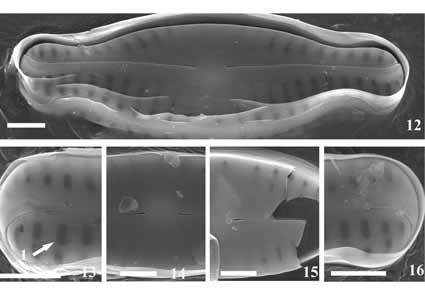
A new species was discovered in Taihang Valley, Shanxi province, China. It shared the typical characteristics of the genus Chamaepinnularia, such as chambered striae, vela-covered areolae and small frustules. Valves of Chamaepinnularia taihangensis sp. nov. are linear-lanceolate with capitate apices. Valve margins showed distinct triple curvatures in light microscopy. Axial area and central area narrow, rhombic. The new species was compared with the four related taxa, C. hassiaca, C. justa, C. krookiformis and C. soehrensis. These species differed from the new species in valve outline, valve size, stria density and the shape of the central area. The details of the valves as shown by light and scanning electron microscopy are described. This new species occurs in benthic and epiphyte habitats. We discuss the ecological breadth and systematic position of the genus Chamaepinnularia.
References
<p align="justify"><span style="color: #000000;"><span style="font-family: Times New Roman, serif;"><span style="font-size: small;">Beauger, A., Wetzel, C.E,. Allain, E., Bertin, C., Voldoire, O., Breton, V., Baker, L.-A., Kolovi, S., Biron, D. & Ector, L. (2022) Chamaepinnularia salina (Bacillariophyta), a new diatoms species from French mineral springs. Phytotaxa 538 (1): 55–73. https://doi.org/10.11646/phytotaxa.538.1.5</span></span></span>
<p align="justify"><span style="color: #000000;"><span style="font-family: Times New Roman, serif;"><span style="font-size: small;">Bessey, C.E. (1907) A synopsis of plant phyla. University Studies of the University of Nebraska 7: 275–373.</span></span></span>
<p align="justify"><span style="color: #000000;"><span style="font-family: Times New Roman, serif;"><span style="font-size: small;">Bory de Saint-Vincent, J.B.G.M. (1822) Bacillarées. Dictionnaire Classique d’Histoire Naturelle 2: 127–129. </span></span></span>
<p align="justify"><span style="color: #000000;"><span style="font-family: Times New Roman, serif;"><span style="font-size: small;">Brébisson, A. de. (1838) Considérations sur les Diatomées et essai d’une classification des genres et des espèces appartenant à cette famille. Brée l’Ainé Imprimeur-Libraire, Falaise, 22 pp. https://doi.org/10.5962/bhl.title.64353</span></span></span>
<p align="justify"><span style="color: #000000;"><span style="font-family: Times New Roman, serif;"><span style="font-size: small;">Cantonati, M. & Lange-Bertalot, H. (2009) On the ultrastructure of Chamaepinnularia schauppiana Lange-Bertalot & Metzeltin (Naviculaceae sl). Diatom research 24 (1): 225–231. https://doi.org/10.1080/0269249X.2009.9705793</span></span></span>
<p align="justify"><span style="color: #000000;"><span style="font-family: Times New Roman, serif;"><span style="font-size: small;">Cleve, P.T. (1894) Synopsis of the Naviculoid Diatoms, Part I. Kongliga Svenska-Vetenskaps Akademiens Handlingar 26: 1–194.</span></span></span>
<p align="justify"><span style="color: #000000;"><span style="font-family: Times New Roman, serif;"><span style="font-size: small;">Czarnecki, D.B. (1994) The freshwater diatoms culture collection at Loras College, Dubuque, Iowa. Memoirs of the California Academy of Sciences 17: 155–174.</span></span></span>
<p align="justify"><span style="color: #000000;"><span style="font-family: Times New Roman, serif;"><span style="font-size: small;">Cox, E. J. (2015) Coscinodiscophyceae, Mediophyceae, Fragilariophyceae, Bacillariophyceae (Diatoms). In: Jaklitsch, W., Baral, H.O., Lücking, R., Lumbsch, H.T. & Frey, W. (eds.) Syllabus of Plant Families. Adolf Engler’s Syllabus der Pflanzenfamilien. Part 2/1. Photoautotrophic eukaryotic algae: Glaucocystophyta, Cryptophyta, Dinophyta/Dinozoa, Haptophyta, Heterokontophyta/Ochrophyta, Chlorarachniophyta/Cercozoa, Euglenophyta/Euglenozoa, Chlorophyta, Streptophyta. pp. 64–100. [Borntraeger Verlagsbuchhandlung, Stuttgart]</span></span></span>
<p align="justify"><span style="color: #000000;"><span style="font-family: Times New Roman, serif;"><span style="font-size: small;">Ehrenberg, C.G. (1843) Mittheilungen uber 2 neue asiatische Lager fossiler Infusorie-Erden aus dem russischen Trans-Kaukasien (Grusien) und Sibirien. Bericht uber die zur Bekanntmachung geeigneten. Verhandlungen der Koniglich Preussischen Akademie der Wissenschaften zu Berlin 1843: 43–49.</span></span></span>
<p align="justify"><span style="color: #000000;"><span style="font-family: Times New Roman, serif;"><span style="font-size: small;">Falasco, E., Bona, F., Isaia, M., Piano, E., Wetzel, C.E., Hoffmann, L. & Ector, L. (2015) Nupela troglophila sp. nov., an aerophilous diatom (Bacillariophyta) from the Bossea cave (NW Italy), with notes on its ecology. Fottea 15 (1): 1–9. https://doi.org/10.5507/fot.2015.001</span></span></span>
<p align="justify"><span style="color: #000000;"><span style="font-family: Times New Roman, serif;"><span style="font-size: small;">Genkal, S.I & Yarushina, M.I. (2016) New data to morphology, ecology and distribution of rare species Chamaepinnularia circumborealis and Neidiopsis wulffii (Bacillariophyta). Novoosti Sistematiki Nizshikh Rastenii 50: 34–42. https://doi.org/10.31111/nsnr/2016.50.34</span></span></span>
<p align="justify"><span style="color: #000000;"><span style="font-family: Times New Roman, serif;"><span style="font-size: small;">Kaleli, A. (2019) Benthic diatom composition of Iztuzu Coastal Lake, Dalyan (Aegean Sea, Turkey). Aquatic Sciences and Engineering 34: 122–130. https://doi.org/10.26650/ASE2019575987</span></span></span>
<p align="justify"><span style="color: #000000;"><span style="font-family: Times New Roman, serif;"><span style="font-size: small;">Kong, C. (2020) Taxonomical study of Diatoms from Sanjiang plain wetland, China. Harbin Normal University [Master Dissertation], 480 pp.</span></span></span>
<p align="justify"><span style="color: #000000;"><span style="font-family: Times New Roman, serif;"><span style="font-size: small;">Kociolek, J.P., Blanco, S., Coste, M., Ector, L., Liu, Y., Karthick, B., Kulikovskiy, M., Lundholm, N., Ludwig, T., Potapova, M., Rimet, F., Sabbe, K., Sala, S., Sar, E., Taylor, J., Van de Vijver, B., Wetzel, C.E., Williams, D.M., Witkowski, A., Witkowski, J. (2022) DiatomBase. Available from: https://www.diatombase.org (accessed 13 Mar. 2023) https://doi.org/10.14284/504</span></span></span>
<p align="justify"><span style="color: #000000;"><span style="font-family: Times New Roman, serif;"><span style="font-size: small;">Kociolek, J.P., Kopalova, K., Hamsher, S., Kohler, T., Van de Vijver, B., Convey, P. & McKnight, D. (2017) An extreme case of endemism in Antarctica: The freshwater diatom genus Luticola. Polar Biology 40: 1185–1196. https://doi.org/10.1007/s00300-017-2090-7</span></span></span>
<p align="justify"><span style="color: #000000;"><span style="font-family: Times New Roman, serif;"><span style="font-size: small;">Kobayashi, H. (1997) Comparative studies among four linear-lanceolate Achnanthidium species (Bacillariophyceae) with curved terminal raphe endings. Nova Hedwigia 65 (1–4): 147–164. https://doi.org/10.1127/nova.hedwigia/65/1997/147</span></span></span>
<p align="justify"><span style="color: #000000;"><span style="font-family: Times New Roman, serif;"><span style="font-size: small;">Krammer, K. (2003) Cymbopleura, Delicata, Navicymbula, Gomphocymbellopsis, Afrocymbella. In: Diatoms of Europe, Diatoms of the European Inland waters and comparable habitats. Vol. 4. pp. 1–529.</span></span></span>
<p align="justify"><span style="color: #000000;"><span style="font-family: Times New Roman, serif;"><span style="font-size: small;">Kulikovskiy, M., Maltsev, Y.I., Glushchenko, A.M. Gusev, E.S., Kapsutin, D.A., Kuznetsova, I.V., Frolova, L. & Kociolek, J.P. (2020) Preliminary molecular phylogeny of the diatom genus Nupela with the description of a new species and consideration of the interrelationships of taxa in the suborder Neidiineae D.G.Mann sensu E.J. Cox. Fottea 20: 192–204. https://doi.org/10.5507/fot.2020.009</span></span></span>
<p align="justify"><span style="color: #000000;"><span style="font-family: Times New Roman, serif;"><span style="font-size: small;">Kulikovskiy, M. & Lange-Bertalot, H. (2010) Morphology and distribution of Naviculadicta witkowskii Lange-Bertalot & Metzeltin and its transfer to the genus Chamaepinnularia Lange-Bertalot & Krammer. Diatom research 25 (1): 67–76. https://doi.org/10.1080/0269249X.2010.9705829</span></span></span>
<p align="justify"><span style="color: #000000;"><span style="font-family: Times New Roman, serif;"><span style="font-size: small;">Kützing, F.T. (1844) Die Kieselschaligen Bacillarien oder Diatomeen. Nordhausen: zu finden bei W. Köhne, 152 pp. https://doi.org/10.5962/bhl.title.64360</span></span></span>
<p align="justify"><span style="color: #000000;"><span style="font-family: Times New Roman, serif;"><span style="font-size: small;">Lai, G.G., Ector, L., Padedda, B.M., Lugliè, A. & Wetzel, C.E. (2019) Chamaepinnularia thermophila (Bacillariophyceae): synonymy with Navicula tongatensis Hustedt and update of its geographic distribution and ecology. Oceanological and Hydrobiological Studies 48: 105–115. https://doi.org/10.1515/ohs-2019-0011</span></span></span>
<p align="justify"><span style="color: #000000;"><span style="font-family: Times New Roman, serif;"><span style="font-size: small;">Lange-Bertalot, H. (1995) Gomphosphenia paradoxa nov. spec. et nov. gen. und Vorschlag zur Lösung taxonomischer Probleme infolge eines veränderten Gattungskonzepts von Gomphonema (Bacillariophyceae). Nova Hedwigia 60: 241–252.</span></span></span>
<p align="justify"><span style="color: #000000;"><span style="font-family: Times New Roman, serif;"><span style="font-size: small;">Lange-Bertalot, H. & Metzeltin, D. (1996) Indicators of oligotrophy-800 taxa representative of three ecologically distinct lake types, Carbonate buffered-Oligodystrophic-Weakly buffered soft water. Iconographia Diatomologica 2: 1–390.</span></span></span>
<p align="justify"><span style="color: #000000;"><span style="font-family: Times New Roman, serif;"><span style="font-size: small;">Lange-Bertalot, H. & Genkal, S.I. (1999) Diatoms from Siberia I-Islands in the Arctic Ocean (Yugorsky-Shar Strait) Diatomeen aus Siberien. I. Insel im Arktischen Ozean (Yugorsky-Shar Strait). Iconographia Diatomologica 6: 1–271.</span></span></span>
<p align="justify"><span style="color: #000000;"><span style="font-family: Times New Roman, serif;"><span style="font-size: small;">Levkov, Z. (2009) Amphora sensu lato. Diatoms of Europe: Diatoms of the European Inland Waters and Comparable Habitats, Vol 5: 5–916.</span></span></span>
<p align="justify"><span style="color: #000000;"><span style="font-family: Times New Roman, serif;"><span style="font-size: small;">Liu, Q., Luo, X., Xie, S. & Kociolek, J.P. (2022) New and interesting diatoms from the Shimen Wetwalls, Yunnan Province, China. II. The diatom genus Nupela Vyverman & Compère (Bacillariophyceae). Journal of Oceanology and Limnology, 1–15. https://doi.org/10.1007/s00343-021-1281-9</span></span></span>
<p align="justify"><span style="color: #000000;"><span style="font-family: Times New Roman, serif;"><span style="font-size: small;">Lokhande, V., Radhakrishnan, C., Kociolek, J.P., Lowe, R.L. Karthick, B. (2021) The diatom genus Luticola D.G. Mann (Bacillariophyceae) in the Western Ghats of India. Description of eight new species, systematics, and comments on the biogeography of the genus. European Journal of Phycology 56: 142–158. https://doi.org/10.1080/09670262.2020.1783460</span></span></span>
<p align="justify"><span style="color: #000000;"><span style="font-family: Times New Roman, serif;"><span style="font-size: small;">Li, J. & Qi, Y. (2018) Flora algarum sinicarum aquae dulcis Tomus XXIII Bacillariophyta Naviculaceae (III). Beijing: Science Press, 214 pp.</span></span></span>
<p align="justify"><span style="color: #000000;"><span style="font-family: Times New Roman, serif;"><span style="font-size: small;">Liu, Y., Fan, Y. &Wang, Q. (2015) Newly recorded Genera and species of diatom from Great Xing’an Mountains, China. Acta Hydrobiologica Sinica 39: 382–393.</span></span></span>
<p align="justify"><span style="color: #000000;"><span style="font-family: Times New Roman, serif;"><span style="font-size: small;">Mann, D.G. (1999) Crossing the Rubicon: The effectiveness of the marine/freshwater interface as a barrier to the migration of diatom germplasm. In: Proceedings of the 14th International Diatom Symposium, Koenigstein, 1999. Koeltz Scientific Books. pp. 1–21. https://doi.org/10.1080/0269249X.1999.9705463</span></span></span>
<p align="justify"><span style="color: #000000;"><span style="font-family: Times New Roman, serif;"><span style="font-size: small;">Medlin, L.K. (2016) Evolution of the diatoms: major steps in their evolution and a review of the supporting molecular and morphological evidence. Phycologia 55 (1): 79–103. https://doi.org/10.2216/15-105.1</span></span></span>
<p align="justify"><span style="color: #000000;"><span style="font-family: Times New Roman, serif;"><span style="font-size: small;">Peszek, L., Rybak, M., Lange-Bertalot, H., Kociolek, J.P. & Witkowski, A. (2021) Three new Luticola D.G.Mann (Bacillariophyta) species from Rapa Nui (Easter Island) found in aerophytic diatom assemblage dominated by widely distributed taxa. PeerJ 9: e11142. https://doi.org/10.7717/peerj.11142</span></span></span>
<p align="justify"><span style="color: #000000;"><span style="font-family: Times New Roman, serif;"><span style="font-size: small;">Potapova, M. (2011) Patterns of Diatom Distribution in Relation to Salinity. In: Seckbach, J. & Kociolek, P. (Eds.) The Diatom World. Springer, Dordrecht. pp. 313–332. https://doi.org/10.1007/978-94-007-1327-7_14</span></span></span>
<p align="justify"><span style="color: #000000;"><span style="font-family: Times New Roman, serif;"><span style="font-size: small;">Potapova, M.G. & Ponader, K.C. (2004) Two common North American diatoms, Achnanthidium rivulare sp. nov. and A. deflexum (Reimer) Kingston: morphology, ecology and comparison with related species. Diatom Research 19 (1): 33–57. https://doi.org/10.1080/0269249X.2004.9705606</span></span></span>
<p align="justify"><span style="color: #000000;"><span style="font-family: Times New Roman, serif;"><span style="font-size: small;">Round, F.E. & Sims, P.A. (1981) The distribution of diatom genera in marine and freshwater environments and some evolutionary considerations. In: Proceedings of the Sixth symposium on recent and fossil Diatoms. Budapest, pp. 301–320.</span></span></span>
<p align="justify"><span style="color: #000000;"><span style="font-family: Times New Roman, serif;"><span style="font-size: small;">Round, F.E., Crawford, R.M. & Mann, D.G. (1990) The diatoms: Biology and morphology of the genera. Cambridge University Press, Cambridge, 747 pp.</span></span></span>
<p align="justify"><span style="color: #000000;"><span style="font-family: Times New Roman, serif;"><span style="font-size: small;">Rybak, M., Witkowski, A., Peszek, L., Kociolek, J.P., Risjani, R., Nguyen, H.D., Zhang, J., Yunianta, Y. Nguyen, V.D., Gastineau, R., Duong, T.T., Rosa, P. & Meleder, V. (2021) Brackish and marine Luticola D.G.Mann (Bacillariophyta) species from the Java Sea and South China Sea coasts with the description of three new species. Phytokeys 183: 115–142.</span></span></span>
<p align="justify"><span style="color: #000000;"><span style="font-family: Times New Roman, serif;"><span style="font-size: small;">Rumrich, U., Lange-Bertalot, H. & Rumrich, M. (2000) Diatoms of the Andes from Venezuela to Patagonia/Tierra del Fuego and two additional contributions. Iconographia Diatomologica. Vol. 9:1–673.</span></span></span>
<p align="justify"><span style="color: #000000;"><span style="font-family: Times New Roman, serif;"><span style="font-size: small;">Sala, S., Vouilloud, A.A., Plata-Díaz, Y. & Pedraza, E. (2014) Nupela species (Naviculales: Bacillariophyceae) from Colombian lowland waters including N. acaciensis nov. sp. and N. catatumbensis nov. sp. Revista de Biología Tropical 62 (1): 241–255. https://doi.org/10.15517/rbt.v62i1.8363</span></span></span>
<p align="justify"><span style="color: #000000;"><span style="font-family: Times New Roman, serif;"><span style="font-size: small;">Simonato, J., Sala, S., Kociolek, J.P., Diaz, Y & Nuñez, A.M. (2020) Three new species of Luticola from the Colombian Amazon. Diatom Research 35: 377–393. https://doi.org/10.1080/0269249X.2020.1813205</span></span></span>
<p align="justify"><span style="color: #000000;"><span style="font-family: Times New Roman, serif;"><span style="font-size: small;">Stepanek, J. & Kociolek, J.P. (2019) Molecular phylogeny of the amphoroid diatom (Bacillariophyta) genera Amphora and Halamphora indicates complex patterns of morphological and ecological evolution. Journal of Phycology 55: 442–456. https://doi.org/10.1111/jpy.12836</span></span></span>
<p align="justify"><span style="color: #000000;"><span style="font-family: Times New Roman, serif;"><span style="font-size: small;">Sterken, M., Verleyen, E., Jones, V.J., Dominic, A.H., V yverman, W., Sabbe, K. & Van de Vijver, B. (2015) An illustrated and annotated checklist of freshwater diatoms (Bacillariophyta) from Livingstone, Signy and Beak island (Maritime Antarctic Region). Plant Ecology and Evolution 148: 431–455. https://doi.org/10.5091/plecevo.2015.1103</span></span></span>
<p align="justify"><span style="color: #000000;"><span style="font-family: Times New Roman, serif;"><span style="font-size: small;">Van de Vijver, B., Sterken, M. Vyverman, W., Mataloni, G., Nedbalová, L., Kopalová, K., Elster, J., Verleyen, E. & Sabbe, K. (2010) Four new non–marine diatom taxa from the Subarctic and Antarctic regions. Diatom Research 25: 431–443. https://doi.org/10.1080/0269249X.2010.9705861</span></span></span>
<p align="justify"><span style="color: #000000;"><span style="font-family: Times New Roman, serif;"><span style="font-size: small;">Van de Vijver, B., Kopalová, K., Zidarova, R. & Cox, E.J. (2013) New and interesting small-celled naviculoid diatoms (Bacillariophyta) from the Maritime Antarctic Region. Nova Hedwigia 97 (1/2): 189–208. https://doi.org/10.1127/0029-5035/2013/0101</span></span></span>
<p align="justify"><span style="color: #000000;"><span style="font-family: Times New Roman, serif;"><span style="font-size: small;">Vyverman, W. & Compère, P. (1991) Nupela giluwensis gen. & spec. nov. A new genus of naviculoid diatoms. Diatom Research 6: 175–179. https://doi.org/10.1080/0269249X.1991.9705156</span></span></span>
<p align="justify"><span style="color: #000000;"><span style="font-family: Times New Roman, serif;"><span style="font-size: small;">Wetzel, C.E., Martinez-Carreras, N., Hlubikova, D., Hoffmann, L., Pfister, L. & Ector, L. (2013) New combinations and type analysis of Chamaepinnularia species (Bacillariophyceae) from aerial habitats. Cryptogamie, Algologie 34: 149–168. https://doi.org/10.7872/crya.v34.iss2.2013.149</span></span></span>
<p align="justify"><span style="color: #000000;"><span style="font-family: Times New Roman, serif;"><span style="font-size: small;">Williams, D.M. (2012) Diatoma moniliforme: Commentary, relationships and an appropriate name. Nova Hedwigia Beiheft 141: 255–261.</span></span></span>
<p align="justify"><span style="color: #000000;"><span style="font-family: Times New Roman, serif;"><span style="font-size: small;">Witkowski, A. (1994) Recent and fossil diatom flora of the Gulf of Gdansk, Southern Baltic Sea. Origin, composition and changes of diatom assemblages during the Holocene. Bibliotheca Diatomologica 28: 1–313.</span></span></span>
<p align="justify"><span style="color: #000000;"><span style="font-family: Times New Roman, serif;"><span style="font-size: small;">Witkowski, A., Lange-Bertalot, H. & Metzeltin, D. (2000) Diatom Flora of Marine Coasts I. Iconographia Diatomologica. Vol. 7. pp. 1–925.</span></span></span>
<p align="justify"><span style="color: #000000;"><span style="font-family: Times New Roman, serif;"><span style="font-size: small;">Yang, H., Wang, H., Liu, N. & Wang, W. (2012) Analysis on the Geological Periods’Climate Phenomena in the Great Valley of Taihang Mountain. Sci-tech information development & economy 22 (14): 136–138 + 142.</span></span></span>
<p align="justify"><span style="color: #000000;"><span style="font-family: Times New Roman, serif;"><span style="font-size: small;">?elazna-Wieczorek, J. & Olszy?ski, R.M. (2016) Taxonomic revision of Chamaepinnularia krookiformis Lange-Bertalot et Krammer with a description of Chamaepinnularia plinskii sp. nov. Fottea 16 (1): 112–121. https://doi.org/10.5507/fot.2016.001</span></span></span>