

Abstract
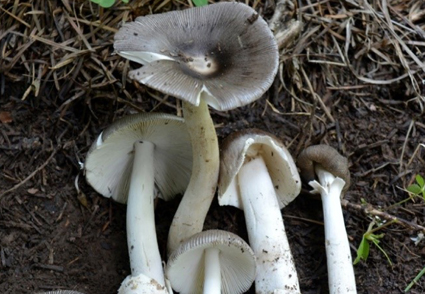
Amanita sharmae, a new species of A. sect. vaginatae is described from India based on 2-gene phylogenetic analyses and morphological data. It is characterized by a small to medium-sized basidiomata, dark grey to olive grey pileus, broadly ellipsoid to ellipsoid basidiospores (10‒14 × 7‒10 μm), the presence of clamp connections, and its occurrence under Abies pindrow and Picea smithiana in coniferous forest.
References
Bas C. (1977) Species concept in Amanita sect. Vaginatae I. The species concept in Hymenomycetes. Bibliotheca Mycologica 61: 79–103.
Cui, Y.Y., Cai, Q., Tang, L., Liu, J.W. & Yang, Z.L. (2018) The family Amanitaceae: molecular phylogeny, higher–rank taxonomy and the species in China. Fungal Diversity 91: 5–230. https://doi.org/10.1007/s13225-018-0405-9
Das, K., Ghosh, A., Chakraborty, D, Li, J., Qiu, L., Baghela, A., Halama, M., Hembrom, M.E., Mehmood, T., Parihar, A., Pencakowski, B., Bielecka, M., Reczynska, K., Sasiela, D., Singh, U., Song, Y., Swierkosz, K., Szczesniak, K., Uniyal, P., Zhang, J. & Buyck, B. (2017) Fungal Biodiversity Profiles 31–40. Cryptogamie Mycologie 38: 1–56. https://doi.org/10.7872/crym/v38.iss3.2017.353
Edler, D., Klein, J., Antonelli, A. & Silvestro, D. (2021) raxmlGUI 2.0: a graphical interface and toolkit for phylogenetic analyses using RAxML. Methods in Ecology and Evolution 12: 373–377. https://doi.org/10.1111/2041-210X.13512
Gardes, M. & Bruns, T.D. (1993) ITS primers with enhanced specificity for basidiomycetes-application to the identification of mycorrhizae and rusts. Molecular Ecology 2: 113–118. https://doi.org/10.1111/j.1365-294X.1993.tb00005.x
Hosen, M.I., Mehmood, T., Das, K., Kudzma, L.V. & Bhatt, R.P. (2018) Amanita tullossiana, a new species, and two new records of Amanita section Lepidella from north-western Himalaya, India. MycoKeys 37: 73–92. https://doi.org/10.3897/mycokeys.37.26420
Jabeen, S., Kiran, M., Ullah, S., Wilson, A.W., Mueller, G.M., Fiaz, M. & Khalid, A.N. (2017) Amanita glarea, a new species in section Vaginatae from Pakistan. Phytotaxa 306 (2): 135–145. https://doi.org/10.11646/phytotaxa.306.2.3
Justo, A., Morgenstern, I., Hallen-Adams, H.E. & Hibbett, D.S. (2010) Convergent evolution of sequestrate forms in Amanita under Mediterranean climate conditions. Mycologia 102: 675–688. https://doi.org/10.3852/09-191
Kim, C.S., Jo, J.W., Kwag, Y.N., Oh, J., Shrestha, B., Sung, G.H. & Han, S.K. (2013) Four Newly Recorded Amanita Species in Korea: Amanita sect. Amanita and sect. Vaginatae. Mycobiology 41: 131–138. https://doi.org/10.5941/MYCO.2013.41.3.131
Kornerup, A. & Wanscher, J.H. (1978) Methuen Handbook of Colour, 3rd edn. Eyre Methuen Ltd., London, U.K., 252 pp.
Kumar, A., Mehmood, T. & Sharma, Y.P. (2021) Amanita griseofusca: A new record to Indian mycobiota from Jammu and Kashmir, India. Kavaka 53: 28–32. https://doi.org/10.36460/Kavaka/57/2021/28-32
Kumar, A., Mehmood, T., Atri, N.S. & Sharma Y.P. (2021) Revised and an updated checklist of the Amanitaceae from India with its specific distribution in Indian States. Nova Hedwigia 112: 223–240. https://doi.org/10.1127/nova_hedwigia/2021/0617
Kumar, A., Sharma, R., Verma K., Mehmood, T. & Sharma, Y.P. (2022) Amanita indogrisea, a new species of Amanita subg. Amanitiana sec. Roanokenses from India. Karstenia 60: 1–9. https://doi.org/10.29203/ka.2022.513
Kumar, S., Stecher, G. & Tamura, K. (2016) MEGA7: Molecular Evolutionary Genetics Analysis version 7.0 for bigger datasets. Molecular Biology and Evolution 33: 1870–1874. https://doi.org/10.1093/molbev/msw054
Lanfear, R., Frandsen, P.B., Wright, A.M., Senfeld, T. & Calcott, B. (2017) PartitionFinder 2: new methods for selecting partitioned models of evolution for molecular and morphological phylogenetic analyses. Molecular Biology and Evolution 34 (3): 772–773. https://doi.org/10.1093/molbev/msw260
Malysheva, E.F. & Kovalenko, A.E. (2015) Fungi of the Russian Far East. IV. Amanita sect. Vaginatae in the central Sikhote-Alin. Mbrokoubz b abnoganokoubz 49: 151–163.
Mehmood, T., Bhatt, R.P., Chowdhary, A.K. & Singh, U. (2018) Taxonomy and ecological notes on Amanita section Phalloideae (Agaricales: Amanitaceae) in western Himalaya, India. EN- VIS Bulletin Himalayan Ecology 25: 144–152
Mehmood, T., Das, K., Hosen, I., Bhatt, R.P., Uniyal, P. & Singh, U. (2018) Two new species of Amanita (Amanitaceae) from North-western Himalaya, India. Phytotaxa 367 (3): 219–232. https://doi.org/10.11646/phytotaxa.367.3.2
Neville, P. & Poumarat, S. (2009) Quelques espèces nouvelles ou mal délimitées d’Amanita de la soussection Vaginatinae. 1er complément à Amaniteae, Fungi Europaei 9. Fungi non Delineati: 51–52, 1–200.
Raina, R.K. & Koul, M.N. (2011) Impact of climatic change on agro-ecological zones of the Suru-Zanskar valley, Ladakh (Jammu and Kashmir), India. Journal of Ecology and the Natural Environment 3: 424–440.
Romshoo, S.A., Irfan, R., Altaf, S. & Dar, G.H. (2020) Jammu and Kashmir State: An Overview. In: Dar, G. & Khuroo, A. (Eds.) Biodiversity of the Himalaya: Jammu and Kashmir State. Topics in Biodiversity and Conservation, vol. 18. Springer, Singapore. https://doi.org 10.1007/978-981-32-9174-4-6
Ronquist, F., Teslenko, M., Van der Mark, P., Ayres, D.L., Darling, A., Hohna, S., Larget, B., Liu, L., Suchard, M.A. & Huelsenbeck, J.P. (2012) Mr.Bayes 3.2: efficient Bayesian phylogenetic inference and model choice across a large model space. Systematic Biology 61: 539–542. https://doi.org/10.1093/sysbio/sys029
Talavera, G. & Castresana J. (2007) Improvement of phylogenies after removing divergent and ambiguously aligned blocks from protein sequence alignments. Systematic Biology 56: 564–577. https://doi.org/10.1080/10635150701472164
Tang, L.P., Cai, Q., Lee, S.S., Buyck, B., Zhang, P. & Yang, Z.L. (2015) Taxonomy and phylogenetic position of species of Amanita sect. Vaginatae from tropical Africa. Mycological Progress 14: 1–15. https://doi.org/10.1007/s11557-015-1061-z
Tibpromma, S., Hyde, K.D., Jeewon, R., Maharachchikumbura, S.S.N., Liu, J.K., Bhat, J.D., Jones, E.B.G., Mckenzie, E.H.C., Camporesi, E., Liu, J.K., Bulgakov, T.S., Doilom M., Santiago, A.L.C.M. de. A., Drechsler-Santos., Das, K., Manimohan, P., Gibertoni, T.B., Lima, D.X., Ekanayaka, A.H., Thongba, B., Lee, H.B., Yang, Jun Bo., Kirk, P.M., Sysouphanthong, P., Singh, A.K., Boonme, S., Dong, W., AnilRaj, K.N., Latha, K.P.D., Phookamsak, R., Phukhamsakda, C., Konta, S., Jayasiri, S.C., Norphanphoun, C., Tennakoon, D.S., Li, J., Dayarathne, M.C., Perera, R.H., Xiao, Y., Wanasinghe, D.N., Senanayake, I.C., Ishani, D., Goonasekara, De Silva N.I., Mapook, A., Jayawardena, R.S., Dissanayake, A.J., Manawasinghe, I.S., Chethana, K.W.T., Luo,Zong-Long., Hapuarachchi, K.K., Baghela, A., Soares, A.M., Vizzini, A, Meiras-Ottoni, A., Mes?ic´, A., Dutta, A.K., Fragoso de Souza, C.A., Richter, C., Lin,Chuan-Gen., Chakrabarty, D., Daranagama, D.A., Lima, D.X., Chakraborty, D., Ercole, E.,Wu, F., Simonini, G., Vasquez, G., Alves da Silva, G., Plautz, H.I., Ariyawansa, H.A., Lee, H., Kus?n, I., Song, J., Sun, J., Karmakar, J., Huk, Semwal, K.C., Thambugala, K.M., Voigt, K., Acharya, K., Rajeshkumar, K.C.,Ryvarden, L., Jadan, M., Hosen M.I.,Miks??, M., Samarakoon, M.I., Wijayawardene, N.N., Kim, N.k., Matoc?ec, N., Singh, P.S., Tian, Q., Bhatt, R.P., Vilela de Oliveira, R.J., Tulloss, R.E., Aamir, S., Kaewchai, S., Marathe, S.D., Khan, S., Hongsanan, S., Adhikari. S., Mehmood, T., Bandyopadhyay, T.K., Svetasheva, T.Y., Nguyen,T.T.T., Anton?n, V., Li, W.J., Wang, Y., Indoliya, Y., Tkalc?ec, Z., Elgorban, A.M., Bahkali, A.H., Tang, A.M.C., Su Hong-Yan., Zhang, H.,Promputtha, I., Luangsa-ard, J., Xu,` J., Yan, J., Chuan, K., Stadler, M., Mortimer, P.E., Chomnunti, P., Zhao, Q., Phillips, A.J.L., Nontachaiyapoom, S., Wen, T.-C. & Karunarathna, S.C. (2017) Fungal diversity notes 491–603: taxonomic and phylogenetic contributions to fungal taxa. Fungal Diversity 83: 1–261. https://doi.org/10.1007/s13225-017-0378-0
Tulloss, R.E. (1994) Type studies in Amanita section Vaginatae I: some taxa described in this century (studies 1–23) with notes on description of spores and refractive hyphae in Amanita. Mycotaxon 52: 305–396.
Tulloss, R.E. & Yang, Z.L. (2021) Studies in the Amanitaceae. Available from: http://www.amanitaceae.org/ (accessed 1 November 2021)
Vilgalys, R. & Hester, M. (1990) Rapid genetic identification and mapping of enzymatically amplified ribosomal DNA from several Cryptococcus species. Journal of Bacteriology 172 (8): 4238–4246. https://doi.org/10.1128/jb.172.8.4238-4246.1990
White, T.J., Bruns, T., Lee, S. & Taylor, J. (1990) Amplification and direct sequencing of fungal ribosomal RNA genes for phylogenetics. In: Innis, M.A., Gelfand, D.H., Sninsky, J.J. & White, T.J. (Eds.) PCR Protocols: a guide to methods and applications. Academic Press, San Diego, New York, pp. 315–322. https://doi.org/10.1016/B978-0-12-372180-8.50042-1
Yang, Z.L. (1997) Die Amanita-Arten von Südwestchina. Bibliotheca Mycologica 170: 1–240.
Yang, Z.L. (2005) Flora fungorum sinicorum. Vol. 27. Amanitaceae. Science Press, Beijing.
Zhang, L.F., Yang, J.B. & Yang, Z.L. (2004) Molecular phylogeny of eastern Asian species of Amanita (Agaricales, Basidiomycota): taxonomic and biogeographic implications. Fungal Diversity 17: 219–238.
Cui, Y.Y., Cai, Q., Tang, L., Liu, J.W. & Yang, Z.L. (2018) The family Amanitaceae: molecular phylogeny, higher–rank taxonomy and the species in China. Fungal Diversity 91: 5–230. https://doi.org/10.1007/s13225-018-0405-9
Das, K., Ghosh, A., Chakraborty, D, Li, J., Qiu, L., Baghela, A., Halama, M., Hembrom, M.E., Mehmood, T., Parihar, A., Pencakowski, B., Bielecka, M., Reczynska, K., Sasiela, D., Singh, U., Song, Y., Swierkosz, K., Szczesniak, K., Uniyal, P., Zhang, J. & Buyck, B. (2017) Fungal Biodiversity Profiles 31–40. Cryptogamie Mycologie 38: 1–56. https://doi.org/10.7872/crym/v38.iss3.2017.353
Edler, D., Klein, J., Antonelli, A. & Silvestro, D. (2021) raxmlGUI 2.0: a graphical interface and toolkit for phylogenetic analyses using RAxML. Methods in Ecology and Evolution 12: 373–377. https://doi.org/10.1111/2041-210X.13512
Gardes, M. & Bruns, T.D. (1993) ITS primers with enhanced specificity for basidiomycetes-application to the identification of mycorrhizae and rusts. Molecular Ecology 2: 113–118. https://doi.org/10.1111/j.1365-294X.1993.tb00005.x
Hosen, M.I., Mehmood, T., Das, K., Kudzma, L.V. & Bhatt, R.P. (2018) Amanita tullossiana, a new species, and two new records of Amanita section Lepidella from north-western Himalaya, India. MycoKeys 37: 73–92. https://doi.org/10.3897/mycokeys.37.26420
Jabeen, S., Kiran, M., Ullah, S., Wilson, A.W., Mueller, G.M., Fiaz, M. & Khalid, A.N. (2017) Amanita glarea, a new species in section Vaginatae from Pakistan. Phytotaxa 306 (2): 135–145. https://doi.org/10.11646/phytotaxa.306.2.3
Justo, A., Morgenstern, I., Hallen-Adams, H.E. & Hibbett, D.S. (2010) Convergent evolution of sequestrate forms in Amanita under Mediterranean climate conditions. Mycologia 102: 675–688. https://doi.org/10.3852/09-191
Kim, C.S., Jo, J.W., Kwag, Y.N., Oh, J., Shrestha, B., Sung, G.H. & Han, S.K. (2013) Four Newly Recorded Amanita Species in Korea: Amanita sect. Amanita and sect. Vaginatae. Mycobiology 41: 131–138. https://doi.org/10.5941/MYCO.2013.41.3.131
Kornerup, A. & Wanscher, J.H. (1978) Methuen Handbook of Colour, 3rd edn. Eyre Methuen Ltd., London, U.K., 252 pp.
Kumar, A., Mehmood, T. & Sharma, Y.P. (2021) Amanita griseofusca: A new record to Indian mycobiota from Jammu and Kashmir, India. Kavaka 53: 28–32. https://doi.org/10.36460/Kavaka/57/2021/28-32
Kumar, A., Mehmood, T., Atri, N.S. & Sharma Y.P. (2021) Revised and an updated checklist of the Amanitaceae from India with its specific distribution in Indian States. Nova Hedwigia 112: 223–240. https://doi.org/10.1127/nova_hedwigia/2021/0617
Kumar, A., Sharma, R., Verma K., Mehmood, T. & Sharma, Y.P. (2022) Amanita indogrisea, a new species of Amanita subg. Amanitiana sec. Roanokenses from India. Karstenia 60: 1–9. https://doi.org/10.29203/ka.2022.513
Kumar, S., Stecher, G. & Tamura, K. (2016) MEGA7: Molecular Evolutionary Genetics Analysis version 7.0 for bigger datasets. Molecular Biology and Evolution 33: 1870–1874. https://doi.org/10.1093/molbev/msw054
Lanfear, R., Frandsen, P.B., Wright, A.M., Senfeld, T. & Calcott, B. (2017) PartitionFinder 2: new methods for selecting partitioned models of evolution for molecular and morphological phylogenetic analyses. Molecular Biology and Evolution 34 (3): 772–773. https://doi.org/10.1093/molbev/msw260
Malysheva, E.F. & Kovalenko, A.E. (2015) Fungi of the Russian Far East. IV. Amanita sect. Vaginatae in the central Sikhote-Alin. Mbrokoubz b abnoganokoubz 49: 151–163.
Mehmood, T., Bhatt, R.P., Chowdhary, A.K. & Singh, U. (2018) Taxonomy and ecological notes on Amanita section Phalloideae (Agaricales: Amanitaceae) in western Himalaya, India. EN- VIS Bulletin Himalayan Ecology 25: 144–152
Mehmood, T., Das, K., Hosen, I., Bhatt, R.P., Uniyal, P. & Singh, U. (2018) Two new species of Amanita (Amanitaceae) from North-western Himalaya, India. Phytotaxa 367 (3): 219–232. https://doi.org/10.11646/phytotaxa.367.3.2
Neville, P. & Poumarat, S. (2009) Quelques espèces nouvelles ou mal délimitées d’Amanita de la soussection Vaginatinae. 1er complément à Amaniteae, Fungi Europaei 9. Fungi non Delineati: 51–52, 1–200.
Raina, R.K. & Koul, M.N. (2011) Impact of climatic change on agro-ecological zones of the Suru-Zanskar valley, Ladakh (Jammu and Kashmir), India. Journal of Ecology and the Natural Environment 3: 424–440.
Romshoo, S.A., Irfan, R., Altaf, S. & Dar, G.H. (2020) Jammu and Kashmir State: An Overview. In: Dar, G. & Khuroo, A. (Eds.) Biodiversity of the Himalaya: Jammu and Kashmir State. Topics in Biodiversity and Conservation, vol. 18. Springer, Singapore. https://doi.org 10.1007/978-981-32-9174-4-6
Ronquist, F., Teslenko, M., Van der Mark, P., Ayres, D.L., Darling, A., Hohna, S., Larget, B., Liu, L., Suchard, M.A. & Huelsenbeck, J.P. (2012) Mr.Bayes 3.2: efficient Bayesian phylogenetic inference and model choice across a large model space. Systematic Biology 61: 539–542. https://doi.org/10.1093/sysbio/sys029
Talavera, G. & Castresana J. (2007) Improvement of phylogenies after removing divergent and ambiguously aligned blocks from protein sequence alignments. Systematic Biology 56: 564–577. https://doi.org/10.1080/10635150701472164
Tang, L.P., Cai, Q., Lee, S.S., Buyck, B., Zhang, P. & Yang, Z.L. (2015) Taxonomy and phylogenetic position of species of Amanita sect. Vaginatae from tropical Africa. Mycological Progress 14: 1–15. https://doi.org/10.1007/s11557-015-1061-z
Tibpromma, S., Hyde, K.D., Jeewon, R., Maharachchikumbura, S.S.N., Liu, J.K., Bhat, J.D., Jones, E.B.G., Mckenzie, E.H.C., Camporesi, E., Liu, J.K., Bulgakov, T.S., Doilom M., Santiago, A.L.C.M. de. A., Drechsler-Santos., Das, K., Manimohan, P., Gibertoni, T.B., Lima, D.X., Ekanayaka, A.H., Thongba, B., Lee, H.B., Yang, Jun Bo., Kirk, P.M., Sysouphanthong, P., Singh, A.K., Boonme, S., Dong, W., AnilRaj, K.N., Latha, K.P.D., Phookamsak, R., Phukhamsakda, C., Konta, S., Jayasiri, S.C., Norphanphoun, C., Tennakoon, D.S., Li, J., Dayarathne, M.C., Perera, R.H., Xiao, Y., Wanasinghe, D.N., Senanayake, I.C., Ishani, D., Goonasekara, De Silva N.I., Mapook, A., Jayawardena, R.S., Dissanayake, A.J., Manawasinghe, I.S., Chethana, K.W.T., Luo,Zong-Long., Hapuarachchi, K.K., Baghela, A., Soares, A.M., Vizzini, A, Meiras-Ottoni, A., Mes?ic´, A., Dutta, A.K., Fragoso de Souza, C.A., Richter, C., Lin,Chuan-Gen., Chakrabarty, D., Daranagama, D.A., Lima, D.X., Chakraborty, D., Ercole, E.,Wu, F., Simonini, G., Vasquez, G., Alves da Silva, G., Plautz, H.I., Ariyawansa, H.A., Lee, H., Kus?n, I., Song, J., Sun, J., Karmakar, J., Huk, Semwal, K.C., Thambugala, K.M., Voigt, K., Acharya, K., Rajeshkumar, K.C.,Ryvarden, L., Jadan, M., Hosen M.I.,Miks??, M., Samarakoon, M.I., Wijayawardene, N.N., Kim, N.k., Matoc?ec, N., Singh, P.S., Tian, Q., Bhatt, R.P., Vilela de Oliveira, R.J., Tulloss, R.E., Aamir, S., Kaewchai, S., Marathe, S.D., Khan, S., Hongsanan, S., Adhikari. S., Mehmood, T., Bandyopadhyay, T.K., Svetasheva, T.Y., Nguyen,T.T.T., Anton?n, V., Li, W.J., Wang, Y., Indoliya, Y., Tkalc?ec, Z., Elgorban, A.M., Bahkali, A.H., Tang, A.M.C., Su Hong-Yan., Zhang, H.,Promputtha, I., Luangsa-ard, J., Xu,` J., Yan, J., Chuan, K., Stadler, M., Mortimer, P.E., Chomnunti, P., Zhao, Q., Phillips, A.J.L., Nontachaiyapoom, S., Wen, T.-C. & Karunarathna, S.C. (2017) Fungal diversity notes 491–603: taxonomic and phylogenetic contributions to fungal taxa. Fungal Diversity 83: 1–261. https://doi.org/10.1007/s13225-017-0378-0
Tulloss, R.E. (1994) Type studies in Amanita section Vaginatae I: some taxa described in this century (studies 1–23) with notes on description of spores and refractive hyphae in Amanita. Mycotaxon 52: 305–396.
Tulloss, R.E. & Yang, Z.L. (2021) Studies in the Amanitaceae. Available from: http://www.amanitaceae.org/ (accessed 1 November 2021)
Vilgalys, R. & Hester, M. (1990) Rapid genetic identification and mapping of enzymatically amplified ribosomal DNA from several Cryptococcus species. Journal of Bacteriology 172 (8): 4238–4246. https://doi.org/10.1128/jb.172.8.4238-4246.1990
White, T.J., Bruns, T., Lee, S. & Taylor, J. (1990) Amplification and direct sequencing of fungal ribosomal RNA genes for phylogenetics. In: Innis, M.A., Gelfand, D.H., Sninsky, J.J. & White, T.J. (Eds.) PCR Protocols: a guide to methods and applications. Academic Press, San Diego, New York, pp. 315–322. https://doi.org/10.1016/B978-0-12-372180-8.50042-1
Yang, Z.L. (1997) Die Amanita-Arten von Südwestchina. Bibliotheca Mycologica 170: 1–240.
Yang, Z.L. (2005) Flora fungorum sinicorum. Vol. 27. Amanitaceae. Science Press, Beijing.
Zhang, L.F., Yang, J.B. & Yang, Z.L. (2004) Molecular phylogeny of eastern Asian species of Amanita (Agaricales, Basidiomycota): taxonomic and biogeographic implications. Fungal Diversity 17: 219–238.