

Abstract
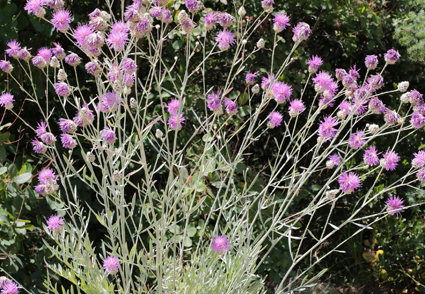
Centaurea dolopica from Omvriaki area in Central Greece is described and illustrated as a species new to science based on morphological and molecular evidence. Detailed description of the new species, distribution, ecology, conservation status, as well as comparison with closely related species are provided. Individuals of Centaurea dolopica were also examined karyologically resulting to the chromosome number 2n = 2x = 22 accompanied by comprehensive karyotype analysis. Phylogenetic study including the new species and major representatives of Centaurea section Acrocentron was conducted using two nuclear markers (ITS, ETS). The results revealed the placement of Centaurea dolopica in the Greek-Aegean clade of the section in close evolutionary relationship with the members of the C. achaia group, corroborating the morphological and karyological data.
References
Boissier, E. (1856) Diagnoses plantarum orientalium novarum, ser. 2, 3. B. Herrmann, Lipsia, 177 pp.
Boissier, E. (1859) Diagnoses plantarum orientalium novarum, ser. 2, 6. B. Herrmann, Lipsia, 148 pp.
Candolle, A.P. de (1837) Prodromus systematis naturalis regni vegetabilis, vol. 6. Treutel & Würtz, Paris, 536 pp.
Chasapis, M., Karagiannakidou, V. & Theodoropoulos, K. (2004) Phytosociological research of Quercus coccifera L. pseudomaquis on Mount Chortiatis, northern Greece. Israel Journal of Plant Sciences 52: 357–381. https://doi.org/10.1560/N0YU-G77C-TLKX-HW5K
Cuvier, F. (1826) Dictionnaire des sciences naturelles, vol. 44. Levrault, Strasbourg, 526 pp.
Damboldt, J. & Matthäs, U. (1975) Chromosomenzahlen einiger mediterraner und mitteleuropäischer Centaurea-Arten (Asteraceae). PIant Systematics and Evolution 123: 103–115. https://doi.org/10.1007/BF00981769
Darlington, C.D. & La Cour, L. (1969) The handling of chromosomes. George Allen and Unwin, London, 272 pp.
Dobroczajeva, D.N. (1949) Voloshki URSR, yikh poshirennya ta istoriya rozvitku. Botanichnyi Zhurnal 6 (2): 63–76.
Flora of Greece web (2022) Vascular plants of Greece – an annotated checklist. Version IV, July 2022. Available from: https://portal.cybertaxonomy.org/flora-greece/ (accessed 5 September 2022)
Font, M., Vallès, J., Susanna, A. & Garcia-Jacas, N. (2008) Auto- and allopolyploidy in Centaurea sect. Acrocentron s.l. (Asteraceae, Cardueae): karyotype and fluorochrome banding pattern analyses. Collectanea Botanica (Barcelona) 27: 7–18. https://doi.org/10.3989/collectbot.2008.v27.1
Font, M., Garcia-Jacas, N., Vilatersana, R., Roquet, C. & Susanna, A. (2009) Evolution and biogeography of Centaurea section Acrocentron inferred from nuclear and plastid DNA sequence analyses. Annals of Botany 103 (6): 985–997. https://doi.org/10.1093/aob/mcp022
Garcia-Jacas, N. & Susanna, A. (1992) Karyological notes on Centaurea sect. Acrocentron (Asteraceae). Plant Systematics and Evolution 179: 1–18. https://doi.org/10.1007/BF00938015
Gardou, C. (1969) Caryosystématique des Centaurées de la section Acrocentron Cass. Bulletin de la Société botanique de France 116: 29–38. https://doi.org/10.1080/00378941.1969.10838638
Gardou, C. (1974) Quelques vues synthétiques sur les Centaurées de la section Acrocentron (Cass.) O. Hoffm. dans la flore Mediterranéenne. Colloques internationales du CNRS Montpellier. Flora Mediterranea 235: 537–547.
Georgiadis, Th. & Christodoulakis, D. (1984) Contribution à l’étude cytogéographique des Centaurées de I’ile de Samos. Candollea 39: 307–318.
Hayek, A. von (1901) Die Centaurea-Arten Österreich-Ungarns. Denkschriften der Kaiserlichen Akademie der Wissenschaften. Mathematisch-naturwissenschaftliche Klasse 70: 585–773.
Healey, A., Furtado, A., Cooper, T. & Henry, R.J. (2014) Protocol: A simple method for extracting next-generation sequencing quality genomic DNA from recalcitrant plant species. Plant Methods 10: 21. https://doi.org/10.1186/1746-4811-10-21
Hilpold, A. (2012) Evolution of the Centaurea Acrolophus subgroup. PhD Thesis, University of Barcelona, Barcelona.
Hilpold, A., Garcia-Jacas, N., Vilatersana, R. & Susanna, A. (2014) Taxonomical and nomenclatural notes on Centaurea: A proposal of classification, a description of new sections and subsections, and a species list of the redefined section Centaurea. Collectanea Botanica (Barcelona) 33: 1–29. https://doi.10.3989/collectbot.2013.v33.001
IUCN (2022) The IUCN Red List of Threatened Species. Version 2021-3. Available from: https://www.iucnredlist.org (accessed 23 September 2022)
Kamari, G. (1976) Cytotaxonomic study of the Crepis neglecta L. complex in Greece [in Greek with English summary]. Ph.D. thesis, University of Patras, Patras, Greece.
Katoh, K. & Standley, D.M. (2016) A simple method to control over-alignment in the MAFFT multiple sequence alignment program. Bioinformatics (Oxford, England) 32: 1933–1942. https://doi.org/10.1093/bioinformatics/btw108
Larsson, A. (2014) AliView: a fast and lightweight alignment viewer and editor for large data sets. Bioinformatics (Oxford, England) 30 (22): 3276–3278. https://doi.org/10.1093/bioinformatics/btu531
Levan, A., Fredga, K. & Sandberg, A.A. (1964) Nomenclature for centromeric position on chromosomes. Hereditas 52: 201–220. https://doi.org/10.1111/j.1601-5223.1964.tb01953.x
Linnaeus, C. (1753) Species plantarum. L.Salvius, Holmia [Stockholm], 1200 pp.
Maddison, W.P. & Maddison, D.R. (2021) Mesquite: a modular system for evolutionary analysis. Version 3.70 [http://www.mesquiteproject.org]
Miller, P. (1754) The gardener’s dictionary, ed. 4. Privately published, London, 520 pp.
Moore, S.L.M. (1878) Alabastra diversa. Journal of Botany 16: 129–138.
Östergren, G. & Heneen, W.K. (1962) A squash technique for chromosome morphological studies. Hereditas 48: 332–341. https://doi.org/10.1111/j.1601-5223.1962.tb01817.x
Pan?i?, J. (1856) Verzeichniss der in Serbien wildwachsenden Phanerogamen. Verhandlungen des Zoologisch-Botanischen Vereins in Wien 6: 475–598.
Phitos, D. (1970) Zur Polyploidie in der Gattung Centaurea L. Sektion Acrocentron (Compositae). Berichte der Deutschen Botanischen Gesellschaft 83: 69–73
Phitos, D. (1971) Cytotaxonomische Studien der griechischen Centaurea-Arten, Sektion Acrocentron (Compositae). Berichte der Deutschen Botanischen Gesellschaft 84: 255–259.
Phitos, D. & Kamari, G. (1973) Cytologische Untersuchungen an einigen griechischen Blutenpflanzen (Centaurea, Aethionema). Biologia Gallo-Hellenica 4: 147–151.
Phitos, D. & Georgiadis, Th. (1981) A propos du grupe de Centaurea achaia Boiss. et Heldr. de la section Acrocentron (Cass.) DC. Botanika Chronika 1 (2): 99–114.
Phitos, D., Constantinidis, Th. & Kamari, G. (Eds.) (2009) The Red Data Book of rare and threatened plants of Greece, vol. 1. Hellenic Botanical Society, Patras, 405 pp. [In Greek]
POWO (2022) Plants of the World Online. Facilitated by the Royal Botanic Gardens, Kew. Published on the Internet. Available from: http://www.plantsoftheworldonline.org/ (accessed 5 September 2022)
Rambaut, A. (2014) FigTree v1.4.2. Institute of Evolutionary Biology, University of Edinburgh, Edinburgh. [https://tree.bio.ed.ac.uk/software/figtree/]
Rambaut, A., Drummond, A.J., Xie, D., Baele, G. & Suchard, M.A. (2018) Posterior summarisation in Bayesian phylogenetics using Tracer 1.7. Systematic Biology 67 (5): 901–904. https://doi.org/10.1093/sysbio/syy032
Ranjbar, M. & Negaresh, K. (2013) A contribution to Centaurea sect. Acrocentron (Asteraceae) from Iran. Phytotaxa 149 (1): 50–60. https://doi.org/10.11646/phytotaxa.149.1.6
Rechinger, K.H. (1956) Plantae novae ex insula Euboea. Anzeiger der Österreichische Akademie der Wissenschaften, Mathematisch-Naturwissenschatliche Klasse 9: 95–103.
Rice, A., Glick, L., Abadi, S., Einhorn, M., Kopelman, N.M., Salman-Minkov, A., Mayzel, J., Chay, O. & Mayrose, I. (2015) The Chromosome Counts Database (CCDB) – a community resource of plant chromosome numbers. New Phytologist 206: 19–26. https://doi.org/10.1111/nph.13191
Ronquist, F., Teslenko, M., Van Der Mark, P., Ayres, D.L., Darling, A., Höhna, S., Larget, B., Liu, L., Suchard, M.A. & Huelsenbeck, J.P. (2012) MrBayes 3.2: efficient Bayesian phylogenetic inference and model choice across a large model space. Systematic Biology 61: 539–542. https://doi.org/10.1093/sysbio/sys029
Routsi, E. (1993) Biosystematic study of the section Acrocentron (Cass.) DC. of the genus Centaurea L. in Greece. PhD Thesis, University of Patras, Greece.
Routsi, E. & Georgiadis, T. (1988) In: IOPB chromosome number reports XCIX. Taxon 37: 396–399.
Routsi, E. & Georgiadis, T. (1994a) Contribution to the systematics of the genus Centaurea section Acrocentron (Asteraceae) in Greece. Nordic Journal of Botany 14 (4): 369–378.
Routsi, E. & Georgiadis, T. (1994b) Systematic review of Centaurea rupestris L., section Acrocentron (Cass.) DC. in Greece. Candollea 49: 359–368.
Routsi, E. & Georgiadis, T. (1999) Cytogeographical study of Centaurea L. sect. Acrocentron (Cass.) DC. (Asteraceae) in Greece. Botanica Helvetica 109 (2): 139–151.
Runemark, H. (1967) Studies in the Aegean Flora XII. Cytologic and morphologic investigations in Centaurea. Botaniska Notiser 120: 161–176.
Stamatakis, A. (2014) RAxML version 8: a tool for phylogenetic analysis and post-analysis of large phylogenies. Bioinformatics (Oxford, England) 30: 1312–1313. https://doi.org/10.1093/bioinformatics/btu033
Stebbins, G.L. (1971) Chromosomal evolution in higher plants. Edward Arnold, London, 216 pp.
Uysal, T., Ertu?rul, K., Susanna, A. & Garcia-Jacas, N. (2009) New chromosome counts in the genus Centaurea (Asteraceae) from Turkey. Botanical Journal of the Linnean Society 159: 280–286. https://doi.org/10.1111/j.1095-8339.2008.00939.x
Vladimirov, V., Dane, F. & Tan, K. (2015) New floristic records in the Balkans: 28. Phytologia Balcanica 21 (3): 367–399.
Wagenitz, G. (1955) Pollenmorphologie und Systematik in der Gattung Centaurea L. s. l. Flora 142: 213–279. https://doi.org/10.1016/S0367-1615(17)33078-1
Wagenitz, G. & Gamal-Eldin, E. (1985) Zur Kenntnis der griechischen Centaurea-Arten der sektion Acrokentron. Botanische Jahrbücher für Systematik, Pflanzengeschichte und Pflanzengeographie 107: 95–127.
Zografidis, A., Bancheva, S. & Tan, K. (2014) A new yellow-flowered species of Centaurea (Asteraceae) from Mt Imittos, Attica, Greece. Phytologia Balcanica 20 (1): 57–63.