
Abstract
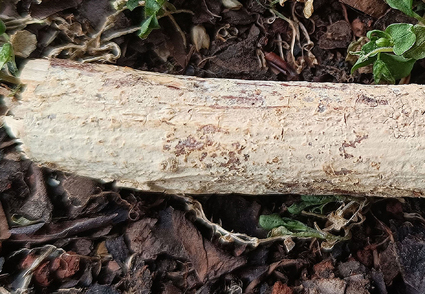
Vararia yunnanensis sp. nov. is proposed based on a combination of morphological features and molecular evidence. Vararia yunnanensis is characterized by the resupinate basidiomata with a cracking hymenial surface, a dimitic hyphal system with generative hyphae bearing simple-septa, and colorless, slightly thick-walled, smooth, amyloid basidiospores measuring 5–12 × 3.5–9 µm. The phylogenetic analyses of ITS+nLSU in Russulales showed that V. yunnanensis nested into the family Peniophoraceae, in which V. yunnanensis grouped within the genus Vararia. Furthermore, the ITS sequence data indicated that the new species is sister to Vararia ellipsospora.
References
Bernicchia, A. & Gorjón, S.P. (2010) Fungi Europaei 12: Corticiaceae s.l. Alassio: Edizioni Candusso. Lomazzo 12: 1008.
Boidin, J. (1967) Basidiomycètes Lachnocladiaceae résupinés de la Republique Centrafricaine. Cahiers de La Maboké 5: 23–35.
Boidin, J. (1980) Application du concept biologique del’espèce aux Basidiomycètes. Le genre Vararia section Vararia au Gabon. Cryptogamie Mycologie 1: 265–384.
Boidin, J., Gilles, G. & Lanquetin, P. (1987) Basidiomycètes Aphyllophorales de l’Île de la Réunion. IX - Les genres Dichostereum Pilat et Vararia Karsten. Bulletin de la Société Mycologique de France 103: 119–135.
Boidin, J. & Lanquetin, P. (1975) Vararia subgenus Vararia (Basidiomycetes, Lachnocladiaceae): étude spèciale des espèces d’ Afrique intertropicale. Bulletin de la Société Mycologique de France 91: 457–513.
Boidin, J. & Lanquetin, P. (1984) Compléments au genre Vararia P. Karst. (Basidiomycetes). Persoonia 12: 243–262.
Boidin, J. & Lanquetin, P. (1987) Le genre Scytinostroma Donk (Basidiomycetes, Lachnocladiaceae). Bibliotheca Mycologica 114: 1–130.
Boidin, J., Lanquetin, P. & Gilles, G. (1980) Application du concept biologique del’espèce aux Basidiomycètes. Le genre Vararia section Vararia au Gabon. Cryptogamie Mycologie 1: 265–384.
Cunningham, G.H. (1955) Thelephoraceae of New Zealand. Part IV. The genus Vararia. Transactions and Proceedings of the Royal Society of New Zealand 82: 973–985.
Dai, Y.C. (2012) Two new polypores from tropical China, and renaming two species in Polyporus and Phellinus. Mycoscience 53: 40–44. https://doi.org/10.1007/s10267-011-0135-2
Dai, Y.C., Cui, B.K., Si, J., He, S.H., Hyde, K.D., Yuan, H.S., Liu, X.Y. & Zhou, L.W. (2015) Dynamics of the worldwide number of fungi with emphasis on fungal diversity in China. Mycological Progress 14: 62.
Fan, L.F., Wu, Y.D., Wu, F. & Dai, Y.C. (2021) Calocera tibetica sp. nov. (Dacrymycetaceae, Dacrymycetales) from southwestern China. Phytotaxa 500 (2): 133–141. https://doi.org/10.11646/phytotaxa.500.2.6
Felsenstein, J. (1985) Confidence intervals on phylogenetics: an approach using bootstrap. Evolution 39: 783–791. https://doi.org/10.2307/2408678
Grosse-Brauckmann, H. & Kummer, V. (2004) Fünf bemerkenswerte Funde corticioider Pilze aus Deutschland. Feddes Repertorium 115: 90–101. https://doi.org/10.1002/fedr.200311029
Guan, Q.X., Zhao, W. & Zhao C.L. (2021) A new species of Punctularia (Punctulariaceae, Basidiomycota) from southwest China. Phytotaxa 489 (3): 285–292. https://doi.org/10.11646/phytotaxa.489.3.5
Hibbett, D.S. Gilbert, L.B. & Donoghue, M.J. (2000) Evolutionary instability of ectomycorrhizal symbioses in Basidiomycetes. Nature 407: 506–508. https://doi.org/10.1038/35035065
Jiang, N., Voglmayr, H., Bian, D. R., Piao, C.G., Wang, S.K. & Li, Y. (2021). Morphology and phylogeny of Gnomoniopsis (Gnomoniaceae, Diaporthales) from fagaceae leaves in China. Journal of Fungi 7: 792. https://doi.org/10.3390/jof7100792
Karsten, P.A. (1898) Kritisk Ofversigt af Finlands Basidsvampar. Biology 3: 1–36.
Katoh, K., Rozewicki, J. & Yamada, K.D. (2019) MAFFT online service: multiple sequence alignment, interactive sequence choice and visualization. Briefings in Bioinformatics 20: 1160–1166. https://doi.org/10.1093/bib/bbx108
Lanquetin, P. (1973) Utilisation des cultures dans la systeìmatique des Vararia Karst subg. Dichostereum (Pilat) Boid. (Basidiomycètes Lachnocladiaceae). Bulletin Mensuel De La Socieìteì Linneìenne De Lyon 42: 167–192. https://doi.org/10.3406/linly.1973.10071
Larsson, A. (2014) AliView: a fast and lightweight alignment viewer and editor for large data sets. Bioinformatics 30: 3276–3278. https://dx.doi.org/10.1093/bioinformatics/btu531
Larsson, E. & Larsson, K.H. (2003) Phylogenetic relationships of russuloid Basidiomycetes with emphasis on aphyllophoralean taxa. Mycologia 95: 1037–1065. https://doi.org/10.1080/15572536.2004.11833020
Leal-Dutra, C.A., Neves, M.A., Griffith, G.W., Reck, M.A., Clasen, L.A. & Dentinger, B.T.M. (2018) Reclassification of Parapterulicium Corner (Pterulaceae, Agaricales), contributions to Lachnocladiaceae and Peniophoraceae (Russulales) and introduction of Baltazaria gen. nov. MycoKeys 37: 39–56. https://doi.org/10.3897/mycokeys.37.26303.
Liu, S.L. & He, S.H. (2016) The genus Vararia (Russulales, Basidiomycota) in China. Two new species and two new Chinese records. Nordic Journal of Botany 34: 553–558. https://doi.org/10.1111/njb.01170
Liu, S.L. & He, S.H. (2018) Taxonomy and phylogeny of Dichostereum (Russulales), with descriptions of three new species from southern China. MycoKeys 40: 111–126. https://doi.org/10.3897/mycokeys.40.28700
Liu, S.L. (2019) Taxonomy and phylogeny of Vararia and related genera in China. Beijing Forestry University.
Liu, S.L., Nakasone, K.K. & He, S.H. (2019) Michenera incrustata sp. nov. (Peniophoraceae, Russulales) from southern China. Nova Hedwigia 108: 197–206. https://doi.org/10.1127/nova_hedwigia/2018/0500
Liu, S.L., Tian, Y., Nie, T., Thawthong, A., Hyde, K.D., Xu, L.L. & He, S.H. (2017) Updates on East Asian Asterostroma (Russulales, Basidiomycota): new species and new records from Thailand and China. Mycological Progress 16: 667–676. https://doi.org/10.1007/s11557-017-1301-5
Ma, X. & Zhao C.L. (2021) Xylodon bambusinus and X. xinpingensis spp. nov. (Hymenochaetales) from southern China. Phytotaxa 511 (3): 231–247. https://doi.org/10.11646/phytotaxa.511.3.3
Miller, M.A., Holder, M.T., Vos, R., Midford, P.E., Liebowitz, T., Chan, L., Hoover, P. & Warnow, T. (2009) The CIPRES Portals. CIPRES. [http://www.phylo.org/sub_sections/portal] [http://www.webcitation.org/5imQlJeQa]
Núñez, M. & Ryvarden, L. (2001) East Asian polypores 2. Synopsis Fungorum 14: 165–522.
Nylander, J.A.A. (2004) MrModeltest v2. Program distributed by the author. Uppsala: Evolutionary Biology Centre, Uppsala University. Uppsala, Sweden.
Parmasto, E. (1968) Conspectus Systematis Corticiacearum. Institutum Zoologicum et Botanicum Academiae Scientiarum R.P.S.S. Estonicae, Tartu 261 pp.
Petersen, J.H. (1996) Farvekort. The Danish Mycological Society’s colour-chart. Foreningen til Svampekundskabens Fremme, Greve.
Qu, M.H., Wang, D.Q. & Zhao, C.L. (2022) A phylogenetic and taxonomic study on Xylodon (Hymenochaetales): focusing on three new Xylodon species from Southern China. Journal of Fungi 8: 35. https://doi.org/10.3390/jof8010035
Ronquist, F. & Huelsenbeck, J.P. (2003) Mrbayes 3: bayesian phylogenetic inference under mixed models. Bioinformatics 19: 1572–1574. https://doi.org/10.1093/bioinformatics/btg180.
Ryvarden, L. & Melo, I. (2014) Poroid fungi of Europe. Synopsis Fungorum 31: 1–455.
Stalpers, J.A. (1996) The aphyllophoraceous fungi II. Keys to the species of the Hericiales. Studies in Mycology 40: 1–183.
Suhara, H., Maekawa, N., Ushijima, S., Kinjo, K. & Hoshi, Y. (2010) Asterostroma species (Basidiomycota) from mangrove forests in Japan. Mycoscience 51: 75–80. https://doi.org/10.1007/S10267-009-0006-2
Swofford, D.L. (2002) PAUP*: phylogenetic analysis using parsimony (*and other methods). Version 4.0b10. Sinauer Associates, Massachusetts.
Vu, D., Groenewald, M., de Vries, M., Gehrmann, T., Stielow, B., Eberhardt, U., Al-Hatmi, A., Groenewald, J. Z., Cardinali, G., Houbraken, J., Boekhout, T., Crous, P.W., Robert, V. & Verkley, G.J.M. (2019) Large-scale generation and analysis of filamentous fungal DNA barcodes boosts coverage for kingdom fungi and reveals thresholds for fungal species and higher taxon delimitation. Studies in Mycology 92: 135–154. https://doi.org/10.1016/j.simyco.2018.05.001
Wang, H. & Zhao, C.L. (2021) Hyphodermella aurantiaca sp. nov. (Polyporales, Basidiomycota) as evidenced by morphological characters and phylogenetic analyses. Annales Botanici Fennici 58: 61–68. https://doi.org/10.5735/085.058.0110
Wang, H., He, X. & Zhao, C.L. (2020) Scytinostroma yunnanense sp. nov. (Russulales, Basidiomycota) evidenced by morphological characteristics and phylogenetic analyses in China. Phytotaxa 451 (2): 145–153. https://doi.org/10.11646/phytotaxa.451.2.4
Welden, A.L. (1965) West Indian species of Vararia with notes on extralimital species. Mycologia 57: 502–520. https://doi.org/10.1080/00275514.1965.12018236
White, T.J., Bruns, T., Lee, S. & Taylor, J. (1990) Amplification and direct sequencing of fungal ribosomal RNA genes for phylogenetics. PCR protocols: a guide to methods and applications 18: 315–322. https://doi.org/10.1016/B978-0-12-372180-8.50042-1
Wu, F., Man, X.W., Tohtirjap, A. & Dai, Y.C. (2022) A comparison of polypore funga and species composition in forest ecosystems of China, North America, and Europe. Forest Ecosystems: 100051. https://doi.org//10.1016/j.fecs.2022.100051
Wu, F., Zhou, L.W., Vlasák, J. & Dai, Y.C. (2022a) Global diversity and systematics of Hymenochaetaceae with poroid hymenophore. Fungal Divers 113: 1–192. https://doi.org/10.1007/s13225-021-00496-4
Zhao, C.L. & Wu, Z.Q. (2017) Ceriporiopsis kunmingensis sp. nov. (polyporales, basidiomycota) evidenced by morphological characters and phylogenetic analysis. Mycological Progress 16: 93–100. https://doi.org/10.1007/s11557-016-1259-8
Zong, T.K., Wu, J.R. & Zhao C.L. (2021) Three new Xenasmatella (Polyporales, Basidiomycota) species from China. Phytotaxa 489 (2): 111–120. https://doi.org/10.11646/phytotaxa.489.2.1
Boidin, J. (1967) Basidiomycètes Lachnocladiaceae résupinés de la Republique Centrafricaine. Cahiers de La Maboké 5: 23–35.
Boidin, J. (1980) Application du concept biologique del’espèce aux Basidiomycètes. Le genre Vararia section Vararia au Gabon. Cryptogamie Mycologie 1: 265–384.
Boidin, J., Gilles, G. & Lanquetin, P. (1987) Basidiomycètes Aphyllophorales de l’Île de la Réunion. IX - Les genres Dichostereum Pilat et Vararia Karsten. Bulletin de la Société Mycologique de France 103: 119–135.
Boidin, J. & Lanquetin, P. (1975) Vararia subgenus Vararia (Basidiomycetes, Lachnocladiaceae): étude spèciale des espèces d’ Afrique intertropicale. Bulletin de la Société Mycologique de France 91: 457–513.
Boidin, J. & Lanquetin, P. (1984) Compléments au genre Vararia P. Karst. (Basidiomycetes). Persoonia 12: 243–262.
Boidin, J. & Lanquetin, P. (1987) Le genre Scytinostroma Donk (Basidiomycetes, Lachnocladiaceae). Bibliotheca Mycologica 114: 1–130.
Boidin, J., Lanquetin, P. & Gilles, G. (1980) Application du concept biologique del’espèce aux Basidiomycètes. Le genre Vararia section Vararia au Gabon. Cryptogamie Mycologie 1: 265–384.
Cunningham, G.H. (1955) Thelephoraceae of New Zealand. Part IV. The genus Vararia. Transactions and Proceedings of the Royal Society of New Zealand 82: 973–985.
Dai, Y.C. (2012) Two new polypores from tropical China, and renaming two species in Polyporus and Phellinus. Mycoscience 53: 40–44. https://doi.org/10.1007/s10267-011-0135-2
Dai, Y.C., Cui, B.K., Si, J., He, S.H., Hyde, K.D., Yuan, H.S., Liu, X.Y. & Zhou, L.W. (2015) Dynamics of the worldwide number of fungi with emphasis on fungal diversity in China. Mycological Progress 14: 62.
Fan, L.F., Wu, Y.D., Wu, F. & Dai, Y.C. (2021) Calocera tibetica sp. nov. (Dacrymycetaceae, Dacrymycetales) from southwestern China. Phytotaxa 500 (2): 133–141. https://doi.org/10.11646/phytotaxa.500.2.6
Felsenstein, J. (1985) Confidence intervals on phylogenetics: an approach using bootstrap. Evolution 39: 783–791. https://doi.org/10.2307/2408678
Grosse-Brauckmann, H. & Kummer, V. (2004) Fünf bemerkenswerte Funde corticioider Pilze aus Deutschland. Feddes Repertorium 115: 90–101. https://doi.org/10.1002/fedr.200311029
Guan, Q.X., Zhao, W. & Zhao C.L. (2021) A new species of Punctularia (Punctulariaceae, Basidiomycota) from southwest China. Phytotaxa 489 (3): 285–292. https://doi.org/10.11646/phytotaxa.489.3.5
Hibbett, D.S. Gilbert, L.B. & Donoghue, M.J. (2000) Evolutionary instability of ectomycorrhizal symbioses in Basidiomycetes. Nature 407: 506–508. https://doi.org/10.1038/35035065
Jiang, N., Voglmayr, H., Bian, D. R., Piao, C.G., Wang, S.K. & Li, Y. (2021). Morphology and phylogeny of Gnomoniopsis (Gnomoniaceae, Diaporthales) from fagaceae leaves in China. Journal of Fungi 7: 792. https://doi.org/10.3390/jof7100792
Karsten, P.A. (1898) Kritisk Ofversigt af Finlands Basidsvampar. Biology 3: 1–36.
Katoh, K., Rozewicki, J. & Yamada, K.D. (2019) MAFFT online service: multiple sequence alignment, interactive sequence choice and visualization. Briefings in Bioinformatics 20: 1160–1166. https://doi.org/10.1093/bib/bbx108
Lanquetin, P. (1973) Utilisation des cultures dans la systeìmatique des Vararia Karst subg. Dichostereum (Pilat) Boid. (Basidiomycètes Lachnocladiaceae). Bulletin Mensuel De La Socieìteì Linneìenne De Lyon 42: 167–192. https://doi.org/10.3406/linly.1973.10071
Larsson, A. (2014) AliView: a fast and lightweight alignment viewer and editor for large data sets. Bioinformatics 30: 3276–3278. https://dx.doi.org/10.1093/bioinformatics/btu531
Larsson, E. & Larsson, K.H. (2003) Phylogenetic relationships of russuloid Basidiomycetes with emphasis on aphyllophoralean taxa. Mycologia 95: 1037–1065. https://doi.org/10.1080/15572536.2004.11833020
Leal-Dutra, C.A., Neves, M.A., Griffith, G.W., Reck, M.A., Clasen, L.A. & Dentinger, B.T.M. (2018) Reclassification of Parapterulicium Corner (Pterulaceae, Agaricales), contributions to Lachnocladiaceae and Peniophoraceae (Russulales) and introduction of Baltazaria gen. nov. MycoKeys 37: 39–56. https://doi.org/10.3897/mycokeys.37.26303.
Liu, S.L. & He, S.H. (2016) The genus Vararia (Russulales, Basidiomycota) in China. Two new species and two new Chinese records. Nordic Journal of Botany 34: 553–558. https://doi.org/10.1111/njb.01170
Liu, S.L. & He, S.H. (2018) Taxonomy and phylogeny of Dichostereum (Russulales), with descriptions of three new species from southern China. MycoKeys 40: 111–126. https://doi.org/10.3897/mycokeys.40.28700
Liu, S.L. (2019) Taxonomy and phylogeny of Vararia and related genera in China. Beijing Forestry University.
Liu, S.L., Nakasone, K.K. & He, S.H. (2019) Michenera incrustata sp. nov. (Peniophoraceae, Russulales) from southern China. Nova Hedwigia 108: 197–206. https://doi.org/10.1127/nova_hedwigia/2018/0500
Liu, S.L., Tian, Y., Nie, T., Thawthong, A., Hyde, K.D., Xu, L.L. & He, S.H. (2017) Updates on East Asian Asterostroma (Russulales, Basidiomycota): new species and new records from Thailand and China. Mycological Progress 16: 667–676. https://doi.org/10.1007/s11557-017-1301-5
Ma, X. & Zhao C.L. (2021) Xylodon bambusinus and X. xinpingensis spp. nov. (Hymenochaetales) from southern China. Phytotaxa 511 (3): 231–247. https://doi.org/10.11646/phytotaxa.511.3.3
Miller, M.A., Holder, M.T., Vos, R., Midford, P.E., Liebowitz, T., Chan, L., Hoover, P. & Warnow, T. (2009) The CIPRES Portals. CIPRES. [http://www.phylo.org/sub_sections/portal] [http://www.webcitation.org/5imQlJeQa]
Núñez, M. & Ryvarden, L. (2001) East Asian polypores 2. Synopsis Fungorum 14: 165–522.
Nylander, J.A.A. (2004) MrModeltest v2. Program distributed by the author. Uppsala: Evolutionary Biology Centre, Uppsala University. Uppsala, Sweden.
Parmasto, E. (1968) Conspectus Systematis Corticiacearum. Institutum Zoologicum et Botanicum Academiae Scientiarum R.P.S.S. Estonicae, Tartu 261 pp.
Petersen, J.H. (1996) Farvekort. The Danish Mycological Society’s colour-chart. Foreningen til Svampekundskabens Fremme, Greve.
Qu, M.H., Wang, D.Q. & Zhao, C.L. (2022) A phylogenetic and taxonomic study on Xylodon (Hymenochaetales): focusing on three new Xylodon species from Southern China. Journal of Fungi 8: 35. https://doi.org/10.3390/jof8010035
Ronquist, F. & Huelsenbeck, J.P. (2003) Mrbayes 3: bayesian phylogenetic inference under mixed models. Bioinformatics 19: 1572–1574. https://doi.org/10.1093/bioinformatics/btg180.
Ryvarden, L. & Melo, I. (2014) Poroid fungi of Europe. Synopsis Fungorum 31: 1–455.
Stalpers, J.A. (1996) The aphyllophoraceous fungi II. Keys to the species of the Hericiales. Studies in Mycology 40: 1–183.
Suhara, H., Maekawa, N., Ushijima, S., Kinjo, K. & Hoshi, Y. (2010) Asterostroma species (Basidiomycota) from mangrove forests in Japan. Mycoscience 51: 75–80. https://doi.org/10.1007/S10267-009-0006-2
Swofford, D.L. (2002) PAUP*: phylogenetic analysis using parsimony (*and other methods). Version 4.0b10. Sinauer Associates, Massachusetts.
Vu, D., Groenewald, M., de Vries, M., Gehrmann, T., Stielow, B., Eberhardt, U., Al-Hatmi, A., Groenewald, J. Z., Cardinali, G., Houbraken, J., Boekhout, T., Crous, P.W., Robert, V. & Verkley, G.J.M. (2019) Large-scale generation and analysis of filamentous fungal DNA barcodes boosts coverage for kingdom fungi and reveals thresholds for fungal species and higher taxon delimitation. Studies in Mycology 92: 135–154. https://doi.org/10.1016/j.simyco.2018.05.001
Wang, H. & Zhao, C.L. (2021) Hyphodermella aurantiaca sp. nov. (Polyporales, Basidiomycota) as evidenced by morphological characters and phylogenetic analyses. Annales Botanici Fennici 58: 61–68. https://doi.org/10.5735/085.058.0110
Wang, H., He, X. & Zhao, C.L. (2020) Scytinostroma yunnanense sp. nov. (Russulales, Basidiomycota) evidenced by morphological characteristics and phylogenetic analyses in China. Phytotaxa 451 (2): 145–153. https://doi.org/10.11646/phytotaxa.451.2.4
Welden, A.L. (1965) West Indian species of Vararia with notes on extralimital species. Mycologia 57: 502–520. https://doi.org/10.1080/00275514.1965.12018236
White, T.J., Bruns, T., Lee, S. & Taylor, J. (1990) Amplification and direct sequencing of fungal ribosomal RNA genes for phylogenetics. PCR protocols: a guide to methods and applications 18: 315–322. https://doi.org/10.1016/B978-0-12-372180-8.50042-1
Wu, F., Man, X.W., Tohtirjap, A. & Dai, Y.C. (2022) A comparison of polypore funga and species composition in forest ecosystems of China, North America, and Europe. Forest Ecosystems: 100051. https://doi.org//10.1016/j.fecs.2022.100051
Wu, F., Zhou, L.W., Vlasák, J. & Dai, Y.C. (2022a) Global diversity and systematics of Hymenochaetaceae with poroid hymenophore. Fungal Divers 113: 1–192. https://doi.org/10.1007/s13225-021-00496-4
Zhao, C.L. & Wu, Z.Q. (2017) Ceriporiopsis kunmingensis sp. nov. (polyporales, basidiomycota) evidenced by morphological characters and phylogenetic analysis. Mycological Progress 16: 93–100. https://doi.org/10.1007/s11557-016-1259-8
Zong, T.K., Wu, J.R. & Zhao C.L. (2021) Three new Xenasmatella (Polyporales, Basidiomycota) species from China. Phytotaxa 489 (2): 111–120. https://doi.org/10.11646/phytotaxa.489.2.1