

Abstract
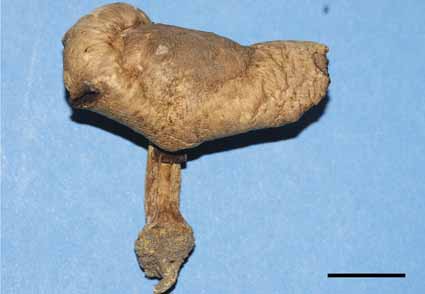
Original morphological descriptions and newly generated ribosomal DNA sequence data of A. bresadolanus, “A. infidus” and A. romagnesii are compared in this manuscript. In 23 specimens we evaluated the main morphological characters traditionally used to distinguish these taxa: shape of the stipe base, odour, size and shape of spores, presence/absence of cheilocystidia, and toxicity. The ITS rDNA region was sequenced in all specimens, except for an authentic collection of A. romagnesii (KW-M 71176) and two specimens with subglobose spores attributed to “A. infidus” (as A. alessii nom. inval.) by Curreli & Contu. No diagnostic molecular characters were found among all specimens examined that would justify the separation of the originally described entities A. bresadolanus, “A. infidus” and A. romagnesii. Based on our analysis of the morphological and molecular characters, we conclude that all three entities belong to a single taxon, whose correct name is A. bresadolanus based on priority over A. romagnesii. The apparent contradiction between the ellipsoid spores found by us in the two specimens of “A. infidus” identified by Alessio and the subglobose spores depicted by him in the original publication is explained by the extreme variability of the spore shape in this taxon. Our morphological study of the two specimens identified as “A. alessii” suggests that they might belong to A. pseudopratensis a member of A. sect. Xanthodermatei or to an unknown taxon. Nomenclatural problems of the names “A. infidus”, “A. alessii” and A. bresadolanus are revisited and it is concluded that the two first names are invalidly published.
References
<p align="justify"><span style="color: #000000;"><span style="font-family: Times New Roman, serif;"><span style="font-size: small;">Alessio, C.L. (1984) Le vicissitudini nomenclatoriali d’uno sventurato “prataiolo”. Micologia Italiana 13 (3): 57–60.</span></span></span>
<p align="justify"><span style="color: #000000;"><span style="font-family: Times New Roman, serif;"><span style="font-size: small;">Altschul, S.F., Gish, W., Miller, W., Myers, E.W. & Lipman, D.J. (1990) Basic local alignment search tool. Journal of Molecular Biology 215: 403–410. https://doi.org/10.1016/S0022-2836(05)80360-2</span></span></span>
<p align="justify"><span style="color: #000000;"><span style="font-family: Times New Roman, serif;"><span style="font-size: small;">Arya, C.P., Manoj-Kumar, A., Pradeed, C.K & Parra, L.A. (2022) Agaricus brunneodiscus, a new species of Agaricus section Rarolentes from India. Phytotaxa 533 (4): 181–193. https://doi.org/10.11646/phytotaxa.533.4.1</span></span></span>
<p align="justify"><span style="color: #000000;"><span style="font-family: Times New Roman, serif;"><span style="font-size: small;">Bohus, G. (1969) Agaricus Studies II. Annales Historico–Naturales Musei Nationalis Hungarici 61: 151–156.</span></span></span>
<p align="justify"><span style="color: #000000;"><span style="font-family: Times New Roman, serif;"><span style="font-size: small;">Bohus, G. (1971) Agaricus Studies III. Annales Historico–Naturales Musei Nationalis Hungarici 63: 77–82.</span></span></span>
<p align="justify"><span style="color: #000000;"><span style="font-family: Times New Roman, serif;"><span style="font-size: small;">Bon, M. (1981) Combinations et noms nouveaux. Documents Mycologiques 11 (44): 28.</span></span></span>
<p align="justify"><span style="color: #000000;"><span style="font-family: Times New Roman, serif;"><span style="font-size: small;">Bon, M. & Cappelli, A. (1983) Novitates. Genre Agaricus. Documents Mycologiques 13 (52): 16.</span></span></span>
<p align="justify"><span style="color: #000000;"><span style="font-family: Times New Roman, serif;"><span style="font-size: small;">Bresadola, G. (1931) Iconographia Mycologica 17. Società Botanica Italiana Museo Civico di Storia Naturalle di Trento, Milano, Italy, 5 pp. </span></span></span>
<p align="justify"><span style="color: #000000;"><span style="font-family: Times New Roman, serif;"><span style="font-size: small;">Cappelli, A. (1984) Fungi Europaei 1 (Agaricus). Libreria editrice Giovanna Biella, Saronno, Italy, 560 pp.</span></span></span>
<p align="justify"><span style="color: #000000;"><span style="font-family: Times New Roman, serif;"><span style="font-size: small;">Cappelli, A. (2010) Approccio al Genere Agaricus II. Rivista di Micologia 53 (3): 195–210.</span></span></span>
<p align="justify"><span style="color: #000000;"><span style="font-family: Times New Roman, serif;"><span style="font-size: small;">Consiglio, G. (1999) Contributo alla conoscenza del macromiceti della regione Emilia-Romagna – XIV, genere Agaricus. Micologia e Vegetazione Mediterranea 14 (1): 3–18.</span></span></span>
<p align="justify"><span style="color: #000000;"><span style="font-family: Times New Roman, serif;"><span style="font-size: small;">Cooke, M.C. & Quélet, L. (1878) Clavis Synoptica Hymenomycetum Europaeorum, Hardwicke & Bogue, London, 240 pp.</span></span></span>
<p align="justify"><span style="color: #000000;"><span style="font-family: Times New Roman, serif;"><span style="font-size: small;">Curreli, S. & Contu, M. (1991) Agaricus alessii (Psalliota infida Alessio) una specie della sezione Xanthodermatei dalla posizione tassonomica discussa. Micologia Veneta 7 (1): 9–13.</span></span></span>
<p align="justify"><span style="color: #000000;"><span style="font-family: Times New Roman, serif;"><span style="font-size: small;">Darriba, D., Taboada, G.L., Doallo, R. & Posada, D. (2012) jModelTest 2: more models, new heuristics and parallel computing. Nature Methods 9: 772. https://doi.org/10.1038/nmeth.2109</span></span></span>
<p align="justify"><span style="color: #000000;"><span style="font-family: Times New Roman, serif;"><span style="font-size: small;">Dörfelt, H. (1975) Zur Kenntnis der Pilzflora des Greizer Waldes. Veröffentlichungen Museen der Stadt Gera. Naturwissenschaftliche Reihe 2–3: 40–74.</span></span></span>
<p align="justify"><span style="color: #000000;"><span style="font-family: Times New Roman, serif;"><span style="font-size: small;">Earle, F.S. (1903) A key to the North American species of Inocybe I. Torreya 3 (11): 168–170.</span></span></span>
<p align="justify"><span style="color: #000000;"><span style="font-family: Times New Roman, serif;"><span style="font-size: small;">Edwards, A. & Leech, T. (2014) Agaricus bresadolanus—a toxic mushroom. Field Mycology 15 (4): 113–114. https://doi.org/10.1016/j.fldmyc.2014.09.004</span></span></span>
<p align="justify"><span style="color: #000000;"><span style="font-family: Times New Roman, serif;"><span style="font-size: small;">Essette, H. (1964) Les psalliotes. Éditions Paul Lechevalier, Paris, 136 pp.</span></span></span>
<p align="justify"><span style="color: #000000;"><span style="font-family: Times New Roman, serif;"><span style="font-size: small;">Felsenstein, J. (1985) Confidence limits on phylogenies: an approach using the bootstrap. Evolution 39: 783–791. https://doi.org/10.2307/2408678</span></span></span>
<p align="justify"><span style="color: #000000;"><span style="font-family: Times New Roman, serif;"><span style="font-size: small;">Fries, E.M. (1821) Systema Mycologicum 1. Officina Berlingiana, Lund, 520 pp.</span></span></span>
<p align="justify"><span style="color: #000000;"><span style="font-family: Times New Roman, serif;"><span style="font-size: small;">Gardes, M. & Bruns, T.D. (1993) ITS primers with enhanced specificity for basidiomycetes–Application to the identification of mycorrhizae and rusts. Molecular Ecology 2 (2): 113–118. https://doi.org/10.1111/j.1365-294X.1993.tb00005.x</span></span></span>
<p align="justify"><span style="color: #000000;"><span style="font-family: Times New Roman, serif;"><span style="font-size: small;">Heim, R. (1957) Les Champignons d’Europe 2. N. Boubée & Cie, Paris, 572 pp.</span></span></span>
<p align="justify"><span style="color: #000000;"><span style="font-family: Times New Roman, serif;"><span style="font-size: small;">Heinemann, P. & Rammeloo, J. (1985) De la mesure des spores et son expression. Agarica 6: 366–380.</span></span></span>
<p align="justify"><span style="color: #000000;"><span style="font-family: Times New Roman, serif;"><span style="font-size: small;">Ihrmark, K., Bödeker, I.T.M., Cruz-Martínez, K., Friberg, H., Kubartova, A., Schenck, J., Strid, Y., Stenlid, J., Brandström-Durling, M., Clemmensen, K.E. & Lindahl, B.D. (2012) New primers to amplify the fungal ITS2 region–evaluation by 454-sequencing of artificial and natural communities. FEMS Microbiology Ecology 82: 666–677. https://doi.org/10.1111/j.1574-6941.2012.01437.x</span></span></span>
<p align="justify"><span style="color: #000000;"><span style="font-family: Times New Roman, serif;"><span style="font-size: small;">Katoh, K., Misawa, K., Kuma, K. & Miyata, T. (2002) MAFFT: a novel method for rapid multiple sequence alignment based on fast Fourier transform. Nucleic Acids Research 30 (14): 3059–3066. https://doi.org/10.1093/nar/gkf436</span></span></span>
<p align="justify"><span style="color: #000000;"><span style="font-family: Times New Roman, serif;"><span style="font-size: small;">Kerrigan, R.W., Callac, P., Challen, M., Guinberteau, J. & Parra, L.A. (2006) [“2005”] Agaricus section Xanthodermatei: a phylogenetic reconstruction with commentary on taxa. Mycologia 97 (6): 1292–1315. https://doi.org/10.1080/15572536.2006.11832737</span></span></span>
<p align="justify"><span style="color: #000000;"><span style="font-family: Times New Roman, serif;"><span style="font-size: small;">Kozlov, A.M., Darriba, D., Flouri, T., Morel, B. & Stamatakis, A. (2019) RAxML-NG: a fast, scalable and user-friendly tool for maximum likelihood phylogenetic inference. Bioinformatics 35 (21): 4453–4455. https://doi.org/10.1093/bioinformatics/btz305</span></span></span>
<p align="justify"><span style="color: #000000;"><span style="font-family: Times New Roman, serif;"><span style="font-size: small;">Kühner, R. & Romagnesi, H. (1953) Flore analytique des champignons supérieurs (Agarics, Boletes, Chantarelles), Masson et CIE, Paris, 556 pp. </span></span></span>
<p align="justify"><span style="color: #000000;"><span style="font-family: Times New Roman, serif;"><span style="font-size: small;">Holmgren, P.K., Holmgren, N.H. & Barnett, L.C. (1990) Index Herbariorum. Part. I : The herbaria of the world, Regnum Vegetabile 159, The New York Botanic Garden Press, New York, 704 pp.</span></span></span>
<p align="justify"><span style="color: #000000;"><span style="font-family: Times New Roman, serif;"><span style="font-size: small;">Ling, Z.-L., Zhou, J.-L., Parra, L.A., De Kesel, A., Callac, P., Cao, B., He, M.-Q. & Zhao, R.-L. (2021) Four new species of Agaricus subgenus Spissicaules from China. Mycologia 113 (2): 476–491. https://doi.org/10.11646/phytotaxa.533.4.1</span></span></span>
<p align="justify"><span style="color: #000000;"><span style="font-family: Times New Roman, serif;"><span style="font-size: small;">Linnaeus, C. (1753) Species Plantarum. Impensis Laurentii Salvii, Holmiae, 1200 pp.</span></span></span>
<p align="justify"><span style="color: #000000;"><span style="font-family: Times New Roman, serif;"><span style="font-size: small;">Murray, M.G. & Thompson, W.F. (1980) Rapid isolation of high molecular weight plant DNA. Nucleic Acids Research 8: 4321–4326. https://doi.org/10.1093/nar/8.19.4321</span></span></span>
<p align="justify"><span style="color: #000000;"><span style="font-family: Times New Roman, serif;"><span style="font-size: small;">Nauta, M.M. (1999) Notulae ad floram agaricinam neerlandicam – XXXIII. Notes on Agaricus section Spissicaules. Persoonia 17 (2): 221–233.</span></span></span>
<p align="justify"><span style="color: #000000;"><span style="font-family: Times New Roman, serif;"><span style="font-size: small;">Nauta, M.M. (2001) 1. Agaricus L. In: Noordeloos, M.E., Kuyper, T.W. & Vellinga, E.C. (eds.) Flora Agaricina Neerlandica 5. A.A. Balkema publishers, Lisse, pp. 23–61.</span></span></span>
<p align="justify"><span style="color: #000000;"><span style="font-family: Times New Roman, serif;"><span style="font-size: small;">Ortiz-Santana, B., Chen, J., Parra, L.A., Angelini, C., Jean-Lodge, D., Kerrigan, R.W. & Callac, P. (2021) The genus Agaricus in the Caribbean II. Refined phylogeny of Agaricus subg. Spissicaules with description of two new sections and eight new species. Mycological Progress 20: 381–411. https://doi.org/10.1007/s11557-021-01686-9</span></span></span>
<p align="justify"><span style="color: #000000;"><span style="font-family: Times New Roman, serif;"><span style="font-size: small;">Parra, L.A. (2008) Fungi Europaei 1. Agaricus L. Allopsalliota Nauta & Bas. Edizioni Candusso, Alasssio, 824 pp.</span></span></span>
<p align="justify"><span style="color: #000000;"><span style="font-family: Times New Roman, serif;"><span style="font-size: small;">Peck, C.H. (1875) Report of the Botanist. Report of the State Botanist, New York State Museum 27: 74–116.</span></span></span>
<p align="justify"><span style="color: #000000;"><span style="font-family: Times New Roman, serif;"><span style="font-size: small;">Pouchet, A. (1954) Toxicité de Psalliota radicata. Bulletin de la Société Linnéenne de Lyon 10: 259–260.</span></span></span>
<p align="justify"><span style="color: #000000;"><span style="font-family: Times New Roman, serif;"><span style="font-size: small;">Quélet, L. (1877) [“1876”] De quelques espèces nouvelles de champignons du Jura et des Vosges (suppl. 4). Bulletin de la Société Botanique de France 23: 324 (xl)–332 (xlviii). https://doi.org/10.1080/00378941.1876.10825683</span></span></span>
<p align="justify"><span style="color: #000000;"><span style="font-family: Times New Roman, serif;"><span style="font-size: small;">Rea, C. (1922) British Basidiomycetes. University Press, Cambridge, 799 pp.</span></span></span>
<p align="justify"><span style="color: #000000;"><span style="font-family: Times New Roman, serif;"><span style="font-size: small;">Reid, D.A. (1972) Fungorum Rariorum Icones Coloratae VI. Verlag von J. Cramer, Lehre, 64 pp.</span></span></span>
<p align="justify"><span style="color: #000000;"><span style="font-family: Times New Roman, serif;"><span style="font-size: small;">Relhan, R. (1786) Flora Cantabrigiensi Supplementum. Typis Academicis Excudebat J. Archdeacon, Cantabrigiae, 39 pp. </span></span></span>
<p align="justify"><span style="color: #000000;"><span style="font-family: Times New Roman, serif;"><span style="font-size: small;">Romagnesi, H. (1937) Liste des champignons supérieurs recueillis à Paris. Bulletin de la Société Mycologique de France 53: 117–133.</span></span></span>
<p align="justify"><span style="color: #000000;"><span style="font-family: Times New Roman, serif;"><span style="font-size: small;">Ronquist, F., Teslenko, M., Van der Mark, P., Ayres, D.L., Darling, A. Höhna, S., Larget, B., Liu, L. Suchard, M.A. & Huelsenbeck, J.P. (2012) MrBayes 3.2: efficient Bayesian phylogenetic inference and model choice across a large model space. Systematic Biology 61 (3): 539–542. https://doi.org/10.1093/sysbio/sys029</span></span></span>
<p align="justify"><span style="color: #000000;"><span style="font-family: Times New Roman, serif;"><span style="font-size: small;">Saccardo, P.A. (1887) Sylloge Fungorum V. Typis Seminarii, Patavii, 1146 pp.</span></span></span>
<p align="justify"><span style="color: #000000;"><span style="font-family: Times New Roman, serif;"><span style="font-size: small;">Turland, N.J., Wiersema, J.H., Barrie, F.R., Greuter, W., Hawksworth, D.L., Herendeen, P.S., Knapp, S., Kusber, W.-H., Li, D.-Z., Marhold, K., May, T.W., Mcneill, J., Monro, A.M., Prado, J., Price, M.J. & Smith, G.F. (2018) International Code of Nomenclature for algae, fungi, and plants (Shenzhen Code) adopted by the Nineteenth International Botanical Congress Shenzhen, China, July 2017. Regnum Vegetabile 159. Koeltz Botanical Books, Glashütten, 253 pp. https://doi.org/10.12705/Code.2018</span></span></span>
<p align="justify"><span style="color: #000000;"><span style="font-family: Times New Roman, serif;"><span style="font-size: small;">Vittadini, C. (1832) Descrizione dei Funghi Mangerecci 1–3. Tipografia e Libreria de Felice Rusconi, Milano, 364 pp.</span></span></span>
<p align="justify"><span style="color: #000000;"><span style="font-family: Times New Roman, serif;"><span style="font-size: small;">Wasser, S.P. (1976) Morphometry of spores and taxonomy of genus Agaricus Fr. emend. Karst. Ukrayins’kyi Bototanichnyi Zhurnal 33 (3): 305–308.</span></span></span>
<p align="justify"><span style="color: #000000;"><span style="font-family: Times New Roman, serif;"><span style="font-size: small;">Wasser, S.P. (1977) New and rare species of Agaricaceae Cohn. family. Ukrayins’kyi Bototanichnyi Zhurnal 34 (3): 305–308.</span></span></span>
<p align="justify"><span style="color: #000000;"><span style="font-family: Times New Roman, serif;"><span style="font-size: small;">Wasser, S.P. (1980) Flora Fungorum RSS Ucrainicae, Naukova Dumka, Kiev, 328 pp.</span></span></span>
<p align="justify"><span style="color: #000000;"><span style="font-family: Times New Roman, serif;"><span style="font-size: small;">Wasser, S.P. (1989) Tribe Agariceae Pat. of the Soviet Union, Koeltz Scientific Books, Konenigstein, 120 pp.</span></span></span>
<p align="justify"><span style="color: #000000;"><span style="font-family: Times New Roman, serif;"><span style="font-size: small;">White, T.M., Bruns, T., Lee, S. & Taylor, J. (1990) Amplification and direct sequencing of fungal ribosomal RNA for phylogenetics. In: Innis, M.A., Gelfand, D.H., Sninsky, J.J. & White, T.J. (Eds.) PCR Protocols A Guide to Methods and Applications. Academic Press, London, pp. 315–321. https://doi.org/10.1016/B978-0-12-372180-8.50042-1</span></span></span>
<p align="justify"><span style="color: #000000;"><span style="font-family: Times New Roman, serif;"><span style="font-size: small;">Zhao, R.-L., Zhou, J.-L., Chen, J., Margaritescu, S., Sánchez-Ramírez, S., Hyde, K.D., Callac, P., Parra, L.A., Li, G.-J. & Moncalvo, J.-M. (2016) Towards standardizing taxonomic ranks using divergence times – a case study for reconstruction of the Agaricus taxonomic system. Fungal Diversity 78 (1): 239–292. https://doi.org/10.1007/s13225-016-0357-x</span></span></span>