

Abstract
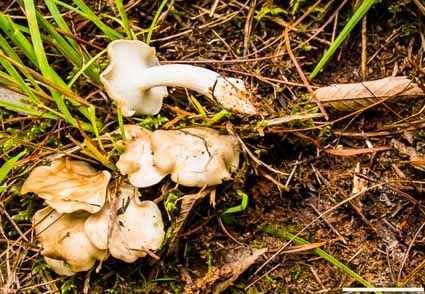
We describe a new species of Lyophyllum based on the morphology and molecular phylogenetic analyses. The species is widely distributed above ca. 2000 m in mixed forests dominated by Pinus yunnanensis, Pinus armandi, and Quercus fabrei in Yunnan Province. It can be distinguished by its greyish orange pileus surface, margin with waves when old; globose to subglobose spores (4.5–5.6 × 4.3–5.4 µm), clavate basidia (25–34 × 7–9 µm). Moreover, the growth rate of cultured mycelia of the species in the YPD medium is higher than that of L. decastes complex species under the same conditions. Phylogenetic analyses based on the internal transcribed spacer (ITS) and large ribosomal subunit (LSU) regions of the nuclear ribosomal DNA (nrDNA) indicated that L. pallidofumosum is a distinct taxon closely related to L. fumosum and L. shimeji.
References
<p align="justify"><span style="color: #000000;"><span style="font-family: Times New Roman, serif;"><span style="font-size: small;">Cooper, J.A. (2014) New species and combinations of some New Zealand agarics belonging to Clitopilus, Lyophyllum, Gerhardtia, Clitocybe, Hydnangium, Mycena, Rhodocollybia and Gerronema. Mycosphere 5: 263–288. https://doi.org/10.5943/mycosphere/5/2/2</span></span></span>
<p align="justify"><span style="color: #000000;"><span style="font-family: Times New Roman, serif;"><span style="font-size: small;">Darriba, D., Taboada, G., Doallo, R. & Posada, D. (2012) jModelTest 2: more models, new heuristics and parallel computing. Nature Methods 9: 772. https://doi.org/10.1038/nmeth.2109</span></span></span>
<p align="justify"><span style="color: #000000;"><span style="font-family: Times New Roman, serif;"><span style="font-size: small;">Endo, N., Ushijima, S., Nagasawa, E., Sugawara, R., Okuda, Y., Sotome, K., Nakagiri, A. & Maekawa, N. (2019) Taxonomic reconsideration of Tricholoma foliicola (Agaricales, Basidiomycota) based on basidiomata morphology, living culture characteristics, and phylogenetic analyses. Mycoscience 60: 323–330. https://doi.org/10.1016/j.myc.2019.07.002</span></span></span>
<p align="justify"><span style="color: #000000;"><span style="font-family: Times New Roman, serif;"><span style="font-size: small;">Fries, E.M. (1821) Systema Mycologicum. vol 1. Ex Officina Berlingiana, Lundae, 520 pp.</span></span></span>
<p align="justify"><span style="color: #000000;"><span style="font-family: Times New Roman, serif;"><span style="font-size: small;">Guindon, S. & Gascuel, O. (2003) A Simple, Fast, and Accurate Algorithm to Estimate Large Phylogenies by Maximum Likelihood. Systematic biology 52: 696–704. https://doi.org/10.1080/10635150390235520</span></span></span>
<p align="justify"><span style="color: #000000;"><span style="font-family: Times New Roman, serif;"><span style="font-size: small;">Hall, T.A. (1999) Bioedit: a user-friendly biological sequence alignment editor and analysis program for windows 95/98/ NT. Nucleic Acids Symposium Series 41: 95–98.</span></span></span>
<p align="justify"><span style="color: #000000;"><span style="font-family: Times New Roman, serif;"><span style="font-size: small;">Hofstetter, V., Clémençon, H., Vilgalys, R. & Moncalvo, J.-M. (2002) Phylogenetic analyses of the Lyophylleae (Agaricales, Basidiomycota) based on nuclear and mitochondrial rDNA sequences. Mycological Research 106: 1043–1059. https://doi.org/10.1017/S095375620200641X</span></span></span>
<p align="justify"><span style="color: #000000;"><span style="font-family: Times New Roman, serif;"><span style="font-size: small;">Katoh, K. & Standley, D.M. (2013) MAFFT multiple sequence alignment software version 7: improvements in performance and usability. Molecular biology and evolution 30: 772–780. https://doi.org/10.1093/molbev/mst010</span></span></span>
<p align="justify"><span style="color: #000000;"><span style="font-family: Times New Roman, serif;"><span style="font-size: small;">Kornerup, A. & Wanscher, J.H. (1978) Methuen handbook of colour. Methuen, London, 252 pp.</span></span></span>
<p align="justify"><span style="color: #000000;"><span style="font-family: Times New Roman, serif;"><span style="font-size: small;">Kozlov, A.M., Darriba, D., Flouri, T., Morel, B. & Stamatakis, A. (2019) RAxML-NG: a fast, scalable and user-friendly tool for maximum likelihood phylogenetic inference. Bioinformatics (Oxford, England) 35: 4453–4455. https://doi.org/10.1093/bioinformatics/btz305</span></span></span>
<p align="justify"><span style="color: #000000;"><span style="font-family: Times New Roman, serif;"><span style="font-size: small;">Larsson, E. & Sundberg, H. (2011) Lyophyllum shimeji, a species associated with lichen pine forest in northern Fennoscandia. Mycoscience: 289–295. https://doi.org/10.1007/s10267-010-0104-1</span></span></span>
<p align="justify"><span style="color: #000000;"><span style="font-family: Times New Roman, serif;"><span style="font-size: small;">Li, T., Li, T.H., Wang, C.Q., Deng, W.Q. & Song, B. (2017) Gerhardtia sinensis (Agaricales, Lyophyllaceae), a new species and a newly recorded genus for China. Phytotaxa 332 (2): 172–180. https://doi.org/10.11646/phytotaxa.332.2.4</span></span></span>
<p align="justify"><span style="color: #000000;"><span style="font-family: Times New Roman, serif;"><span style="font-size: small;">Li, T.H. & Zhang, W.M. (1991) A study of Lyophyllum fumosum and its synonyms. Edible Fungi of China 10: 35+37.</span></span></span>
<p align="justify"><span style="color: #000000;"><span style="font-family: Times New Roman, serif;"><span style="font-size: small;">Li, X. & Li, Y. (2009) Present status and future prospects of Lyophyllum Karst. in China. Acta Edulis Fungi 16: 75–79.</span></span></span>
<p align="justify"><span style="color: #000000;"><span style="font-family: Times New Roman, serif;"><span style="font-size: small;">Liu, P.G. (1993) Introduction of a valuable edible fungus from Yunnan—Lyophyllum shimeji (Kaeam.) Hongo. Edible Fungi of China 12: 29.</span></span></span>
<p align="justify"><span style="color: #000000;"><span style="font-family: Times New Roman, serif;"><span style="font-size: small;">Moncalvo, J.-M. & Clémençon, H. (1992) A comparative study of fruit body morphology and culture characters in the Lyophyllum decastes complex (Agaricales, Basidiomycetes) from Japan and Europe. Transactions of the Mycological Society of Japan 33: 3–11.</span></span></span>
<p align="justify"><span style="color: #000000;"><span style="font-family: Times New Roman, serif;"><span style="font-size: small;">Moncalvo, J.-M. & Clémençon, H. (1994) Enzymic studies as an aid to the taxonomy of the Lyophyllum decastes complex. Mycological Research 98: 375–383. https://doi.org/10.1016/S0953-7562(09)81192-1</span></span></span>
<p align="justify"><span style="color: #000000;"><span style="font-family: Times New Roman, serif;"><span style="font-size: small;">Moncalvo, J.-M., Lutzoni, F.M., Rehner, S.A., Johnson, J. & Vilgalys, R. (2000) Phylogenetic Relationships of Agaric Fungi Based on Nuclear Large Subunit Ribosomal DNA Sequences. Systematic biology 49: 278–305. https://doi.org/10.1093/sysbio/49.2.278</span></span></span>
<p align="justify"><span style="color: #000000;"><span style="font-family: Times New Roman, serif;"><span style="font-size: small;">Moncalvo, J.-M., Rehner, S.A. & Vilgalys, R. (1993) Systematics of Lyophyllum Section Difformia Based on Evidence from Culture Studies and Ribosomal DNA Sequences. Mycologia 85: 788–794. https://doi.org/10.1080/00275514.1993.12026333</span></span></span>
<p align="justify"><span style="color: #000000;"><span style="font-family: Times New Roman, serif;"><span style="font-size: small;">Ohta, A. (1994) Some cultural characteristics of mycelia of a mycorrhizal fungus, Lyophyllum shimeji. Mycoscience 35: 83–87. https://doi.org/10.1007/BF02268533</span></span></span>
<p align="justify"><span style="color: #000000;"><span style="font-family: Times New Roman, serif;"><span style="font-size: small;">Osmundson, T., Robert, V., Schoch, C., Baker, L., Smith, A., Robich, G., Mizzan, L. & Garbelotto, M. (2013) Filling Gaps in Biodiversity Knowledge for Macrofungi: Contributions and Assessment of an Herbarium Collection DNA Barcode Sequencing Project. PloS one 8: e62419. https://doi.org/10.1371/journal.pone.0062419</span></span></span>
<p align="justify"><span style="color: #000000;"><span style="font-family: Times New Roman, serif;"><span style="font-size: small;">Pera, J. & Alvarez, I.F. (1995) Ectomycorrhizal fungi of Pinus pinaster. Mycorrhiza 5: 193–200. https://doi.org/10.1007/BF00203337</span></span></span>
<p align="justify"><span style="color: #000000;"><span style="font-family: Times New Roman, serif;"><span style="font-size: small;">Persoon, C.H. & Besemann, C.A. (1801) Synopsis methodica fungorum. Sistens enumerationem omnium huc vsque detectarum specierum, cum brevibus descriptionibus nec non synonymis et observationibus selectis. Apud Henricum Dietrich, Gottingae, 706 pp. https://doi.org/10.5962/bhl.title.166151</span></span></span>
<p align="justify"><span style="color: #000000;"><span style="font-family: Times New Roman, serif;"><span style="font-size: small;">Ronquist, F., Teslenko, M., van der Mark, P., Ayres, D.L., Darling, A., Höhna, S., Larget, B., Liu, L., Suchard, M.A. & Huelsenbeck, J.P. (2012) MrBayes 3.2: efficient Bayesian phylogenetic inference and model choice across a large model space. Systematic biology 61: 539–542. https://doi.org/10.1093/sysbio/sys029</span></span></span>
<p align="justify"><span style="color: #000000;"><span style="font-family: Times New Roman, serif;"><span style="font-size: small;">Sánchez-García, M. & Matheny, P.B. (2017) Is the switch to an ectomycorrhizal state an evolutionary key innovation in mushroom-forming fungi? A case study in the Tricholomatineae (Agaricales). Evolution 71: 51–65. https://doi.org/10.1111/evo.13099</span></span></span>
<p align="justify"><span style="color: #000000;"><span style="font-family: Times New Roman, serif;"><span style="font-size: small;">Singer, R. (1949) The agaricales (mushroom) in modern taxonomy. Lilloa 22: 126–455.</span></span></span>
<p align="justify"><span style="color: #000000;"><span style="font-family: Times New Roman, serif;"><span style="font-size: small;">Singer, R. (1986) The Agaricales in Modern Taxonomy. Koeltz Scientific Books, Königstein, 1069 pp.</span></span></span>
<p align="justify"><span style="color: #000000;"><span style="font-family: Times New Roman, serif;"><span style="font-size: small;">Sundberg, H. (2010) Phylogeny of Lyophyllum section Difformia Does hon-shimeji (L. shimeji) occur in Sweden? Master thesis of Department of Plant and Environmental Sciences, University of Gothenburg, Sweden, 19 pp.</span></span></span>
<p align="justify"><span style="color: #000000;"><span style="font-family: Times New Roman, serif;"><span style="font-size: small;">Vaidya, G., Lohman, D.J. & Meier, R. (2011) SequenceMatrix: concatenation software for the fast assembly of multi-gene datasets with character set and codon information. Cladistics: the international journal of the Willi Hennig Society 27: 171–180. https://doi.org/10.1111/j.1096-0031.2010.00329.x</span></span></span>
<p align="justify"><span style="color: #000000;"><span style="font-family: Times New Roman, serif;"><span style="font-size: small;">Varga, T., Krizsán, K., Földi, C., Dima, B., Sánchez-García, M., Sánchez-Ramírez, S., Szöll?si, G.J., Szarkándi, J.G., Papp, V., Albert, L., Andreopoulos, W., Angelini, C., Antonín, V., Barry, K.W., Bougher, N.L., Buchanan, P., Buyck, B., Bense, V., Catcheside, P., Chovatia, M., Cooper, J., Dämon, W., Desjardin, D., Finy, P., Geml, J., Haridas, S., Hughes, K., Justo, A., Karasi?ski, D., Kautmanova, I., Kiss, B., Kocsubé, S., Kotiranta, H., LaButti, K.M., Lechner, B.E., Liimatainen, K., Lipzen, A., Lukács, Z., Mihaltcheva, S., Morgado, L.N., Niskanen, T., Noordeloos, M.E., Ohm, R.A., Ortiz-Santana, B., Ovrebo, C., Rácz, N., Riley, R., Savchenko, A., Shiryaev, A., Soop, K., Spirin, V., Szebenyi, C., Tomšovský, M., Tulloss, R.E., Uehling, J., Grigoriev, I.V., Vágvölgyi, C., Papp, T., Martin, F.M., Miettinen, O., Hibbett, D.S. & Nagy, L.G. (2019) Megaphylogeny resolves global patterns of mushroom evolution. Nature Ecology & Evolution 3: 668–678. https://doi.org/10.1038/s41559-019-0834-1</span></span></span>
<p align="justify"><span style="color: #000000;"><span style="font-family: Times New Roman, serif;"><span style="font-size: small;">Vilgalys, R. & Hester, M. (1990) Rapid genetic identification and mapping of enzymatically amplified ribosomal DNA from several Cryptococcus species. Journal of Bacteriology 172: 4238–4246. https://doi.org/10.1128/jb.172.8.4238-4246.1990</span></span></span>
<p align="justify"><span style="color: #000000;"><span style="font-family: Times New Roman, serif;"><span style="font-size: small;">Vu, D., Groenewald, M., de Vries, M., Gehrmann, T., Stielow, B., Eberhardt, U., Al-Hatmi, A., Groenewald, J.Z., Cardinali, G., Houbraken, J., Boekhout, T., Crous, P.W., Robert, V. & Verkley, G.J.M. (2019) Large-scale generation and analysis of filamentous fungal DNA barcodes boosts coverage for kingdom fungi and reveals thresholds for fungal species and higher taxon delimitation. Studies in Mycology 92: 135–154. https://doi.org/10.1016/j.simyco.2018.05.001</span></span></span>
<p align="justify"><span style="color: #000000;"><span style="font-family: Times New Roman, serif;"><span style="font-size: small;">Walther, G., Garnica, S. & Weiß, M. (2005) The systematic relevance of conidiogenesis modes in the gilled Agaricales. Mycological Research 109: 525–544. https://doi.org/10.1017/S0953756205002868</span></span></span>
<p align="justify"><span style="color: #000000;"><span style="font-family: Times New Roman, serif;"><span style="font-size: small;">Wang, X.Q., Zhou, D.Q., Zhao, Y.C., Zhang, X.L., Li, L. & Li, S.H. (2013) Lyophyllum rhombisporum sp. nov. from China. Mycotaxon 123: 473–477. https://doi.org/10.5248/123.473</span></span></span>
<p align="justify"><span style="color: #000000;"><span style="font-family: Times New Roman, serif;"><span style="font-size: small;">White, T.J., Bruns, T., Lee, S. & Taylor, J. (1990) Amplification and direct sequencing of fungal ribosomal RNA genes for phylogenetics. In: Innis, M.A., Gelfand, D.H., Sninsky, J.J. &White, T.J. (Eds.) PCR Protocols: a guide to methods and applications. Academic Press, San Diego, CA, pp. 315–322. https://doi.org/10.1016/B978-0-12-372180-8.50042-1</span></span></span>
<p align="justify"><span style="color: #000000;"><span style="font-family: Times New Roman, serif;"><span style="font-size: small;">Yamada, A., Ogura, T. & Ohmasa, M. (2001) Cultivation of mushrooms of edible ectomycorrhizal fungi associated with Pinus densiflora by in vitro mycorrhizal synthesis. Mycorrhiza 11: 59–66. https://doi.org/10.1007/s005720000092</span></span></span>